

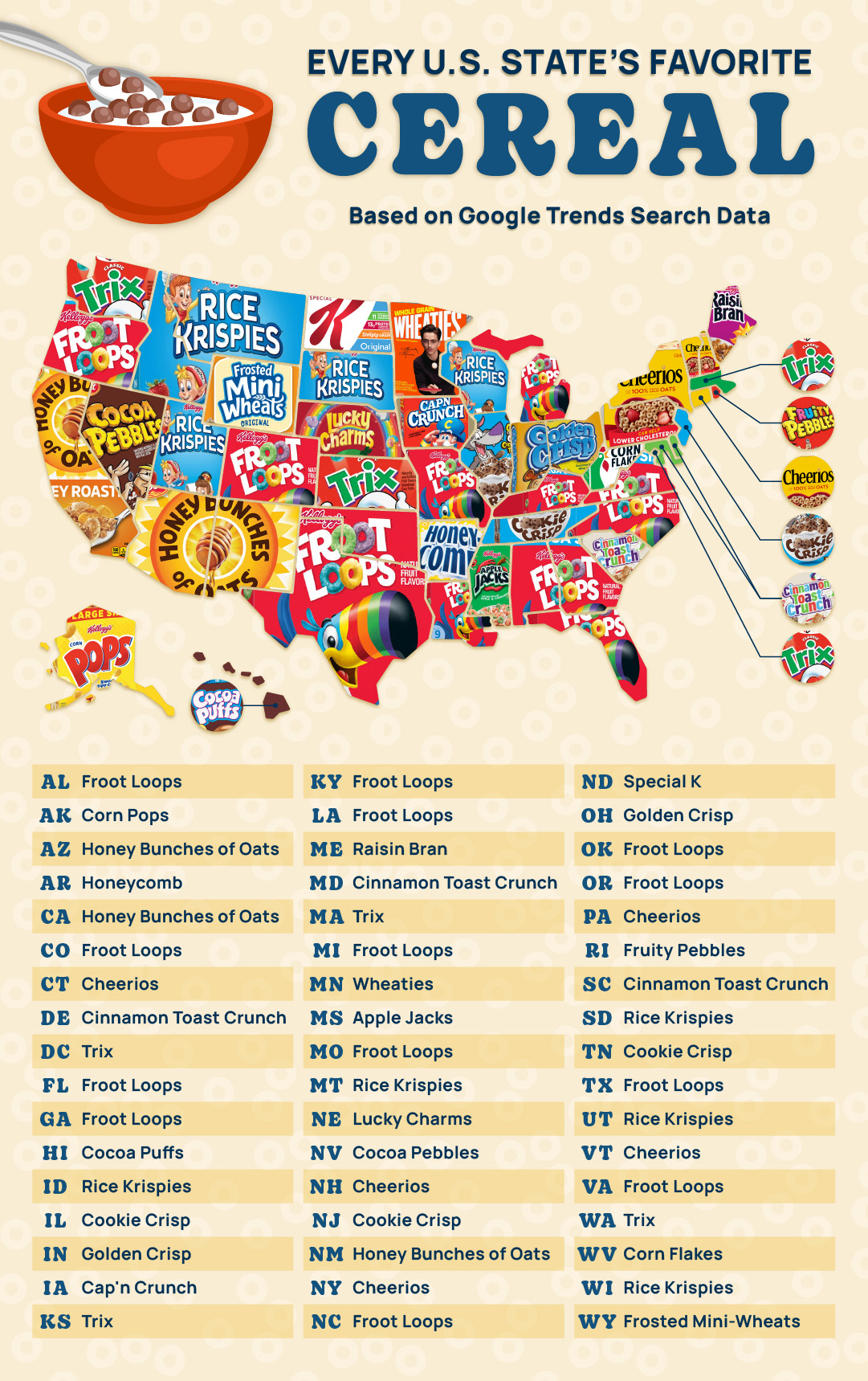
A new study has revealed the cereals Americans crave most, with one sugary treat deemed the fan-favorite in 13 states.
The research team at Concordia University, St. Paul, based in Minnesota, set out to discover the most popular type of cereal in every U.S. state.
Results found that Americans love the multi-colored, ring-shaped Froot Loops, with the cereal being the most popular in 13 states: Alabama, Colorado, Florida, Georgia, Kentucky, Louisiana, Michigan, Missouri, North Carolina, Oklahoma, Oregon, Texas, and Virginia.
Kellogg’s Rice Krispies came in second place, as it was the most popular cereal in five states: Idaho, Montana, South Dakota, Utah and Wisconsin. The brand had the same ranking as the other ring-shaped cereal, General Mills’ Cheerios, which was also the most popular in another five states (Connecticut, New Hampshire, New York, Pennsylvania and Vermont).
Results were reached through analyzing Google Trends data and identifying the most-searched cereal in every U.S. state and Washington, DC, between January 2025 and January 2026.
Other beloved cereals had a place on the list, with the fruit-shaped Trix from General Mills being the most popular in Washington, DC, Kansas, Massachusetts and Washington. The chocolate-flavored treat, Cocoa Puffs, was found to be the fan-favorite in Hawaii and Nevada. Cinnamon Toast Crunch was in the most demand in Delaware, Maryland and South Carolina.
Despite the ranked levels of popularity, breakfast cereal sales have been declining for years. In the 52 weeks ending July 3, 2021, Americans bought nearly 2.5 billion boxes of cereal, but that number was down more than 13 percent to 2.1 billion by July 2025, according to market research company Nielsen IQ.
Cereal sales have been struggling for multiple reasons, including concerns about food processing and sugar intake. One cup of Lucky Charms contains 24 percent of a consumer’s daily recommended intake of sugar, for example.
“Cereal finds it really hard to get out from underneath that,” Tom Rees, global insight manager for staple foods at the consulting company Euromonitor, said in a statement in July 2025. “It can’t escape the fact that it doesn’t look like a natural food. You have to create it and form it.”
Artificial dyes — like the petroleum-based colors that brighten Froot Loops — have also come under fire. In 2024, dozens of people rallied outside the headquarters for WK Kellogg’s in Battle Creek, Michigan, demanding that it remove artificial dyes from its cereals.
In recent years, companies have been responding to concerns over artificiality in cereal. Kellogg and General Mills have both pledged to phase out artificial dyes from all of their products by the end of 2027.
