

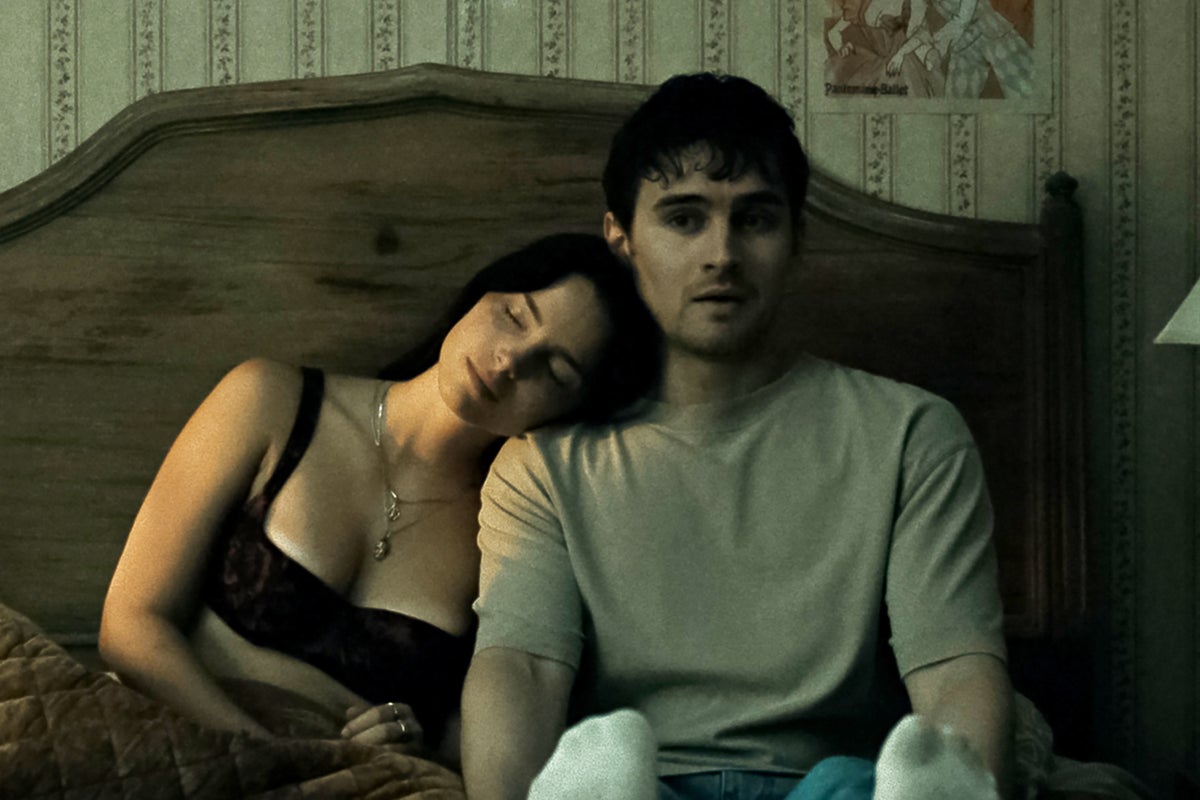

Oh, so it’s a romance…”
“No, it’s not a romance. It’s a love story.”
“Isn’t that the same thing?”
One could easily think nothing of this brief interaction between Bear and Nikki, the two main characters in the new indie horror flick Obsession. And yet it sums up something crucial about what’s about to unfold: Bear’s confusing of romance – all grand gestures, drama and dopamine-fuelled “I can’t get enough of you” intensity – for sacrificial, selfless love. Perhaps it would be easier for him if we had as many words for love as the Greeks did; they certainly knew their eros from their agape.
The film has proven a surprise hit after one particular clip went viral on social media, with cinemagoers praising its combination of offbeat humour, creepy performances, jumpscares and unadulterated gore. But it’s perhaps the subtler messages around autonomy, control and the nature of consent explored beneath the bloodstained surface that really give the movie its edge.
The premise of Obsession is simple. Seemingly sweet, quiet Bear has been hopelessly in love with his friend and colleague, Nikki, since high school. Though he’s harboured this secret crush forever, he’s decided now is the time to grasp the nettle and bare his soul – only he wusses out when given the opportunity. Instead, he makes a wish, using a “One Wish Willow”, for the object of his affections to love him “more than anyone in the f***ing world”.
Needless to say, the wish works – a little too well. Cue the new, “loved-up” Nikki becoming increasingly disturbing, deranged and terrifying as the movie unfurls.
The primal horror here doesn’t come from the adage of “be careful what you wish for” or the time-honoured trope of “crazy”, lust-struck women for whom passion morphs into bunny-boiling violence. No, I’d argue it derives from something much more insidiously sinister that women have learnt to fear: the self-proclaimed “nice guy”, the one who befriends her and gains her trust, all the while biding his time and harbouring other designs.
This theme has been romanticised as nauseum in popular culture – the idea of the lovesick unfortunate who pines silently and unrequitedly, from Duckie and Andie in Pretty in Pink (1986) to Chris and Jamie in 2005’s Just Friends. In fact, the whole friends-to-lovers structure governs such a plethora of romcoms and books – I’m looking at you, When Harry Met Sally – that we’ve almost come to see this journey as being the ideal way of finding one’s happily ever after. Just as the enemies-to-lovers plot is problematic when it comes to portraying romantic love as a constant verbal sparring match based on little more than chemistry, vibes and good-looking leads though, so this narrative can warp our ideas about relationships.
Of course, plenty of people are legitimately friends first before a romantic connection develops. Feelings grow over time; dynamics can and do shift. But there is something about the idea of a seemingly platonic friend harbouring a long-held, all-encompassing crush in the dark that is undeniably violating. There is nothing “romantic” about discovering that a person you trusted, made yourself vulnerable with and poured your heart out to had a hidden agenda. There is nothing “romantic” about pretending to be someone’s friend for years when you really wanted something more from them all along. It feels dishonest. More than that: it feels like a betrayal. The entire “friendship” is built on a lie.
Though often framed as “sweet”, there’s a dark side to all this withheld yearning: it can be more indicative of limerence than love. The former is characterised by all-consuming infatuation and obsession, the focus being on the possession of a desired “object” rather than an authentic, relational connection with – and deep level of care for – another human.
So it proves with Bear in Obsession – there is a glaring lack of empathy for the woman he claims to love throughout the film. When he finally twigs that Nikki is enslaved by his wish rather than acting of her own volition, that doesn’t stop him from taking advantage; one sex scene makes for deeply uncomfortable viewing, her face slack, her eyes as lifeless as a blow-up doll.
There is nothing ‘romantic’ about discovering that a person you trusted, made yourself vulnerable with and poured your heart out to had a hidden agenda
It raises troubling questions about consent, bringing to mind previous films like 2012’s excellent “romcom” Ruby Sparks, in which a man is able to exercise control over every aspect of his dream girl after he writes her into existence. It also speaks to the chilling reality that some men would, given the chance, choose a powerless automaton designed to be in their thrall over a woman with real agency and desire, as explored in films like 2025’s Companion or the Channel 4 series Humans (a fact that will likely become ever more apparent as convincingly human-looking AI robots make the jump from sci-fi to the real world).
As the story progresses, it becomes obvious that poor, “freaky” Nikki is in fact trapped in a state of unrelenting mental torture beneath the too-wide smiles and spine-chilling adoration – “kill me, please,” she quietly pleads in one scene – yet any remorse for the pain Bear has caused her, unwittingly or not, is only notable by its absence. The simple omission of two words – “I’m sorry” – is evidence enough that she was always more prize than person to him.
Without giving too many spoilers, even right at the last, he is unable to perform the one truly selfless act that would save her.
Forget the bodies, bludgeoning and blood splattering – Nikki may ostensibly be the film’s monster, but the real horror lies in the feigned friendship of a man who would happily strip a woman of all free will, if only it meant he could live out his fantasy.