

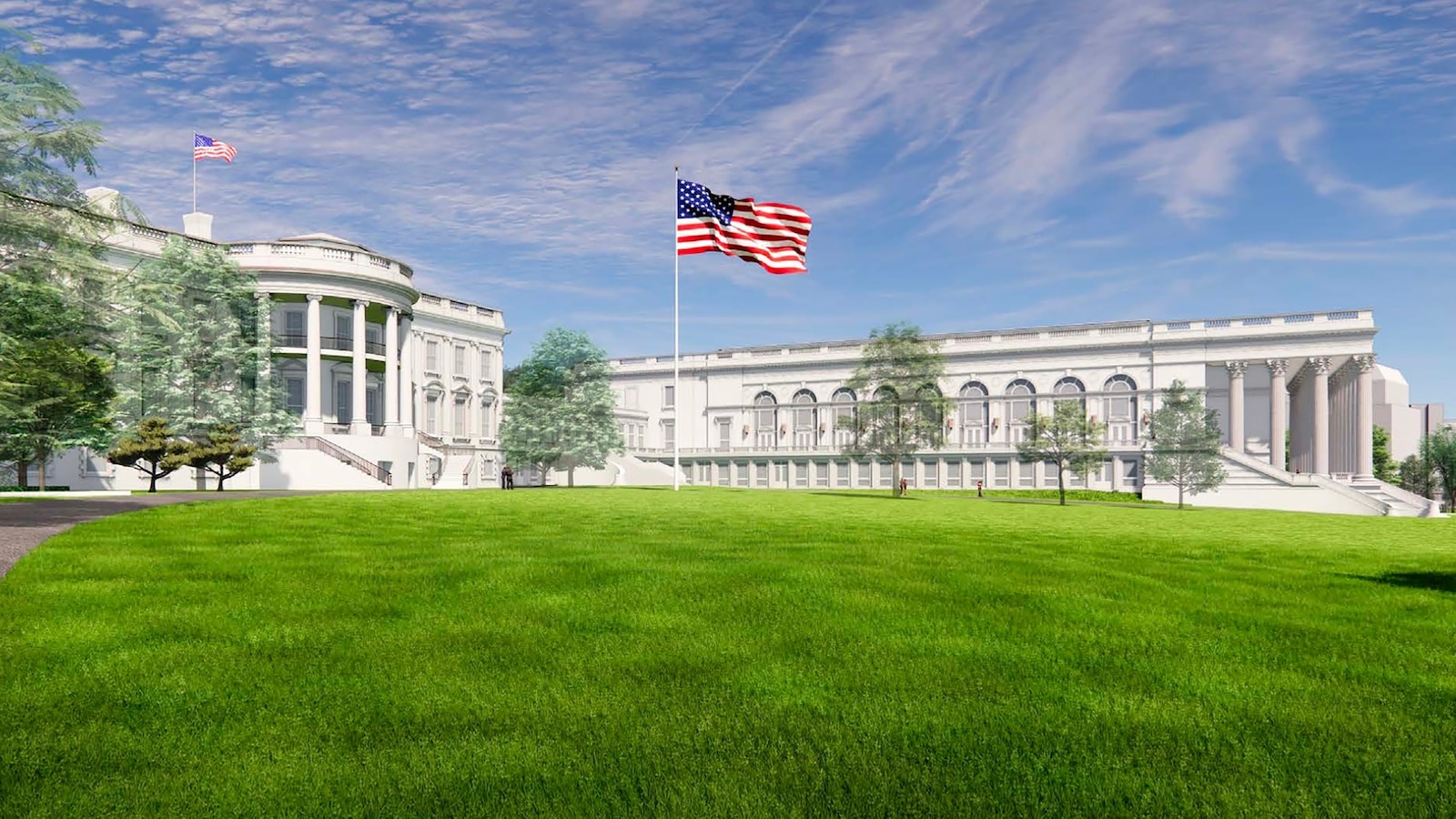

President Donald Trump’s plans to build a White House ballroom are in the hands of three appellate judges who will hear oral arguments Friday over whether construction should be allowed to continue.
The panel of the U.S. Court of Appeals for the D.C. Circuit will weigh the Trump administration’s request to throw out a lower court judge’s order halting the construction, in a lawsuit brought by historic preservationists.
U.S. District Judge Richard Leon ruled in late March that Trump has gone beyond his authority in building the ballroom, given that it has not been authorized by Congress.
Leon’s order was administratively stayed by the appellate panel on April 17, a move that has allowed construction to continue since then.
The Trump administration has argued in court papers that beyond the president’s desire to build a large, permanent event space to host future inaugurations and state dinners, the ballroom — part of a broader “East Wing Modernization Project” — is essential to national security.
The Justice Department points to recent shootings that have occurred in relatively close proximity to the president, including at the White House Correspondents’ Dinner in April and on Pennsylvania Avenue in May, as examples of why the ballroom is needed for security reasons. Both of those incidents had gunmen allegedly exchanging fire with Secret Service police officers.
The government’s filings in the case have described the ballroom project as a fortification of the entire White House complex, saying that with its “deeply ensconced bunker, and its attendant bomb shelters, hospitals, medical facilities, and other National Security functions, to the highly sophisticated Drone Port and Sniper Nests atop the Ballroom, the complex is a highly knitted, unified whole.”
A 31-page report on the White House ballroom submitted to the panels reviewing the project show the proposed addition to the White House from additional angles and features new renderings of the project.
Commission of Fine Arts
The administration also argues that the group that has sued, the National Trust for Historic Preservation, lacks the standing necessary to bring a case.
Lawyers for the National Trust say that it’s Congress, not the president, that controls the grounds of the White House, and that Leon was correct to determine in his ruling that no statute “comes close” to giving Trump the authority he claims to construct a large edifice next to the executive mansion.
“The public’s interest in its government following the law, and the maintenance of the President’s proper role in our system of separated powers, underscore that the district court did not abuse its discretion,” they write in a brief, urging the appeals court judges to let Judge Leon’s injunction stand.
Prior to beginning consideration this week of an immigration enforcement funding bill, Senate Republicans removed a $1 billion provision, drafted in response to a request from the Secret Service, that officials said a portion of which would have gone toward security-related aspects of the ballroom project.
Arguments in the case will be heard by Obama-appointee Patricia Millett, Trump-appointee Neomi Rao and Biden-appointee Brad Garcia.
ABC News’ Peter Charalambous contributed to this report.