

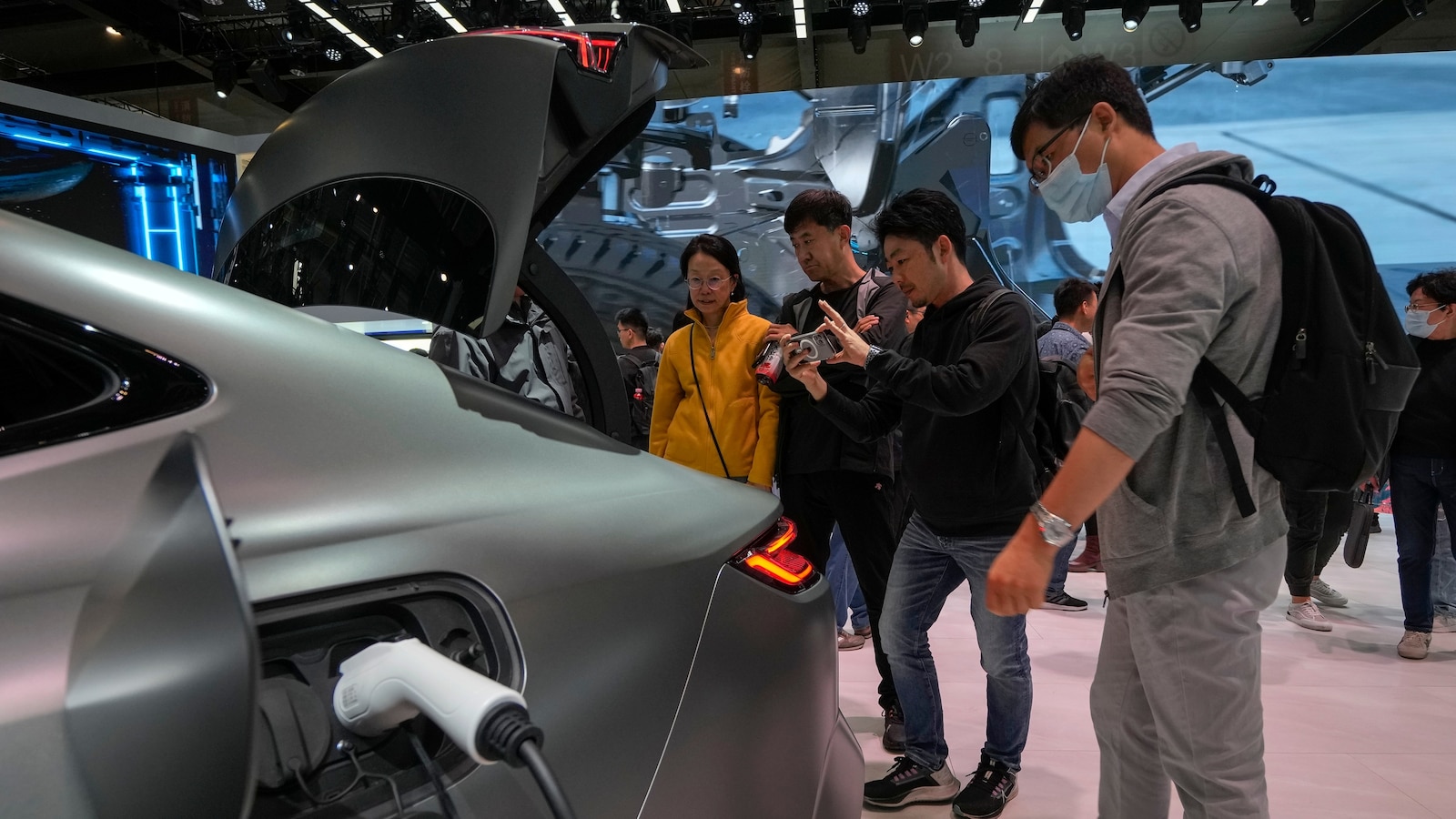
HONG KONG — Chinese electric vehicles’ ultrafast charging is only getting faster.
On Wednesday, Geely Auto unveiled technology that can charge an electric vehicle battery from 10% to 70% in just 4.5 minutes, a leap analysts called a significant development for the Chinese auto group.
Geely is joining the ranks of BYD, which last year overtook Tesla as the world’s biggest EV maker, as well as CATL, the world’s largest EV battery maker, both of which this year rolled out around 5-minute EV ultrafast charging.
By comparison, some of the fastest-charging EVs available in the U.S. currently can take roughly 20 minutes, analysts said.
“China is way, way, way ahead in terms of multiple players engaged in the charging competition,” said Lei Xing, an independent analyst of China’s auto industry based in Amherst, Massachusetts.
Chinese automakers are seeking to eliminate the “ultimate barrier” to EV adoption – range anxiety – by narrowing the gap between EV charging and the roughly five-minute refueling experience of gasoline vehicles, explained Stephen Chan, an analyst at S&P Global Ratings.
At a launch event Wednesday, Geely Auto announced its new system that can charge an EV from 10% to 70% in 4.5 minutes, and 10% to 97% in just 8 minutes and 40 seconds.
BYD in March launched a new generation of its “blade” EV battery that it said can charge an EV from 10% to 70% in 5 minutes, and from 10% to 97% in 9 minutes. In April, CATL rolled out technology that can charge an EV from 10% to 80% in 3 minutes and 44 seconds, and from 10% to 98% in 6 minutes and 27 seconds.
Despite the breakthroughs, experts cautioned there are other obstacles.
“The real challenge is whether the battery can accept that level of current quickly and repeatedly without overheating, excessive degradation or internal bottlenecks,” said Chris Liu, a Shanghai-based senior analyst at Omdia, a technology research and advisory group.
With more than 100 domestic passenger car brands, Chinese auto makers face intense competition. Domestic car sales have fallen for months in China as automakers are exporting more cars overseas. A focus on technological advancements like ultrafast charging is a way to set themselves apart and try to improve sales.
But success will depend on factors including the scale of companies’ charging network.
For one, the majority of China’s public charging stations still operate below 1 megawatt, while Geely, BYD and CATL’s ultrafast charging technologies rely on higher charging power to reach their full potential, said Chan at S&P. That means network expansions or grid updates will remain as hurdles for large-scale adoption.
Some in the industry are already taking ambitious steps. China’s BYD, for instance, is targeting 20,000 superfast charging stations by the end of this year, followed by 30,000 more in 2027 and 40,000 in 2028, bringing the total to 90,000 stations by that time, according to a Deutsche Bank analysis.
Other countries including the U.S. is still behind China when it comes to ultrafast EV charging.
In the U.S., EV fast-charging sessions typically take roughly 20 to 40 minutes to charge from 10% to 80%, according to S&P, although newer models from brands like Hyundai, Kia and Porsche can reduce charging times to approximately 18 to 20 minutes under optimal conditions.
“Overall, while the battery-charging network in the U.S. is growing at a rapid pace, it is still well behind China’s ultrafast charging speeds by orders of magnitude,” said Neal Ganguli, a partner and managing director in the automotive and industrial practice at consultancy AlixPartners.
But Ganguli also believes the U.S. may not be attempting to match China’s “megawatt race” in EV charging at least in the near future, but to pursue a “more moderate” path to upgrades.

