

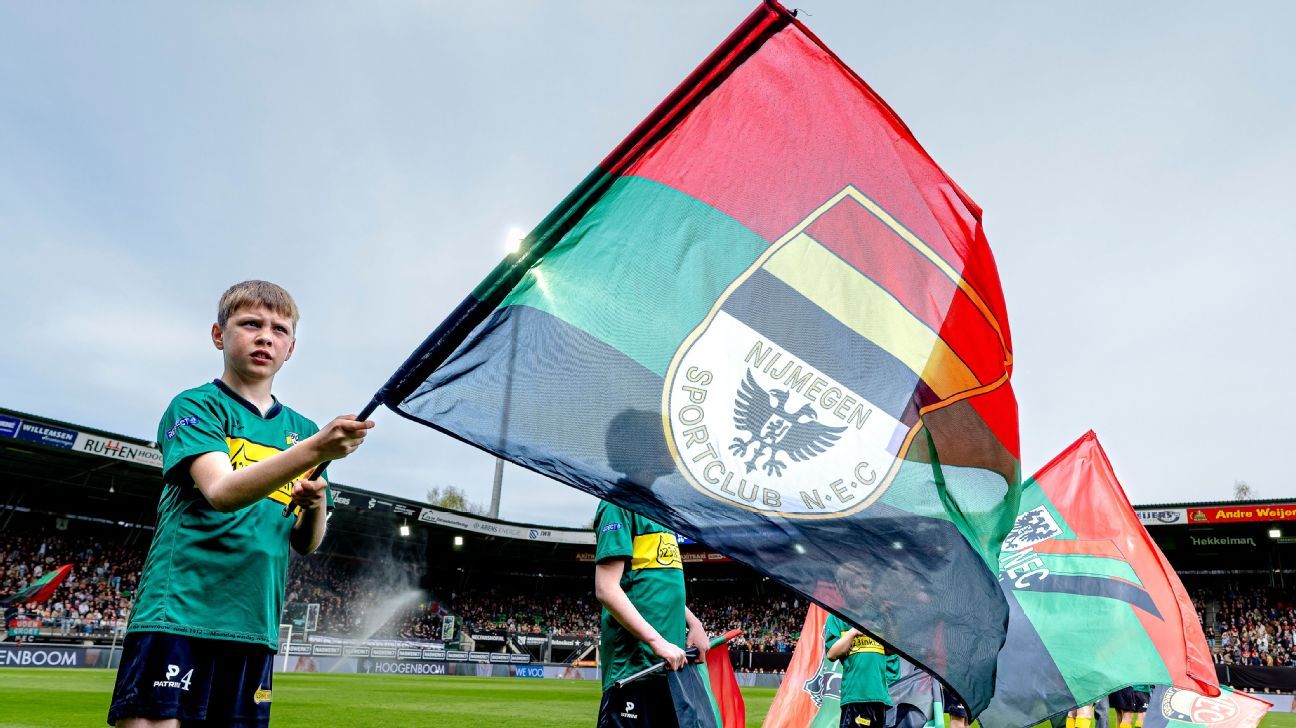

NIJMEGEN, Netherlands — Deep inside a forest in Nijmegen’s Goffertpark, on the Netherlands’ eastern border with Germany, just over 12,500 people have been gathering each week to watch some of the most chaotic, risky football that 2026 has had to offer.
It’s an absurdly innocent and serene setting for an incredible story that has made waves across Europe this year: N.E.C. Nijmegen are on the verge of the most successful season in their 125-year trophyless history — and it’s thanks to a crazy majority investor, who employs a crazy manager, who plays a crazy brand of attacking football.
“Crazy — that’s exactly the word for it,” N.E.C. supporter Stefan Verhagen tells ESPN. “In 62 years, I have never seen anything like it. Teams come here, and they are shaking in their boots.”
Eniesee play in a style that most would consider reckless, if not downright foolish. It’s a modern version of the “Total Football” style invented and perfected by the great Rinus Michels and Johan Cruyff of Ajax in 1970s, and which all Dutch soccer fans have craved ever since. And it’s as simple in its philosophy.
“Here, we kick the ball, we run forward — and we score,” Florian, another fan, says.
It might sound dangerous to put so much faith in attacking play, but for N.E.C. it works. After a 1-1 draw on Saturday in a match with serious UEFA Champions League implications against giants Feyenoord — courtesy of an incredible 97th-minute equalizer — the club sit third in the Eredivisie table, three points ahead of Ajax with four games to go, while they face AZ Alkmaar in the KNVB cup final this weekend.
N.E.C.’s relentlessly attacking, high-pressing football is a whirlwind experience. TV figures regularly place their games in the top three most watched on a weekend in the country, but it has to be seen live to be believed.
Into the forest
There are three traditional powerhouses in Dutch football: Ajax, Feyenoord and PSV Eindhoven. Among them, the trio have won the vast majority of Eredivisie (top tier) titles since it was formed in 1956, and it’s rare for major stories to hail from elsewhere.
Since promotion back to the top division in 2021, N.E.C. have spent most of their time battling away in the bottom half of the table; 11th- and 12th-placed finishes between 2021-2023 felt par for the course. Their highest-ever league finish is fifth, secured back in 2003, but since then have been relegated and promoted back up twice.
That’s part of what makes NEC’s rise so special: Not only is it different and refreshing, but it takes place in a significantly more humble setting than, say, Ajax’s super-slick, modern, 55,000-seater Johan Cruyff Arena. To get to NEC’s Goffertstadion you have to walk into a forest; on the way, you pass the club’s training pitches, which are disturbingly easy to access for the public — they’re not walled off, not kept out of sight, and much of the training equipment is simply left out on the grass.
Turn the corner a little further down the track and the stadium appears. It’s small (seating around 12,500 people) and looks even smaller due to the fact that it is dug into the ground, which creates a concrete moat that separates the stands from the pitch. You could mistake it for a concert venue were it not for the giant NEC badge on the metal facade.
Some fans, like the 67-year-old Stefan, have been attending games for decades but are now experiencing something completely new. He takes his hat off — a Russian-style ushanka with the ear flaps pinned up — and brandishes it proudly; it’s covered in pin badges marking crucial games he’s been to. There’s a Hamburg one in the center, signifying their last venture into Europe (a 2008-09 Europa League campaign that Manchester City, Paris Saint-Germain and AC Milan all participated in). He has also been to see his team lose five domestic cup finals, the first in 1973, and hopes to make it a sixth time lucky this weekend as they take on AZ Alkmaar. A win would ensure a 2026-27 Europa League campaign at minimum.
Inside, countless visual cues remind you that this is no star-studded arena. There’s a third dugout placed pitch side for fans who win a competition to sit almost on the sideline, just 10-foot from the team benches. Meanwhile, the N.E.C. players’ boots show signs of wear and tear — these are not superstars who are handed four fresh pairs per game, with custom fits to mold their feet.
The teams emerge from the tunnel for kickoff to the sound of Fox’s iconic NFL theme tune. But after that first whistle … all hell breaks loose.
Schreuder’s Way
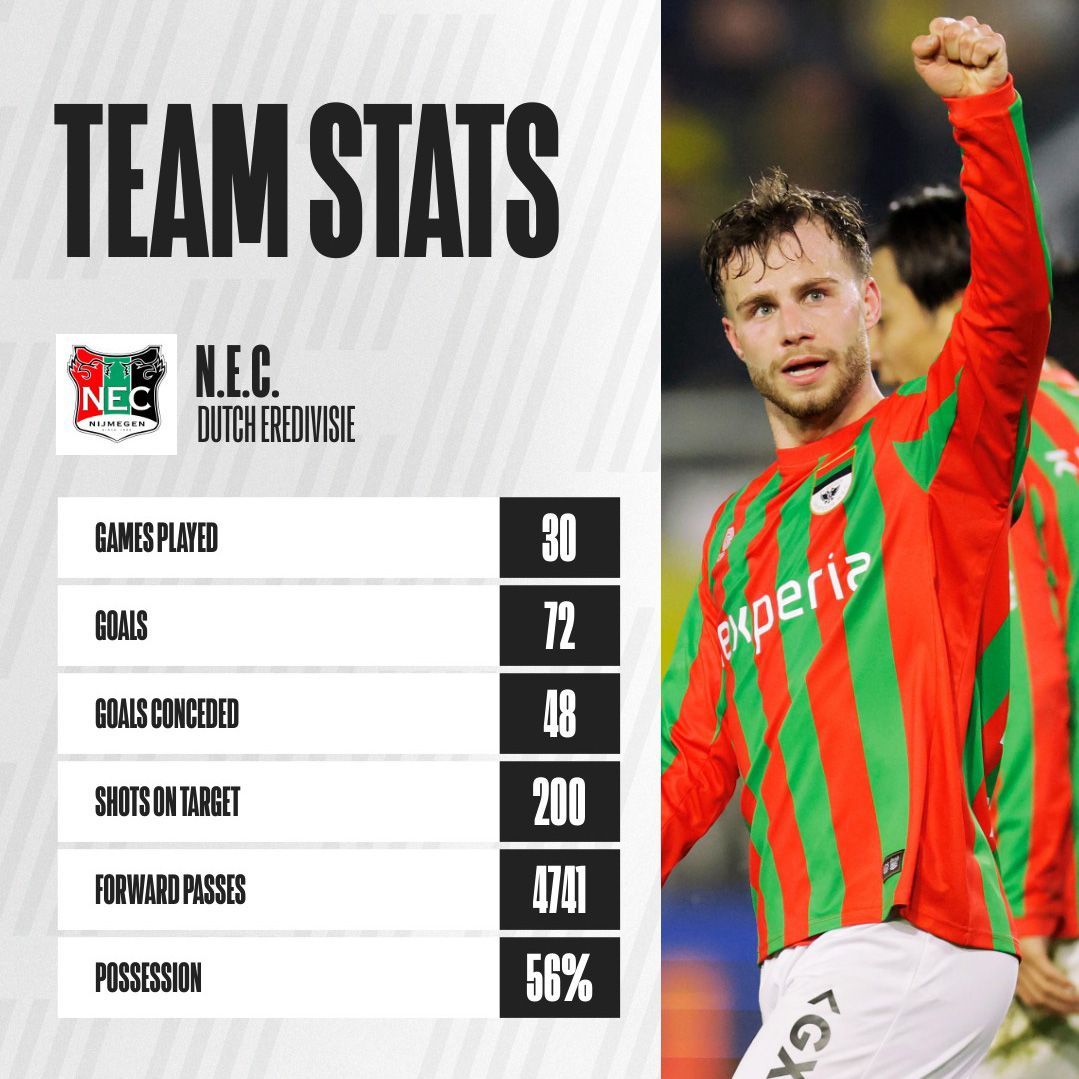
N.E.C. have scored 74 goals in the Eredivisie this season, a tally bettered only by PSV (84), who cantered to the title with five games to spare. They’ve also conceded 48, which is only a handful fewer than the majority of sides at the other end of the table embroiled in the relegation battle. In 30 games, Eniesee have scored 3+ goals 13 times, and conceded 3+ on seven occasions.
As those statistics suggest, their games are usually wild. That is down to their relentlessly attacking coach, Dick Schreuder.
After spells on the coaching staff with Barnet in England and the Philadelphia Union in MLS, among other jobs, Schreuder, 54, rose to prominence in the Netherlands in 2021, taking charge of a terrible PEC Zwolle side, who were rooted to the bottom of the table, and transforming them into a team worth watching that nearly clambered to safety.
Schreuder led Zwolle back to the top tier at the first attempt the following season, with his side scoring 99 goals — 13 of which came in one game against Den Bosch — but he then departed for Spanish third-tier side CD Castellón.
It was a curious move on paper, but Castellón’s owner, Bob Voulgaris, is a prolific sports bettor who leverages data in his decision processes. Naturally, PEC Zwolle’s attacking numbers were off the charts, so he turned to Schreuder and he said yes — in part due to the sporting project, in part because the warmer climate soothed the Dutchman’s sore knee from his career as a player.
After setting the 2023-24 third tier alight with his side netting a record of 74 goals, Schreuder got Castellón promoted to the Segunda División, but was sacked within six months after a dip in form. He wasn’t out of a job for long, though, as he was lured back to the Netherlands in 2025 by N.E.C. and has been charming the forest with his “Total Football” style ever since.
“Dutch people love attacking football,” says ESPN NL’s Sjors Grol. “That’s been the case ever since Cruyff and Michels invented ‘Total Football’ in the 1970s. In a sport where the result seems more important than the performance these days, Schreuder is trying to find a balance between beautiful football and results again. He has now succeeded in doing so at his third club in four years.
“Right now, in Nijmegen, Schreuder can do no wrong. He has given the people a taste of football bliss in a way the city never thought possible. Not only is success addictive, but so is the feeling that you’re playing the best football in the country. That’s what N.E.C. supporters are feeling right now.”
Attack, attack, attack
In a season where the English Premier League has become a land of the giants — in which the fittest, strongest and tallest compete for dominance in endless duels and set-piece scenarios — N.E.C.’s relentlessly attacking, high-pressing, risky football feels like something out of a video game. But they work hard on the training ground to perfect the art form.
“It all comes down to intensity,” Sjors adds. “Players don’t get a chance to catch their breath between drills, which is one reason they’re fitter than ever. Never before has this club attacked as much as it has this season. From the very first second, a connection has formed between fans and players, and that’s been reinforced by 12 goals in the first three games of the season.”
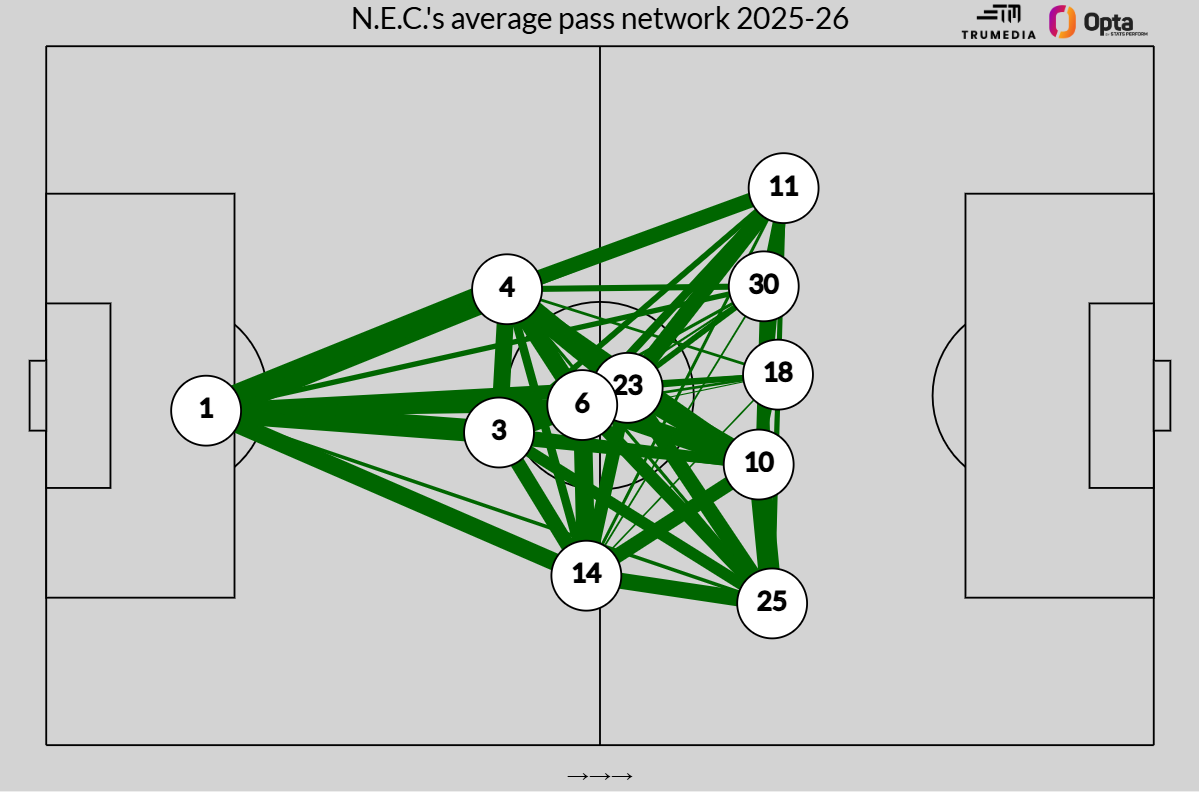
Schreuder’s wing backs are actually wingers and his attacking midfielders are basically strikers; the midfielders buccaneer forward at will.
But while it may masquerade as a 3-4-2-1 on paper, this isn’t anything like the same formation you’ll have seen with Manchester United under Ruben Amorim. Here, there is a major focus placed on attacking with width. Perhaps that should come as no surprise, given Schreuder was a winger in his playing days. N.E.C. rank third in the Eredivisie for open play crosses (441) and second for attempted take-ons (603).
The combinations, runs and passes between his players are not only brilliant, but incredibly confusing for opponents to deal with at times … and a big part of that is because his center backs keep running up the pitch.
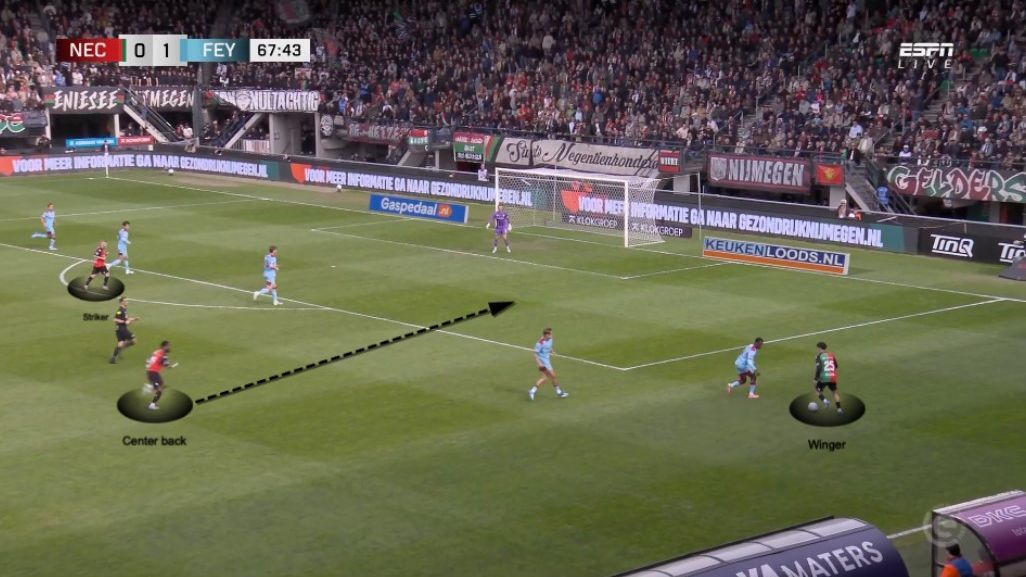
Indeed, it’s common for one of N.E.C.’s outside center backs to end up in the opponent’s penalty box. On the left, Ahmetcan Kaplan or Deveron Fonville go steaming forward, their runs ripping apart opponents’ man-to-man marking and creating space. On the right it’s more subtle; right center back Eli Dasa often waits for his winger, Sami Ouaiassa, to attract a crowd, then slips beyond the play and into the box unnoticed.
Once these kinds of rotations start happening, any player can end up just about anywhere on the pitch. Except for the goalkeeper, of course.
A great example of this was the third goal scored in the 3-1 win against Sparta Rotterdam in February, which came from getting six players into or close to the box, where pretty much all of them were in the wrong spots for their position (and yes, there was a center back among them).
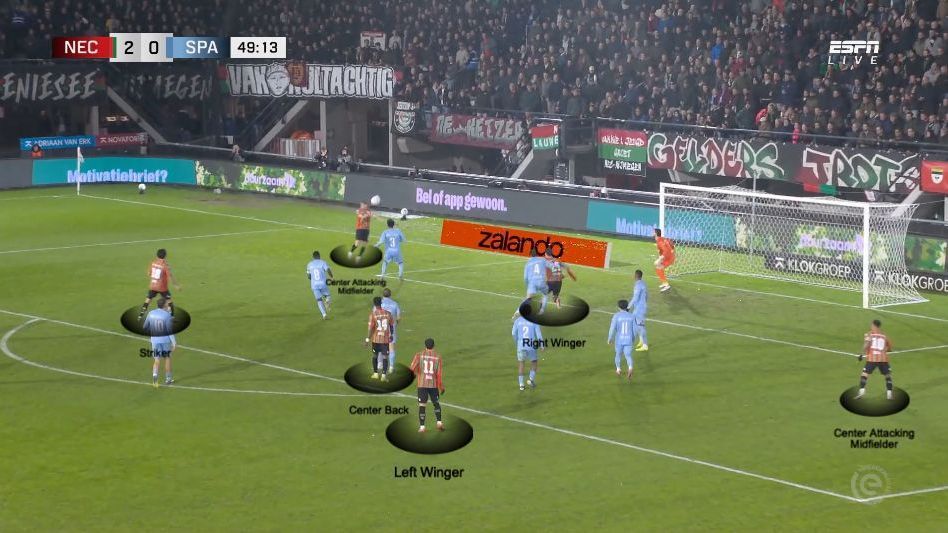
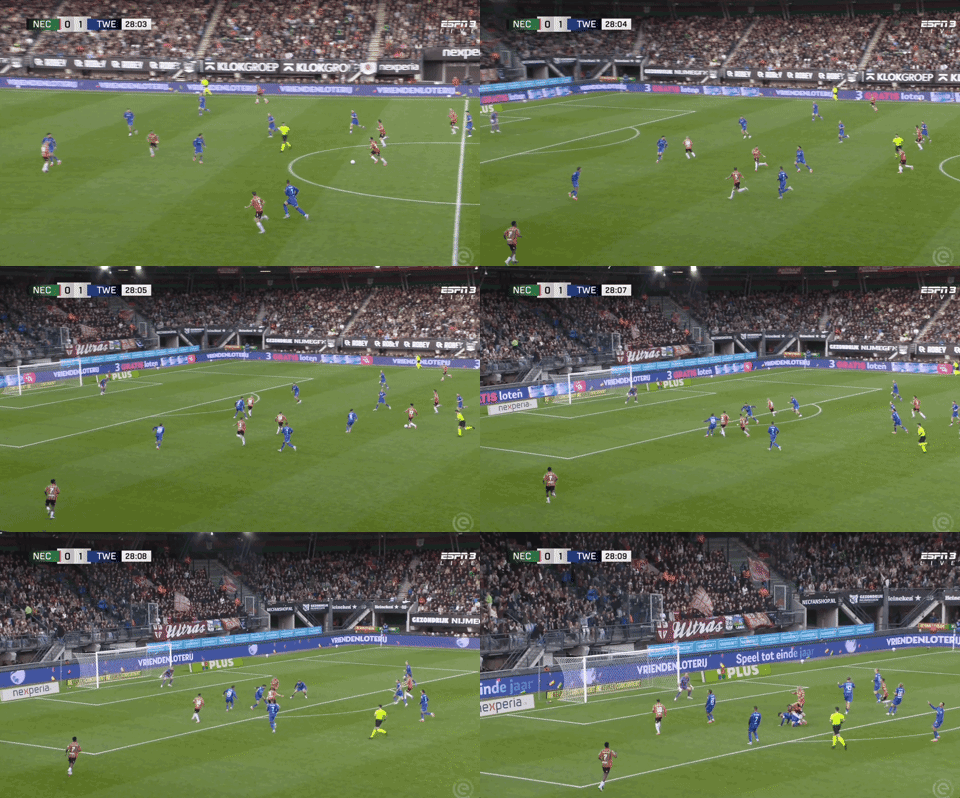
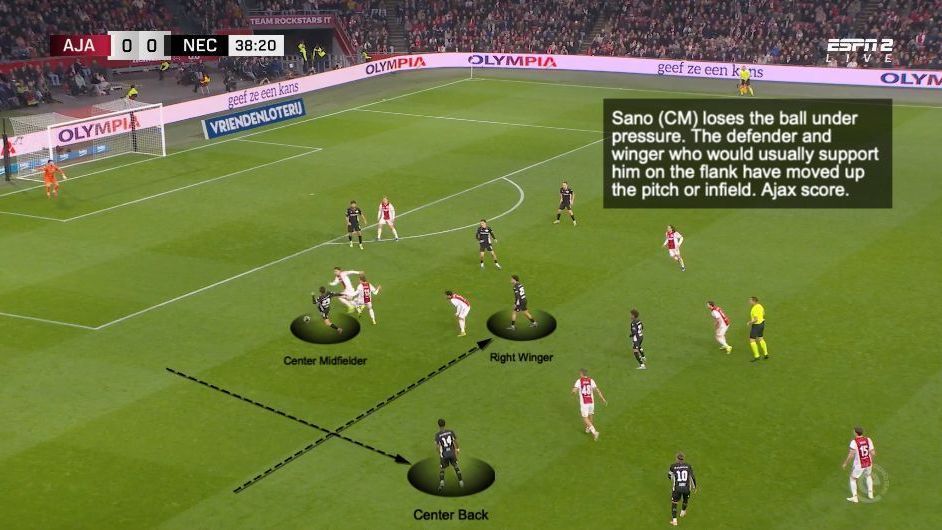
But center backs hurtling forward isn’t just limited to N.E.C.’s attacking play — they do it in the deep buildup, too. Schreuder’s take on pass-and-move football is on the extreme side, and can lead to issues when the team are caught on the ball near their goal (below) …
It can also cause problems when they’ve committed too many players high up the pitch, meaning one long, straight ball from the opponent can lead to a chance (see below).
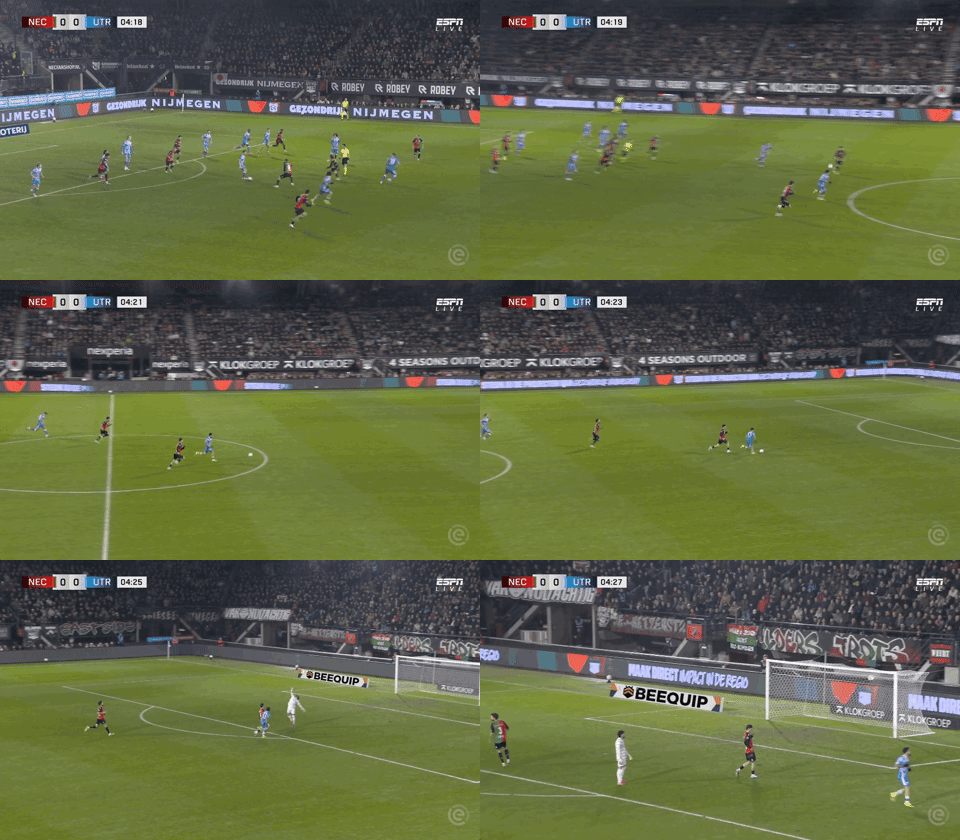
These problems are effectively unavoidable. Because N.E.C. commit so many players forward in attack, the only logical way for them to defend is to press and try to win the ball back high up if they lose it. They generally do this very well — they top the Eredivisie for duels won (1,613), possessions won in the final third (165) and high turnovers forced (302) — but breaches happen and they can look pretty bad to the casual fan when they do.
Schreuder accepts that risk on the basis that, more often than not, his team can plug the holes — or, failing that, simply outscore their opponents.
A deathbed promise
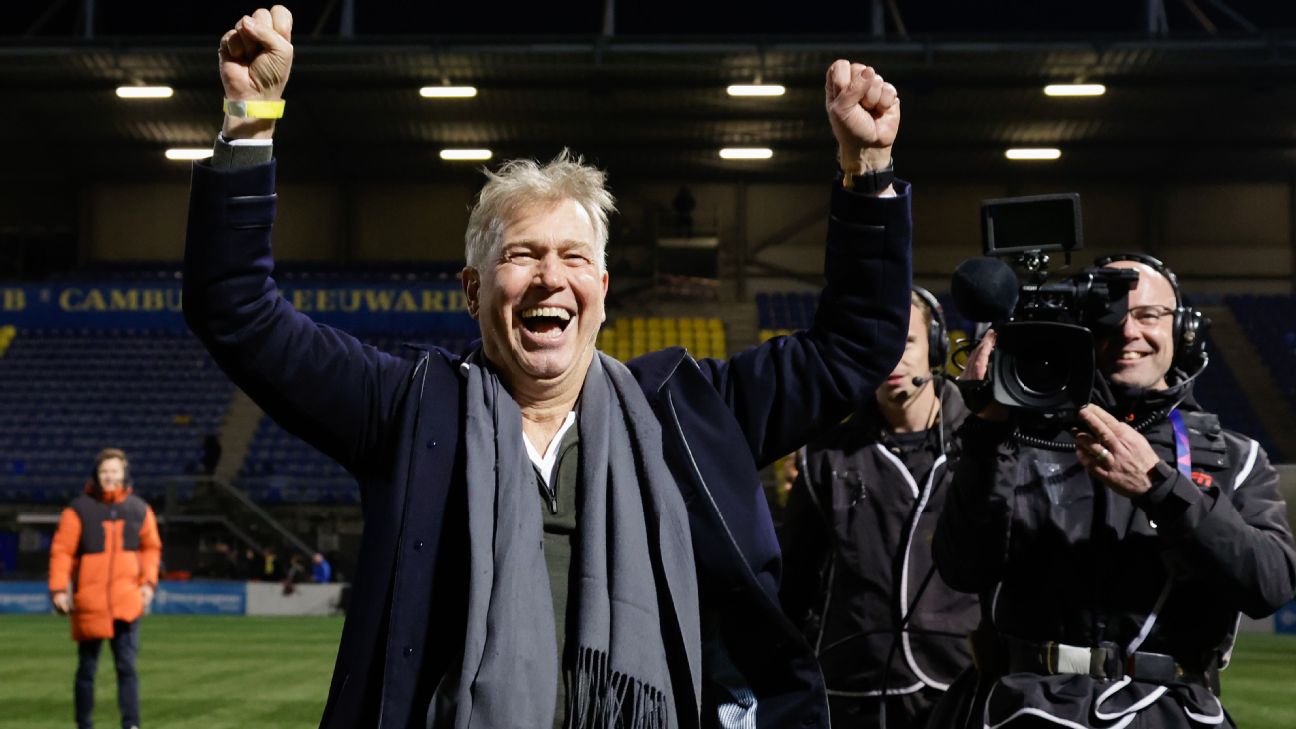
It’s fitting that N.E.C.’s success has been built on crazy football, as you could argue “crazy” is a top-down directive.
The club’s major investor, Marcel Boekhoorn, is a prominent-but-silent figure in the project. A Dutch billionaire born in Nijmegen, he promised his father on his deathbed that he would take care of his beloved soccer team. And he offers enough funding to ensure the club don’t have to raise funds through player exits, while they can afford to offer more than a one-year contract to an older player if the deal is right.
The financial stability he offers allowed N.E.C. to turn down huge bids — €15 million from Ajax and €20 million from Nottingham Forest — for their star young midfielder Kodai Sano. That would have been a club-record departure, a fee N.E.C. could never have refused a few years ago, but could also have scuppered a special season. They were able to decline.
Aside from that, he made some good decisions when appointing his front office and giving them the freedom to flourish. For example: Carlos Aalbers, a man renowned for being one of the best scouts in the Netherlands, and with a handy habit of recruiting top Asian prospects (he scouted Ritsu Doan, now at Eintracht Frankfurt, and Yukinari Sugawara, who played in the Premier League for Southampton last season.)
But, like his team, there’s no doubt Boekhoorn also has a flair for the remarkable. After buying Ouwehands Zoo in Utrecht in 2000, he campaigned China’s government for 16 years to move two pandas to it. Finally, in 2016, he was successful; pandas Xing Ya and Wu Wen moved over to the Netherlands in a deal signed in front of president Xi Jinping.
His office at Ouwehands Zoo is above a gorilla enclosure; a hatch on the floor can be opened so you can throw food through it, and several N.E.C. players have done so after signing their contracts. Not everything the billionaire touches turns to gold though, as he once got stung in a deal to bring in a rare white crocodile; after paying for it to be imported, a rain shower revealed that it was a regular croc that had been painted white.
“The players have always adored Marcel; everyone admires the way he lives his life,” Sjors says. “That makes an impression on the players. In some cases, it starts as early as their first meeting at his zoo. A question we journalists often ask big new signings is what their meeting with Marcel was like, because that’s important as an introduction to the club.
“Among the fans, he enjoys a status unlike anyone else in Nijmegen. The fact that he helps the club, because he is one of its biggest fans himself, gives him the necessary prestige. This stems from the promise he made to his father.”
Champions League dreams
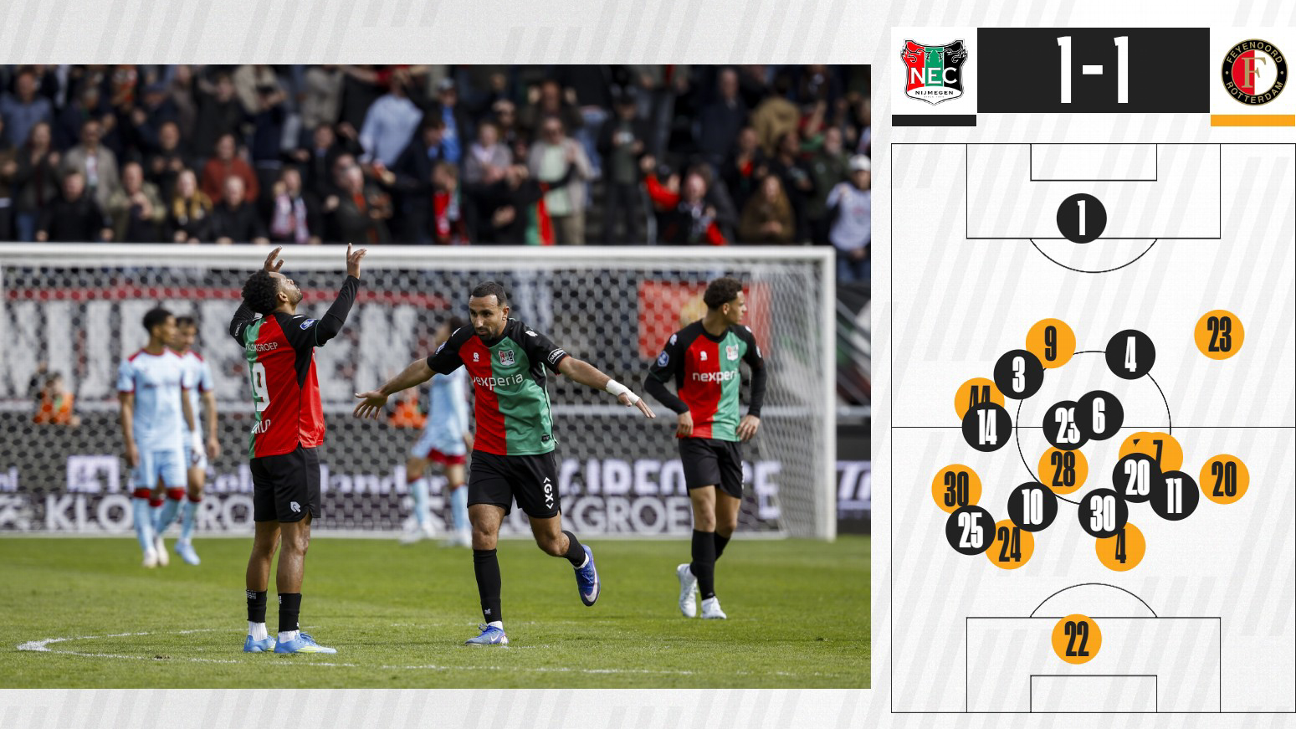
Last weekend, N.E.C.’s 1-1 draw against Feyenoord –a match that had a serious implication in their chase to play Champions League football next season — was everything you would expect (as you can see from the average position graphic above).
N.E.C. had conceded from a corner and were mightily fortunate to avoid a red card to center back Philippe Sandler, who clumsily brought the Feyenoord striker down as the last man having been caught out over the top (sound familiar?)
But, true to this season’s form, it ended with a dramatic 97th-minute equalizer that saw the stadium erupt with noise and joy, after Schreuder took off his entire defense to chase a late goal.
Substitute Danilo, one of three forwards thrown on in place of the defenders, was the hero — making up for a horror miss five minutes earlier — as wave after wave of attack finally broke the resistance of a traditional powerhouse of Dutch football.
Having been fed a steady diet of cautious, underdog football in previous years, this is not something NEC supporters are used to — but understandably, they’ve embraced it willingly.
Danilo’s goal generated a roar that never seemed to cease, extending long beyond the final whistle. Barely anyone left the Goffertstadion early — there’s no real advantage to doing so as only a few hundred cars are parked outside and thousands opt to cycle to the stadium instead. With little threat of gridlock or queuing, why duck out early and miss these special moments?