

Average annual house price growth slowed to 2% in June from 3% the previous month, according to Office for National Statistics (ONS) figures.
Across the UK, the average house price increased by 2.0% to reach £272,000 in the 12 months to June, slowing from 3.0% in the 12 months to May.
ONS head of housing market indices Aimee North said: ”Annual UK house price inflation slowed significantly in June because price growth was weaker this summer than it was last year following stamp duty changes in England and Northern Ireland.”
In contrast to early summer 2026, strong price growth was recorded in May and June 2025 as average price levels rebounded after a sharp fall in April 2025, the report said.
Average prices increased in June to reach £293,000 (1.8% annual growth) in England, £213,000 (1.8%) in Wales, and £195,000 (2.3%) in Scotland.
In Northern Ireland, the average was £202,000 in the second quarter of 2026, jumping by 9.2% annually.
This was the highest annual inflation rate for Northern Ireland since the fourth quarter of 2022.
In England, the North West had the highest house price inflation, at 4.7% in the 12 months to June, while the figure was lowest in London at 2.5%, although the rate of fall slowed from 3.1% in the 12 months to May.
It is the 10th month in a row of annual falls in the capital, mainly caused by decreases in inner London, the report said.
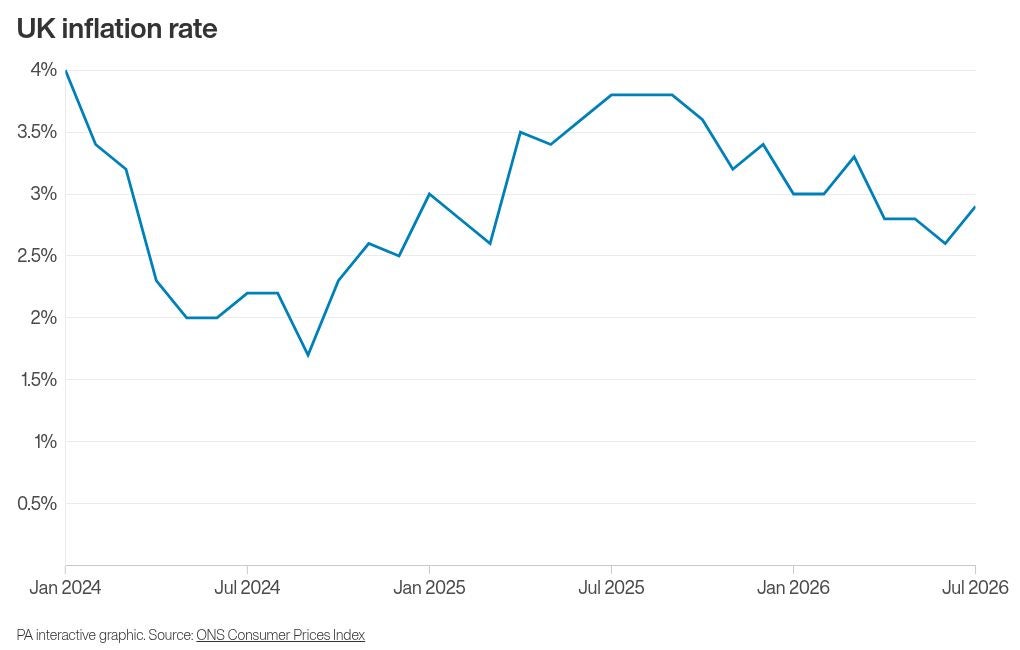
The figures were released as the ONS said Consumer Prices Index (CPI) inflation accelerated to 2.9% in July, up from a 15-month low of 2.6% in June.
Get a free fractional share worth up to £100.
Capital at risk.
Terms and conditions apply.
ADVERTISEMENT

Get a free fractional share worth up to £100.
Capital at risk.
Terms and conditions apply.
ADVERTISEMENT
David Hollingworth, associate director at L&C Mortgages, said: “The increase is largely in line with market expectations, which is important from a mortgage borrowers’ perspective.
“Financial markets are already factoring in the threat of interest rates having to climb to combat higher inflation.”
He added: “There remains a volatile backdrop and it’s impossible to rule out more yo-yoing in mortgage rates at this stage.
“The good news is that, because today’s increase in inflation was widely anticipated, it’s less likely for there to be big repercussions in markets that would put more pressure on lenders funding costs in the short term.”
The ONS also said the average monthly private rent in the UK was £1,393 in July – around £50 (3.7%) higher than a year earlier.
Jeremy Leaf, a north London estate agent said: “The rental data confirms what we have seen on the ground – that demand remains strong, particularly for higher-end houses among those returning from holiday seeking accommodation before the new school term.”
Nicky Stevenson, managing director of Fine & Country, said: “With homes taking longer to sell and more properties competing for buyers’ attention, realistic pricing is becoming increasingly important.”
Nathan Emerson, chief executive at property professionals’ body Propertymark, said: “While short-term fluctuations are a normal part of the property market, they can influence confidence and lead some homeowners to delay decisions until there is greater certainty about the direction of the market.”
Iain McKenzie, chief executive of the Guild of Property Professionals, said: “Looking ahead to the autumn, we expect activity to pick up as the usual seasonal bounce returns, provided mortgage rates continue to ease and economic uncertainty does not intensify.
“Price growth is likely to remain modest for the rest of the year, with the market increasingly driven by affordability and local conditions rather than broad national momentum.”
Ian Futcher, a financial planner at wealth manager Quilter, said: “Looking ahead, mortgage rates will continue to be the key driver of the housing market.
“If lender competition continues and borrowing costs can gradually ease, activity should remain supported, but a swing the other way could see the market stall once again.”
Richard Donnell, executive director of research at Zoopla, said: “People are renting for longer, which will support demand for rented homes and steady growth in rents, particularly as we come into the busy time of year for the rental market as students and those starting new jobs compete for a still scarce supply of rented homes.
“Rents are rising slowly in many big university cities but growth is faster in affordable towns adjacent to big cities.”
Sarah Coles, head of personal finance at AJ Bell, said of the house price figures: “It’s a useful reminder for anyone considering investing in property that there will be years when your investment doesn’t keep pace with inflation.
“It’s easy to think we understand property because we live in it, but it’s a very different beast as an investment.”

