

.jpeg?trim=0,0,0,0&width=1200&height=800&crop=1200:800)
It is not uncommon for Brits to cut back on spending or pause home buying decisions in the run-up to a Budget, in anticipation of what changes may be on the way for household finances.
But a raft of residential expert voices believe there is certainly one move borrowers should not hold off on ahead of the Autumn Budget 2026: securing a mortgage rate swiftly.
There are 487,350 fixed rate UK mortgages coming to an end in the final three months of 2026, according to the Financial Conduct Authority. For those that need to remortgage, they will be doing so in a year that has seen rates climb more than once amid the Middle East conflict.
In September, swap rates, which are the interest rates that banks charge each other for borrowing, are higher than they were a month ago – meaning lenders in turn have edged up mortgage prices. NatWest, Santander, HSBC, Lloyds Bank and TSB are among the lenders to do so.
Mark Harris, who leads mortgage broker SPF Private Clients, says it is “difficult to predict what will happen to mortgage rates between now and Christmas as we don’t yet know what rabbits the Chancellor might pull out of his hat in the Budget nor how the gilt markets will react”.
But for consumers weighing up the pros and cons of finding a new rate before or after the Budget, new research for The Independent by estate agency Yopa offers some insight.
Rates around Budget announcements
To explore whether there have been meaningful moves around rates in the run-up to and after events such as Spring statements and Autumn Budgets, Yopa looked at average two and five year mortgage fixes (assuming 75 per cent LTV, fixed-rate and owner occupied) in the month before and after the fiscal events.
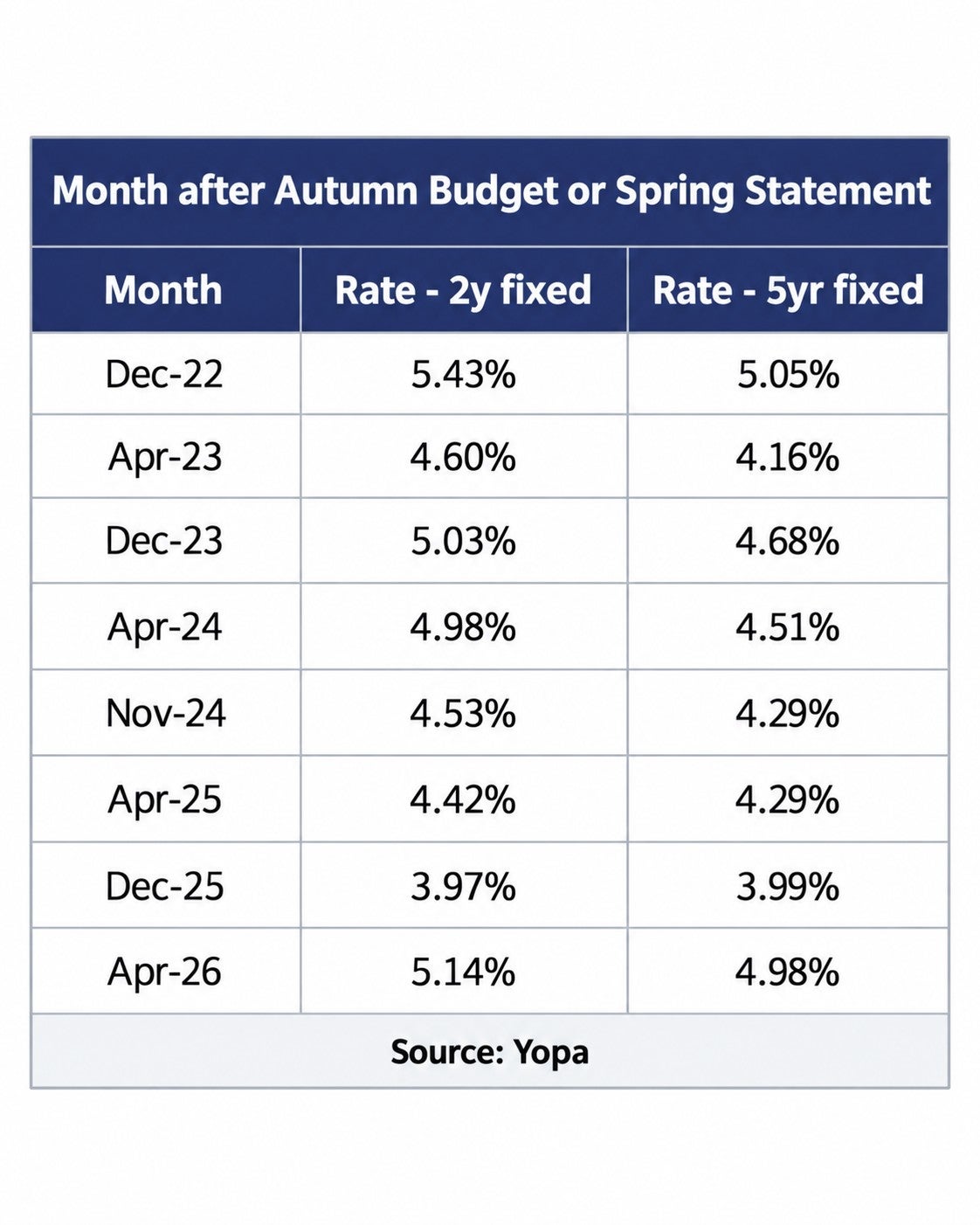
CEO Verona Frankish noted that there tended to be “relatively little immediate difference in mortgage costs in the month either side of a major fiscal statement,” but says the findings do not mean the consequences of a Budget can’t have a much greater impact further down the line.

Get a free fractional share worth up to £100.
Capital at risk.
Terms and conditions apply.
ADVERTISEMENT
Get a free fractional share worth up to £100.
Capital at risk.
Terms and conditions apply.
ADVERTISEMENT
“The clearest example is the Truss mini-Budget. There wasn’t an immediate knee-jerk change in mortgage rates within the narrow month-before and month-after window, but we know the wider market fallout that followed was significant,” she added.
The Yopa boss says the analysis helps to show how “mortgage rates have spent the last few years fluctuating within a fairly stubborn range”.
How might mortgage rates move next?
Average two year and five fixes sat at 5.77 per cent and 5.83 per cent respectively on 16 September, Moneyfacts data shows – the latter sitting at its highest level since November 2023.
The Bank of England is likely to hold the base rate at 3.75 per cent when its Monetary Policy Committee announces its decision on September 17 – but mortgage rates can move quickly regardless, leaving experts to advise fixing fast once homeowners are in the final six months of their existing deals.
Grainne Gilmore, head of residential at real assets advisor Cluttons:
“Recently, with the intensification of hostilities between US and Iran, and the continued blocks to getting oil through the Strait of Hormuz, as well as nervousness around the upcoming UK Budget, swap rates have been climbing, which may lead to mortgage rates being re-priced upwards, even if there is no rise in base rates.”
But she says any breakthrough in the Middle East, and any reassurance from the government at the Budget that it will stick to its fiscal rules rather than funding spending by more borrowing, “could also result in money-market rates falling, which could also lead to mortgage rates being reduced, even without a base rate cut”.
“Acting early can only ever be an advantage when looking for a new mortgage rate,” Ms Gilmore concluded.
.jpeg)
Mark Harris, CEO of mortgage broker SPF Private Clients:
If your existing mortgage deal ends within the next six months, you should obtain another offer now, he suggests.
Speak to a whole-of-market broker to find the best deal on the market for your circumstances. Harris adds: “Your current lender will generally offer you a product transfer, or deal to remortgage onto, three to four months before your existing rate comes to an end. If rates have continued to rise [when signing a deal], stick with the option you secured; if they have fallen you can switch to the new, cheaper product.”
Andrew Montlake, CEO of of mortgage broker Coreco:
Regarding securing a mortgage rate, Montlake says: “I would not panic, but I would certainly start the process earlier than usual. If your fixed rate ends in the next six months, there is little downside in reviewing your options now and securing something that can potentially be changed later if rates improve.”
Michael Lawlor, business principal at Mortgage Advice Bureau:
A wait and see approach can mean missing deals that suit you, Mr Lawlor said.
“What surprises me most is how many existing clients still want to hold out for lower rates when I get in touch. Those who have let me secure a rate early for them have seen real, tangible savings. There’s simply no downside to locking in sooner rather than later,” he underlined.
Louisa Sedgwick, managing director at Paragon Bank:
“My sense is that mortgage rates are likely to end the year broadly around current levels, although further periods of volatility are entirely possible,” Ms Sedgwick suggested. She agrees that it is sensible for borrowers to begin reviewing options available early, and that includes buy-to-let customers.
“Rates can change from one day to the next, so landlords approaching a refinancing point or considering a new purchase should speak to a broker who can assess the available products against their circumstances and appetite for risk.”
When investing, your capital is at risk and you may get back less than invested. Past performance doesn’t guarantee future results.

.jpeg?trim=0,0,0,0&width=1200&height=800&crop=1200:800&description=Why+experts+are+warning+half+a+million+Brits+to+fix+your+mortgage+before+the+Budget)