

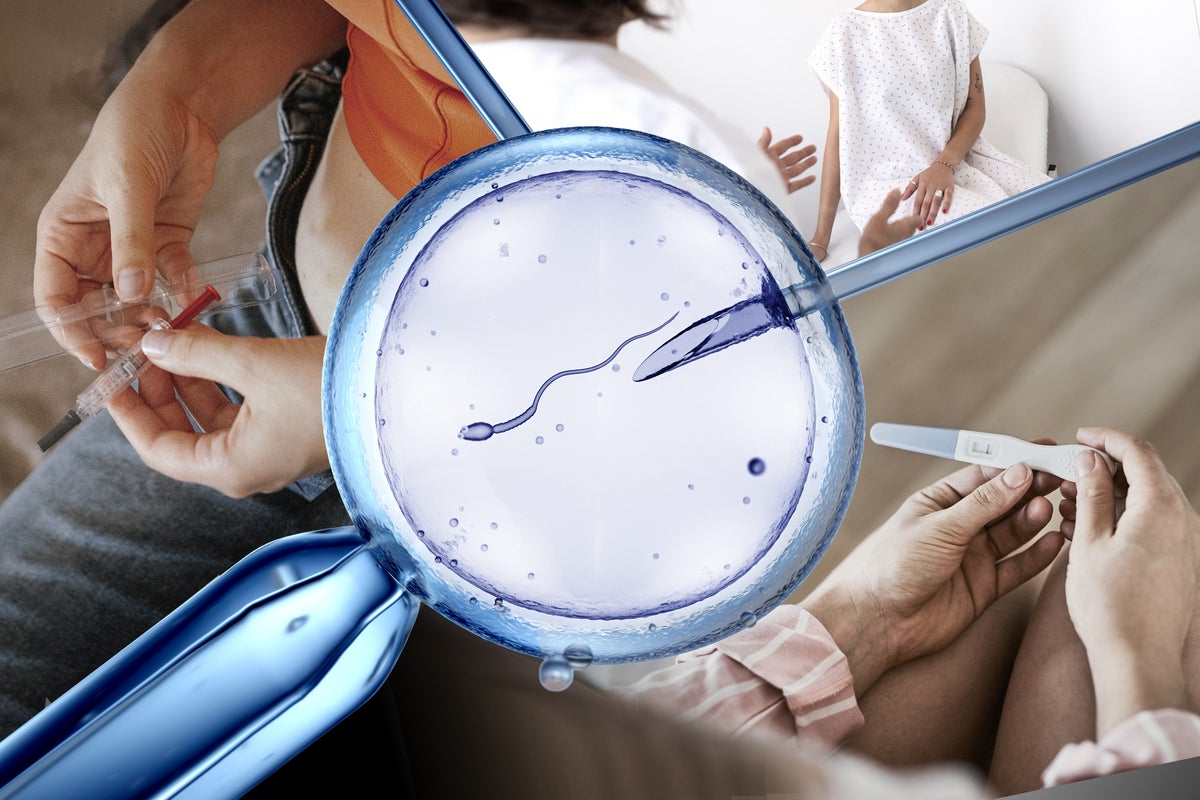

I think we should stop calling it a ‘postcode lottery’. A lottery implies that you’ve got some luck in this – but you’ve only got luck if you happen to live in that particular place. You don’t get any more luck once you’re there. You’re stuck.”
Sarah Norcross, director of the Progress Educational Trust (PET), a charity that improves choices for people affected by infertility, is talking about the current access to fertility treatment. More specifically, access to in vitro fertilisation (IVF) on the NHS in England.
It’s a particularly relevant topic, given that today, 25 July, is World IVF Day: it commemorates the birth of Louise Joy Brown in Oldham, Greater Manchester, in 1978, the first baby ever conceived through IVF.
But although Brown’s remarkable legacy lives on, nearly 50 years later IVF provision is something of a roulette in the very country in which the pioneering treatment was invented. Eligibility and the number of cycles couples are entitled to vary wildly between areas. Rules are governed by NHS local integrated care boards (ICBs), which are able to conjure up their own policies at will.
In some places, IVF is offered to women up to the age of 42; in others, it’s capped at 35. In some places, couples are offered three full rounds of IVF; in others, one partial round. In some places, as long as there are no children from the current relationship, the couple will be eligible; in others, the existence of any kids from previous relationships immediately prohibits treatment.
There is no rhyme or reason to this – it’s just an issue of resource distribution amid a health service stretched wafer thin. It is, as Norcross says, “grossly unfair”.
The “luck” element is significant even at a granular level. PET research has revealed that female GPs are nearly 20 per cent more likely than their male peers to refer patients for NHS-funded fertility treatment.
“Whether you can access treatment, what provision you’ll receive and under what conditions is fundamentally inequitable,” says Gwenda Burns, chief executive of the Fertility Alliance, a national charity offering support to those struggling with infertility.
Rather than improving, provision is getting substantively worse. In the past year alone, five separate ICBs in England have reduced their IVF offering.
On 1 April 2026, NHS Greater Manchester cut the number of cycles offered from up to three to just one. Katherine Sheerin, NHS Greater Manchester’s chief healthcare commissioning officer, said that, while they know the decision will be “upsetting and disappointing” for some, “access to NHS-funded IVF depends on where someone lives, and that variation is unfair and cannot continue as it is. Moving to a single policy removes this postcode variation.”
From 1 February 2026, NHS Cheshire and Merseyside ICB also went from offering two or three cycles to one. “We have a responsibility to ensure services are provided fairly for everyone across the region and by moving to a single funded IVF cycle, we can continue to offer treatment in a consistent way that remains clinically appropriate and financially sustainable,” a spokesperson told The Independent.
Whether you can access treatment and what provision you’ll receive is fundamentally inequitable
Gwenda Burns, Fertility Alliance
Across South Yorkshire, IVF cycles were slashed from two to one in December 2025. “This decision has not been taken lightly by the Board,” Chris Edwards, interim chief executive at NHS South Yorkshire, said of the decision. “However, in a difficult financial climate we have a responsibility to balance the needs of all our communities and ensure that we are delivering the best possible value for money within the resources available.”
At the beginning of July 2025, NHS Sussex’s ICB reduced the number of cycles patients can receive from three to one; they declined to comment when approached by The Independent.
Finally, in a double blow, Kent and Medway quietly announced in April this year that they would cut provision from two cycles for women up to the age of 40 to one cycle for women 37 and under.
On the ground, these changes have caused patients and doctors a huge amount of stress as they’ve tried to fast-track referrals to beat the deadline. “We’ve just been trying to get people through as quickly as possible so they can get their two or three rounds,” says Nicola Tempest, a consultant gynaecologist and lecturer at the University of Liverpool.
Holly, a 39-year-old psychotherapist who lives in Margate, was one patient whose IVF came under threat after Kent and Medway’s shrinkflation. Following a two-year wait for treatment, she and her partner started their first cycle in January; by the end of February, it had “dramatically failed”, she says. “We didn’t get any embryos, and we were extremely unprepared for that. I was utterly devastated.”

On top of this grief, more anxiety was piled on. For her second round, Holly was required to get an AMH test, which measures a hormone that indicates how many eggs someone has. By this point, it was the end of March.
“I had an appointment with my fertility doctor and she told me about the change in funding,” says Holly. “She said, ‘you have to get this AMH test done now, because otherwise you might not get your second round.’”
The NHS’s free AMH test would take too long – Holly was forced to arrange the test privately at a cost of more than £100, get up at 4am the next morning, and race home afterwards in time to start work.
“The stress was insane, and the potential implications were incredible,” she says. “To go from two rounds to one, four embryo transfers to two…”
The sudden reduction of eligibility due to age in Kent and Medway was particularly brutal; 38 is the age at which, according to some studies, women see a more rapid decline in fertility, and are therefore more likely to need assisted reproduction.
We didn’t get any embryos, and we were extremely unprepared for that. I was utterly devastated
Holly, psychotherapist
One academic review, for example, found that the rate of women defined as infertile who conceived without medical intervention within a year held steady at 29 per cent from the ages of 35 to 38. After that, it dropped far more quickly.
In fact, the backlash in Kent and Medway has been severe enough that the ICB has very recently pressed pause on this deeply unpopular move. “NHS Kent and Medway has listened to feedback following its decision to change the criteria for fertility services from 1 April 2026, and is now reviewing that change,” a spokesperson told The Independent. While the review is underway, the original criteria have been reinstated.
While this is undoubtedly good news, the likelihood that IVF provision will stay the same or improve during this next review process seems low if the national landscape is anything to go by.
Ignoring guidance
Putting aside the ICBs that have recently cut access, it is very rare to find one that is following NICE guidance. NICE stands for the National Institute for Health and Care Excellence – the official arm of the UK government responsible for providing evidence-based guidance, advice and standards for the NHS.
NICE updated its IVF guidelines in March this year, replacing the previous recommendations issued in 2013. These state that people who meet the eligibility criteria and are under 40 should be offered three full cycles of IVF. If they have not conceived after three cycles and are still under the age of 40, healthcare providers should consider up to three further cycles.
The number of cycles is crucial because, although it might sound obvious, the more cycles someone has, the higher the chance overall that they will have a baby. “Clinically, multiple cycles increase the overall chance of a live birth,” says Burns. “Reducing from three to one dramatically lowers the cumulative probability of success.”
Depressingly, only two ICBs in the whole of England are currently offering the recommended three full cycles: North East London and North East and North Cumbria.
The number of cycles is only one part of the story, too; some ICBs offer “non-full”, rather than “full” cycles. NICE guidelines define a “full” cycle as one in which, after egg retrieval and fertilisation, every resultant viable embryo has been transferred (one at a time – multiple embryo transfer is no longer practised in the UK) or one has resulted in pregnancy. But some ICBs will only transfer one viable embryo after retrieval, while others may cap it at two. Currently, only 11 of the 42 ICBs in England offer “full” cycles.
“It’s hard to communicate the message because it’s so complicated – but the bottom line is that, in many cases, we’re seeing ICBs making massive cuts and salami-slicing care,” says Norcross.
The issue is that NICE guidance is just that – guidance. There is no obligation to adopt it, and most ICBs simply choose not to as a cost-cutting exercise.
Not a ‘lifestyle choice’
Fertility treatment is frequently framed as a “luxury” or a “lifestyle choice”. This problematic viewpoint was recently spouted by Reform UK county councillor Bridget Porter in Kent, who compared IVF to “butt lifts” and “boob enhancements”, saying that increasing spending on fertility would be “frivolous”, reports the BBC.
Yet reproduction is anything but. The World Health Organisation (WHO) defines infertility as a “disease of the reproductive system”, and it’s becoming an increasingly pertinent public health problem, given that fertility and birth rates are declining the world over.
In 2025, births in England and Wales fell for the fourth year in a row and hit their lowest level for nearly 50 years, according to ONS data. The number of children born per woman in England and Wales has fallen to 1.4, well below the replacement rate – the number of babies per woman needed to sustain a population size – of 2.1.
This demographic shift is a cause for concern. “If you’ve got too many older people being supported by a much smaller young taxpaying population, it’s going to cause massive problems,” says Kevin McEleny, a consultant urologist and chair of the British Fertility Society (BFS). “One way of mitigating it is by allowing those who want to have children to do so.”
Are we really saying that the rich middle class are more entitled to have children than working class people?
Kevin McEleny, British Fertility Society
But while countries like Denmark and France are addressing their ageing populations by increasing fertility treatment provision, England is not.
Economically speaking, for every £1 spent on IVF, a country gets 8.5 times this back in terms of tax recouped from the children produced via the treatment, according to research. “The people who do healthcare economics have said these children are an asset,” says Norcross. “You get a really good return on your investment as a government.”
The difficulty is that political decisions are often made on a short-term basis, with those in charge looking from election to election rather than prioritising policies that will reap rewards in 40 years. And yet access to free fertility treatment is popular with the public; in a survey conducted by IPSOS on behalf of PET, 57 per cent of respondents said they thought IVF should be offered on the NHS.
The case for change
Some politicians are making the case for change, with Conservative MP Sir Gavin Williamson proposing a bid to amend the NHS bill to force ICBs to follow NICE recommendations on IVF.
“This is the country that invented IVF, yet Integrated Care Boards are rationing it unevenly,” he says. “NICE guidelines exist precisely to prevent this, and they are being ignored. Enforcing them across every region is the obvious fix, and it is long overdue.”
This issue is only going to get more pressing; IVF patients have tripled in 30 years, and roughly one child in every UK classroom is now born via IVF. This trend will likely continue unless we better shape society around our biology – enabling people to have children younger. As it stands, financial insecurity is causing people to push life milestones like parenthood later and later, resulting in natural conception becoming more difficult.
In the meantime, a lack of access to free fertility treatment is already creating a two-tier society. Only 25 per cent of IVF cycles in England are done through the NHS, according to the latest HFEA data, which means that 75 per cent are paid for privately, at a cost of £5,000 to £8,000 a pop.
For same-sex couples, there is an in-built bill before they have any chance of accessing NHS care. In the vast majority of areas, they must have completed at least six cycles of (unsuccessful) self-funded artificial insemination (IUI) before they’re considered for treatment, costing from around £750 per round, rising to £1,400 if donor sperm needs to be purchased – a total of £4,500 to £8,400.
“Are we really saying that the rich middle class are more entitled to have children than working class people?” asks McEleny. “Is that the kind of country we want to live in?”
It doesn’t have to be this way. Across Scotland, NHS boards follow the gold standard: three full rounds for women up to 40. They did a phased implementation, first introducing two rounds, then extending to three. “We’re meant to be a UK NHS, not an NHS England and an NHS Scotland,” points out Burns, “so why isn’t there equitable treatment across the country in line with the NICE guidelines?”
McEleny concludes with this warning: “There will come a time, mark my words, when they will be desperate for people to have more children. By then it’ll be too late. Make it easier now.”