
Home Blog Page 167

Would you trust a tiny dental robot?

0
Would you trust a tiny dental robot?


NEWYou can now listen to Fox News articles!

Nobody hears “you need a crown” and feels excited. You start thinking about the drilling, the temporary crown, the return visit and the time it takes to get everything finished.

Now, researchers at the University of Basel in Switzerland are working on a tiny dental robot that could one day change that process. The prototype is called MIR, short for Miniature Intraoral Robot. University of Basel says the device could help prepare teeth for crowns and reduce the number of dental appointments needed for treatment.

WOULD YOU PAY $8,000 FOR A ROBOT TO FOLD LAUNDRY?

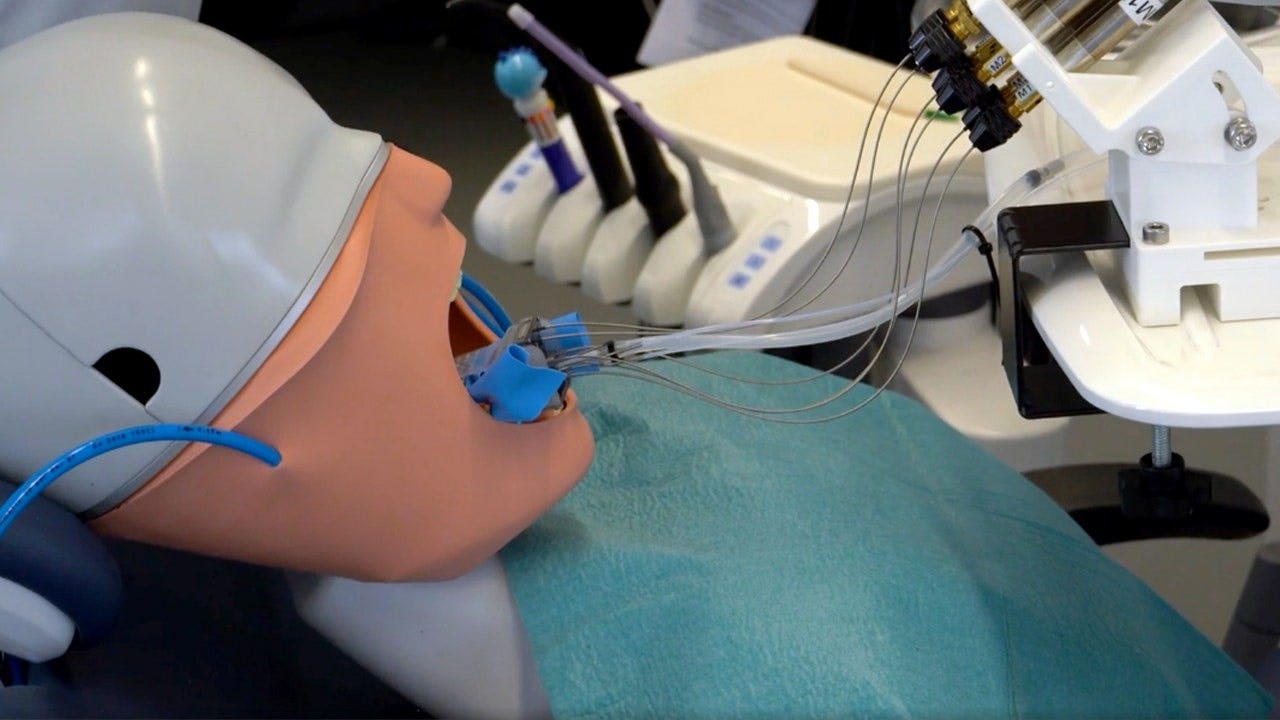
The idea may sound intense because we are talking about a drill-equipped robot inside your mouth. However, the current design keeps the larger motor and control parts outside the mouth. The small in-mouth robot connects to them through flexible drive shafts, cables and tubes.

Free live CyberGuy class: Sick of Spam? Join us July 22

Join us Wednesday, July 22, at 1 PM ET for a free CyberGuy Live class that will help you cut down on robocalls, spam texts, junk email and other unwanted messages. Kurt “CyberGuy” Knutsson will walk you step by step through simple ways to filter spam, clean up your inbox and recognize the messages that could put your personal information at risk. No technical experience is needed. You’ll also receive our spam-stopping checklist, and every registrant will get a link to the class recording afterward.

Reserve your free spot today at CyberGuyLive.com.

University of Basel researchers are developing MIR, a tiny dental robot designed to help prepare teeth for crowns with digital precision. (University of Basel, Catherine Weyer)

Why crowns take more than one dental visit

If tooth decay leaves a large cavity, a dentist may need to prepare the tooth for a crown. Today, that can mean several steps. The dentist removes decay, fills the cavity, shapes the tooth, takes an impression and fits a temporary crown. Then, the permanent crown gets made and placed during a later visit.

That is where MIR could help. The goal is to move more of the process into a digital workflow. After a scan, a dentist could plan how much tooth material the robot should remove. Then, the crown could be ordered right away instead of waiting for another appointment.

How the tiny dental robot works

MIR attaches to a custom-fitted dental splint made from the patient’s scan. That splint connects the robot to the teeth. So, if the patient turns their head, the robot moves with them.

That detail stood out to me. Anyone who has ever tried to stay perfectly still in a dental chair knows how hard that can be. Even a small twitch can feel huge when a drill is near your tooth.

The robot is designed to follow a digital treatment plan. In testing, it prepared tooth models in two stages. First, it used a wider drill to reduce the top of the tooth surface. Then, a longer, thinner drill worked along the sides.

HUMANOID ROBOTS PERFORM LIVE SURGERY IN WORLD FIRST

How small is MIR?

The University of Basel says the MIR prototype is about the size of a wine cork. It measures 43 by 26 by 28 millimeters. Dr. Yukiko Tomooka, the paper’s first author, said the robot was designed to fit comfortably inside an open mouth.

That small size is key. A dental robot cannot feel bulky or block the dentist’s view. It also cannot depend on a giant device sitting inside your mouth. So, the Basel team moved the larger parts outside the mouth and kept the in-mouth unit compact.

The project page from the University of Basel’s Department of Biomedical Engineering says the team wants MIR to enable a fully digital treatment workflow for tooth preparation. The long-term vision is a crown that can be manufactured before or during the preparation process using CAD-CAM dental technology.
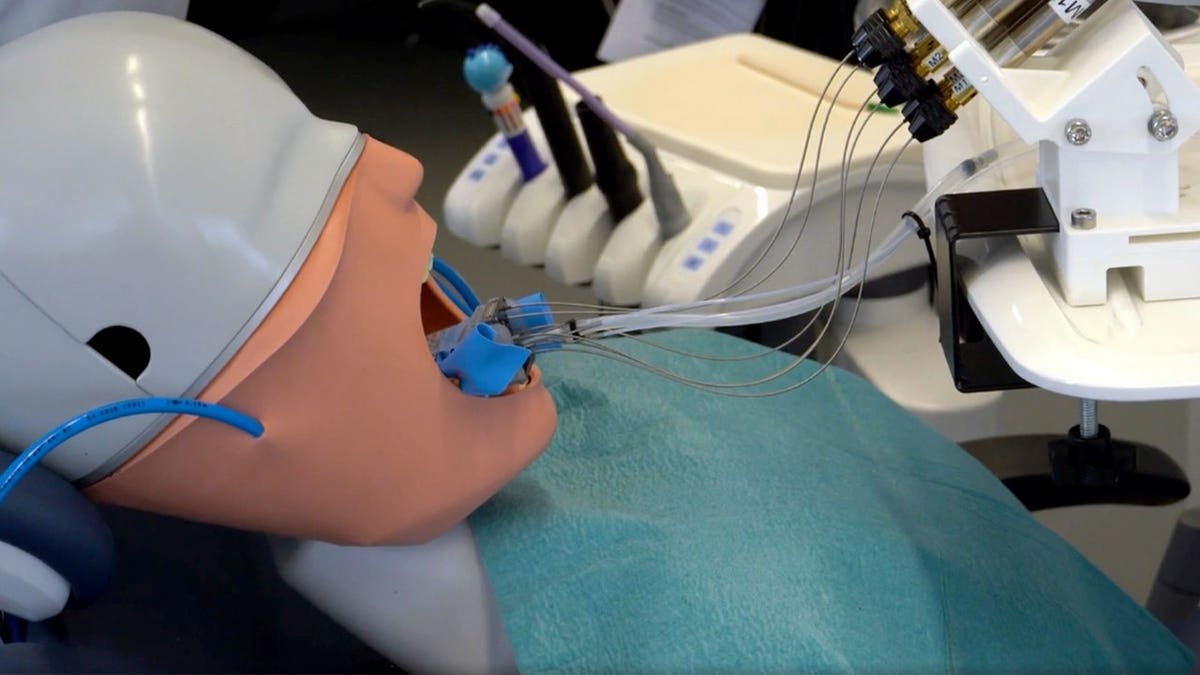
The dental robot being tested on a synthetic tooth model.

Researchers say the miniature dental robot has been tested on synthetic tooth models and dental-like ceramic materials. (University of Basel, Catherine Weyer)

How precise is the dental robot?

So far, MIR has been tested on tooth models made of synthetic resin and on ceramic material with hardness similar to tooth enamel. In those tests, the robot’s positional error was less than 0.2 millimeters, even though the current version does not yet have sensors to directly measure or correct its position.

Researchers also measured the force created during drilling. University of Basel says the forces stayed below five newtons, which it compares to the gravitational force of a half-liter bottle of water. The team is also studying the robot’s noise level to better understand how it might work in a real dental office.

Why MIR still has a long road ahead

This tiny robot has not yet reached dental offices. University of Basel says more work is needed before MIR can be used in dental practices. The next step is to add sensors and a camera, so the system can track its position and monitor the treatment as it happens.

That safety piece is a big deal. The team wants MIR to know where it is, even after a power outage. Professor Georg Rauter, who leads the research group, said the goal is for the robot to continue from the right position using sensor data.

In other words, the robot needs better awareness before anyone should trust it near a real tooth. Precision on models is one thing. A real mouth adds saliva, movement, pressure, nerves and patient anxiety.

Who is behind the tiny dental robot?

MIR was developed by researchers at the Department of Biomedical Engineering at the University of Basel. The idea came from researchers at the University of Zurich, who also took part in the work.

The University of Basel project page lists the BIROMED-Lab, the Clinic of Reconstructive Dentistry at the University of Zurich, Camlog Biotechnologies and the University of Bern’s ARTORG Center as collaborators. The project is sponsored by Innosuisse. The research was published in IEEE Transactions on Medical Robotics and Bionics.

BIONIC HANDS ARE NOW TEACHING ROBOTS TO FEEL
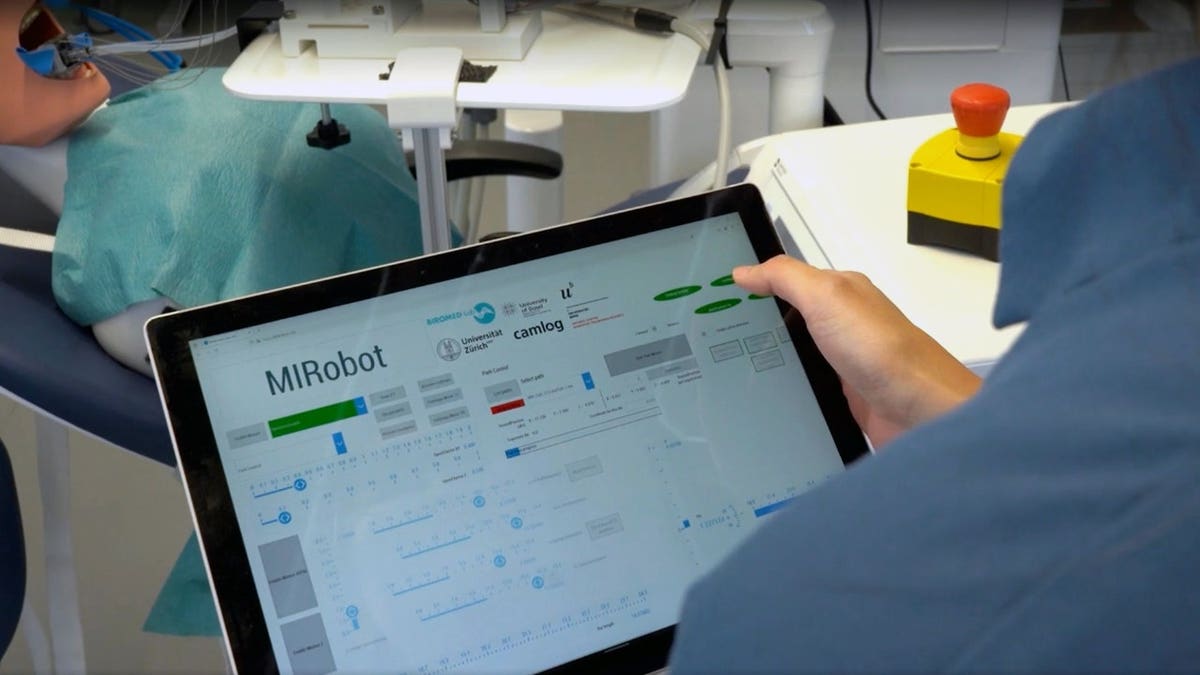
A person monitors the dental robot with a monitor.

MIR remains a prototype, with researchers planning to add sensors and a camera before testing it in real dental settings. (University of Basel, Catherine Weyer)

What this means for you

If you have ever needed a crown, you know the process can drag on. MIR could eventually make that experience faster by letting dentists scan, plan and prepare the tooth with more digital precision.

Still, this technology remains in development. You should not expect a tiny robot to show up at your next dental appointment. Researchers still need to add sensors, add a camera and prove that the system can work safely in real treatment settings.

Even so, this is worth watching. Dentistry is already moving toward digital scans, computer-designed crowns and more guided procedures. A robot like MIR could push that trend further, especially if it can reduce repeat visits.

Kurt’s key takeaways

This is the kind of dental tech that makes you lean forward and squirm a little. A tiny robot mounted inside your mouth may sound intense. Still, the goal is something many of us would welcome: fewer follow-up appointments when a crown is needed. The most important detail is that MIR remains a prototype. It has only been tested on models and dental-like materials so far. The team still plans to add sensors and a camera before real dental use. If MIR works, a future crown appointment could feel more like a guided digital procedure than the drawn-out process many of us know today.

Would you trust a tiny robot to drill your tooth if it meant fewer trips to the dentist? Let us know by writing to us at CyberGuy.com.

CLICK HERE TO DOWNLOAD THE FOX NEWS APP

Sign up for my FREE CyberGuy Report

  • Get my best tech tips, urgent security alerts and exclusive deals delivered straight to your inbox.
  • For simple, real-world ways to spot scams early and stay protected, visit CyberGuy.com trusted by millions who watch CyberGuy on TV daily.
  • Plus, you’ll get instant access to my Ultimate Scam Survival Guide free when you join.

Copyright 2026 CyberGuy.com. All rights reserved.



Source link

Newcastle: How have missed targets affected summer rebuild?

0
Newcastle: How have missed targets affected summer rebuild?


It feels a slightly different project, however, as the fifth anniversary of the Saudi Arabia-led takeover approaches.

Even when Newcastle were in relegation trouble in 2022, the hierarchy at the time sold a dream to Bruno Guimaraes that they could be a “big power”.

Now, though, the Newcastle captain has intimated he wishes to join Arsenal, who have yet to make contact with the club.

As adored as Guimaraes is on Tyneside, does the 28-year-old have the patience to help lead a new era at Newcastle as the captain of a young group who will take time to flourish?

Does Guimaraes feel this is potentially the last chance he would have to win a Premier League title or the Champions League if Arsenal come to the table?

In the past 12 months he has watched Alexander Isak move to Liverpool and Anthony Gordon join Barcelona.

Newcastle, fresh from a Uefa settlement, have also sold Sandro Tonali to Tottenham in a deal worth up to £100m which will enable them to significantly reinvest within the game’s financial rules.

Tonali left Newcastle to link up with fellow Italian Roberto de Zerbi, but he will also command far bigger wages because of Spurs’ higher revenues despite also missing out on Europe.

Football finance expert Kieran Maguire says there have been a variety of “pull factors” that Newcastle have had to contend with.

“The opportunity to play for clubs of the stature of Barcelona or to play in London is very attractive to players,” he said.

“With Newcastle not competing in Europe this season, that could be a contributory factor. The Champions League is the biggest tournament in terms of club football for a player and that’s an attraction.

“The other issue is wages. Guimaraes is handsomely paid at Newcastle, but they can’t match Arsenal‘s wages.

Arsenal can pay £300,000 a week, which will be close to twice what he is on at present. If you’re 28 and looking at a four-year contract, you do the sums and that becomes very attractive.”

The challenge for Newcastle is to prove that this can still be a “very attractive” project in its own right.

Not only to Guimaraes but future signings too.


Source link

Financial expert reveals seven ways to automate money and build wealth

0
Financial expert reveals seven ways to automate money and build wealth


Juggling daily responsibilities is demanding enough without the constant pressure of tracking every bill, savings transfer, and budget check.

Fortunately, taking control of your finances doesn’t have to be a time-consuming ordeal. Automating a few key tasks can simplify money management, reduce missed payments, and keep you on track with financial goals without constant effort.

To discover where to begin, Zoe Brett, a financial planner at EQ Investors, explains the key benefits of putting some finances on autopilot.

She also shares seven tedious administrative tasks that can be automated today.

What are the benefits of putting some of your finances on autopilot?

Automation is particularly useful for saving and budgeting.

“Putting some of your pay check on autopilot by funnelling it into a spending account and having automated payments for your savings, investments and bills helps ensure everything that needs to be paid is paid,” says Brett.

Over a long-term period, it can help put you in a more financially stable position.

Automation is particularly useful for saving and budgeting (Getty Images)

“Your savings and investments will gradually build up through these small automations, and will help improve your wealth overall in the long term,” says Brett.

She adds that these automatic processes can also help prevent decision fatigue.

“If you can build automation into things, then it’s one less thing you’ve got to think about amongst all the school runs, work and anything else that’s on your mind,” says Brett.

“As humans we can get a bit decision fatigued and having to consciously make decisions about your finances every single month, even if it’s a simple decision, can get a bit overwhelming.

Trading 212 logo

Get a free fractional share worth up to £100.
Capital at risk.

Terms and conditions apply.

Go to website

ADVERTISEMENT

Trading 212 logo

Get a free fractional share worth up to £100.
Capital at risk.

Terms and conditions apply.

Go to website

ADVERTISEMENT

“However, if you just automate it, it takes the decision process out of it for you and becomes a habit that you don’t have to think about.”

Here are seven ways to put your money on autopilot today…

1. Spending

“Having some of your pay check automatically go into a spending account as soon as you get paid is a big thing you can do,” says Brett. “This will help separate your needs from your wants, and that’s a really important first step.”

2. Bills

“Bills often come out at different times of the month, and monitoring that to make sure that there’s enough money left in your account to pay for everything can be really stressful,” says Brett.

“However, if all your bills are automated then you don’t have to worry about missing a payment.”

Over a long-term period, automation can help put you in a more financially stable position
Over a long-term period, automation can help put you in a more financially stable position (Alamy/PA)

3. Emergency fund

“If you’re building an emergency fund, automating savings into this every month is a really good idea,” recommends Brett.

4. Lump expenditures

“If you have some lump-sum expenditures that you need to save for, such as Christmas or a big summer holiday, setting up different pots for each of these can be helpful because you can automate a fixed amount of money to go into each pot every month,” says Brett.

“This prevents these bigger expenses from being thrust upon you and breaks them down into smaller, more manageable, amounts instead.”

5. Investments

Automating your investment plan puts your wealth accumulation on autopilot – although there are risks associated with investing your money due to its unpredictable nature.

“This takes the worry out of timing the market because that money will just go in every month and you will then benefit from the pound cost averaging,” says Brett.

6. Money round-up features

Many digital banks and financial technology apps offer automatic spending round-up features to help users build a financial cushion without altering their daily spending habits.

“What happens is that every time you spend money, it will round it up to the nearest pound and will funnel that extra money into a savings account,” explains Brett.

“This is a great automated process that gradually builds up savings for you.”

By automating a few key tasks, you can make managing your money simpler, reduce the chance of missed payments, and stay on track with your financial goals without the constant effort
By automating a few key tasks, you can make managing your money simpler, reduce the chance of missed payments, and stay on track with your financial goals without the constant effort (PA Archive)

7. Automate any pay rises

To stop lifestyle inflation from eating up your pay rises, immediately divert a fixed percentage of any raise into a dedicated savings or investment account.

“When you get a pay rise, before you get used to that money it can helpful to automate some of it into savings or investments because that’s a really good way of building wealth before you’ve even felt the benefit of the increased money,” suggests Brett.

How to start:

Most banking apps will have a level of this automation already built in.

“It doesn’t need to be anything super fancy or technical, you could just start by setting up a common standing order for each of these areas,” suggests Brett.

If you are not confident at using these apps, pick up the phone.

“Most banks provide a telephone banking service so you should be able to set a standing order up over the phone if you’re not comfortable with tech,” says Brett.

“Somebody in a call centre should be able to talk you through how to set it up or do it for you over the phone.”


Source link

Heartstopper star reveals he was burgled during film’s premiere with emotional selfie

0
Heartstopper star reveals he was burgled during film’s premiere with emotional selfie


Emmerdale’s Bradley Riches has announced his car and coffee truck were stolen, and his house burgled, while he attended the premiere of the new Heartstopper movie.

Riches, who plays Lewis Barton on the ITV soap and lovestruck teenager James on Heartstopper, posted a selfie to his Instagram showing him with tears in his eyes, as he revealed the incident in question.

“This week started so perfectly,” he wrote. “I got back from the Heartstopper premiere after having the best time… only to come home and find out I’d been robbed. My car is gone, but what breaks my heart the most is that my coffee truck has been taken too.”

Actor Bradley Riches posted an emotional selfie announcing the incident (Bradley Riches)

Riches had launched Bradley’s Bar & Cafe in May, posting that he and his husband Scott Johnson-Riches would be selling coffee from their special food truck every Saturday at the New Inn Eccup, a pub located near where Emmerdale is filmed.

Riches wrote that he is “absolutely heartbroken”, adding: “To the person who took them, I hope you have a really bad day.”

More details on the theft were published on the Bradley’s Bar & Cafe Instagram page, with Riches writing that police are investigating.

“After everything we’ve put into building our little business, it’s incredibly upsetting to see it taken away like this,” he wrote. “The theft has been reported to the police, who have been fantastic, but unfortunately they’ve been unable to locate either vehicle at its last known location. We’re asking everyone in the Leeds and Bradford area to please keep an eye out.

“Even the smallest piece of information could make a huge difference. If you think you’ve seen the trailer, the car, or anything that you think might be connected, please send us a private message as soon as possible. We’d be so grateful.”

The bio for the food truck has also been updated to read “currently stolen”.

Riches was attending the 'Heartstopper Forever' premiere in London when the robbery occurred
Riches was attending the ‘Heartstopper Forever’ premiere in London when the robbery occurred (Getty Images)

Riches was appearing at the premiere of the new Netflix film Heartstopper Forever when the theft occurred. The movie, which launches on Netflix today (17 July) serves as the finale to the hit coming-of-age series starring Kit O’Connor and Joe Locke as teenagers in love.

Riches, 24, began his career in musical theatre, before joining the cast of Heartstopper in 2022 and appearing on Celebrity Big Brother in 2024, where he finished in sixth place.

On Emmerdale he plays the long-lost son of Gillian Kearney’s Emma Barton. Like Riches himself, his character has autism. Riches has published two books about neurodivergence – 2023’s “A” Different Kind Of Superpower, a children’s book about growing up with autism, as well as this year’s Autistically Me: How to Understand and Celebrate Our Unique Minds.

In it he writes about being non-verbal until the age of nine, and his diagnosis with autism at the age of 10.


Source link

US attacks southern Iran, as Tehran hits Gulf countries: What’s the latest?

0
US attacks southern Iran, as Tehran hits Gulf countries: What’s the latest?


Iran struck Bahrain, Qatar, Oman, Jordan and Syria in retaliation for US strikes.

For a sixth night in a row, the United States hit Iran in a wave of major attacks. Iran hit back, launching missiles and drones at multiple countries in the Gulf and at US bases in other regional countries.

Iran has said 38 people have been killed, and more than 400 injured, in the US attacks since the two sides met in Switzerland on June 22 for talks to end the war through a 60-day negotiation period, the AFP news agency reported. That includes at least eight people whom Iran said had been killed in overnight attacks by the US.

Here is a recap of what happened over Thursday night and on Friday so far.

Where was Iran attacked?

The US Central Command (CENTCOM) said that at 01:40 GMT on Friday, it completed its latest major wave of attacks against Iran. The US military did not provide many details about the specific sites it hit in Iran.

However, Iranian media reports said US forces struck at least six bridges, a railway station and other sites across Iran, killing at least eight people and injuring several.

Iran’s Fars news agency said the six bridges that were struck in the southern Hormozgan province include:

  • The Gariveh bridge connecting Bandar Abbas to Khmeir and Lara
  • A bridge near the village of Latidan
  • Two bridges on the Kahoorestan-Lar route
  • A partially constructed bridge connecting Bandar e-Khamir, Keshar and Bandar Abbas
  • A bridge in the village of Maru, in the Khmeir district.

Iran’s Ministry of Energy says the latest US attacks have caused damage to power lines in Bandar Abbas and surrounding villages.

Power outages were reported in southern Iran, and electricity started to be restored in certain areas.

Which Gulf countries were attacked?

On Friday morning, Iran’s Islamic Revolutionary Guard Corps (IRGC) claimed a 13th wave of retaliatory strikes against US bases since hostilities renewed.

Bahrain: Air raid sirens were activated in Bahrain on Friday morning as the Ministry of Interior urged people to remain calm.

Qatar: Early on Friday, Qatar’s authorities issued two separate alerts about an hour apart, after the country came under attack from Iranian projectiles, including at least one missile. The projectiles were all intercepted, the country’s Ministry of Defence said. Qatar’s Ministry of Interior reported that one child was injured by falling shrapnel during aerial interceptions over Doha. The child is receiving medical treatment.

Oman: Iran’s IRGC, on Friday, claimed to have destroyed a US air control radar in Oman’s Ghanim region and a maritime control radar on rocks in the Strait of Hormuz, in waters dividing Iran and Oman. A tanker was hit by an unknown projectile on Thursday while sailing about 19 nautical miles (equivalent to about 35km) east of Khasab, Oman, the United Kingdom Maritime Trade Operations agency has said.

Kuwait: The IRGC said on Friday that it hit a US military base in Kuwait, striking a missile defence radar, several key weapons depots and two HIMARS surface-to-surface missile launchers, according to Iran’s Mehr news agency.

Jordan: The Jordanian army said on Friday that it shot down three Iranian missiles targeting the country after its air defence systems intercepted them. The army said the incident did not cause any human casualties, as Jordan’s Royal Engineering Corps teams dealt with falling shrapnel.

Syria: The IRGC said it attacked a US special operations command centre at the al-Tanf military base in Syria, the Tasnim news agency reported on Friday. The IRGC added that the attack was in retaliation for the killing of Iranian soldiers in Iranshahr.

What are Iranian and US leaders saying?

Iranian military spokesperson Ebrahim Zolfaghari said the Strait of Hormuz “will never return to what it was before the 40-day war”, accusing the US of destabilising the waterway.

In a podcast episode with Joe Rogan on Wednesday, US Vice President JD Vance said several Israeli government members tried to influence US public opinion to oppose a deal in the US war with Iran.

“I know beyond a shadow of a doubt that there have been people within the Israeli government who are trying to, like, actually shift us away from that policy because they want to continue the military campaign,” Vance said.


Source link

China’s Xi calls for step up of global effort in AI

0
China’s Xi calls for step up of global effort in AI


SHANGHAI — Development and governance of artificial intelligence should be a global effort, Chinese President Xi Jinping said Friday, while reiterating China’s objections to what he called the “overstretching” of national security concerns.

Speaking at a conference in Shanghai, Xi said AI should not be dominated by any single nation. American-led restrictions have blocked China from accessing some of the world’s most advanced technologies, spurring China’s efforts to build its own know-how and intensifying the tech race between the world’s two biggest economies.

“The development of artificial intelligence should not be a solo performance by any single country but rather a symphony of global cooperation,” Xi said at China’s annual World Artificial Intelligence Conference in Shanghai. Others attending included the leaders of Kazakhstan, Cambodia and Thailand and U.N. Secretary-General António Guterres.

“We should together oppose the practice of overstretching the concept of national security in the field of artificial intelligence, and of placing one’s own security above that of other countries,” he said, repeating a longstanding Chinese complaint.

Over the next five years, he said China will provide 5,000 training opportunities on artificial intelligence to developing countries.

China will expand AI cooperation with the Association of Southeast Asian Nations, the League of Arab States, the African Union, the Community of Latin American and Caribbean States, the Shanghai Cooperation Organization and the BRICS countries, Xi said. He promised to provide access for 30 countries to a Chinese-developed AI meteorological system that provides early warning systems.

A day earlier, 29 countries including Pakistan, Russia and Kazakhstan signed an agreement with China to establish a World Artificial Intelligence Cooperation Organization. State media described it as an intergovernmental organization headquartered in Shanghai promoting global AI governance.

More than 1,100 companies and 1,400 guests are participating in the annual AI conference this year, state media said.

During the conference, tech giant Huawei will be showcasing its powerful AI computing system, the Atlas 950 SuperPoD,.

Some technology analysts now believe China has become an innovator in AI and is no longer just catching up with the U.S. China’s five-year plan until 2030 has prioritized progress in frontiers of science and technology including AI.

China’s open-source AI models, like DeepSeek, have been seen as appealing and often times more affordable alternatives globally to U.S. AI models, which are largely closed-source, and especially across the developing world.

____

Chan reported from Hong Kong. Associated Press writer Ken Moritsugu contributed from Beijing.


Source link

US launches new strikes as Iran says civilian infrastructure hit

0
US launches new strikes as Iran says civilian infrastructure hit


The US launched a wave of strikes against Iran for the sixth night in a row, its military said, as the two sides battled over control of the Strait of Hormuz.

US Central Command (Centcom) said the attacks were intended to “further degrade Iranian military capabilities”, before saying it had boarded a vessel as part of its blockade of Iranian ports.

State media reported that the US had hit civilian infrastructure, including bridges, a train station and an airport. The BBC has verified an attack on one bridge to the west of Bandar Abbas in Hormozgan province.

Iran’s Revolutionary Guards (IRGC) say they have retaliated by striking US maritime surveillance radar sites in Oman as well as targets in Kuwait and Bahrain. They also claim to have attacked a US special operations command centre in Syria.

The IRGC said the surprise attack at al-Tanf in Syria, near the border with Jordan, was in retaliation for the killing of Iranian soldiers two days ago. Neither Syria nor the US have commented on the claim.

Later on Friday, Jordan’s military said it shot down three Iranian missiles with no casualties or damage reported.

Kurdish forces in Iraq also said eight drones were shot down over the Iraqi city of Erbil, with no casualties reported.

As attacks escalate, the Strait of Hormuz – a critical waterway off Iran’s coast that Tehran effectively blocked in response to US-Israeli strikes – has remained shut.

That has impacted the flow of oil from the region and the head of the International Energy Agency, Fatih Birol, says he has concerns about global energy supplies.

“We should be worried, and I am worried, if the situation does not improve in the next few weeks,” Birol said on Thursday night.

On Friday the Chinese and Pakistani foreign ministers called for the US and Iran to stop fighting and resume negotiations.


Source link

Monsoon pantry care: Expert shares the right way to store oil, ghee and honey during rainy season

0
Monsoon pantry care: Expert shares the right way to store oil, ghee and honey during rainy season


The humidity in monsoons not only affects our clothes and furniture, but it can also impact the shelf life of our kitchen essentials. Namrita Malhotra, Founder & Managing Director of Savore, states that while we need to focus on buying premium products, it is equally important to know the right way to store them to preserve their quality. The rain makes food items like oils, ghee, and honey more susceptible to moisture, heat, and frequent exposure to the air.

Humidity can slowly degrade pantry essentials

Namrita Malhotra highlights the fact that while we usually pay attention to the premium quality of our ingredients, we tend to neglect the storage method in which the ingredients are kept. Humidity in the monsoons increases the chances of reduced quality of our cooking ingredients. She states that good storage is as essential as selecting our ingredients.

Store cold-pressed oils away from light and heat

Namrita says that cold-pressed oils need protection from light, heat, and air. Exposure to these three factors increases the oxidation of the oils. Humid air further makes it worse. She recommends us to keep our oils in dark, airtight containers. Also, keep them away from the windows and stove as they will increase their exposure to light and heat. Moreover, it will be better to purchase small containers of oil during monsoon times as opening and closing large containers exposes their contents to more air.

Purchase smaller containers for oil during the monsoon

Instead of buying large bottles that stay open for a very long time, Namrita suggests that we buy smaller quantities of cold-pressed oils during the monsoon. Frequent opening and closing of large containers exposes their contents to air and moisture, and hence, it will be better to choose small packs which will get finished sooner and maintain their freshness.

Ensure that the container is totally dry for ghee

Ghee naturally has a long shelf life; however, it requires protection from moisture during the monsoon. Namrita Malhotra suggests that we store ghee in a clean and dry container made of glass or stainless steel. She adds that it needs to be tightly closed after usage and to use a dry spoon should be used every time to prevent any moisture from entering the container.

Honey requires protection from steam

While honey is known to have a longer shelf life because of its low water content, it also requires proper storage in humid months, according to Namrita Malhotra. It is advised to keep the jar tightly closed and keep the honey away from steam-producing places such as kitchens and stoves. Preventing any moisture from entering the jar will help maintain the quality of honey.

Store pantry items away from windows and sink

The location of the container also plays an important role in storing the food items. Namrita Malhotra advises us to keep oils, ghee, and honey in dry cabinets rather than keeping them next to the window, sink, or kitchen counter. This is because the sunlight, heat, and humidity change frequently in these areas and may harm the food items stored in well-sealed jars.

Small changes bring a huge difference

According to Namrita, preserving the quality of pantry items does not require fancy storage techniques. Just closing the jars immediately after use, preventing any moisture from entering the containers, using dry spoons, and avoiding storage in warm or humid locations can make sure that carefully chosen food items perform efficiently.


Source link

“Volunteering at Sheffield food charity saved me from loneliness”

0
“Volunteering at Sheffield food charity saved me from loneliness”


Three years ago, Ian White was left feeling “suicidal” after the collapse of his marriage, struggling to cope with loneliness and isolation.

The 61-year-old grandfather was invited to a session at FoodCycle, a charity that brings people together through communal dining – and it has changed his life.

White now volunteers with the charity at Primrose Hill in Sheffield, helping to reduce food waste while offering a space for conversation and connection.

He said: “The other guests heard about my situation and made me feel welcome and we formed friendships. I feel wanted – it’s given me meaning in life.”

After separating from his wife, White was eating poorly and lost 8st (51kg) in weight in just one year.

A friend recommended FoodCycle and he was initially nervous about attending.

“There were lots of people I didn’t know and I’m not a confident eater in front of strangers, but I got used to it, and now I’ll eat anywhere,” he said.

Each week volunteers transform surplus food that would otherwise go to waste into three-course meals served free to anyone who wants them.


Source link

Cyclosporiasis outbreak linked to shredded lettuce served at some Taco Bell locations: CDC, FDA

0
Cyclosporiasis outbreak linked to shredded lettuce served at some Taco Bell locations: CDC, FDA


Recent cases of the intestinal illness cyclosporiasis have been linked to shredded iceberg lettuce served at some Taco Bell locations in Indiana, Kentucky, Michigan, Ohio and West Virginia, according to the Centers for Disease Control and Prevention and the Food and Drug Administration.

A traceback investigation carried out by the FDA identified a single supplier of iceberg lettuce from Mexico that supplied the Taco Bell locations where people who became sick reported eating. The supplier has not been publicly identified.

The CDC and FDA said more than 1,644 cases in the current outbreak involve people who reported eating at Taco Bell in those five states, including 94 people who were hospitalized.

“Do not eat shredded iceberg lettuce from Taco Bell locations in Indiana, Kentucky, Michigan, Ohio, and West Virginia,” the CDC said in a notice posted Thursday. “CDC is also investigating other outbreaks and illnesses of cyclosporiasis nationally that are unrelated to this outbreak.”

The CDC said Taco Bell is working to stop using the lettuce.

In an earlier statement, Taco Bell said it had taken “immediate action to voluntarily remove potentially impacted lettuce from a supplier in select states” following “ongoing conversations with public health officials.”

The statement went on to say in part, “We believe public health is a shared responsibility among restaurants, their suppliers, and authorities, and we are proud to have consistently acted quickly and proactively to protect our guests. Taco Bell has taken precautionary action, and we encourage all relevant restaurants, retailers, and foodservice operators to do the same.”

In an FDA statement, the agency said it is working directly with the identified supplier to determine if potentially contaminated shredded iceberg lettuce remains on the market.

“As part of this investigation, FDA and state partners have initiated collection of product samples for testing and analysis,” the statement said. Additionally, FDA has increased screening at the border for products implicated in the outbreak.

Michigan health officials had previously said preliminary findings suggested lettuce or salad greens as a possible source of the outbreak but had not identified a specific ingredient, grower, supplier or retailer.

The new information comes as health officials continue investigating a multistate outbreak of the illness that has sickened an estimated nearly 7,000 people, according to CDC estimates — not all of them tied to the outbreak involving the Taco Bell locations, according to the CDC.

Symptoms of cyclosporiasis include watery diarrhea, fatigue and loss of appetite, according to the CDC. Symptoms usually begin about a week after a person becomes infected.

Cases have been reported in 34 states, with the bulk of illnesses reported in Michigan. State health officials there have reported 4,312 cases and 102 hospitalizations.

In Ohio, state health officials reported 1,244 cases — up from just under 200 cases at the beginning of July.

Earlier this week, Taco Bell said it was voluntarily and temporarily removing some limited ingredients at select restaurants as a precautionary measure.


Source link