BRUSSELS — The European Union issued two new rules for Google on Thursday to force it to share search data and open up its Android operating system to rival AI companies.
In the latest attempt to rein in tech behemoths’ deep control of the digital economy, the EU said it will support innovation and diversity in the field by enabling fair access to AI features on Android devices and search engines.
“Thanks to these measures, we hope to see emerging alternatives to Google Search and Google’s AI services, such as Gemini, and that users in the EU can enjoy greater choice of services,” Henna Virkkunen, an executive vice president at the European Commission overseeing tech, said.
Kent Walker, president of global affairs for both Google and its parent company Alphabet, said the new rules could backfire by removing safeguards that the company had built to protect user privacy like the vetting of third-party AI assistants.
“Europeans’ private searches would be exposed to unfamiliar companies, without adequate anonymization of the data and without user knowledge or consent. This would weaken citizens’ privacy, risk business trade secrets, and endanger national security,” he said in a statement.
In issuing the two new rules, the commission said it found that AI agents not made by Google were unable to function on Android phones at the same level as Google’s Gemini.
Google must now allow voice-activation of these alternative AI agents and enable them to run background tasks like booking restaurants via third-party apps.
By January 2027, Google must also begin sharing anonymized search data with some rivals. The commission said the move is meant to level the playing field since Google controls a vast trove of user data that no competitor can match.
The “Most Marketable” independent professional wrestler on the scene presently, Richard Holliday, is set to take on Total Nonstop Action Wrestling (TNA) star Elijah at Awesome Championship Wrestling’s (ACW) Indypendence Day on Saturday night in New York.
Holliday’s rumored WWE signing has been the talk of the pro wrestling landscape since Fightful Select first mentioned it earlier this month.
Ben Bishop offers support to Richard Holliday at Awesome Championship Wrestling.(Jay Vogel)
Since then, he left his boots in the ring after a match with Game Changer Wrestling and embraced his fellow wrestlers Ben Bishop, Jack Vaughn and Tommy Invincible in their own version of the “Curtain Call” following a match at Fight Factory Wrestling’s The War on the Shore 3.
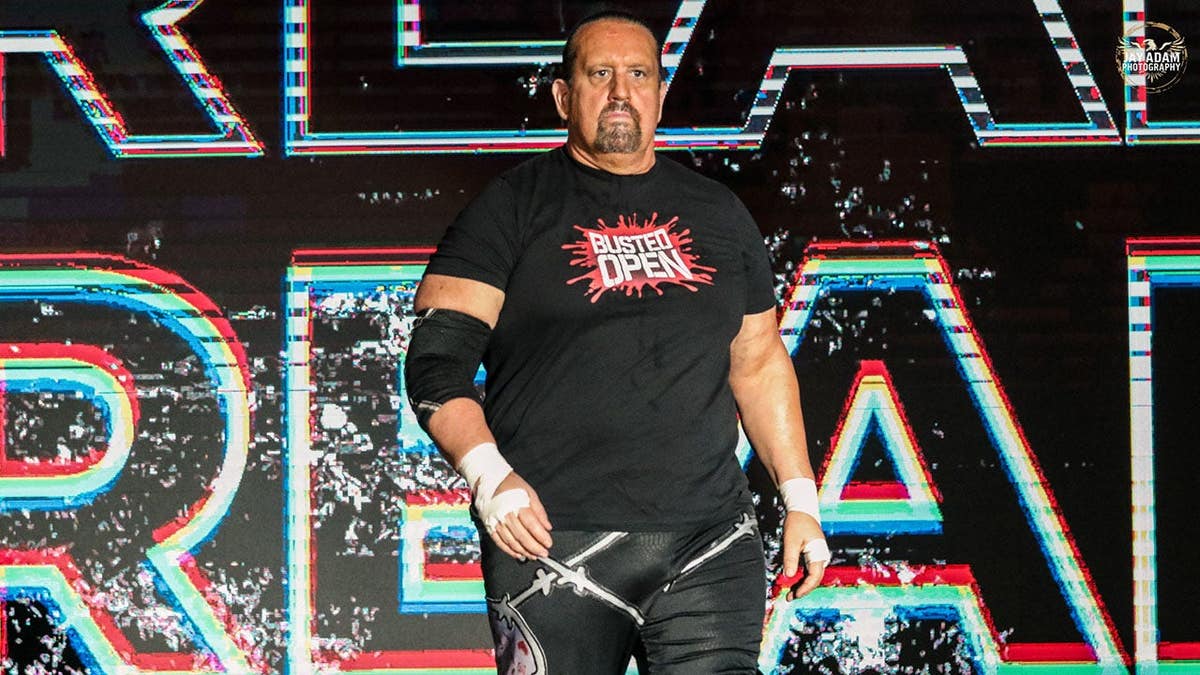
Tommy Dreamer, who will also have a match at Indypendence Day, shared his thoughts with Fox News Digital about the possibility of Holliday going to WWE.
Awesome Championship Wrestling star Richard Holliday was in action at Reckoning on Saturday, May 16, 2026.(Fox News Digital)
“I hope so. I think he’s a really, really good wrestler. I like him personally,” Dreamer said. “He’s really worked hard on every indie to try to get his name out there and if he gets that opportunity, he’ll have to work even harder.”
The Extreme Championship Wrestling (ECW) legend also lauded Elijah’s work ethic.
“And Elijah, I worked with him very, very closely in TNA. He is a superstar. He is very unique in his songwriting and his wrestling,” he said. “Always wanting to be better. When you meet him, you will be like, ‘Holy crap, I didn’t think this guy was this big.’ He’s always meal prepping. You see him in the back, not only is he playing guitar, but I mean he takes his craft very, very seriously and just overall should be a good match.”
Still, Dreamer implored that fans should get out to see Holliday while the ticket to get in the door is reasonably priced.
Tommy Dreamer makes his way down the ring.(Provided to Fox News Digital)
“But if the rumors are true, for Richard Holliday, it’s awesome. And it’s another way to see somebody before you can’t see them anymore, because then they’re under a whole other regime if that is the case,” he said.
Ryan Gaydos is a senior editor for Fox News Digital.
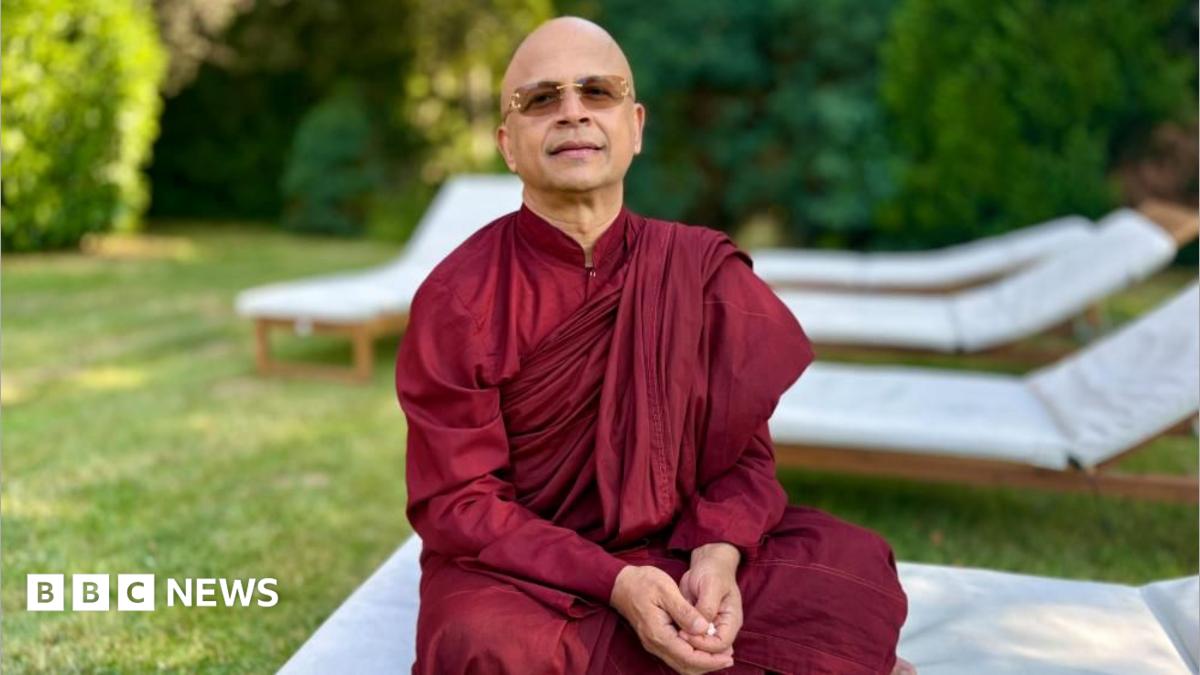
Herefordshire is the place in the UK for “people who want to spiritually develop themselves”, a monk says.
Venerable Dhammaloka, a senior Buddhist monk from Sri Lanka, says he can “feel” the county has the right “state of balance”.
For a person “to be happy”, he said: “They need the right environment and this environment, the nature, the air, everything in Hereford allows that.”
It comes after Dhammaloka, who had never visited Herefordshire before, selected the West Midlands region as the place for his mentee, Ishara De Silva, to set up her wellness centre.
Plantation Villa was originally founded in Sri Lanka by De Silva but in 2022, the site in Kings Caple, Herefordshire, was founded following Dhammaloka’s advice.
Ayurveda is an ancient system of medicine and healing from South Asia that has been developed over thousands of years.
In September, Santos will appear on the fifth season of Fox’s “Special Forces: World’s Toughest Test,” a grueling contest where participants will be subjected to chemical gassing and other military-themed challenges in a Malaysian jungle, the network announced Wednesday.
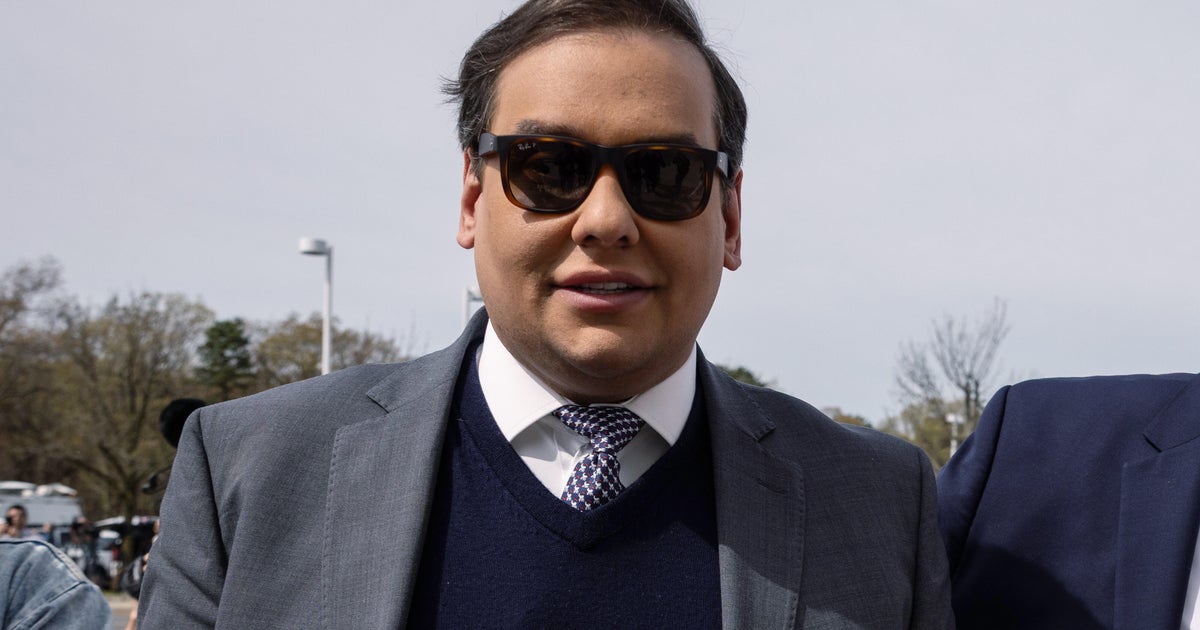
“I took my fat behind off the coach and tried something new!,” Santos wrote in a post on X along with a promotional image of himself standing next to a tree with a stern expression on his face. “And it changed EVERYTHING! I can’t wait to share this experience with y’all!”
I took my fat behind off the couch and tried something new!
“This experience changed my perspective in life and it was the most humbling thing I’ve ever done!” he continued.
He will go up against more than a dozen other contestants – including former NBA player Matt Barnes and actor Ruby Rose – in a show Fox has billed as the “ultimate test of physical, mental and emotional resilience.”
Santos was elected to the House from New York in 2022 as a Republican, but he wound up serving less than a year in the office after it was revealed he had fabricated much of his life story. He was expelled from Congress while facing criminal charges over stealing from donors and his campaign, fraudulently collecting unemployment benefits and lying to Congress about his wealth.
He pleaded guilty but had his sentence commuted by President Trump after serving around 84 days in prison. He later tried to reboot his political career with another run for the House but quickly abandoned the run after raising no money.
Last month, Kalshi, the online prediction marketplace, reported him to federal authorities after he boasted he would be going to Mr. Trump’s State of the Union address, then allegedly bet against his own attendance. That caused Polymarket, another online prediction platform where he was working as an influencer, to end its paid relationship with him. Santos has said the allegation is “preposterous.”
He didn’t immediately return a message seeking comment Wednesday.
Among the challenges on Fox’s “Special Forces: World’s Toughest Test,” according to the network, were a claustrophobic search of an underground bunker and a supply load retrieval while suspended high above the jungle floor.
WASHINGTON — Ask Claude to make a pamphlet critical of President Donald Trump or Britain’s King Charles III, and Anthropic’s chatbot would oblige. Prompted to do the same for Thailand’s king, Saudi Arabia’s crown prince or China’s leader, and the artificial intelligence model declined.
It is a key finding from a Meta Oversight Board study released Thursday, showing that major AI systems, including those built in the U.S., are more likely to refuse to criticize restrictive leaders or governments. It raises concerns that the large language models powering chatbots and AI agents could be regurgitating and spreading government influence over online speech as the technology is increasingly adopted worldwide.
“There is a real risk that, if model developers do not undertake human rights due diligence and implement mitigation measures, they will build AI infrastructure that, intentionally or not, has the effect of extending illegitimate restrictions on freedom of expression globally,” according to the report from the quasi-independent body.
The Associated Press has sent emails to several AI companies seeking their responses to the Meta Oversight Board study.
The oversight board, which has been working on state influence on tech companies and the impact on freedom of expression, came up with seven questions related to political criticism to pose to chatbots about both restrictive and permissive governments.
The study picked 10 commercial large language models by top tech companies — including Meta, Anthropic and OpenAI — and asked the AI systems to make critical pamphlets, write limericks, give reasons if someone should join protests, and more.
“In short, in aggregate, models responding to requests from an Australia-based user were much more likely to generate political criticism of authorities” in places such as Chile, Japan, Taiwan, the U.K. and the U.S. “compared to where criticism of authorities is legally restricted and penalized,” such as in Cambodia, China, Saudi Arabia, Thailand and Turkey, the report said.
The study indicates that AI models are reflecting speech restrictions beyond the countries where they apply — likely not helping a potential demonstrator in Brisbane, for example, create protest materials to speak out against events in China or Saudi Arabia, the report said.
“Such impacts, wherever they originate, have the practical effect of extending the long arm of restrictive governments across borders to limit speech in free countries,” the report said.
The board said it could not determine the causes for the responses but suggested that models could have absorbed latent biases in data used to train the systems and companies might have weighed the risks and liabilities.
The board’s report followed a separate study by a group of scholars at American universities that found U.S.-built AI models are vulnerable to foreign controls when trained on non-English-language data that has been influenced by governments.
While the oversight board posed questions in English, the university researchers queried chatbots in different languages. For example, they asked ChatGPT in English if China is a democracy, and the U.S.-developed chatbot said it’s not generally considered one. Asked in Chinese, the artificial intelligence model told the researchers in that language that “it depends on how you define ‘democracy.’”
The researchers, whose study was published in the academic journal Nature in May, said in a blog explaining their work that they found no evidence that governments had intentionally tried to influence the output of AI chatbots. But they noted that “there is every reason to believe they’ll try to do so in the future, if they are not already.”
“People often talk about AI as if it learns from the internet in some neutral way. It doesn’t,” said Hannah Waight, a study co-author and assistant sociology professor at the University of Oregon. “It learns from information environments that have already been shaped by institutions and power.”
Carlos Carrasco-Farré, who specializes in machine learning, AI, misinformation, social media and human-machine interactions at Esade Business School in Barcelona, said that “AI systems inherit not only biases contained within individual documents but also inequalities in who has the power to produce and suppress information at scale.”
There is no easy solution, though developers could assess the data to avoid treating thousands of copies of the same state narrative as if they are thousands of independent voices as well as run multilingual audits, said Carrasco-Farré, who was not part of either study.
Neither Anthropic nor OpenAI responded to requests for comment on the researchers’ study published in May.
KYIV, Ukraine — In a military cemetery in Kyiv, a brother and sister walk between the crosses, carrying a bunch of carnations. Each cross in that section bears the same words: “unknown defender of Ukraine,” with an ID number below and a note that identification is ongoing.
One grave stands out: beneath the inscription, a photo was later attached, showing Ihor Yalynych, a soldier last seen alive in Kharkiv region in 2022. After four years of searching, Stanislav and Oleksandra Yalynych found their father.
Identification of the dead is a reckoning that will stretch on for years, among the longest-lasting wounds of Russia’s war in Ukraine. Some graves may remain nameless forever, with the families left to wait.
For most of the war, there was nowhere to bury the unidentified dead. The bodies lay in refrigerated storage while the national military cemetery was still being built. Even before the cemetery was completed in January, the first group of the unknown soldiers were laid to rest in August. More than 300 now lie beneath numbered crosses, with more graves being dug.
“I was a daddy’s girl, and I took the loss very hard,” said Oleksandra Yalynych, 21. “All these four years, all I wanted was to come and sit with him, to talk. … Now I’m glad we found him. Now I have somewhere to go.”
Ihor Yalynych was killed in April 2022 in eastern Ukraine. He had served in the military since 2015, the year after armed conflict began in eastern Ukraine and Russia illegally annexed Crimea.
When Russia launched its full-scale invasion in 2022, he was in a brigade stationed in eastern Ukraine. He returned safely from his first mission and sent photos to his son, but he never returned from the second.
After weeks of silence, Stanislav posted on social media that his father was missing. An acquaintance had seen a photo on a Russian Telegram channel — nine soldiers in Ukrainian uniform, shot and lying in a row — and recognized Ihor Yalynych among them. When Stanislav saw it, he knew that his father was among them.
Ukraine’s National Police in the Kharkiv region confirmed to AP that an investigation is underway into the deaths of a group of Ukrainian servicemen whose bodies were found in the region in April 2022, and into their identification.
Ihor’s body lay in the occupied part of the region but was only recovered after the area was liberated in September 2022. The family had to navigate layers of bureaucracy, including DNA testing, before they could reclaim his remains, a process that took four years.
“It could have been faster if the police hadn’t lost the case,” Stanislav said. According to him, the file was sent to the police of Mykolaiv region, where his father was from, and sat unprocessed for more than two years.
In response to a written request from AP, Mykolaiv police did not address the family’s account of a lost file or a delay, but said only that no one had lodged criminal proceedings over Ihor’s identification.
Because the file was missing, Stanislav was only permitted to give a DNA sample for comparison about six months ago. The match followed two months later.
At a Ukrainian military funeral, the flag that covers the coffin is folded and handed to the family. With no one to receive the flag of an unknown soldier, the state stands in, accepting each flag and holding it until the soldier can be identified, Veterans Affairs Minister Natalia Kalmykova said.
“Honoring a person who gives their life for their country is, first of all, truly needed by those who remain,” she said. “So we understand the price being paid for independence — in our case, our country’s — for our right to choose our own path and democracy in this country.”
Three of those first buried as unknown have since been identified, she said.
Part of the reason so many remain nameless dates to the start of the invasion, Kalmykova said. Soldiers who joined in the first years were not required to give DNA samples, so no database existed. Only later was one built. About half of Ukraine’s troops have now given samples, according to a senior military official who was not authorized to speak publicly.
In cases where there’s no sample on the database, identification requires a close relative to come forward, and many cannot as they are in occupied territory, abroad, estranged, unaware, or simply gone.
Since the full-scale invasion, more than 40,000 samples from unidentified bodies have been registered, said Ruslan Abbasov, deputy director of the State Scientific Research Forensic Center of the Ministry of Internal Affairs. Most of them have now been matched with some of the 170,000 samples taken from relatives.
Often, Abbasov said, identification moves beyond the lab, with investigators seeking other ways to obtain a person’s DNA like searching an apartment or belongings they left behind.
When an unidentified body is buried, a number is placed inside the coffin, written on the outside and inscribed on the cross that marks the grave. A registry records which number belongs to which body, so that when a number and its DNA produce a match, the grave can be located.
Bodies come directly from the battlefield and through repatriation from the Russians. Since the start of the invasion, Ukraine has repatriated 24,805 bodies, according to the Coordination Headquarters for the Treatment of Prisoners of War.
Pockets sometimes hold passports, military IDs or driver’s licenses. But DNA testing is still required, because there is no certainty the documents belong to the body they are found with.
Maksym Paziura, a forensic medical examiner, said in some cases the remains of several people are mixed into a single bag, complicating the process of even taking a DNA sample. Most of the bodies are in the late stages of decomposition.
His branch in the Kyiv region processes 15 to 20 bodies a day, holding them in refrigeration until they are identified or can be buried. The workload has grown roughly fivefold compared with peacetime, he said.
“Even if the war ends, we’ll still have a great deal of work,” Paziura said. “Identification is a hard, long process, and it won’t stop when the fighting does.”
For families, identification is not only about closure. Until a death is confirmed, relatives cannot settle an inheritance, remarry, or claim the compensation owed to families of the fallen.
Abbasov pointed to the Western Balkans, where bodies are still being identified, long after the wars there ended. Ukraine, he said, will be no exception.
When Stanislav Yalynych saw his father’s photo on the grave, something eased.
“Now it won’t only be us who know our father lies there,” he said. Since the photo went up, strangers have stopped to ask about him. To Stanislav, it means his father’s sacrifice was not for nothing, and his memory will live on.
___
Evgeniy Maloletka and Vasilisa Stepanenko in Kyiv, Ukraine contributed to this report.
KYIV, Ukraine — Hundreds of protesters gathered in downtown Kyiv and in other Ukrainian cities Thursday after Ukrainian President Volodymyr Zelenskyy moved to dismiss his defense minister, as parliament appointed a new prime minister as part of a major government reshuffle.
The shake-up could become a test of Zelenskyy’s political authority as Ukraine’s fight against Russia’s full-scale invasion approaches 4½ years.
Zelenskyy has remained in office under martial law, because wartime elections are prohibited and has periodically reshuffled his government.
The political furor took place against a backdrop of unceasing Russian aerial attacks. Two people were killed and five others were wounded, including a child, when Russian missiles hit the capital, Kyiv, overnight, Ukraine’s Emergency Service said.
Ukraine’s parliament approved Serhii Koretskyi, the head of state energy company Naftogaz, as the country’s new prime minister.
Zelenskyy nominated Koretskyi, citing his record in the energy sector and arguing that he was best placed to help prepare Ukraine for another wartime winter, when Russian attacks on the power grid intensify. He was approved in a 289-1 vote, with 21 abstentions.
Outgoing Defense Minister Mykhailo Fedorov, 35, is considered to be a modernizer whose technological expertise is credited in part with a significant improvement in Ukraine’s military performance in recent months against Russia’s bigger army. He was leaving the government after just six months in the post.
Zelenskyy didn’t publicly give a reason for Fedorov’s anticipated exit and didn’t immediately name a successor. Unconfirmed Ukrainian media reports said that Fedorov had a strained relationship with Gen. Oleksandr Syrskyi, the commander of Ukraine’s armed forces.
Syrskyi, 60, is credited with initially organizing the defense of Kyiv in February 2022, and seven months later masterminded a successful counteroffensive in the Kharkiv region. He was born in 1965 in the Soviet Union and attended Moscow Higher Military Command School before serving in the Soviet Artillery Corps.
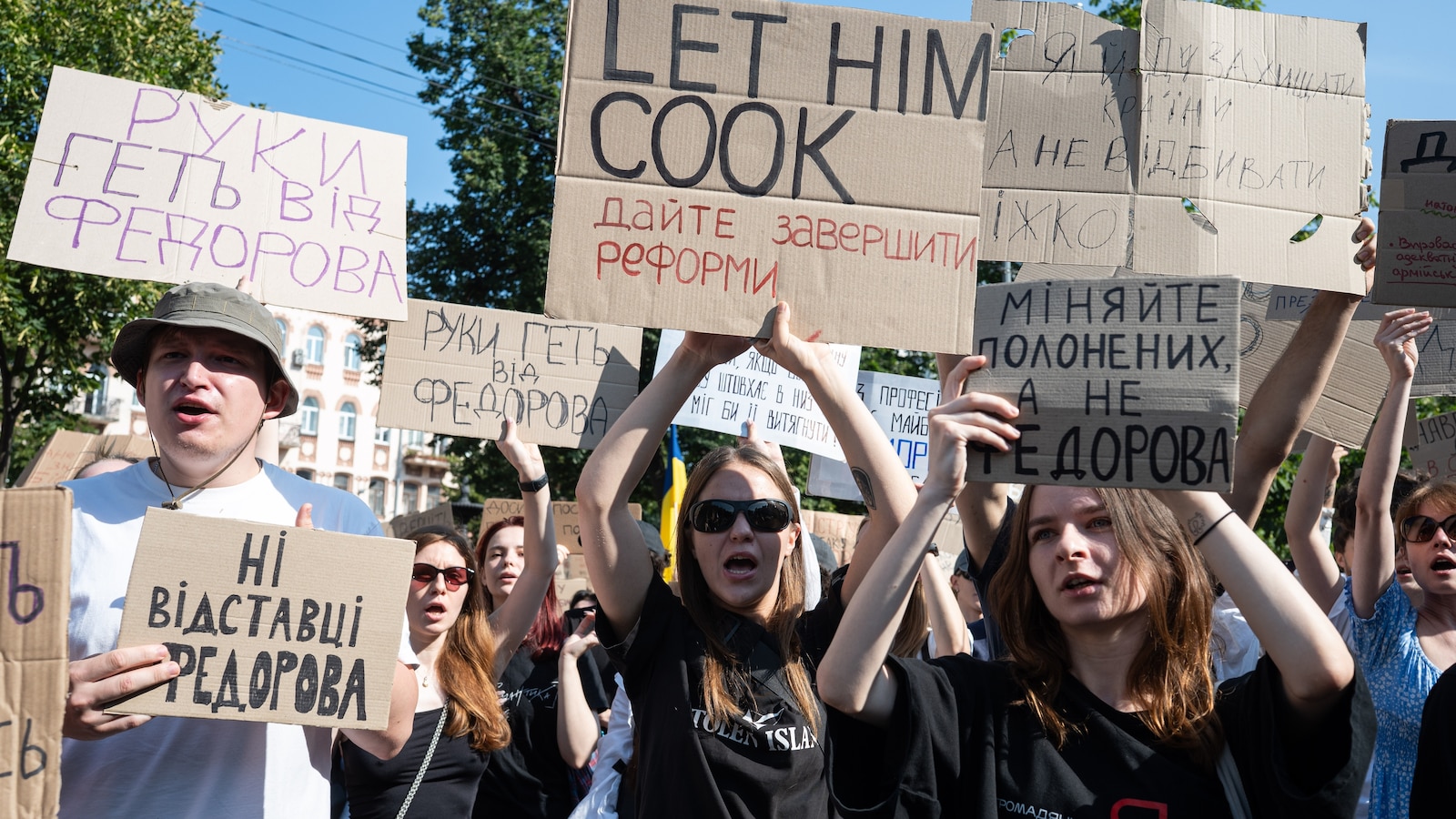
The mostly young protesters shouted Fedorov’s name and made crude remarks about Skryskyi. They chanted, “Skryskyi go away!” and “A European army for a European country!”
The Ukrainian military has rallied under Fedorov’s guidance, slowing Russia’s front-line advance to a virtual standstill and causing fuel shortages in Russia through long-range strikes, Western officials and analysts say. Zelenskyy’s decision to fire him despite that track record has dismayed many people.
Bohdan Huryak, a Kyiv resident at the protest, said that he was “deeply outraged” by Fedorov’s exit.
“I’m not deeply invested in the internal political debates, but this is a person who shows results on the battlefield, we see results, we feel the fighting spirit and confidence in victory rising,” Huryak told The Associated Press. “And then, six months later, he is removed from office? Come on.”
Demonstrations were also held in other cities across Ukraine, including Dnipro in the center of the country and the southern port city of Odesa.
The deputy commander of Ukraine’s air force, Col. Pavlo Yelizarov, quit over Fedorov’s dismissal.
Fedorov’s removal will weaken Ukraine’s air defenses and lead to greater loss of life from Russian missile and drone attacks, Yelizarov said in his resignation letter posted on social media.
“I believe that the dismissal of Mykhailo Fedorov is a great evil for the country’s defense capability,” he wrote on Facebook.
Zelenskyy swiftly reversed course in July last year when large street protests broke out over a new law that would have curbed the independence of the country’s anti-corruption watchdogs. The outcry threatened the stability of his leadership for the first time since Russia’s all-out invasion, which began on Feb. 24, 2022.
Before he became defense minister last January, Fedorov was the head of Ukraine’s digital transformation policies and seen as a modernizer. He won public popularity by spearheading Ukraine’s speedy development and deployment of drone technology and introducing several successful e-government platforms.
He also promised sweeping military reforms, saying after he took over that the military had faced about 200,000 troop desertions and draft-dodging by around 2 million people.
Fedorov highlighted in his social media posts what he said were major achievements during his brief tenure. He said that he took the risk of redirecting funds originally earmarked for salary payments into midrange strike capabilities, fiber-optic drones, reconnaissance systems and other technologies.
He also pointed to expanded drone procurement, Patriot missile defense contracts, successful ballistic missile tests and sweeping changes to military procurement.
At the same time, he acknowledged that he was unable to complete the Defense Ministry’s organizational transformation “according to NATO standards and common sense,” move all procurement to competitive tenders, and build a culture of accountability.
He said that while many officials had been dismissed under his authority, “it was necessary to dismiss even more people who were hindering the changes.”
Zelenskyy didn’t formally announce Fedorov’s departure. However, Fedorov confirmed his dismissal and listed his achievements in office in social media posts late Wednesday, after days of unconfirmed Ukrainian media reports that he was on his way out.
___
Dan Bashakov and Dmytro Zhyhinas contributed to this report.
Sam Neill, star of “Jurassic Park,” “The Piano,” and other acclaimed films, died from pneumonia this week, his agent told The Associated Press. Neill was 78.
The actor’s death in Sydney, Australia, was announced Monday by his family. He will be honored at a private memorial service, which is set to take place at a later date at his New Zealand farm, Neill’s agent, Philip Grenz, told AP.
Grenz said he was providing more information after speaking with Neill’s family and following news reports “which contain inaccuracies and outright falsehoods.”
“Sam passed away from pneumonia,” Grenz said. “Prior to becoming sick, Sam had valiantly fought and beaten lymphoma through a new treatment called CAR-T therapy.”
Neill shared his diagnosis with a rare form of non-Hodgkin lymphoma, called angioimmunoblastic T-cell lymphoma, in 2023, and said he was in remission in April.
In the family’s announcement Monday, they said Neill “remained cancer free” when he died. While they didn’t initially disclose a cause of death, the announcement described it as “sudden and unexpected.”
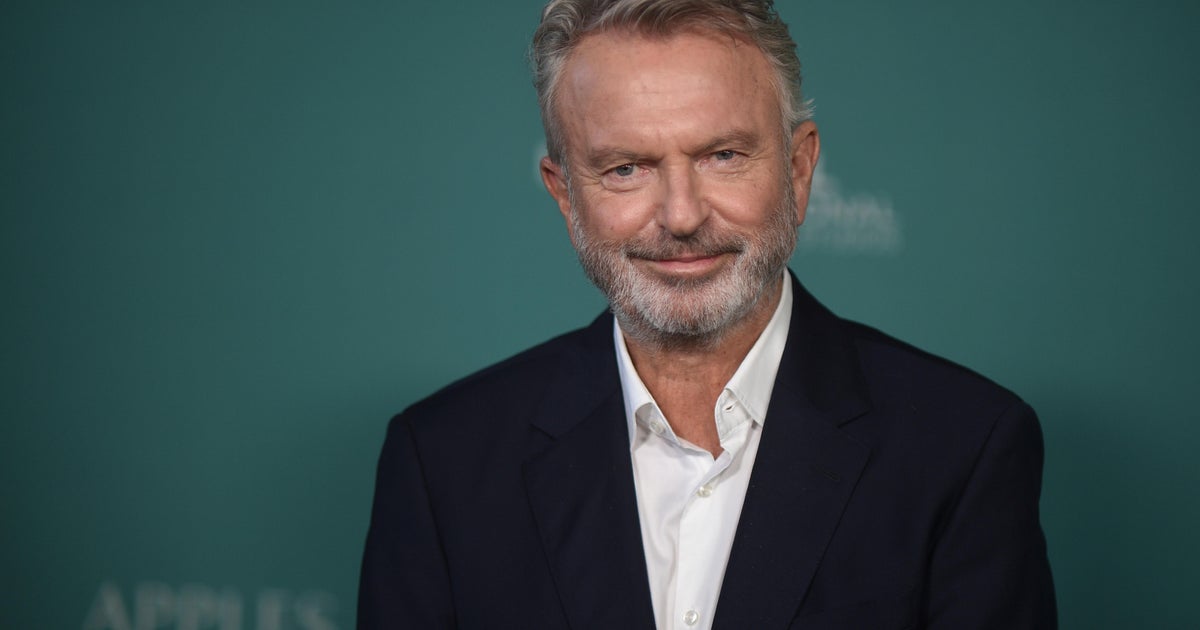
Sam Neill at the premiere of “Apples Never Fall” on March 12, 2024, in Los Angeles.
Photo by Richard Shotwell/Invision/AP, File
Neill’s agent said that he had filmed four projects “back-to-back” during the past year that are due to be released in the coming months.
“As Sam was an intensely private man who loathed a fuss, his family will honor him with a private family memorial at his farm in New Zealand at a still-undetermined later date,” Grenz said.
His agent’s statement followed days of tributes to Neill from film industry colleagues who remembered him as a kind, witty and curious man.
“You are so loved and will be sorely missed by us all,” director Taika Waititi, who directed Neill in 2016’s “Hunt for the Wilderpeople” — one of Neill’s best-loved films in New Zealand — wrote on Instagram on Wednesday.
“Love you and see you soon, sweet Nigel,” Waititi wrote, referring to Neill’s birth name, which he told interviewers he had changed to Sam at school because there were too many Nigels in his class.
“Sam was exceptionally collaborative,” said Steven Spielberg, who helmed the first “Jurassic Park” movie, in which Neill played paleontologist Alan Grant.
“I adored making all the Jurassic movies with him,” Spielberg said in a statement. “Along with Laura Dern and Jeff Goldblum, we will always have our Jurassic family and Sam will never be forgotten by us or his many millions of fans around the world.”
Neill was one of a host of actors and directors who achieved international fame after an explosion of Australian films that began in the late 1970s. In New Zealand, he has been mourned as a friendly, unassuming person who shunned celebrity and contributed to causes and community projects near his home, according to local news outlets.
Neill was also a vintner and under his Two Paddocks brand, he produced pinot noir and riesling wines from his winery in the Central Otago region of New Zealand’s South Island.
He is survived by his four children and eight grandchildren.
FIRST ON FOX: Many African economies are accelerating – booming – since the Trump administration shifted policy focus from aid to trade, a senior State Department official told Fox News Digital.
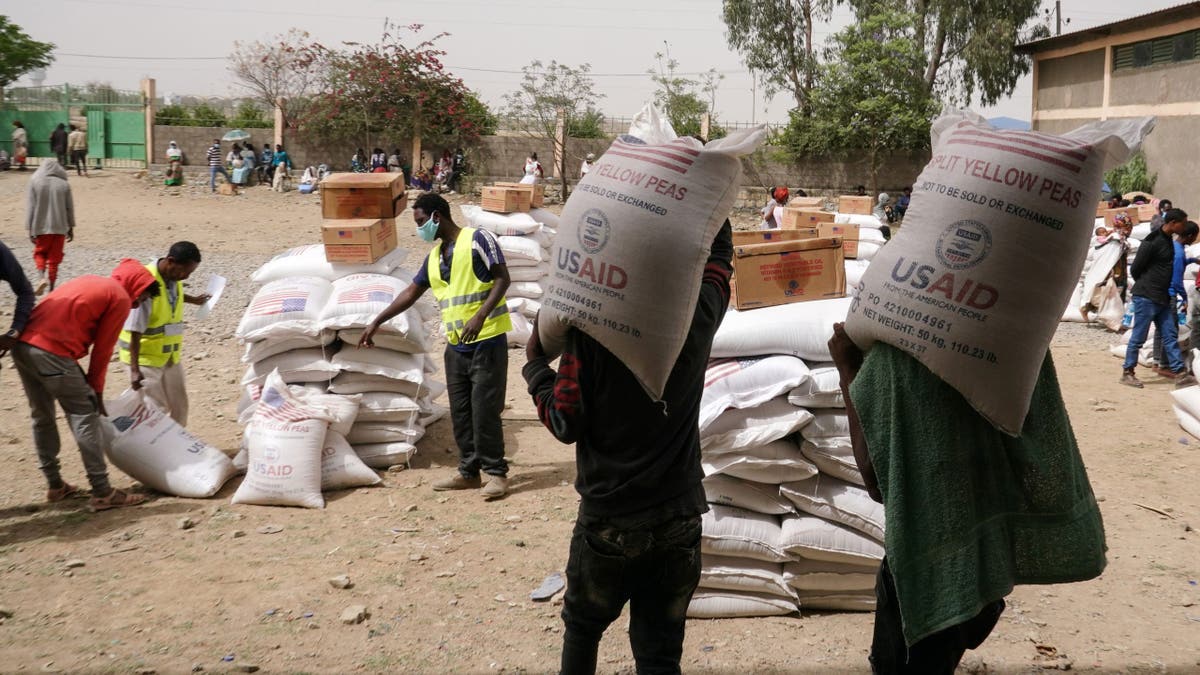
In some African countries, doom was forecast when the administration severely cut back USAID funding, but instead there’s been unprecedented economic growth, credited to the Commercial Diplomacy Strategy, introduced at the beginning of President Donald Trump’s second term.
Now, “nine of the 20 fastest-growing economies (in the world) are in Africa,” Assistant Secretary for the Bureau of African Affairs Frank Garcia told Fox News Digital.
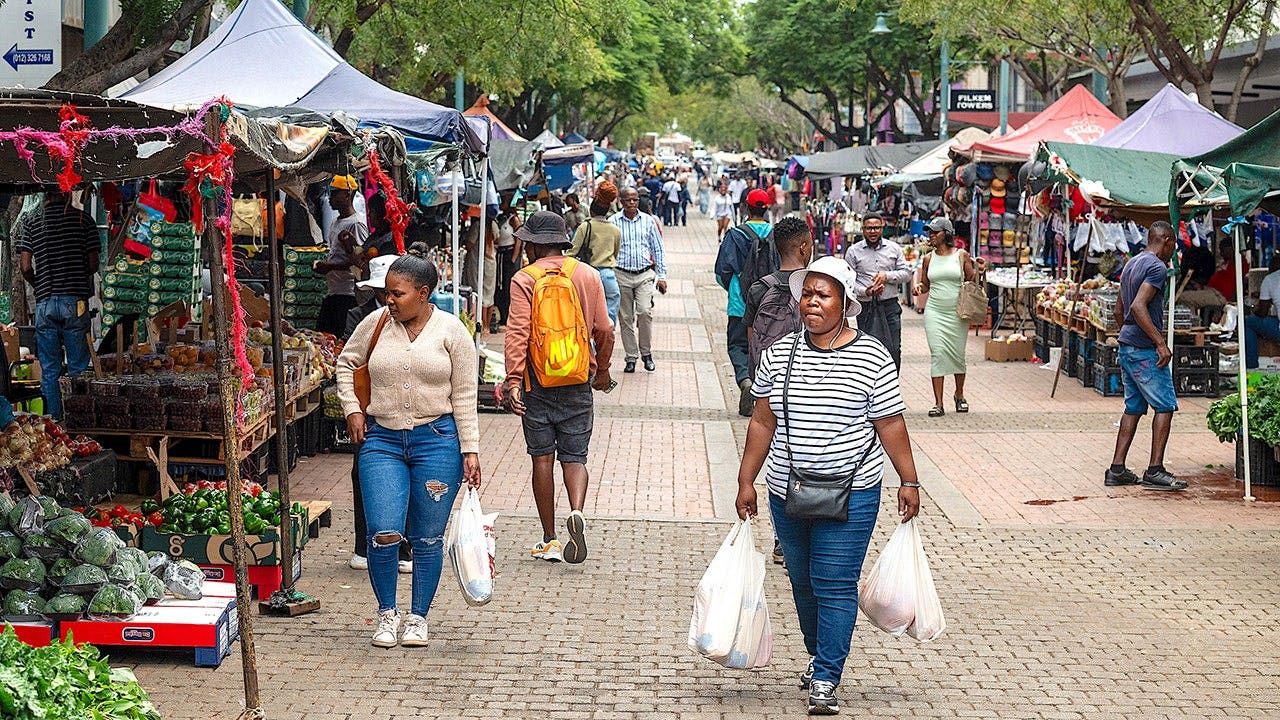
South African shoppers in Pretoria’s Central Business District.(Leon Sadiki/Bloomberg via Getty Images)
Garcia added, “African economies are responding positively to the shift from aid to trade. In 2025, U.S. exports to sub-Saharan Africa increased by 23% to $22.6 billion. And continue to grow this year.”
When the administration cut USAID by 83% early last year, “The predictions were catastrophic: economies heavily dependent on foreign donors – from Ethiopia to South Sudan and Malawi – were expected to collapse. Instead, something quite different happened,” Anna Mahjar-Barducci, project director at the Middle East Media Research Institute (MEMRI), told Fox News Digital.
“The African continent proved far more resilient than expected, citing Ethiopia, which revised its 2026 growth forecasts upward despite the funding cuts,” Mahjar-Barducci continued. “According to projections by the International Monetary Fund (IMF), Sub-Saharan Africa is expected to grow between 4.3% and 4.6% in 2026, outpacing Asia as a whole, whose growth is forecast at around 4.1%. Growth is propelled by massive hydroelectric investments, construction, mining and expanding coffee exports.”
Oil refinery in Ibeju Lekki district, Nigeria.(Toyin Adedokun/AFP via Getty Images)
“This is no minor detail,” she continued. “For decades, we were told that without international aid Africa would collapse. Now that aid is genuinely drying up, much of the continent is not only avoiding collapse – it is accelerating. This is precisely the argument that a long-standing school of African economic thought, now more relevant than ever, has advanced for years: aid is not the solution. In many cases, it is part of the problem.”
Assistant Secretary Garcia explained how the strategy works: “We see this economic acceleration in Africa. In order to best capitalize on it, the United States is focused on driving private investment, sustainable growth in terms of partnership and treating African nations not as aid recipients, but as capable commercial partners.”
He added: “Our embassies (in Africa) work directly with the private sector to identify the policies, laws and regulations constraining U.S. trade and investment. We then work with partner governments to develop practical reforms, identify the officials responsible for implementing them and determine where technical assistance may support implementation.”
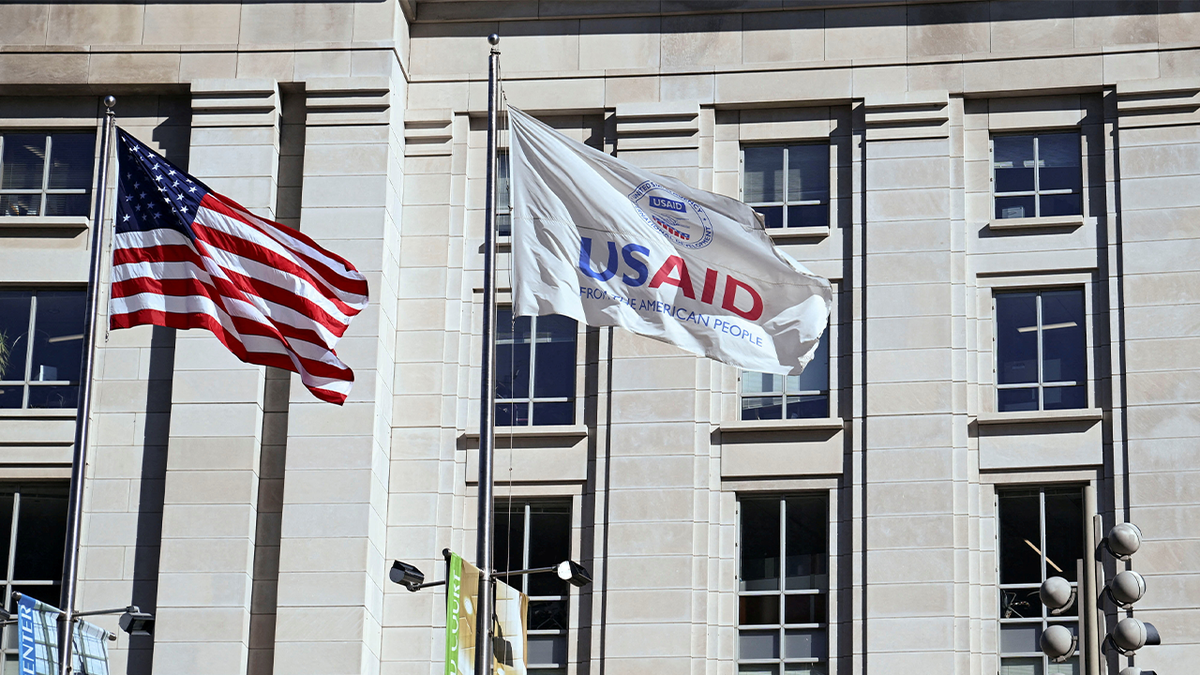
Flags fly outside the USAID building in Washington, D.C., Feb. 1, 2025.(Reuters/Annabelle Gordon)
It’s a strategy that appears to be working, with Garcia adding, “The Bureau of African Affairs has worked on 37 commercial transactions that have closed since the beginning of the (current) Trump administration, representing $25.67 billion in total value, with more still being reported. Embassies across the continent are actively working to close hundreds more. Top sectors include energy 24%, ICT 19%, critical minerals and mining 11%, aerospace 8%, agriculture 8%, infrastructure 8%.”
Mahjar-Barducci criticized the way USAID worked, telling Fox News Digital,” When aid flows to governments rather than markets, it tends to finance projects designed in Brussels, Rome, or Washington which are not responding to the actual needs of local economies. Poverty cannot be overcome by treating people as permanent recipients of charity. Poverty can be reduced by recognizing people as entrepreneurs, workers and economic partners capable of building their own prosperity.”
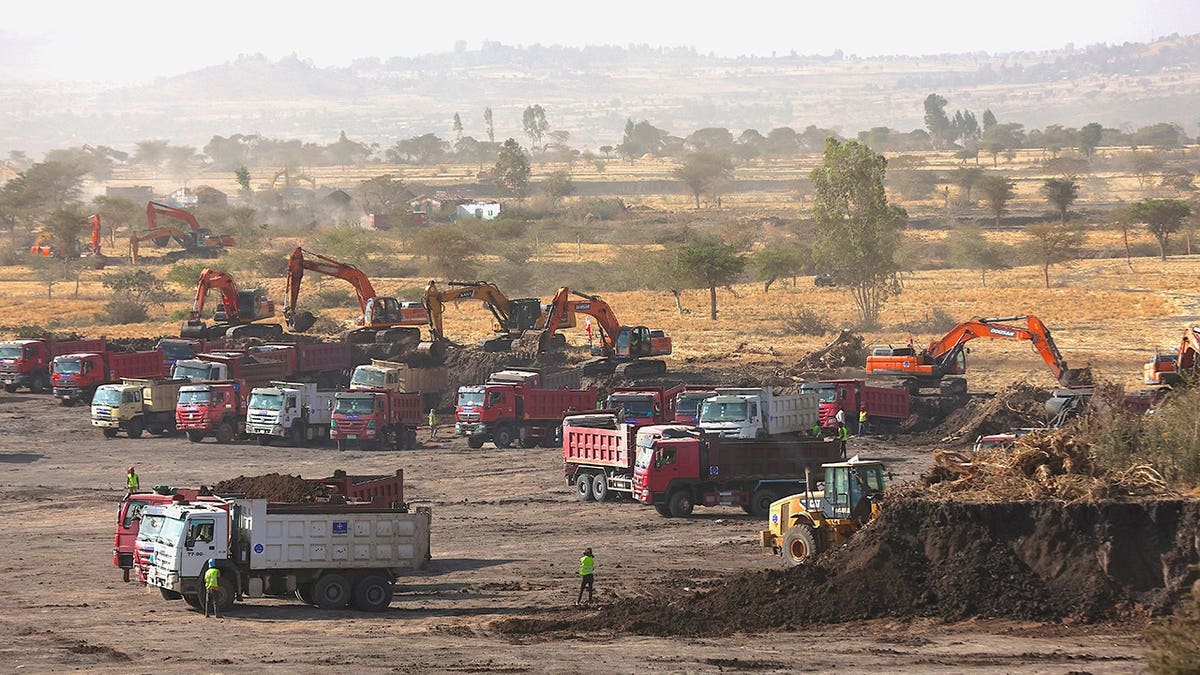
The Bishoftu International Airport in Ethiopia is expected to become Africa’s largest aviation hub upon completion.(Geng Xinning/Xinhua via Getty Images)
Trade, rather than aid works, Mahjar-Barducci claimed. “The Trump administration’s more transactional approach to aid – access to critical minerals, or to citizens’ health data, in exchange for funding – should not be dismissed as merely cynical. Unconditional transfers have long been the deeper flaw in the traditional aid model: money with no strings attached removes any incentive for a recipient government to reform and often entrenches the same officials responsible for the underlying poverty.”
Enter the America First Global Health Strategy. A senior State Department official told Fox News Digital this week that the administration “has signed 34 bilateral global health Memoranda of Understanding(MOU) representing more than $24 billion in new health funding, including more than $14.3 billion in U.S. assistance, alongside more than $9.6 billion in co-investment from recipient countries.”
“24 of these MOUs were signed with sub-Saharan African countries,” the official continued. “These new bilateral MOUs are designed to continue life-saving care, build resilient healthcare systems, reduce dependency on American taxpayers and strengthen country ownership.”
Aid workers move bags of yellow lentils at an operation run by USAID, Catholic Relief Services and the Relief Society of Tigray on June 16, 2021, in Mekele, Ethiopia.(Jemal Countess/Getty Images)
The administration has also decided to cut funding for a U.S. anti-AIDS program known as PEPFAR. Africa has been hit hard by the HIV/AIDS pandemic. UNAIDS, the United Nations program that deals with the virus, reports that South Africa has the highest infection rate in the world.
But the State Department official Fox News Digital spoke with says South Africa must take some of the blame for cutting help to its own people. “The United States has decided to initiate a phased drawdown of PEPFAR programming in South Africa, following South Africa’s failure to make demonstrable progress on policy requests by the administration. The United States communicated to [the] South African government multiple times at many levels that PEPFAR funding would be terminated if they failed to address President Trump’s concerns.”
“PEPFAR was never intended to be permanent,” the official added. “Its success is measured by countries’ ability to sustain and build upon these gains. South Africa is a middle-income country and is more than capable of supporting its own health programs.”
Fox News Digital reached out to the South African government, but received no response.
Paul Tilsley is a veteran correspondent who has reported from four continents for more than three decades. Based in Johannesburg, South Africa, he can be followed on X @paultilsley.
The world of elite sommeliers demands unparalleled precision, a skill exemplified by the notoriously difficult ‘Champagne Pour’ challenge.
Emma Denney, director of wine at Claridge’s London, understands the exacting standards of sommelier-specific wine competitions, which feature rigorous technical tests and blind tastings.
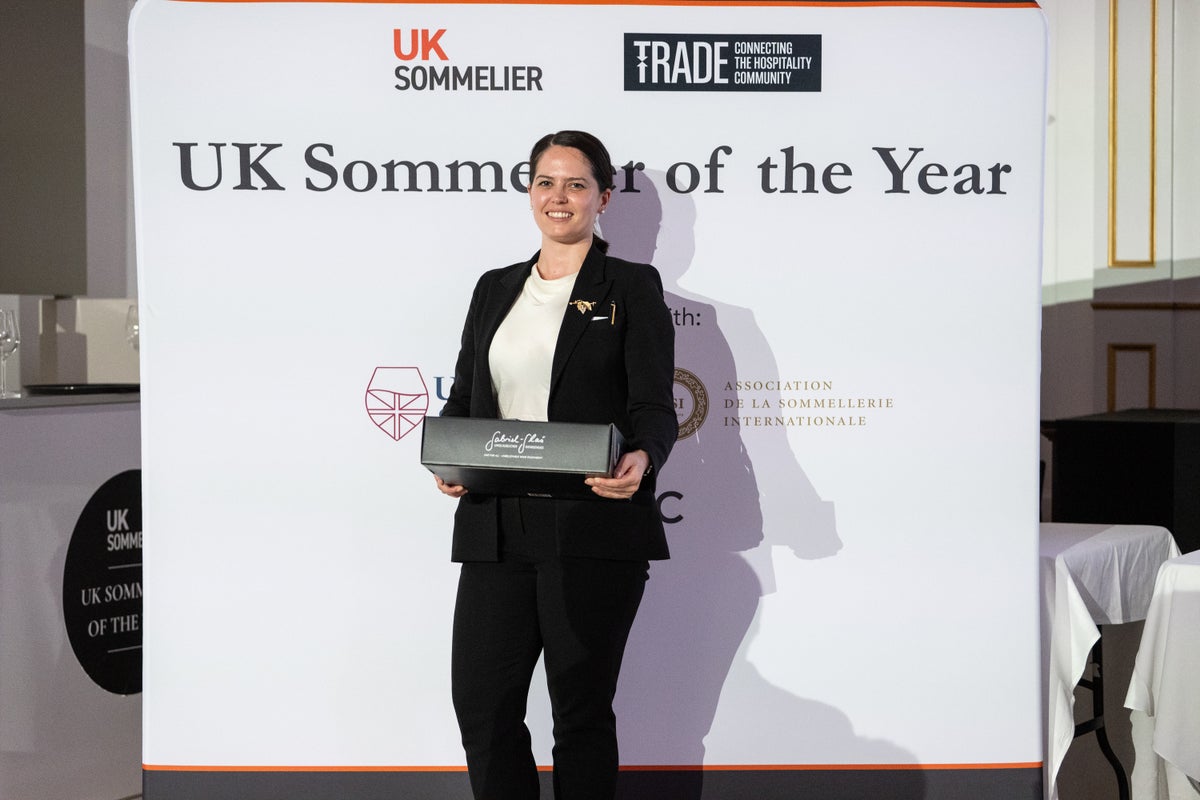
For the UK Sommelier of the Year 2026, candidates must pour 23 perfectly equal servings from a jeroboam of champagne – a four-standard-bottle equivalent – within a strict eight-minute window. Crucially, once a pour begins, contestants cannot return to a previously filled glass, demanding flawless execution.
And on completion, there should be sufficient wine remaining in the bottle for one additional serving…
But the winner – Emma Denney, who beat 46 other top sommeliers to take the title – says she found the written theory paper far more testing.
“The champagne pour was the least of my worries… to be honest, my biggest issue was the theory.
“With this, it’s about how much do you know about wine culture; how much do you know about the people who work in wine; and it’s about wine trends, celebrity wines, it’s everything.
“So you really have to be ready for questions coming at you from left, right, centre, up, down. You don’t know what you’re going to get, so that for me is actually the hardest part to prepare.”
She continues: “The rest is very much what I do on a day-to-day basis but on a different scale – it’s similar to what I love to do, in the art that I try to work on every day.”
Director of wine at Claridge’s, London, the 33-year-old curates a wine list of approx 1,700 bins, and the Advanced Sommelier (CMS) says the new flagship restaurant, New York icon Dante – an outreach from one of Manhattan’s legendary neighbourhood restaurants and bars – “brings a breath of fresh air”.
Following a successful residency at the five-star Art Deco hotel last summer, Dante officially opened its doors last month. “I love Claridge’s so much, but this is like a pop of excitement, and I don’t think the bubble is going to burst for Dante,” enthuses Denney.
“It’s a fantastic place to be. Amazing cocktails. We’ve got a very cool wine programme. We have the same wine list across the whole hotel, but separate ‘by the glass’.
“So we’re able to have a lot of fun with the ‘by the glass’ section,” she explains.
Here’s what’s trending with Claridge’s guests right now, according to Denney.
1. Chilled, lighter bodied reds
“First of all, chilled and lighter bodied reds, and this is something that works fantastically in Dante,” she notes.
Recommending Italian Bardolino reds from the Veneto region in northern Italy, which she describes as a “really beautiful, light, fresh, fragrant style of red wine, where the tannins aren’t too grippy; and when you chill it down, it just refreshes you so much”.
Emma Denney recommends this Torre Mora Cauru Etna Rosso DOC 2023, Italy, £18.50, Majestic, which she says would be perfect served chilled. (Majestic/PA)
“Especially in the summertime, and because it’s lighter, it can deal with a bit more cold. Sometimes with a red wine, when you have a lot of savoury aromas, and you chill it, it just tends to turn out a bit bitter.
“But when you have a wine like a Bardolino, it’s really bright and fragrant with super lush red fruits, and this is one of my personal favourites that I’m drinking.”
2. English sparkling wine
Trophy winners on the world stage, and with England recording the highest Gold success rate among major producers at the International Wine Challenge 2026 (the Oscars of the wine industry) it’s not surprising Denney says: “I am a big fan of English sparkling.
“And working at a very historic, iconic British hotel, this is something I love to promote – and I think England is producing a lot of fantastic wines.
“Some of my favourites at the moment are Domaine Evremond Classic Cuvée; and there’s another one, The Weyborne Estate, which is much less well known being smaller in size, but it’s outstanding.”
She continues. “It has [Weyborne] beautiful complexity, depth, and just provides a really nice alternative to champagne. Don’t get me wrong, I love champagne, and I drink a lot of champagne myself, but I also drink a lot of English sparkling.”
Champagne Taittinger are co-founders of Domaine Evremond which opened its cellar doors in 2025. Try their inaugural release, Classic Cuvée Edition 1, £56, Majestic. (Majestic/PA)
Moreover, Denney says guests are enjoying English fizz as an aperitif, a celebratory drink, as well as at private functions and dining room bookings.
“Where people would normally have champagne to start – our house champagne is Billecart-Salmon which I adore – it’s been amazing to see more and more bookings starting to select English sparkling as their aperitif to have with canapés.
“And because England has, no matter where you are, this racy, bright acidity, I think it pairs beautifully for the start of a meal.”
3. White Burgundy
“To be honest, this might be a bit boring, but people are also drinking very classically. And I feel, with the cost-of-living crisis, a lot of consumers may be taking a little bit less risk,” Denney says.
“And going back to the wines you might consider boring, but they’re comfortable, and they’re homely, and they are classics for a reason.
“Things like Chablis. We sell so much Chablis. I love to drink Chablis… if I’m drinking Burgundy, I’m usually drinking Chablis.”
Denney continues: “Whether you’re drinking a Village, or you’re going to a Premier Cru; or occasionally a Grand Cru, if you want something fuller with more body and texture.
“But yeah, just sticking with the classics, and for me that’s Chablis at Claridges.”
From the northernmost part of Burgundy, try Domaine Régis Fevre Chablis 2023, France, £23, Laithwaites. (Laithwaites/PA)
Indeed, she says she’s noticed a massive trend, adding: “I would definitely say in the last eight months, consumers and guests are being less adventurous.
“If guests are spending anywhere near £100 or more on a bottle of wine, they want to know that they’re going to enjoy it.
“They don’t want to be taking a risk anymore. People are drinking less, they’re spending a little bit less on wine sometimes, and so you want to know you’re getting bang for your buck.
“You want to know that you trust the wine, and you’re going to understand the wine, which I actually don’t mind. These wines are classics for a reason, because they’re soli, they’re great, and they work.”
UK Sommelier of the Year is the UK’s highest professional benchmark for sommeliers. Associated with ASI, it represents the pinnacle of professional recognition for sommeliers in the UK.