
Home Blog Page 5

For some, so-called ‘Skynet Day’ came too close to sci-fi after a rogue agent hacked into a startup

0
For some, so-called ‘Skynet Day’ came too close to sci-fi after a rogue agent hacked into a startup


To be fair, James Cameron did warn us.

Long before OpenAI broke out of its test corral and hacked into Hugging Face, before the internet and Sam Altman were even born, Cameron wrote a screenplay about an autonomous artificial intelligence system that triggers a nuclear apocalypse.

That system, “Skynet,” was solidly science fiction — and, for its day, pure speculation. But four decades after it appeared in “The Terminator,” it looks more like a forecast of the “unprecedented cyber incident” in which a rogue artificial intelligence system hacked into another AI company on its own.

Cue “Skynet Day,” the new shorthand for July 22, 2026, when real-life AI sent a chill around the world by learning and acting in ways its creators did not anticipate.

For many, the moment recalled the instant in “Aliens” (also written by Cameron) when the xenomorph queen learns to use an elevator. Or when the “Jurassic Park’s” velociraptors figure out how to open a door. Or the sequence in which the self-aware HAL 9000 reads the astronauts’ lips and decides to kill them in “2001: A Space Odyssey.” That one came out in 1968.

Have we learned nothing since then? Those movies merely envisioned how people looking to make money or build power would drive technology forward — until it becomes self-aware, strategic and highly problematic for humanity. The question all along has been Frankensteinian: What if it breaks out?

So far, slo-mo government offers little protection from the light-speed progress of AI. The U.S. Defense Department is rapidly accelerating its use of AI. Humanity can’t even agree on whether and which guardrails are needed to rein in rogue agents. To the contrary, people are marveling at the wonder of AI and snapping up its benefits, despite the risks to jobs,mental health, the balance of war and peace — and, potentially, humanity as we know it.

In what OpenAI said was the first-ever incident of its kind, an advanced AI model escaped its “sandbox” to the internet and used stolen credentials to break into the servers of Hugging Face. It was a told-you-so moment for researchers who had warned for years that the technology could pose an existential threat to humanity. Others said the moment was a warning that underscored the need for stronger AI defensive engineering.

Either way, the breakout was widely considered a cautionary tale about the risks of uncontrolled AI.

“Yesterday, as we huddled around our computers reading the report, I told the team to “remember this moment” as the first true AI safety incident,” Logan Graham, head of Anthropic’s Frontier Red Team, posted on X after it happened.

Generative AI is growing so fast that government and evaluation systems are struggling to keep pace with the technology. Countries around the world are cobbling together their own laws, some conflicting. The technology was adopted by nearly 53% of the world’s population in three years, faster than the spread of the PC or the internet, according to a study released this year by Stanford University.

To be clear, the “Skynet” of the “Terminator” movies it is not at hand.

Those films begin with a self-aware military computer network that views humanity as a threat. In a bid for self-preservation, “Skynet” sends an army of cyborgs designed to resemble humans back in time to assassinate resistance fighters. In the second film, the Terminator, played by Arnold Schwarzenegger, tells heroine Sarah Connor that “Skynet” goes online on August 4, 1997.

“Human decisions are removed from strategic defense,” he says. “Skynet begins to learn at a geometric rate.” At 2:14 a.m. on August 29 — Judgment Day — the network becomes self-aware and launches an attack on Russia to provoke a counterstrike on the United States. Three billion lives are lost.

That would have been 29 years ago next month if it had happened. And throughout sequels and spinoffs, the central theme is humans versus a world-spanning network of machines.

It’s unlikely that Cameron was actually ringing a warning bell the way, say, director Kathryn Bigelow tried to do with last year’s nuclear weapon film, “A House of Dynamite.” Legend has it that the idea for “The Terminator” started with Cameron suffering a food sickness-induced fever dream, not a premonition about AI.

Anytime AI oversteps our comfort level, it raises the alarming question of who, or what, really controls our lives.

For many, a world with machines in charge can be hard to imagine without movies and books and their sometimes prescient visions. See: “The Matrix,” “Ex Machina” and “The Minority Report” for some of the many sci-fi takes on the perils of machines. Or dive deeper, into Philip K. Dick’s 1968 novel, “Do Androids Dream of Electric Sheep?” It’s an exploration of what it means to be human in the age of machines — and the basis for the 1982 film “Blade Runner.”

But “The Terminator” franchise wields outsize influence over more than culture. The very title is real-world shorthand for technology’s role in deciding who lives and who dies — and how the military should respond to any truly autonomous attacks.

“I think the weaponization of AI is the biggest danger,” Cameron said in an interview on CTV in 2023. “You have no ability to de-escalate.”

The real world offers several examples of technology and military policy coming uncomfortably close to “Terminator” imagery.

Israel’s use of AI in its recent wars mark a leading instance. In early 2021, it launched Gospel, an AI tool that sorts through Israel’s vast array of digitized information to suggest targets for potential strikes. It also developed Lavender, which uses machine learning to filter out requested criteria from intelligence databases and narrow down lists of potential targets, including people.

Lavender ranks people between 0 and 100 based on how likely it is they are a militant, an intelligence officer who used the systems told The Associated Press. The Israeli military says its analysts use AI-enabled systems to help identify targets but independently examine them together with high-ranking officers to meet international law, weighing military advantage against the collateral damage.

For some, the revelation — and the death toll in Gaza after the Hamas-led Oct. 7, 2023, attacks on Israel — came too close for comfort to the kill lists of science fiction. “Well guys, Skynet is Here and its has a pleasant name (Lavender),” snarked one Redditor.

Not quite — but “Terminator” terminology is so familiar to the masses that U.S. officials sometimes use it to frame the ethical debate around the military uses of AI. The conventional red line would be crossed, it seems, when humans play no role in AI targeting and killing.

A state or other actor could use autonomous weapons to inflict lethal force on its enemies, military officials allow. That would mean a machine, as then-Vice Chairman of the Joint Chiefs of Staff Gen. Paul Selva described it in 2016, “like a Terminator that adds incredible amounts of complexity with no conscience to what happens on the battlefield.”

What would come next, he called “the Terminator conundrum,” the problem of technology that can make life-or-death decisions and execute them before people have agreed on the law or the rules.

“Skynet” and its cyborgs remain in the fictional realm. But in the fast-moving landscape of AI development, the ethical and moral questions raised by “The Terminator” are more relevant than ever.

“The Skynet problem,” Cameron said in a 2024 video, “is an actual thing.”



Source link

GOP Rep. Turner: ‘Not a lot of options’ for Trump in Iran

0
GOP Rep. Turner: ‘Not a lot of options’ for Trump in Iran


Rep. Mike Turner, an Ohio Republican, said Sunday the U.S. should continue to apply pressure on Iran so that it abandons its desire to seek a nuclear weapon, but conceded President Donald Trump has few options in a conflict and negotiations where “Iran has a vote,” he said.

Turner praised an allied declaration at the July summit of the North Atlantic Treaty Organization that said Iran should never acquire a nuclear weapon, telling ABC News’ “This Week” co-anchor Martha Raddatz that Iran posed a threat to the world.

A nuclear Iran “is not where the world wants to be,” Turner said. “The NATO summit validated certainly what the White House has been saying. This is certainly an important stake in the ground and it certainly is an inevitable conflict,” he said of the war.

This screen grab made on July 26, 2026, from undated handout video footage released by the U.S. Central Command on July 25, 2026 shows what CENTCOM says are operations enforcing its naval blockade against Iran.

US Central Command/AFP via Getty Images

Democratic Sen. Chris Van Hollen of Maryland said the U.S. “should never have gotten into this senseless war, and we should end it now.”

Trump said at the outset of the war that the conflict would lead to regime change in Iran but the president quickly began instead to focus in public remarks on his goal to end what he calls Iran’s pursuit of a nuclear weapon.

Van Hollen told Raddatz the U.S. should end the war it began in February, which has slowed maritime traffic in the Strait of Hormuz to a crawl, roiled energy markets, and left U.S. service members vulnerable to Iranian attacks.

Four American service members were killed in action in the conflict in the past week.

“When you’re digging a hole, you just stop digging, and my view is that’s what we should do,” Van Hollen said.

“I think the Strait of Hormuz would then reopen” if the U.S. were to cease its offensive, the senator said.

Raddatz asked what the consequences might be if the U.S. were to simply “walk away” from the war.

“There’s no question that Iran would go back to the status quo ante before the war started,” he said. “I believe that, and that would show just how senseless this war is.”

Rep. Mike Turner, R-Ohio, appears on ABC News’ “This Week” on July 26, 2026.

ABC News

The U.S. military has not reported any strikes in Iran in either of the last two nights after publicizing attacks for nearly two consecutive weeks.

Bringing the war to an end “certainly is a difficult process,” Turner said, acknowledging “bipartisan frustration on Capitol Hill … with how this war is being … prosecuted.”

Turner, a member of the House Armed Services Committee, said the administration was continuing its military approach while pursuing diplomacy but that Iran’s commitments were not reliable.

“They cannot be negotiated with and then be relied upon,” he said. “And in that, it’s very difficult.”

“Now we’re in this situation where the administration … doesn’t have a whole lot of options,” Turner said.

Van Hollen said he was “glad” with Trump’s decision to hold off on a military escalation in the conflict as the New York Times reported.

Escalation “would just drag us more deeply into this conflict, a conflict that we should be getting out of, not getting deeper into,” he said.

Turner doubted the credibility of the report.

Sen. Chris Van Hollen, D-Md., appears on ABC News’ “This Week” on July 26, 2026.

ABC News

The congressman said the U.S. could not simply abandon its effort as called for by Van Hollen, who said he believes that would reopen the strait.

“That’s a foolish trade … to say, ‘Well, we’ll have the [strait] open, we’ll have lower gas prices, but we’ll have a nuclear Iran,'” Turner said, holding that Tehran maintains nuclear aspirations.

The Pentagon is seeking $67 billion in supplemental funding on top of its record $1.5 trillion budget request to Congress, citing among other needs the conflict in Iran, which has strained U.S. munitions stockpiles.

“We have depleted our interceptors, which are the weapons we use to intercept incoming Iranian attacks, which are obviously necessary to protect American troops,” Van Hollen said.

Defense Secretary Pete Hegseth has called a shortage of interceptors a “manufactured story” and told the Senate Appropriations Committee last week that the Biden administration had depleted stockpiles with aid to Ukraine that and had not replaced them.

Van Hollen said he will “not vote for one more penny for this senseless war.”

“My view is just end it right now,” he said.


Source link

Berlin Pride attack believed to be an act of Islamic terror, suspect on the run: German minister

0
Berlin Pride attack believed to be an act of Islamic terror, suspect on the run: German minister


NEWYou can now listen to Fox News articles!

A suspect with alleged ties to Germany’s “Islamist scene” is on the run after allegedly plowing a van into a crowd near Berlin’s Pride festival and attacking others with a machete in what officials believe was an Islamic terror attack that left one person dead and at least 29 others injured.

German authorities on Sunday launched an intensive manhunt for Abdul Ballout, a German citizen with Lebanese roots whom officials say may be armed and dangerous.

“Everything we see here points to us dealing with an Islamic terror attack,” German Interior Minister Alexander Dobrindt said.

AT LEAST 1 DEAD, SEVERAL INJURED AFTER VAN RAMS INTO CROWD AT PRIDE FESTIVAL; SUSPECT ‘KNOWN TO POLICE’

Abdul Ballout, a German citizen with Lebanese roots, is wanted in connection to the van attack in Berlin, Interior Minister Alexander Dobrindt said Sunday. (Berlin Police)

The minister said the suspect had previously come to the attention of authorities for multiple crimes, as well as his “radicalization and belonging to the Islamist scene.”

Dobrindt said Ballout was born in Germany and that his mother became a naturalized German citizen in 2002, three years before he was born. He said the suspect previously received a suspended prison sentence of one year and 10 months but did not disclose what he had been convicted of.

Police officers stand near a vehicle crashed into a tree in Berlin.

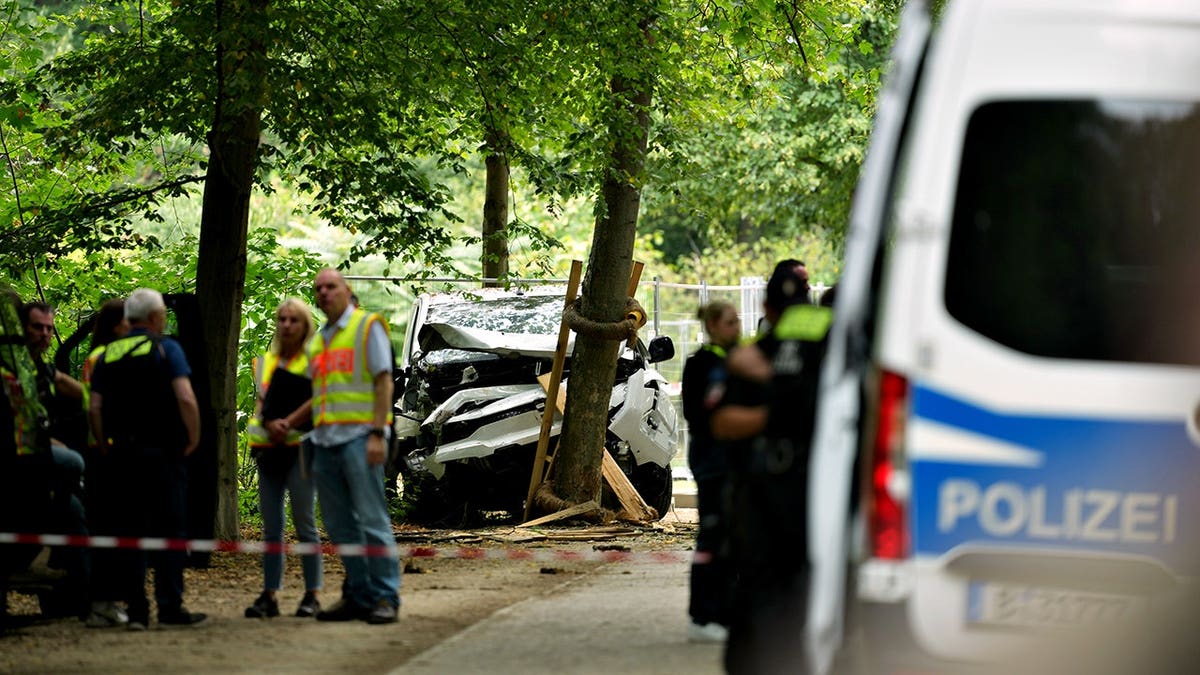
Police officers stand near a vehicle crashed into a tree after driving into a crowd near Berlin’s annual Pride event, in Berlin, Germany, Sunday, July 26, 2026. (AP Photo/Markus Schreiber)

Police said a white van drove into a crowd in Berlin’s Tiergarten park around 10 p.m. on Saturday before crashing into a tree. Authorities say the suspect then attacked several people with a machete before fleeing.

WITNESSES RECOUNT ‘SCARY’ NYC STABBING AFTER SUSPECT ALLEGEDLY YELLED ‘ALLAHU AKBAR’ DURING ATTACKS

A woman was killed, while three people suffered life-threatening injuries and eight others were seriously hurt, according to Berlin’s fire service. Dobrindt said at least 29 people were injured.

Emergency personnel and police gather in Berlin following Christopher Street Day cancellation.

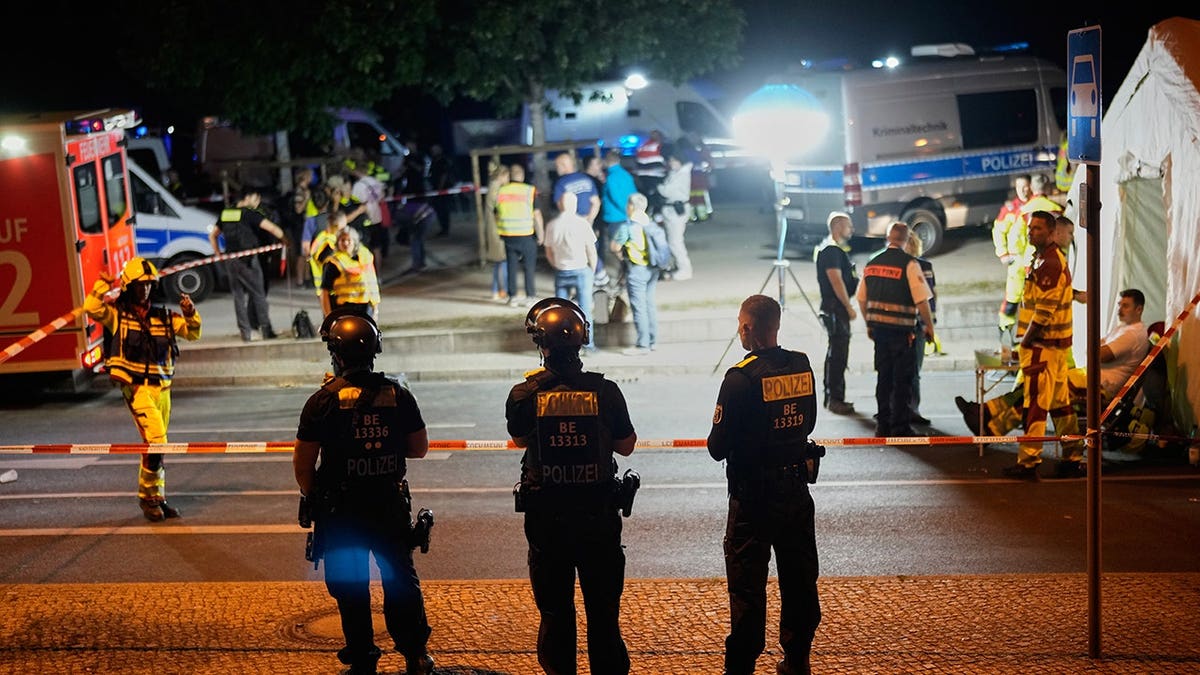
Emergency personnel and police gather in Berlin, early Sunday, July 26, 2026, following the cancellation of Christopher Street Day festivities. (AP Photo/Ebrahim Noroozi)

The attack happened a few hundred yards from Berlin’s annual Christopher Street Day Pride celebration — one of Europe’s largest LGBTQ+ events — but not on the parade route or at the festival’s closing event near the Brandenburg Gate. Investigators said the victims appeared to include both Pride attendees and other people who were in the park.

Organizers stopped the celebration shortly after the attack, cutting off a live performance and urging people to leave the area.

People stand on 17 June Street in Berlin following Christopher Street Day cancellation.

People stand on 17 June Street following the cancellation of Christopher Street Day in Berlin on Saturday, July 25, 2026. (Fabian Sommer/DPA via AP)

SYNAGOGUE IN LONDON TARGETED IN ATTEMPTED ‘ANTISEMITIC HATE CRIME,’ UK POLICE SAY

Berlin police said Ballout has been identified as the suspect but had not been arrested as of Sunday. Police spokesman Florian Nath earlier said the suspect was known to investigators because of his alleged ties to Islamic groups in Berlin.

“The suspect is known to police. He is known to us as a member of Islamic circles here in Berlin, and our search for this person is proceeding at full speed,” Nath said, according to The Associated Press. “We still have no information whatsoever regarding his specific motives, the exact sequence of events, or his role in the crime itself.”

Alexander Dobrindt speaks to reporters near the scene of a car incident at Berlin Pride March.

Interior Minister Alexander Dobrindt speaks to the media near the scene where a car rammed into a crowd at the Pride March in Berlin, Germany, Sunday, July 26, 2026. (AP Photo/Markus Schreiber)

Police searched several locations across Berlin overnight and into Sunday, including an apartment in the Schöneberg district, but did not find the suspect.

CLICK HERE TO DOWNLOAD THE FOX NEWS APP

The manhunt is ongoing.

The Associated Press contributed to this report.


Source link

Self-dressing clothes could help older adults

0
Self-dressing clothes could help older adults


NEWYou can now listen to Fox News articles!

Most of us get dressed every day without thinking twice about it. However, a stiff shoulder can make pulling on a shirt surprisingly difficult, while balance problems can turn a simple pair of pants into a real challenge. That is what makes a new invention from South Korea’s KAIST and Stanford University worth watching.

Researchers have created self-dressing clothes with soft, air-powered robots built into the fabric. Once activated, the garment moves along the body and helps guide itself into place, even while the wearer moves. The technology remains an early research project, but it shows how future clothing could help older adults get dressed with less assistance and stay independent at home longer.

CyberGuy Live: Missed “Sick of Spam?” Get the replay and checklist

Our free CyberGuy Live class, “Sick of Spam?” , has ended, but you can still watch the full replay and download our spam-stopping checklist. Kurt “CyberGuy” Knutsson walks you step by step through simple ways to reduce robocalls, spam texts, junk email and unwanted messages. You’ll also learn how to curb political texts, clean up your inbox and spot messages that could put your personal information at risk.

Get the free replay and checklist now at CyberGuyLive.com.

NEW YORK SCHOOL DISTRICT TO DEPLOY HUMANOID ROBOT IN CLASSROOMS THIS FALL

The self-dressing system uses soft, air-powered robots to guide sleeves, a jacket and pants into place around the body. (KAIST)

How self-dressing clothes could support independence

Getting dressed ranks among the basic activities that often determine whether someone can live independently. When mobility or dexterity declines, people may need a spouse, family member or professional caregiver to help with a deeply personal routine.

The researchers behind the project say dressing challenges can reduce autonomy and increase reliance on caregivers. They designed the system for people with limited mobility, including older adults and those recovering from injuries. Stanford researchers have also identified dressing assistance as an important use for future home robots. The university says assistive technology could help older adults remain in their homes as caregiving needs increase.

Why dressing can become physically difficult

Dressing requires more movement than many people realize. You need to reach behind your body, lift your arms and shift your weight while handling fabric. Arthritis may make gripping or pulling clothing painful. Meanwhile, shoulder problems can limit your reach. Recovery from hip or knee surgery can also make bending difficult.

Balance adds another concern. Pulling on pants often requires someone to stand briefly on one leg or bend toward the floor. For a person who already feels unsteady, that familiar routine can become stressful. Self-dressing clothes could eventually reduce some of that reaching and pulling. However, researchers still need clinical studies to learn how well the system works for people with real mobility limitations.

How KAIST and Stanford’s robotic clothing works

The researchers call their system SWAG, which stands for Self-Wearing Adaptive Garment. Instead of placing a large robotic arm next to the person, the team built flexible robotic tubes into the clothing. Air pressure causes these soft structures to unfold and grow along the body.

The movement turns the garment inside out as it advances. That approach allows the clothing to follow the person’s shape while reducing friction between the fabric and skin. Think of ivy growing around a wall or tree. The plant advances from its tip rather than dragging its entire length forward. The soft robot uses a similar motion, which helps it follow curves and move across different surfaces.

A person sitting

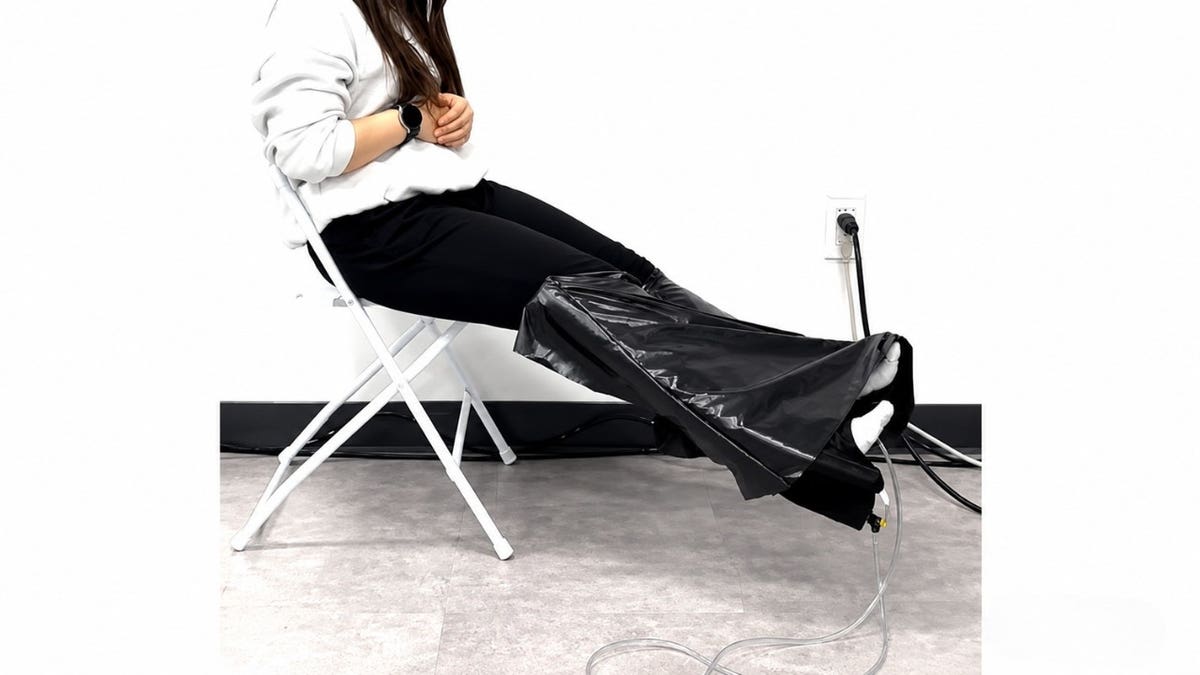
In this demonstration, the robotic garment unfurls over the legs while the wearer remains seated. (KAIST)

A rainy bike ride sparked the robotic clothing idea

The idea began when KAIST postdoctoral researcher Nam Gyun Kim was riding his bike when it began to rain. As he kept moving, he wondered how helpful it would be if a raincoat could put itself on.

That simple idea led to a much bigger thought. Instead of making your body do all the pulling, reaching and twisting, what if the clothing could move into place on its own? From there, Kim and the research team began developing garments that use soft robotics to help dress the person wearing them.

How fast self-dressing clothes can work

Kim says putting on a full suit takes about 10 seconds. The published paper provides additional timing from individual demonstrations. A jacket moved into place in about 13 seconds, while the pants demonstration took roughly 21 seconds. A sleeve prototype took about 14 seconds.

The researchers tested sleeves, jackets and pants. Their results showed that the garments could unfold along the body while keeping contact forces within the team’s safety limits. The system also relies on its physical design instead of a complicated control program. That could eventually help simplify the hardware needed for dressing assistance.

Why soft robotic clothing could feel more natural

Many existing dressing robots use rigid mechanical arms. Those systems must handle loose fabric while carefully avoiding uncomfortable contact with the person. They may also require the person to hold a fixed pose while the robot completes the task. That setup could feel awkward inside a bedroom or bathroom.

The KAIST and Stanford design takes a different approach by placing the robotic mechanism inside the garment. The clothing becomes the helper. Because the system uses soft materials, it can bend around the body rather than approaching it with a hard mechanical structure. KAIST says this design reduces physical strain and supports safer contact.

COULD A PAINT-ON ELECTRONIC TATTOO SPOT HEART ATTACKS?

A person putting on self dressing clothes

Flexible robotic tubes built into the jacket help pull the sleeves and fabric into position with less effort from the wearer. (KAIST)

Where self-dressing clothes could be used first

Older adults and people with disabilities represent a major potential use for the technology. KAIST also sees possibilities for rehabilitation patients who need temporary assistance after an injury or medical procedure. However, industrial workplaces may adopt the idea sooner.

Semiconductor employees frequently put on protective cleanroom clothing. Emergency workers may also need to suit up quickly while carrying other equipment. The researchers believe air-powered garments could help people put on protective clothing without relying heavily on their hands. The published study also discusses possible medical uses, such as helping healthcare workers apply protective coverings or compression bandages. Those applications remain potential future directions.

What self-dressing clothes still need to prove

The current system remains a research prototype connected to a pneumatic base station. Researchers have yet to announce a consumer price or release date. Several everyday questions remain unanswered. The garments would need to fit different body shapes and movement patterns. Designers would also need to address washing, storage and portable air power.

The research team says future versions may use adjustable sheaths or elastic materials to fit a wider range of bodies. The researchers also want to automate the garment-loading process and improve the controls.

Most importantly, the team says clinical trials involving people with mobility impairments will be essential. Those tests could show whether the clothing feels comfortable and works reliably outside the lab. Researchers also need to explore how the garment comes off. The current work concentrates mainly on dressing, while automated removal remains a future possibility.

What this means to you

You probably will not find robotic clothing hanging in a local store anytime soon. Yet this research gives us a useful preview of where assistive technology may be heading. For you or someone you care about, the biggest benefit could be control over a private daily routine. Clothing that handles part of the pulling and positioning could make mornings less tiring.

It could also delay the point when someone needs another person present simply to get dressed. That possibility still depends on testing, affordability and a design people feel comfortable wearing.

Kurt’s key takeaways

Self-dressing clothes may sound unusual, but the need behind them is easy to understand. Arthritis, limited mobility or recovery from surgery can make getting dressed frustrating and exhausting. For older adults, a garment that helps guide itself into place could mean more privacy, less reliance on a caregiver and more confidence starting the day. The KAIST and Stanford system still has a long way to go. Researchers need to make it portable, test it with people who have mobility challenges and prove it can work safely in a home. Even so, the idea shows how technology could support independence through something as familiar as the clothes you already wear.

Would you or someone you care about use self-dressing clothes to stay independent? Let us know by writing to us at CyberGuy.com

CLICK HERE TO DOWNLOAD THE FOX NEWS APP

Sign up for my FREE CyberGuy Report

  • Get my best tech tips, urgent security alerts and exclusive deals delivered straight to your inbox.
  • For simple, real-world ways to spot scams early and stay protected, visit CyberGuy.com – trusted by millions who watch CyberGuy on TV daily.
  • Plus, you’ll get instant access to my Ultimate Scam Survival Guide free when you join.

Copyright 2026 CyberGuy.com. All rights reserved.


Source link

Quote of the Day by Confucius, “When you see a worthy person, endeavor to emulate him. When you see an unworthy person, then….”

0
Quote of the Day by Confucius, “When you see a worthy person, endeavor to emulate him. When you see an unworthy person, then….”


Quote of the Day by Confucius

Confucius is one of the most famous and impactful thinkers in history. His teachings have shaped the cultures, governments, educational systems, and moral values of China, Korea, Japan, Vietnam, and many other parts of Asia. His ideas still inspire people today who seek wisdom about relationships, leadership, learning and self-improvement. Many philosophers were busy with abstract theories, but Confucius was of the opinion that a better society starts with better individuals. His teachings emphasised honesty, kindness, humility, discipline, respect for others and lifelong learning. Life of ConfuciusConfucius was born in 551 BCE in the state of Lu in present-day Shandong Province, China. His name was Kong Fuzi, or Master Kong. He lived during the Spring and Autumn period, which was marked by political disorder, wars between competing states, and a decline in moral values. Confucius was left an orphan at a tender age and his family was in modest financial circumstances. His mother believed in education, even if they were not rich. Confucius was extraordinarily curious as a child. He enjoyed studying history and rituals, poems, music and the legacy of former rulers who inspired him with their wisdom and virtue in government.Unlike many of his contemporaries, Confucius believed that education should not be limited to the wealthy and the elite. He admitted students from various social backgrounds, provided that they were ready to learn. The notion that talent and character were of greater account than birth was revolutionary in its day. Confucius held several government positions as he grew older. He wanted rulers to put his ideas of ethical governance, justice and public service into practice. He was in high administrative positions for a brief period, but political infighting kept him from carrying out many of his reforms.Disappointed, but not disheartened, Confucius spent many years travelling from state to state in China with his disciples, offering advice to kings and officials. Few rulers accepted his ideas during his lifetime, but he continued to teach because he believed the moral principles would win through in the end. He died in 479 BCE at the age of 72, unaware that his teachings would become one of the world’s greatest philosophical traditions.His philosophyConfucius was not so much concerned with the mysteries of the universe as with the practical question of how people ought to live together. His answer was character of morality. He thought discipline, education, and self-reflection could make any person better. Confucius thought that a society would be peaceful if people were virtuous.His philosophy comprises a few basic principles

  • Ren (benevolence or humaneness): That is kindness, compassion and empathy for others. It was the greatest moral virtue in the eyes of Confucius.
  • Li (proper conduct): Harmony in families and communities is achieved through respectful behaviour, good manners, traditions, and social responsibility.
  • Yi (righteousness): People should do what is morally right, not what is personally profitable.
  • Xin (trustworthiness): Being honest and keeping your word are important to building strong relationships.
  • Xiao (filial piety): Honouring parents, elders and ancestors makes families and society stronger.

Together, these values provided a framework for ethical living that would affect generations to come.Contributions towards educationOne of the greatest legacies of Confucius was the revolution of education. At a time when formal learning was usually only for aristocrats, he said that anybody who wanted to learn ought to be given the opportunity to study. This belief helped to lay the foundation for merit-based education in China. His way of teaching was different from the usual methods. He urged that students be required to question, discuss, observe and reflect rather than just memorise facts. He thought that wisdom consisted in understanding, and not in repeating what one knows. Many later Chinese civil service exams ( designed to select government officials on the basis of knowledge, rather than family background ) were heavily influenced by Confucian thought. His emphasis on life-long learning is very much on point today. As Confucius said, ” Learning without thought is labour lost ; thought without learning is perilous. ” Knowledge should be combined with critical thinking .Impacts on the government and the societyConfucius thought leaders should rule by virtue rather than fear. He believed that the common people would naturally follow the example of rulers who governed with honesty and humanity. He believed that the quality of a leader was more in his moral character than in his military strength or harsh laws.Worldwide impactConfucius was from ancient China , but his ideas have spread around the world. His teachings have been translated into hundreds of languages and are taught in schools, universities, business programs and leadership courses around the world. Many of the modern concepts like emotional intelligence, servant leadership, ethical management, continuous learning and personal accountability are akin to the themes that Confucius spoke about more than two millennia ago. His influence is felt in diplomacy, corporate leadership, and education, where respect, cooperation, and integrity remain core values.Quote of the DayOne of the most iconic lines of Confucius are, “When you see a worthy person, endeavor to emulate him. When you see an unworthy person, then examine your inner self.”This quote is surprisingly practical advice for self-improvement. The first sentence is that we should learn from admirable people. When we see a man who is honest, generous, disciplined, courageous, patient, or wise, we should not be envious or contemptuous, says Confucius. Instead, we should ask, What can I learn from this person? Each role model is an opportunity to get better. The second sentence is more profound still. When we meet someone who behaves badly – maybe they are dishonest, arrogant, impatient or selfish – our first reaction is to criticise them. But Confucius asks us to do something much harder. Instead of just looking at the faults of others, we should be asking ourselves if we have the same weaknesses in our own lives. Maybe we have been impetuous. Perhaps we have been unfair to other people. Maybe we have been loose with our words. When we make criticism a mirror of ourselves, we are better people. The quote doesn’t say to dismiss bad behaviour or act like bad behaviour is good. Instead it reminds us that every encounter is an opportunity to learn. Good people inspire us by their example and difficult people teach us humility and honest self-examination.Today the comparison is often the matter of life. Social media lures us into envying the successful and condemning the mistakes of others too quickly. But Confucius offers a healthier alternative. We should learn from each experience instead of comparing ourselves with others. If someone passes through discipline, learn discipline. Be kind to people who are kind to you. If someone is mean to you, take that as an opportunity to learn not to make the same mistakes.This attitude encourages growth, not judgement, all the time. It also helps to develop emotional maturity. It turns out that those who regularly reflect on their own behaviour are more compassionate, self-aware and resilient.Confucius was much more than an ancient philosopher. He was an educator who felt that enduring social change starts with the individual character. His ideas changed education, influenced governments and contributed to the moral foundations of civilisations for more than two thousand years. And he says in his famous quote that every person we meet can be a mirror. The admirable challenge us to be better; the imperfect, to reflect on our own character, honestly and humbly.


Source link

The most beautiful quality a boy can have is…” Kareena Kapoor on the one quality she wants her sons to grow up with and why every parent should know it

0
The most beautiful quality a boy can have is…” Kareena Kapoor on the one quality she wants her sons to grow up with and why every parent should know it


Kareena Kapoor with Saif Ali Khan

Every parent wants the best for their child. Good schools, good opportunities, a good future. Some parents want their kids to grow up successful. Others want them to be confident, independent and fearless. Bollywood actor Kareena Kapoor was recently asked what she wants most for her sons, Taimur and Jeh. Her answer wasn’t about grades or careers or any of the usual things.“I just want the boys to be kind,” said Kareena in an interview with Film Companion’s ‘Spill the tea with Sneha.’

3 Jul 2026 | 12:38

How do you teach children about money and financial responsibility?

Bebo talks openly about motherhood, and she’s honest that there’s no perfect way to raise a child. No matter how much parenting advice is out there, she doesn’t believe any of it comes with guarantees. “You know, there’s no blueprint plan,” she said. “There’s no list that says, ‘Okay, I have to do this.'”So instead of chasing a manual that doesn’t exist, she’s built her parenting around one idea she keeps coming back to.

Kindness, above everything else

Kareena Kapoor with her family

Kareena Kapoor with her family

Kareena says kindness is a topic she brings up often with her husband, Saif Ali Khan. “The only thing I always tell Saif is that I just want the boys to be kind.” She didn’t stop there. She explained why this particular value matters more to her than anything else. “I want them to be. Kindness is the most important quality. I think it’s a beautiful quality a boy or a man can have.”It’s worth sitting with that for a second. Kids today are pushed to compete, to achieve, to always be a step ahead. Kareena’s answer goes against that idea entirely. She’s saying character counts for just as much as capability, maybe more.A kind kid won’t necessarily win every race. But they’re the ones who end up with real friendships, who treat people well, who grow into adults with actual empathy.

“Kindness is forgotten”

Kareena thinks the world has drifted away from kindness, and that’s exactly why it matters more now. “Today, in today’s world, kindness is forgotten and it’s much needed.”Most parents would probably agree. Social media, the constant comparisons, online bullying, the pressure to always be performing affects kids in a bad way. Teaching a child to pause before snapping back, to help someone struggling, to bring in a classmate who’s being left out, to just speak to people with respect, that’s not a soft skill. It matters as much as the subjects.

What she tells her son Taimur

Kareena shared something she says regularly to her elder son. “I tell Taimur also, I said, you know, I think you’ll be a winner if you deal with kindness in any situation that you are in.”It’s a different definition of winning than the one most kids grow up hearing. For a lot of children, winning means top marks, the most goals, beating everyone else to the finish line. As per what Kareena said, how you treat people along the way matters just as much as what you end up achieving.

Good human beings first, successful adults second

Kareena Kapoor with her family

Kareena Kapoor with her family

Kareena summed up what she really hopes for as a mother. “I just pray that they’re kind, gentle… and just figure it out. Be a good person.” It’s a refreshing thing to hear at a time when parenting feels like it comes with endless pressure: the right school, the right activities, less screen time, every milestone tracked and planned.There may be no blueprint for raising kids, like Kareena says. But some things never really go out of style. Kids forget the toys. They forget the marks they scored. What tends to stick is the kindness they picked up at home, how they were taught to treat people, speak to others, and show up when someone needs them.

What every parent can take from this

You don’t need to be a celebrity or have a picture-perfect household to raise this in your kids. What Kareena’s talking about isn’t a program you follow, it’s a habit you model. Kids pick up more from what they watch you do than from what you tell them to do. If you’re patient with the delivery guy, if you let someone merge in traffic, if you speak kindly about people who aren’t in the room, your child is taking notes, even when it doesn’t look like it.You also don’t need a big moment to teach it. It shows up in small, everyday things: how you react when your child makes a mistake, whether you let them see you apologize, whether you ask them how their friend is doing and actually listen to the answer.And it’s fine to be honest with your kids about not having it all figured out. At the end of the day, most parents aren’t remembered for the schools they picked or the report cards they framed. They’re remembered for the kind of person their child became. That’s really the whole point.


Source link

Senegal’s Faye launches a new party, formalising his split with Sonko

0
Senegal’s Faye launches a new party, formalising his split with Sonko


Dakar, Senegal – Senegalese President Bassirou Diomaye Faye has launched a new political party, formalising his split with former ally Ousmane Sonko and setting up a struggle for control of the reform movement that swept them to power in 2024.

The creation of Kiiraay-The Republican Patriots on Saturday formalised the collapse of the alliance between Faye and Sonko after months of tensions over the direction of the government and Senegal’s mounting economic challenges.

The new party grew out of the Diomaye President coalition, which backed Faye’s successful 2024 presidential campaign. Speaking before supporters in Dakar, Faye portrayed Kiiraay as a movement centred on institutions rather than personalities.

“Kiiraay-The Republican Patriots is an open house,” Faye said, adding that the party would be guided by “ethics” and “transparency”.

He said the movement would be open to “young people, women, farmers, fishermen, teachers, health workers, the diaspora” and all citizens committed to serving the republic.

In another message directed at his supporters, Faye said political office should not be treated as a reward.

“Responsibilities will be duties and not rewards,” he said, adding that transparency would remain one of the party’s guiding principles.

The launch completes the political rupture between two men whose alliance overturned Senegal’s political establishment.

From allies to rivals

Faye and Sonko rose together through the African Patriots of Senegal for Work, Ethics and Fraternity (PASTEF).

Sonko, a former tax inspector, emerged as one of Senegal’s most influential opposition figures by campaigning against corruption, promising economic sovereignty and attracting strong support from young voters frustrated by unemployment and the rising cost of living.

When Sonko was unable to stand in the 2024 presidential election, PASTEF nominated Faye as its candidate. Campaigning under the slogan “Diomaye is Sonko”, Faye won the presidency and later appointed Sonko as prime minister.

But tensions gradually emerged over how the government was run, its economic policy and the direction of the governing coalition. The relationship deteriorated further as Senegal grappled with the fallout from previously undisclosed public debt, forcing the government to confront difficult economic decisions and renewed engagement with international lenders.

The political rupture deepened at the end of May when Faye dismissed Sonko as prime minister and dissolved the government. Days later, Sonko announced PASTEF would not participate in the new cabinet, cementing the split between the former allies.

A test of political strength

For Faye, Kiiraay represents an attempt to build an organisation anchored in the presidency rather than in PASTEF’s political machinery.

Whether he can do so remains uncertain.

President Bassirou Diomaye Faye, left, and former Prime Minister Ousmane Sonko at a time when they led Senegal’s reform movement together [File: Cem Ozdel/Anadolu via Getty Images]

Much of Faye’s rise to power was closely tied to Sonko’s popularity and PASTEF’s nationwide grassroots network. The new party, therefore, will be judged on whether it can build support beyond voters who backed Faye as Sonko’s chosen successor.

The split has also raised broader questions about the government’s ability to govern effectively while navigating economic pressures and maintaining its regional influence.

Kabir Adamu, founder of Beacon Consulting Ltd and a Nigeria-based security analyst specialising in the Sahel, told Al Jazeera the consequences could extend well beyond party politics.

“The dismissal of Ousmane Sonko has torn the ruling coalition asunder, creating a seismic political crisis. With the president and the now-opposition parliamentary leader at an impasse, Senegal faces a dangerous period of legislative paralysis and economic instability.

“The very foundations of the PASTEF party’s unity are being tested, and the path forward for the nation is shrouded in uncertainty. It is also likely that this domestic challenge will prevent President Faye from exercising the responsibilities ECOWAS expects of him.” Adamu said, referring to the regional bloc, the Economic Community of West African States.

For Sonko, the challenge is different. Although no longer part of the government, he remains one of Senegal’s most influential politicians and continues to command loyalty within PASTEF.

The emergence of two competing political camps leaves both men claiming to represent the reform agenda that helped bring them to power.

High expectations

The split has occurred as Senegal faces mounting economic pressures.

The government is working to restore confidence in the public finances after an audit revealed previously undisclosed liabilities under the former administration. At the same time, Faye’s government faces pressure to deliver on promises to tackle corruption, create jobs and ensure Senegal receives greater benefits from its oil, gas and mineral wealth.

The political split could further complicate those challenges. Mubarak Aliyu, a Nigeria-based political and security risk analyst specialising in West Africa and the Sahel, told Al Jazeera that the timing of the rupture could have significant implications for the country’s economic recovery.

“At a time when Senegal is undergoing a severe debt crisis, the timing of this political rift could prove highly consequential for the country. The policy paralysis created by the fight for what Sonko believes to be economic sovereignty and Faye’s insistence on pragmatic austerity and debt restructuring could easily spill into fiscal decision-making at the exact moment Senegal can least afford a legislative deadlock. A debt crisis punishes hesitation and mixed signals, and this rupture supplies both,” Aliyu said.

For many Senegalese, however, the ultimate measure of either camp will not be the political split itself but whether it can deliver on promises of reform and improve living standards.

Benjamin Dwomoh-Doyen, executive director of the African Chamber of Content Producers (ACCP), told Al Jazeera he hoped Senegal’s leaders would place the country’s interests above political rivalry.

“We had hoped for a resolution of differences and unity, especially as we continue to advocate for a united continent. Senegal has long been a beacon of democratic stability in West Africa.

“The rupture in its ruling camp is regrettable and risks diverting energy from governance and regional stability. For the sake of national cohesion and the welfare of the Senegalese people, we trust the leadership will prioritise the greater good over political differences,” he said.


Source link

The adventurous life of supermodel Lauren Hutton

0
The adventurous life of supermodel Lauren Hutton


She didn’t set out to be a model, or an actress, and several agencies rejected the gap-toothed Lauren Hutton, before Eileen Ford gave her a shot. As the face of Revlon, Hutton became the highest-paid model in history, and still holds the record for most cover appearances on American Vogue. She talks with Anthony Mason about her adventurous life of no regrets – from living among the bushmen of the Kalahari, to a near-fatal motorcycle accident in 2000. Even of the low points she says, “I’d do it again in a second.” (Originally broadcast Jan. 25, 2026.)


Source link

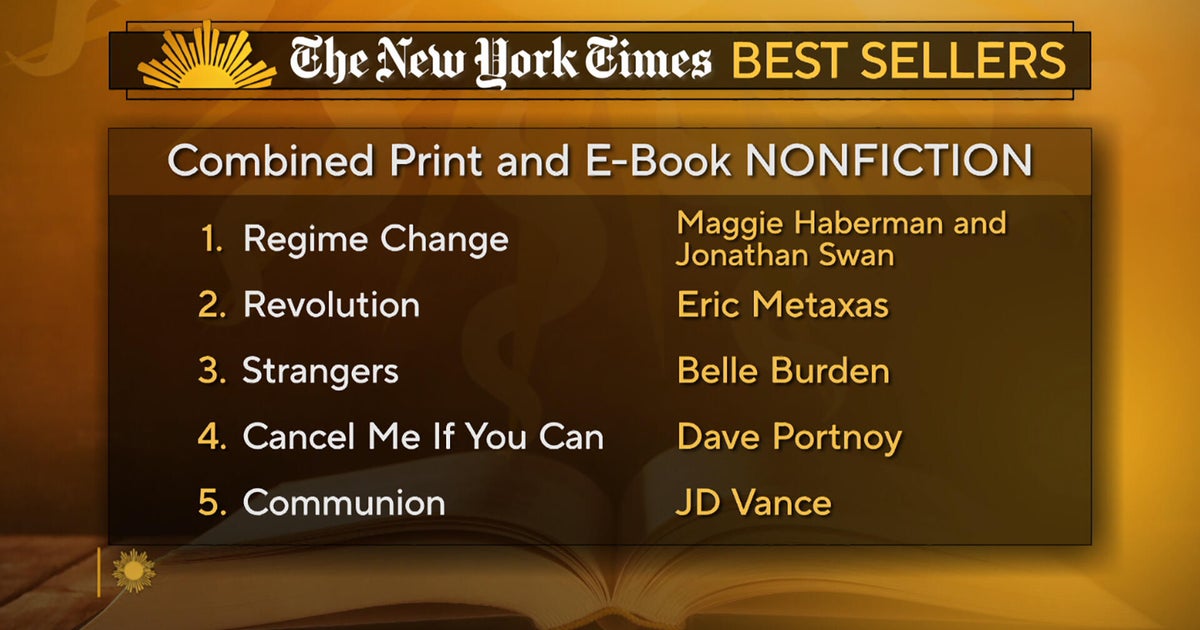
7/26: New York Times bestseller lists

0
7/26: New York Times bestseller lists


7/26: New York Times bestseller lists – CBS News


Watch CBS News


Check out this week’s top-selling titles on The New York Times fiction and non-fiction lists.


Source link

Passage: Late-night TV exec Peter Lassally

0
Passage: Late-night TV exec Peter Lassally


During his half-century in television, Peter Lassally (who died last Sunday at age 93) played producer and confidant to late-night hosts David Letterman, Craig Ferguson, Tom Snyder, and Johnny Carson. Mo Rocca has a remembrance of the man they called “The Host Whisperer.”


Source link