Prosecutors say the man, identified only as ‘Sergej K’, has been in ‘continuous contact’ with Russian intelligence.
Published On 29 Apr 202629 Apr 2026
German authorities have arrested a Kazakh man in Berlin on suspicion of spying for Russia, according to the German Federal Prosecutor’s Office.
Identified only as Sergej K, the man had been “in continuous contact from Germany with a Russian intelligence service” since at least May last year, the office said in a statement on Wednesday, a day after the arrest.
Recommended Stories
list of 4 itemsend of list
Prosecutors said Sergej K provided his Russian handler with details about German military aid for Ukraine, including companies involved in developing drones and robotic systems. He also allegedly sent photos of NATO military convoys and public buildings in Berlin.
Other activities included offering to find other espionage agents in Germany, prosecutors added, but they did not make clear whether he had done so.
There was no immediate reaction from Kazakhstan or Russia.
Previous cases
The case is the latest in a string of Moscow-linked espionage and disinformation plots German authorities claim to have discovered since Russia’s full-scale invasion of Ukraine in 2022.
Two German-Russian dual nationals were arrested in 2024 on suspicion of plotting sabotage attacks on United States military sites in Germany to undermine Western military support for Ukraine.
German police have also arrested various alleged “disposable” agents, known to carry out sabotage and espionage without any formal training for Russia in exchange for small payments.
Earlier this month, Berlin summoned the Russian ambassador to condemn what it called “direct threats” against “targets in Germany”.
Berlin’s Federal Foreign Office said at the time that the threats were intended to undermine Germany’s support for Ukraine. “Our response is clear: we will not be intimidated. Such threats and all forms of espionage in Germany are completely unacceptable,” the Foreign Office said.
Germany has also accused “state-sponsored” Russian hackers of carrying out an “intolerable” 2023 cyberattack on members of the Social Democratic Party, a charge that Russia’s embassy in Germany “categorically rejected”.
Meanwhile, Russia has essentially banned Germany’s international broadcaster Deutsche Welle on the grounds that it produces “hostile anti-Russian propaganda”.
Moscow has repeatedly denied any involvement in Germany-based espionage schemes.
As they mark 15 years of marriage, the Prince and Princess of Wales have honed a distinctive approach to their public wardrobes. Their style eschews overt matching, instead favouring subtle coordination and complementary tones.
From their engagement announcement to significant state visits, their sartorial choices consistently blend symbolism with diplomatic intent. Here’s a look back at some of their most memorable looks together.
Engagement announcement – November 16, 2010
Prince William and the then Kate Middleton, during a photocall to mark their engagement. (PA)
The couple’s first major fashion moment came with their engagement announcement at St James’s Palace.
Kate wore a navy silk jersey wrap dress by the Brazilian-born designer, Daniella Issa Helayel, which sold out within hours and is widely credited with launching what became known as the “Kate effect”. The deep blue tone echoed the sapphire engagement ring, formerly owned by Diana, Princess of Wales.
William opted for a dark suit and tie, establishing early on the pair’s preference for tonal coordination rather than identical dressing.
Wedding day – April 29, 2011
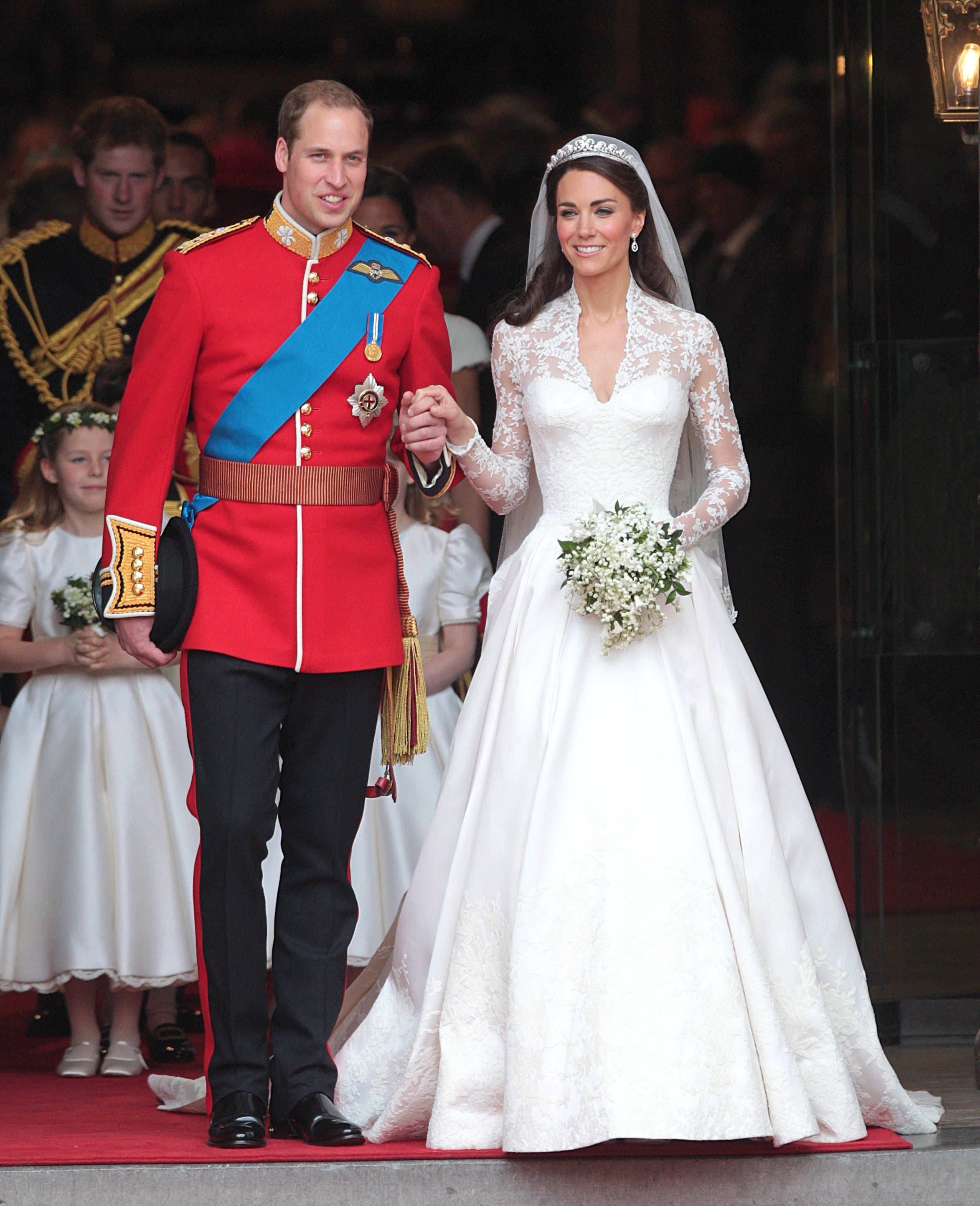
Prince William and his wife Catherine, Duchess of Cambridge emerge from Westminster Abbey after the wedding ceremony. (PA)
For their wedding at Westminster Abbey, the Princess of Wales wore a gown by Sarah Burton for Alexander McQueen, championing British designers.
The design combined a fitted bodice with long lace sleeves and a full skirt, drawing on Victorian corsetry traditions. Hand-cut lace motifs such as a rose, thistle, daffodil and shamrock represented the four nations of the United Kingdom.
William wore the scarlet tunic of the Irish Guards, reflecting his role as Colonel; the contrast between his military uniform and couture bridalwear set a formal template for subsequent royal occasions.
Early engagements – June 25, 2011
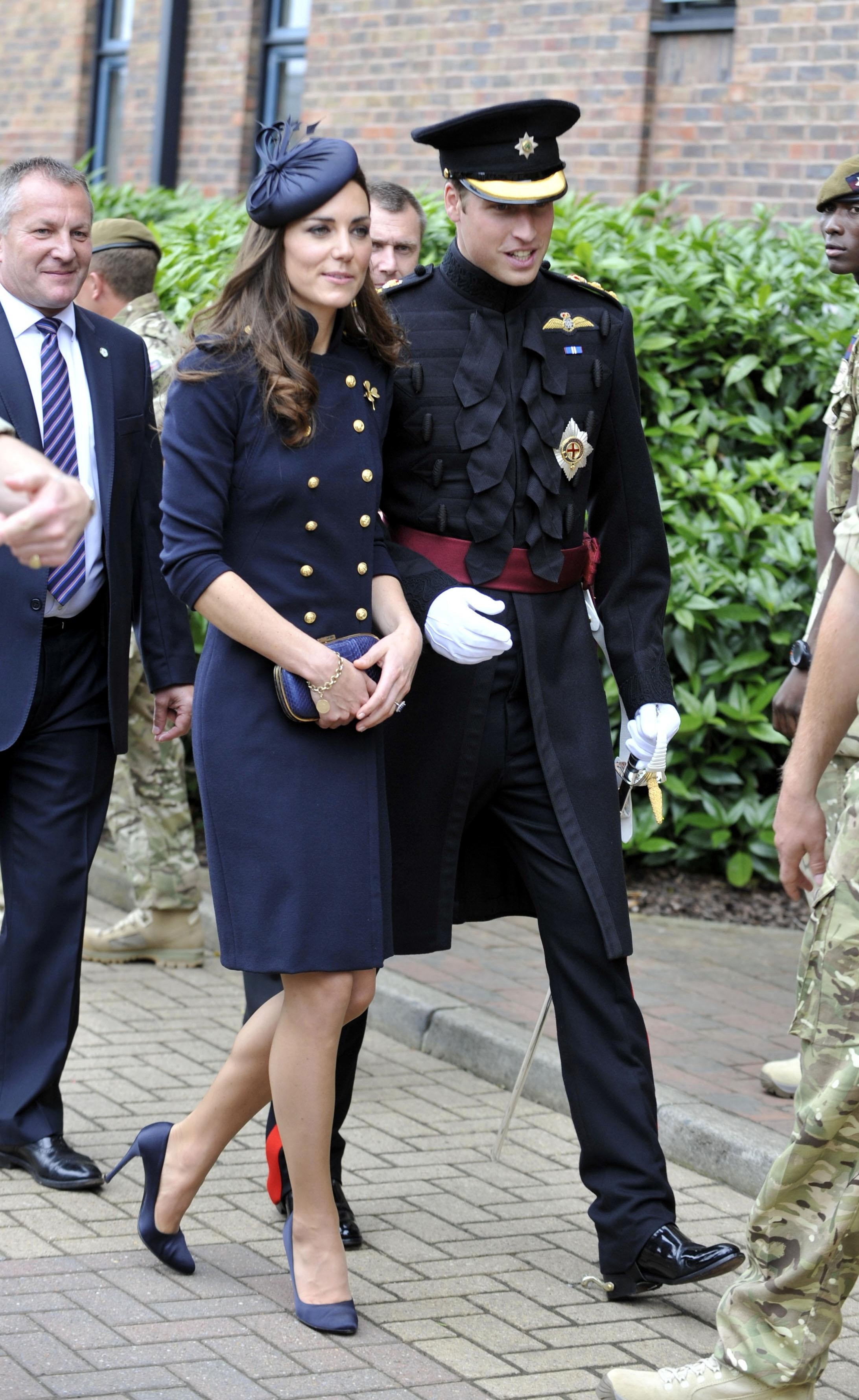
The then Duke and Duchess of Cambridge arrive to talk to the families of members of the 1st Battalion Irish Guards (PA)
In one of their first official appearances after the wedding, at Victoria Barracks in Windsor, the couple appeared in a coordinated, military-influenced palette.
Kate wore a navy coat dress with structured shoulders and prominent gold button detailing, paired with a matching navy fascinator and suede pumps. The look, attributed to Alexander McQueen, reflected the naval setting.
Prince William wore the full ceremonial uniform of the Blues and Royals, including a dark tunic with braid detailing, a peaked cap and a red sash at the waist.
The pairing worked visually without being overtly matched – a styling approach that would become a consistent feature of their joint appearances.
Canada tour – July 2011
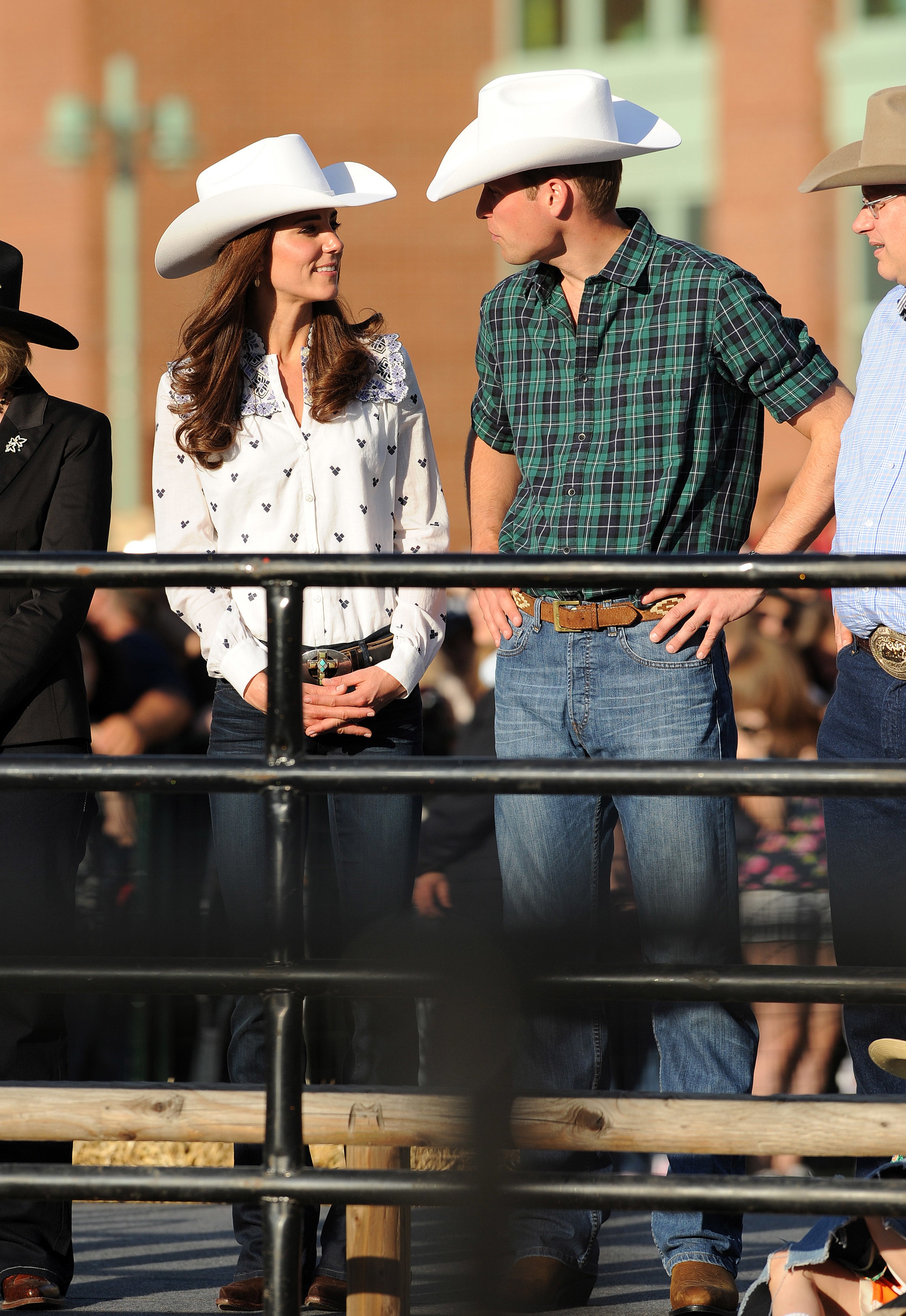
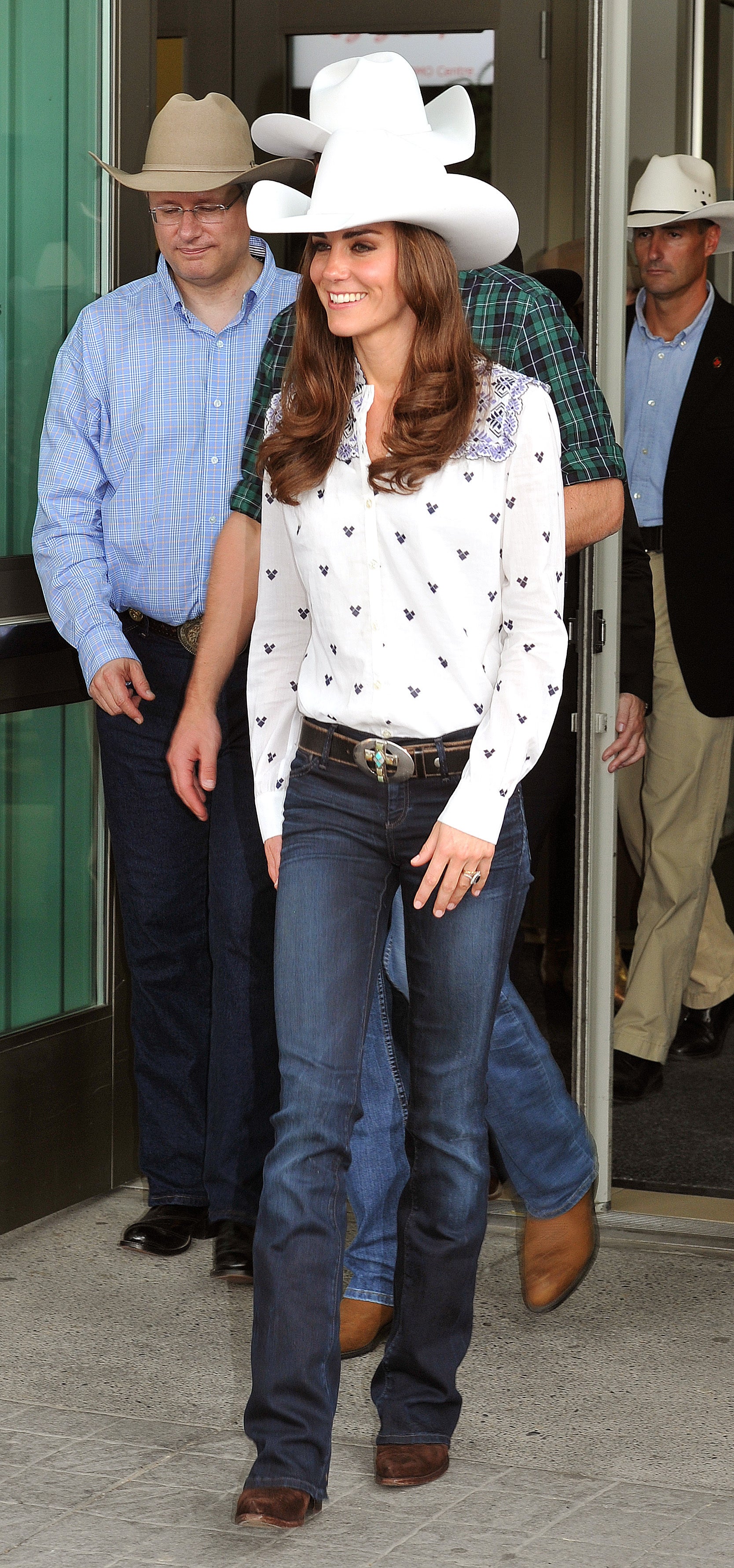
The Duke and Duchess of Cambridge at BMO Centre in Canada, July 2011. (PA)
During their first overseas tour as a married couple, the Duke and Duchess – as they were then – adapted their wardrobe to the local culture.
At the Calgary Stampede, both wore cowboy hats. Kate paired hers with jeans and western-style boots, while William opted for a checked shirt and dark denim.
Kare wore her go-to colours of white and navy. (PA)
The approach to tour dressing – referencing local traditions without appearing overly contrived – has remained a consistent feature of their public appearances.
Birth of Prince George – July 23, 2013
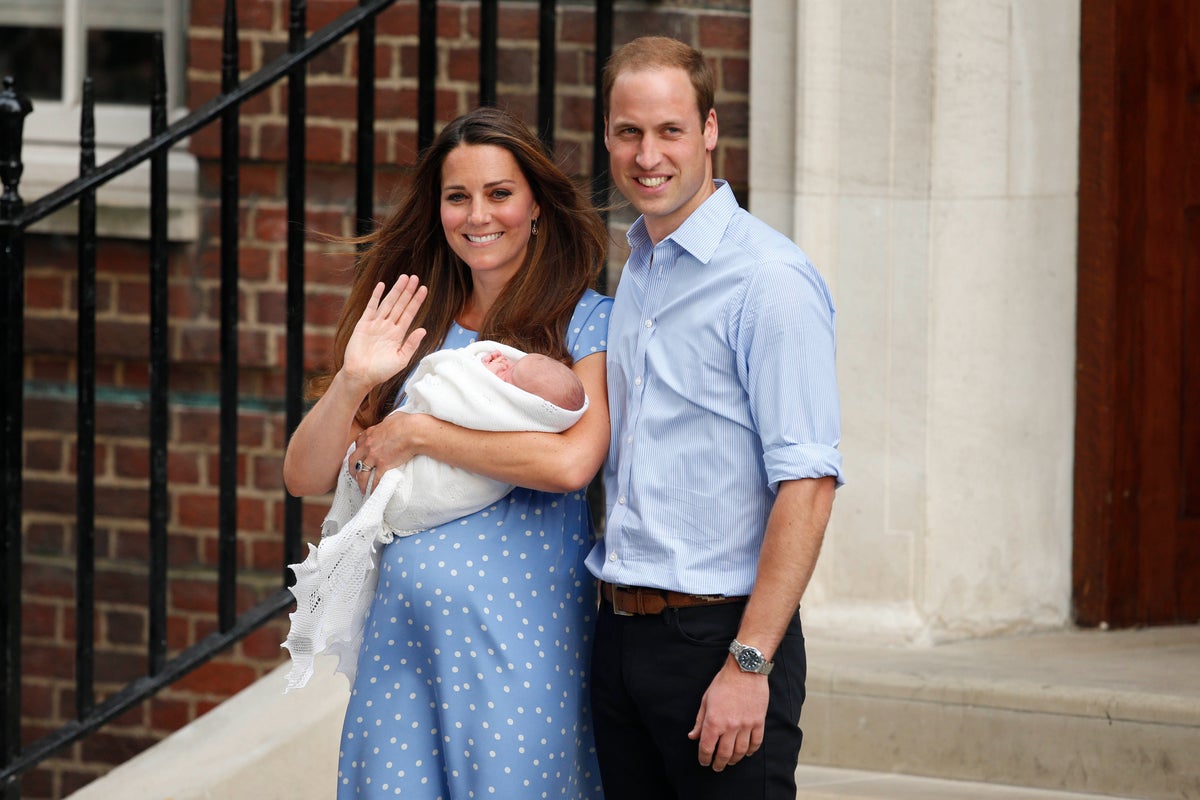
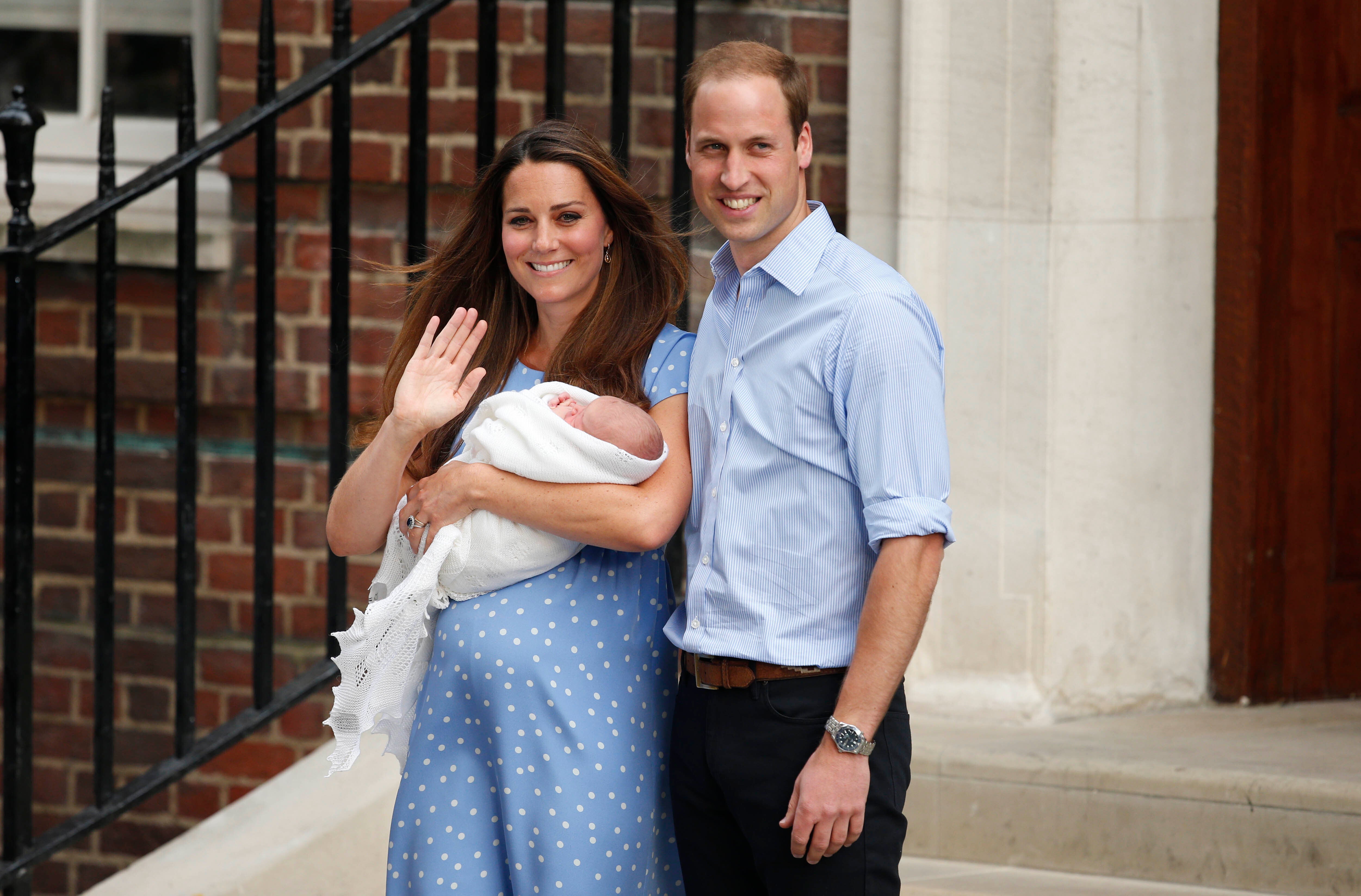
The Duke and Duchess of Cambridge after Prince George was born. (PA)
When Prince George was born, the couple posed outside the Lindo Wing at St Mary’s Hospital in London, in coordinating baby blue.
Kate wore a light blue polka-dot dress by Jenny Packham, widely interpreted as a reference to the dress worn by Diana after William’s birth.
William’s blue shirt reinforced the colour theme, which has been used repeatedly by the couple for family moments.
Ski holiday – March 2016
The Duke and Duchess during a ski holiday. (PA)
It’s no secret that the couple are sporty, and on a family ski trip with Prince George and Princess Charlotte, the couple adopted practical gear in contrasting colours.
Kate wore a white ski jacket with red trousers, while William opted for a blue jacket and dark trousers. The outfits were functional but coordinated enough to maintain an eye-catching appearance in official photographs.
BAFTAs – February 12, 2017
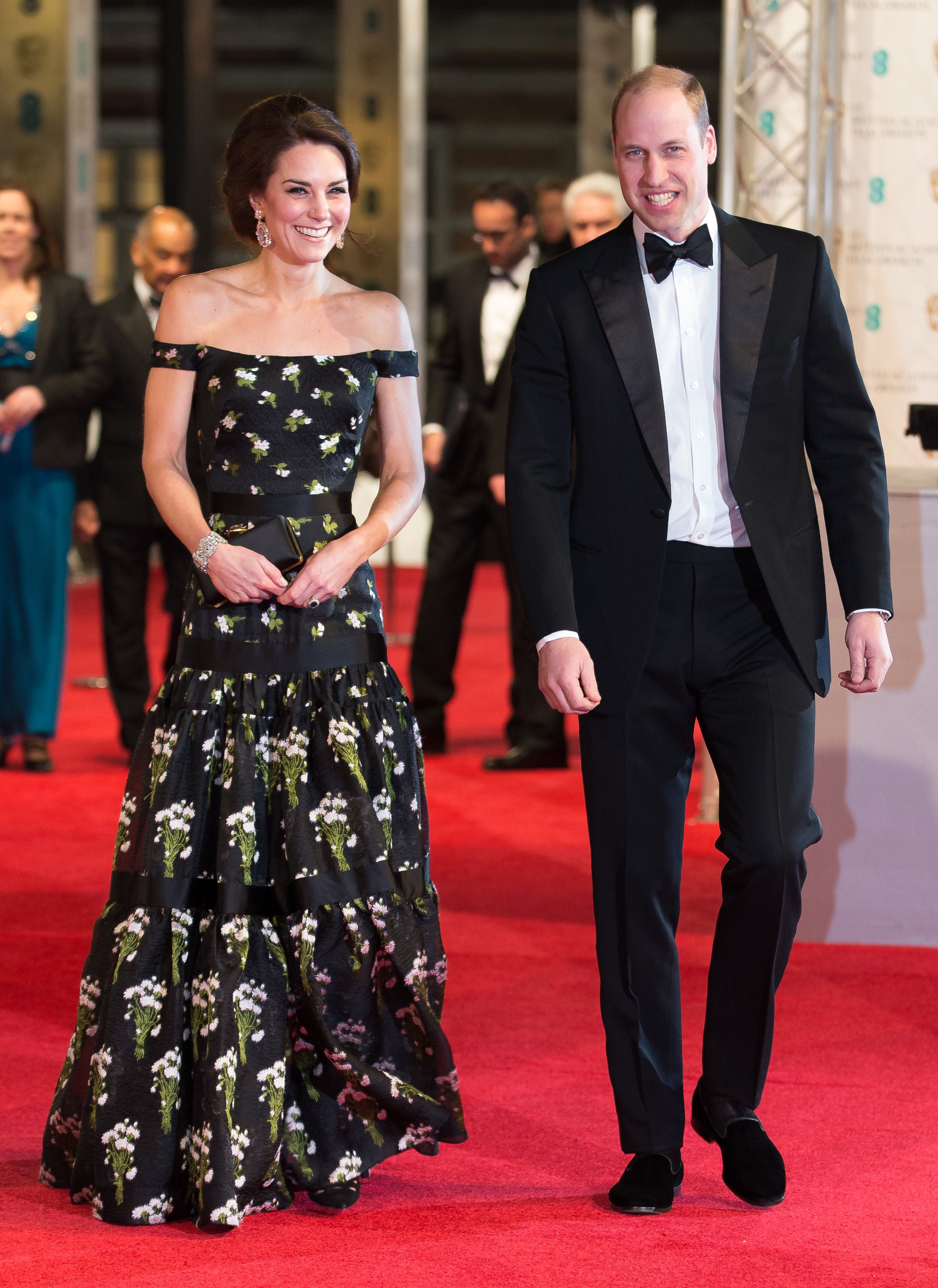
The then Duke and Duchess of Cambridge at the BAFTAs in 2017. (PA)
From the slopes to the red carpet – at the 2017 EE British Academy Film Awards, the couple adhered to a classic black-tie dress code.
Kate wore a black floral gown by her now go-to designer Alexander McQueen, featuring a Bardot neckline and tiered skirt, while William chose a classic and traditional tuxedo. The pair were understated but still turning heads.
Family trip to Germany – July 2017
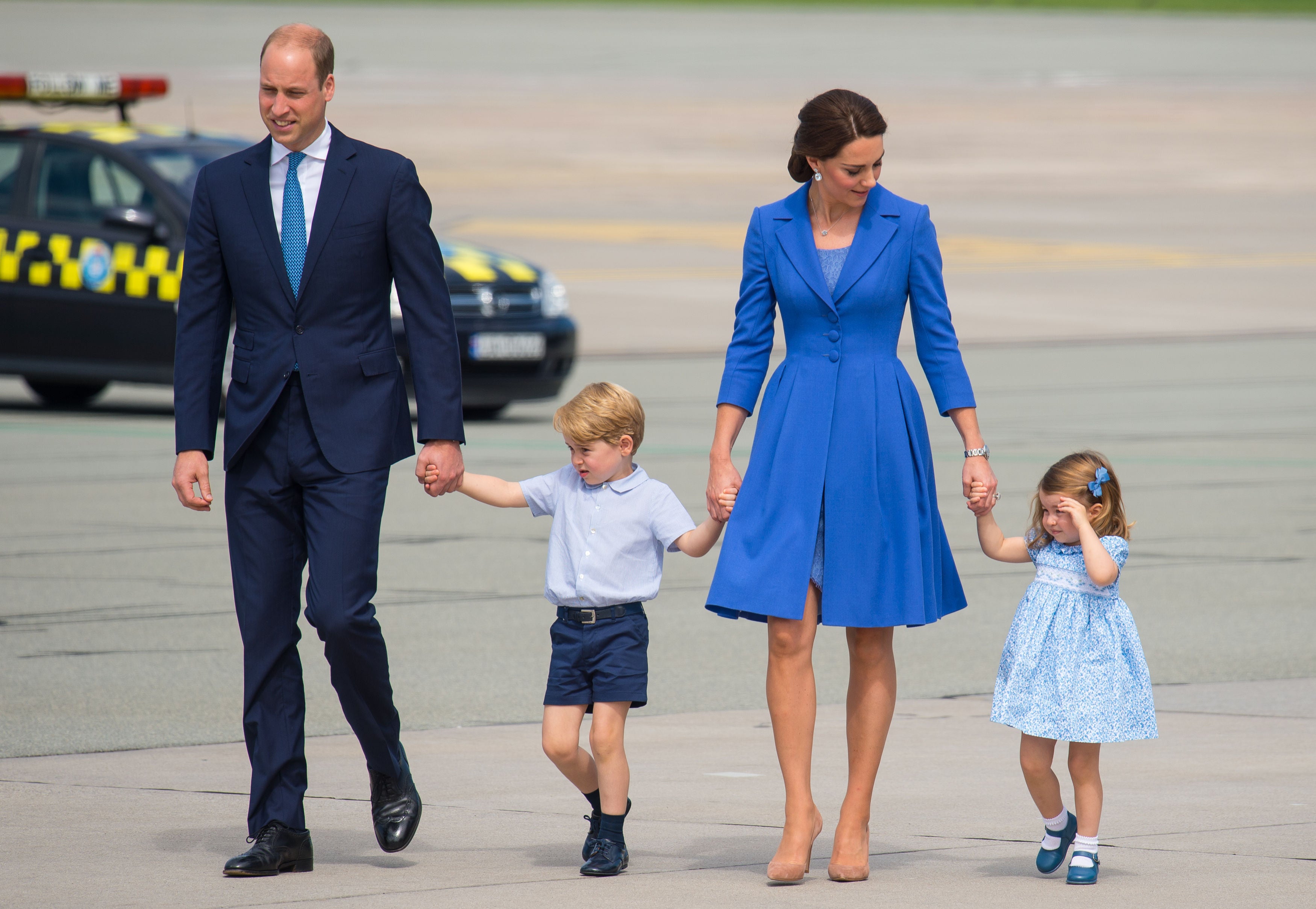
The family coordinated during a trip to Germany (PA)
Arriving in Germany with their two children in July 2017, the family once again coordinated as a family in their favourite shade of blue.
Kate wore a Catherine Walker coat dress, while William opted for a navy suit. The children’s outfits also coordinated, with Prince George wearing a pale blue shirt and navy shorts, and Princess Charlotte in a blue floral dress with matching shoes.
BAFTAs – February 18, 2018
The Duke and Duchess of Cambridge attending the 2018 BAFTAs. (PA)
In 2018, while pregnant with Prince Louis, Kate attended the BAFTAs in a muted green gown by Jenny Packham, featuring a black waistband.
At the time, many attendees wore black in support of the Time’s Up movement: a Hollywood-led initiative launched on January 1, 2018, to combat systemic sexual harassment and gender inequality in the workplace, spurred by the #MeToo movement and Harvey Weinstein scandals.
As a senior royal, Kate is expected to remain politically neutral, so instead of wearing full-black, many viewed her outfit as a subtle acknowledgement of the moment with a black belt. William again wore a black tuxedo.
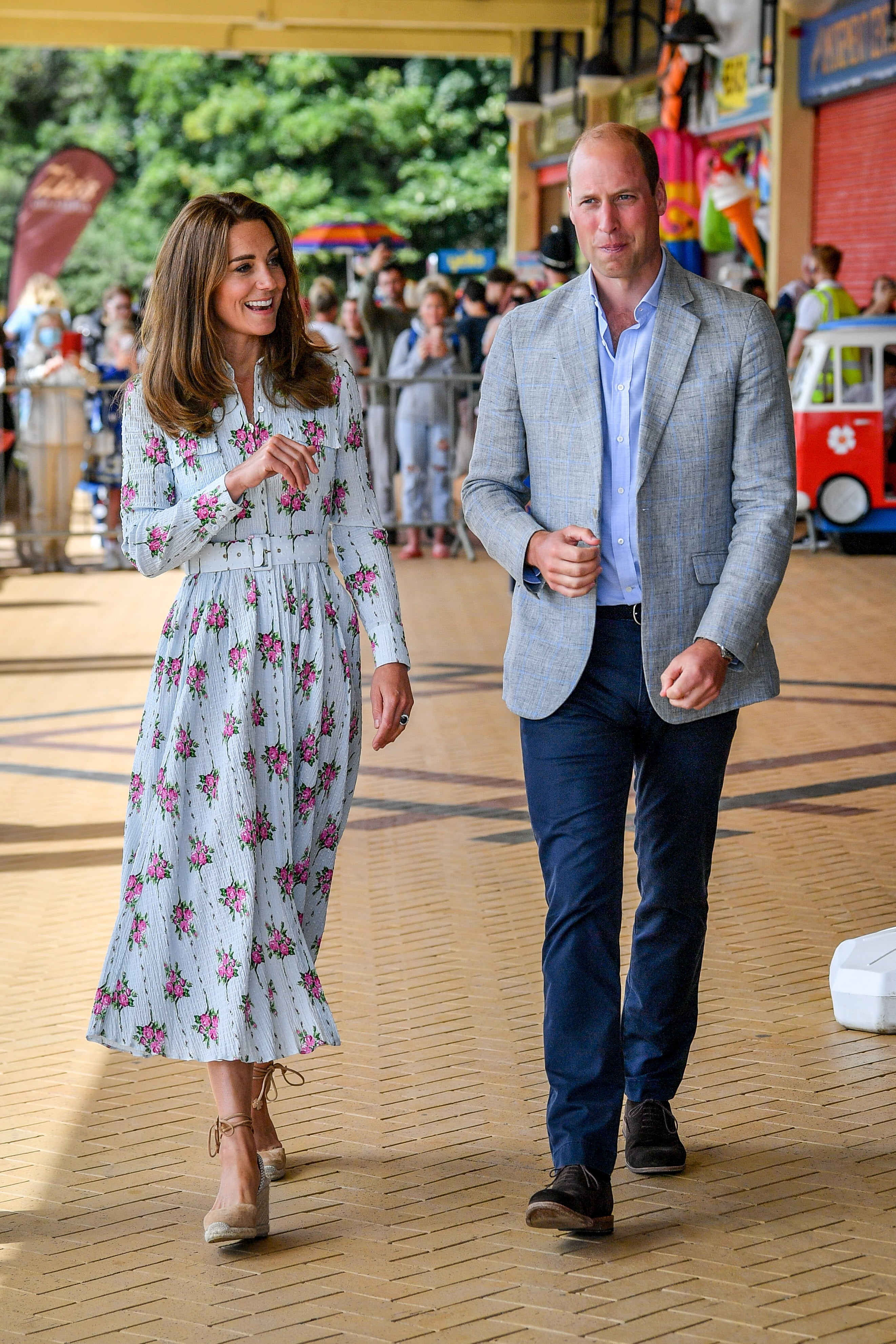
The then Duke and Duchess of Cambridge in South Wales in 2020/ (PA)
During a visit to Barry Island in South Wales, the couple adopted a relaxed yet coordinated approach to summer dressing.
Kate wore a light blue floral midi dress by London-designer Emilia Wickstead, featuring long sleeves, a belted waist and a soft pleated skirt, paired with espadrille wedges. William opted for a grey linen blazer, pale blue shirt and navy trousers.
The shared tones and lightweight fabrics reflected the seaside setting, while maintaining a cohesive look, perfect for a daytime engagement.
Scotland visit – May 2021
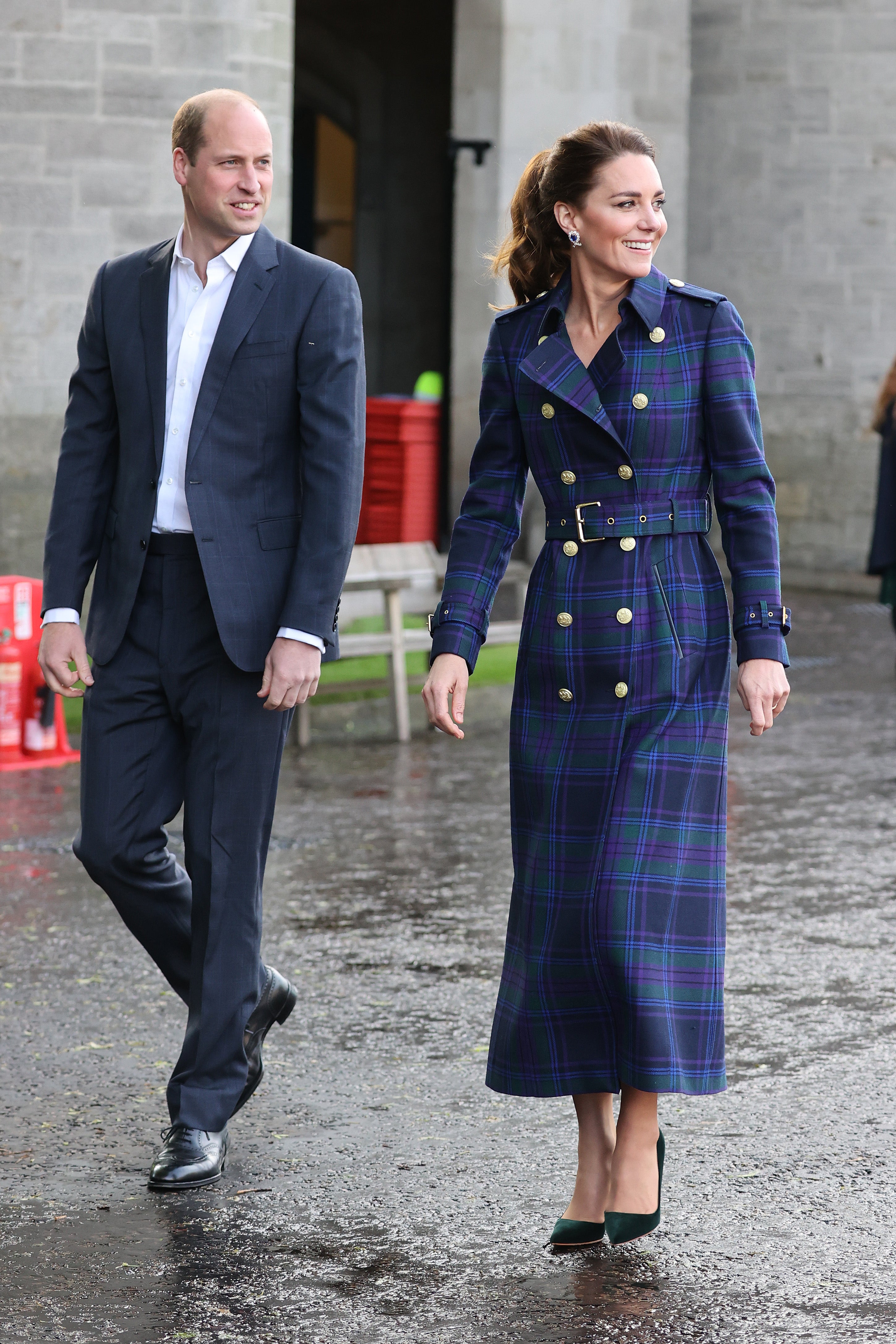
The then Duke and Duchess of Cambridge at the Palace of Holyroodhouse, Edinburgh in 2021. (PA)
In a nod to the nation during a visit to Scotland, Kate wore a green and blue tartan coat by Holland Cooper, referencing traditional Scottish dress, while William coordinated in a subtle tartan suit.
This appearance of Holland Cooper contributed to increased visibility for the British brand, with Kate subsequently wearing the label on several occasions.
Top Gun premiere – May 19, 2022
The then Duke and Duchess of Cambridge at the Top Gun: Maverick UK Premiere. (PA)
For the London premiere of Top Gun: Maverick, the Prince and Princess of Wales leaned into a more directional take on eveningwear.
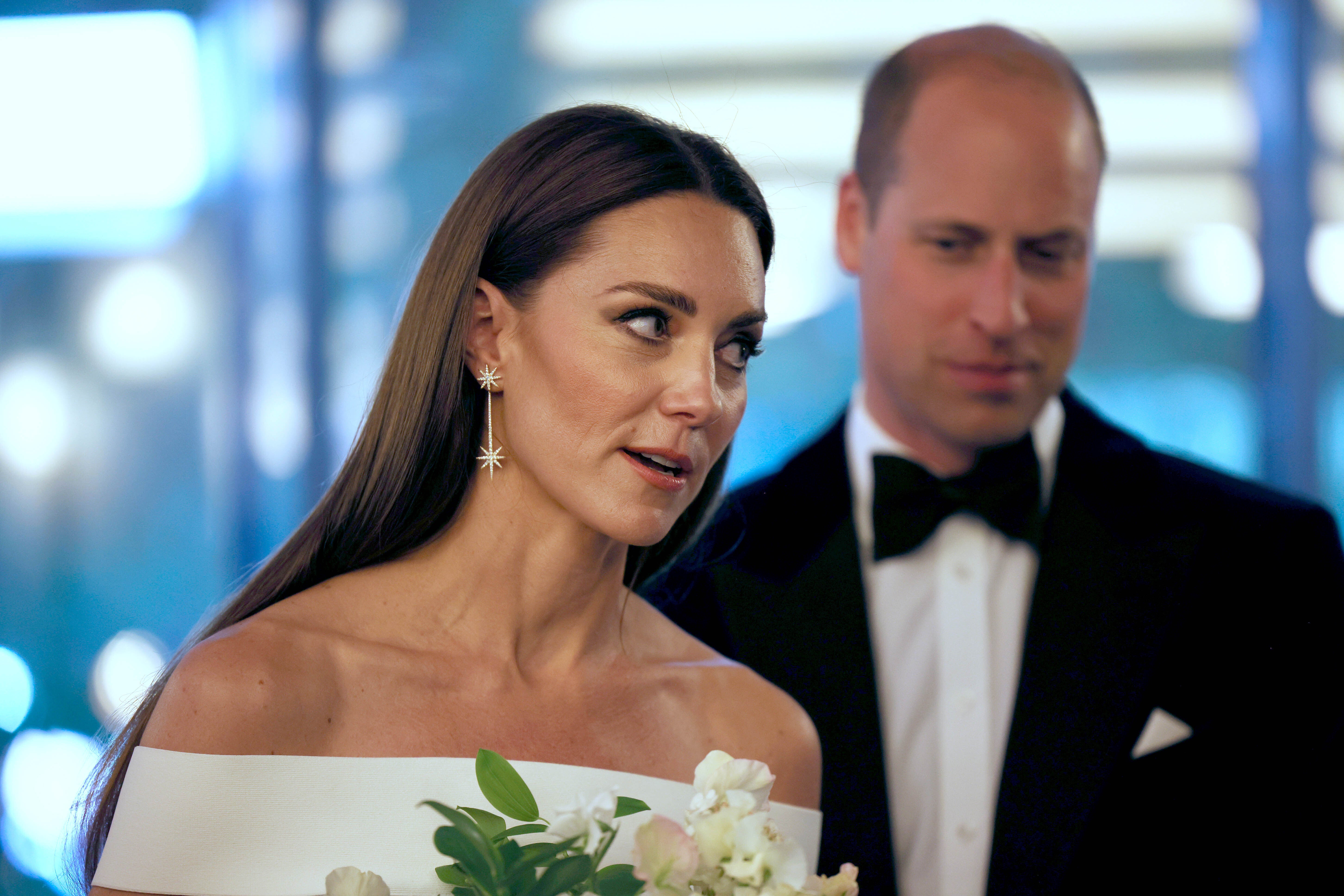
Kate wore a dramatic black off-the-shoulder gown by Roland Mouret, featuring a Bardot neckline – one of her favourite silhouettes – with a white panel detail across the bodice that added a contrasting and contemporary edge. She carried on the Hollywood-inspired style with sleek, straight hair and minimal accessories.
The then Duchess of Cambridge at the Top Gun: Maverick premiere . (PA)
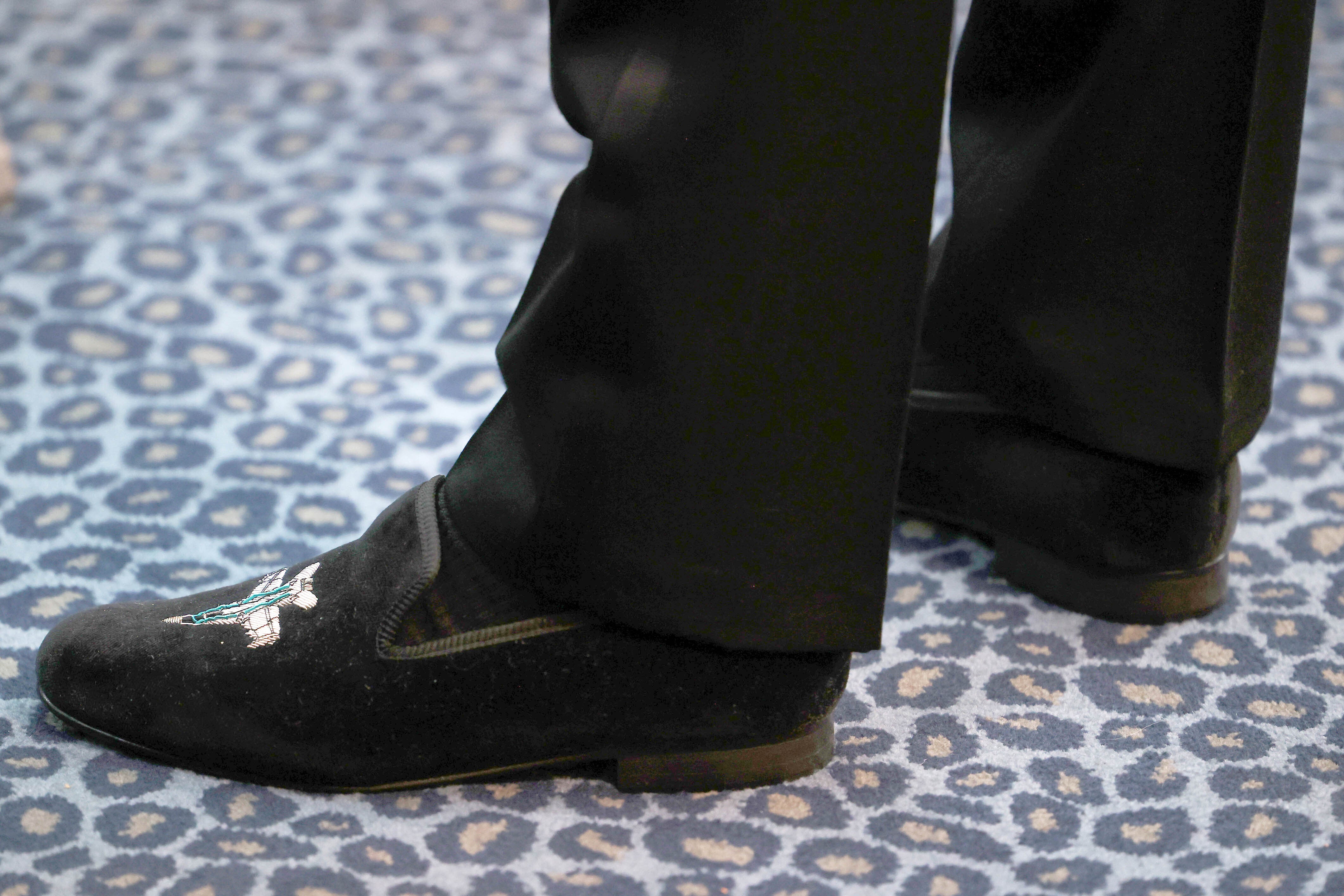
William opted for a classic black tuxedo but introduced a subtle thematic element through his footwear, wearing velvet slippers embroidered with aircraft motifs – a nod to the film’s aviation focus and his own experience as a former RAF search and rescue pilot.
The Duke of Cambridge wearing a pair of shoes embroidered with a fighter aircraft logo. (PA)
It seems method dressing certainly has the royal seal of approval.
Nigeria state visit – March 18, 2026
The Prince and Princess of Wales during the ceremonial welcome for President of Nigeria. (PA)
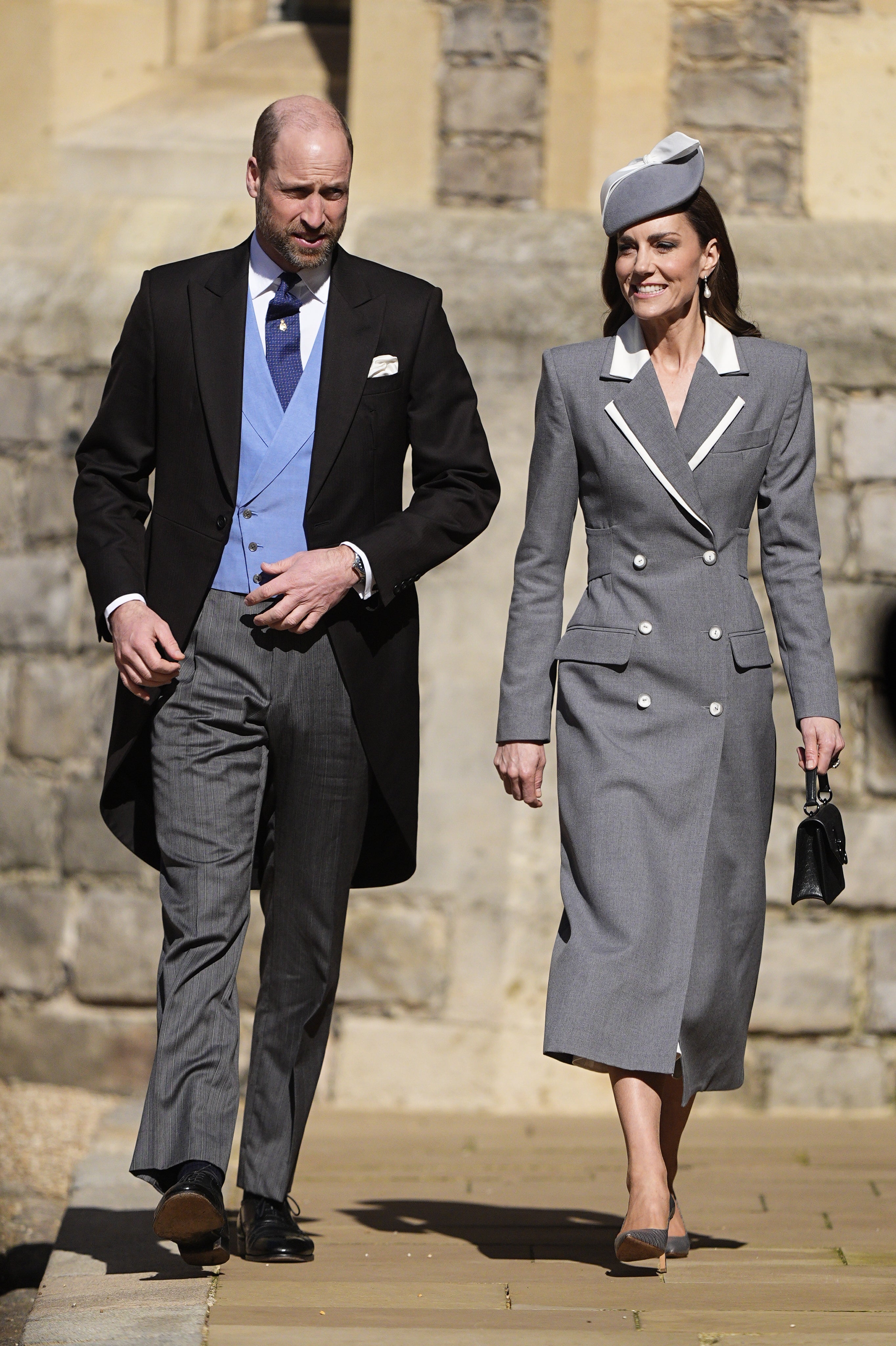
During a state visit from Nigeria’s president and first lady in March 2026, the Princess of Wales used fashion to deliver a diplomatic message, wearing a grey and cream blazer-style frock coat by British-Nigerian designer Tolu Coker.
The Prince of Wales opted for a traditional morning suit, featuring a black tailcoat, striped trousers and a pale blue waistcoat. The tone subtly complemented Kate’s look, maintaining the couple’s consistent approach to coordination while allowing the focus to remain on the symbolic choice of designer.
EXCLUSIVE: A surge in online claims warning of famine in Gaza is gaining traction across social media and international outlets, but newly surfaced data reviewed by Fox News Digital from the United Nations, the Board of Peace and the Israeli military tells a sharply different story.
The figures were shared at a meeting of the Ad Hoc Liaison Committee (AHLC), a forum that coordinates international aid to the Palestinians, by the Board of Peace and described as based on reporting from the U.N.
Children aged 6 to 59 months admitted for acute malnutrition treatment rose from 2,807 cases in January 2025 to a peak of 17,384 in August 2025 before declining steadily to 3,043 in March 2026, an approximately 83% drop, according to the data.
The figures challenge a rapidly spreading narrative that Gaza is facing widespread famine, a claim gaining traction across global media and shaping international pressure on Israel.
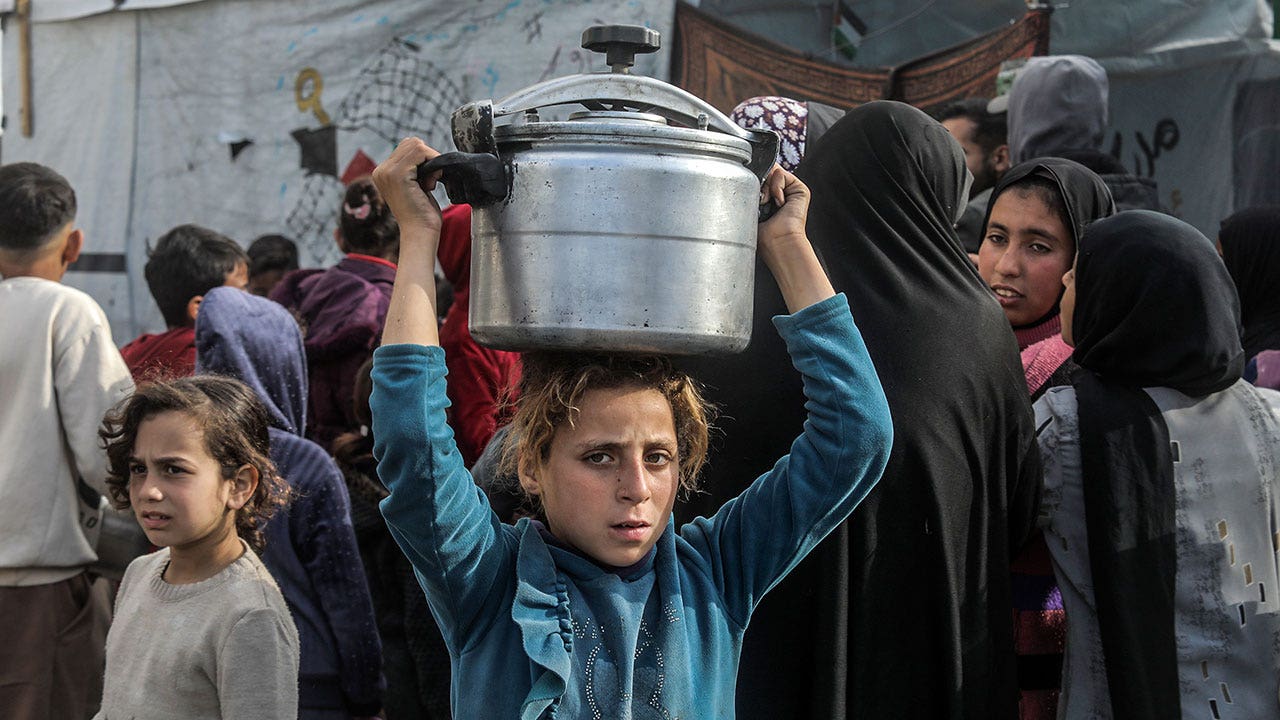
Gazans carry food aid airdropped by Jordan and the United Arab Emirates.(TPS-IL)
The dataset also indicates that most remaining cases are now classified as “moderate” or linked to chronic medical and genetic conditions requiring sustained support.
Separate figures presented at the same meeting, collected by the Board of Peace, show a sharp increase in humanitarian aid delivery following the establishment of the Civil-Military Coordination Center (CMCC) in October 2025. The U.S.-led, multinational hub, located in Israel, is designed to manage post-war Gaza stabilization.
The Civil-Military Coordination Center oversees aid delivery, monitors a U.S.-brokered ceasefire, and coordinates efforts with 60 nations and organizations.
The figures show weekly truck deliveries into Gaza rose from approximately 1,300 to 4,200, while the percentage of trucks diverted en route dropped from roughly 90% to just 1% post-Civil-Military Coordination Center.
The number of people reached with food assistance increased from about 400,000 before the Civil-Military Coordination Center was established to approximately 2.1 million post-coordination center.
And yet, April has seen a spike in messaging alleging “engineered starvation” in Gaza, according to HonestReporting, a U.S.-based pro-Israel media watchdog, with the narrative spreading from Hamas-linked channels to mainstream platforms in a matter of days.
“On April 13, our team began seeing posts about soda and Nutella entering Gaza at the same time that Doctors Without Borders accused Israel of trying to ‘destroy the conditions of life,’” said Jacki Alexander, CEO of HonestReporting. “We used our proprietary AI tool to identify whether this was part of a broader pattern, and that analysis formed the basis of our memo.”
“Since then, we’ve seen continued use of famine-related language across social media and ideologically aligned outlets,” Alexander said. “Content claiming mass starvation has reached millions of views, and the narrative has expanded to include allegations about blocked medical supplies.”
The HonestReporting report said the messaging quickly escalated, with viral posts claiming bakeries were shutting down, food supplies were critically low and an “entire generation” of children faced irreversible harm. The narrative, claimed the report, was further reinforced by coverage in outlets including Drop Site News, Middle East Eye, Mondoweiss and Al Jazeera English.
“Hamas understands that its best leverage exists in the information war,” Alexander said.
“That’s why we developed these tools — to document narrative warfare and create a blueprint to dismantle it,” Alexander told Fox News Digital.
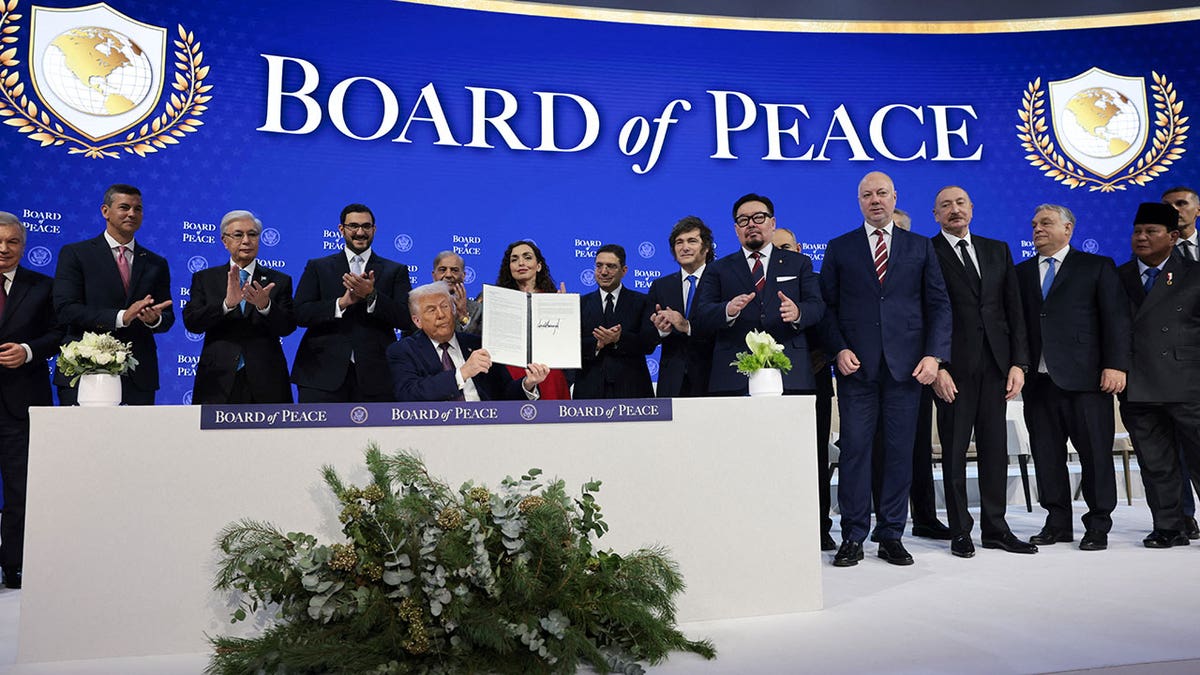
President Donald Trump participates in a charter announcement for his Board of Peace initiative aimed at resolving global conflicts during the 56th annual World Economic Forum in Davos, Switzerland, Jan. 22, 2026.(Jonathan Ernst/Reuters)
In an interview with Fox News Digital, Richard Goldberg, a senior advisor at the Foundation for Defense of Democracies nonprofit, said, “What we’re seeing is a recurring pattern in this conflict where the humanitarian narrative is being weaponized.”
Goldberg argued that the timing of the famine claims is tied to growing pressure on Hamas to disarm and to broader diplomatic efforts involving the United States, Arab states and international partners.
“One of those weapons is trying to resurrect a narrative of famine,” he said.
Hamas is seeking to “undermine” a coalition involved in shaping Gaza’s post-war future, according to Goldberg, and prevent consensus around next steps.
“Hamas is the isolated party, and they do not want to disarm,” he said.
Goldberg said that, unlike earlier stages of the war, the current environment makes it harder for such claims to take hold.
“You now have months of ceasefire, and the U.N. and other partners have been directly involved in the humanitarian effort,” he said.
“They all have the data… and they are all in a position where there’s a brick wall Hamas is going to find for its disinformation tactics,” he added.
Personnel work at the U.S.-led Civil-Military Coordination Center in Kiryat Gat, Israel, on Nov. 19, 2025, coordinating with Israeli counterparts to monitor the Gaza truce.(Ahikam Seri/AFP)
“What worked against just Israel a year ago cannot work as well against an entire coalition,” Goldberg said.
A senior Israeli military official told Fox News Digital that during the ceasefire, humanitarian throughput into Gaza averaged roughly 600 trucks per day, far above what the official said U.N. planning models estimated was required to meet baseline food needs.
“According to the U.N., it’s somewhere between 115 to 130 trucks a day,” the official said, while emphasizing that recent aid levels have significantly exceeded that threshold.
The official said that despite temporary disruptions during the Iran conflict, crossings quickly reopened and aid volumes returned to high levels, arguing that current famine allegations are “completely false.”
“It’s impossible with the amount of aid that is going in,” the official said. “There is no shortage of food in the Gaza Strip for an extended period.”
Israel’s Coordinator of Government Activities in the Territories (COGAT) similarly told Fox News Digital that Israel’s defense establishment believes Hamas is attempting to exploit global attention shifting toward Iran and Lebanon by pushing renewed humanitarian collapse narratives about Gaza.
Hamas has repeatedly sought throughout the war to portray “a deliberately false narrative of the collapse of the humanitarian system” in Gaza in order to increase international pressure on Israel and shape negotiations, according to COGAT.
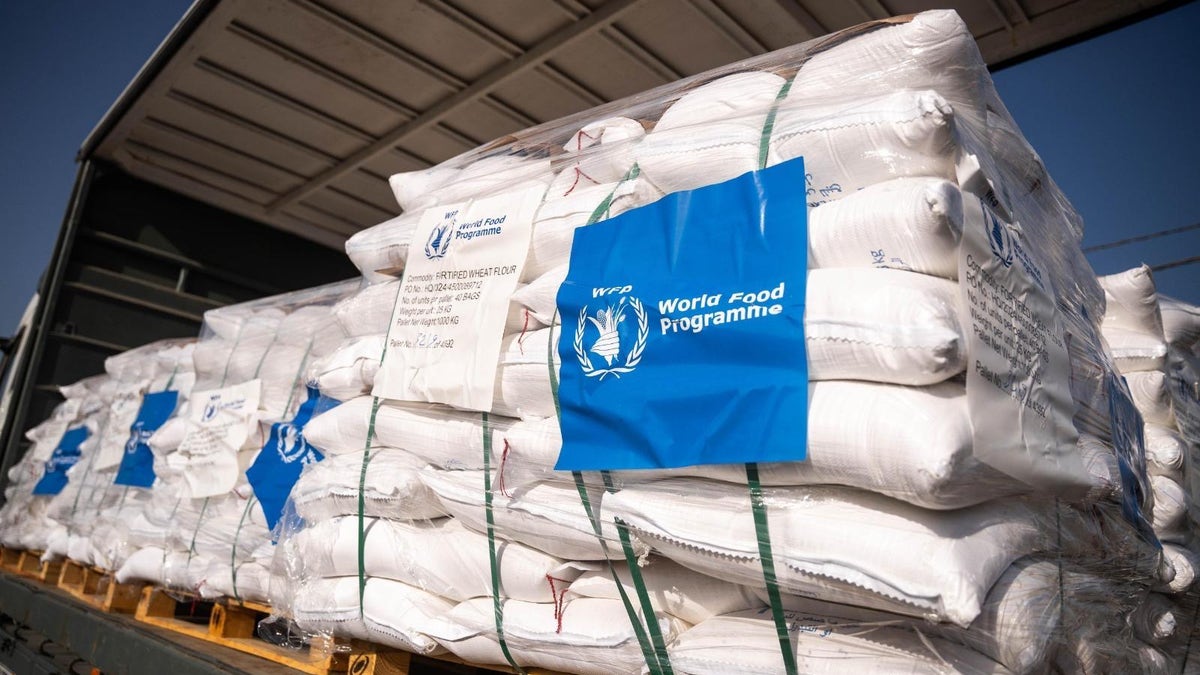
World Food Programme aid is positioned at the Erez crossing on the Israel-Gaza border, according to an IDF spokesman.(IDF Spokesman)
A security official said Hamas intensifies such campaigns whenever diplomatic pressure rises.
“Hamas is trying to stall for time and is using all means to maintain its grip on power,” the official said. “Whenever negotiations over an agreement take place, Hamas intensifies false campaigns about the humanitarian situation in the Gaza Strip in order to secure international support through fabricated crises.”
Fox News Digital has reached out to the United Nations and the World Food Programme for comment.
Efrat Lachter is a foreign correspondent for Fox News Digital covering international affairs and the United Nations. Follow her on X @efratlachter. Stories can be sent to [email protected].
New Delhi — An Indian man dug up his sister’s body and carried it to a bank branch to prove she was dead after being refused access to her account without a death certificate, the lender says.
Jitu Munda, from a constitutionally recognized tribal community in the eastern state of Odisha, went to an Indian Overseas Bank branch on Monday to withdraw money from his deceased sister’s account.
But bank staff told him “withdrawals by a third party are not permitted without proper authorization,” the lender said Tuesday.
Angered by being turned away because he didn’t have her death certificate, Munda returned to the branch carrying the “human remains” of his sister, who had been buried days earlier, the bank said.
Television networks broadcast footage of Munda carrying what appeared to be a corpse partially wrapped in plastic, with skeletal legs visible and slung over his shoulder.
“This created a highly distressing situation at the premises,” the bank said.
It added that the incident stemmed from a “lack of awareness” and the individual’s unwillingness to follow procedures.
“The claim will be settled on (with) priority, once the death certificate is submitted,” it added.
Registration of births and deaths is mandatory in India. But gaps in documentation persist, particularly in rural areas, leaving many families without formal certificates.
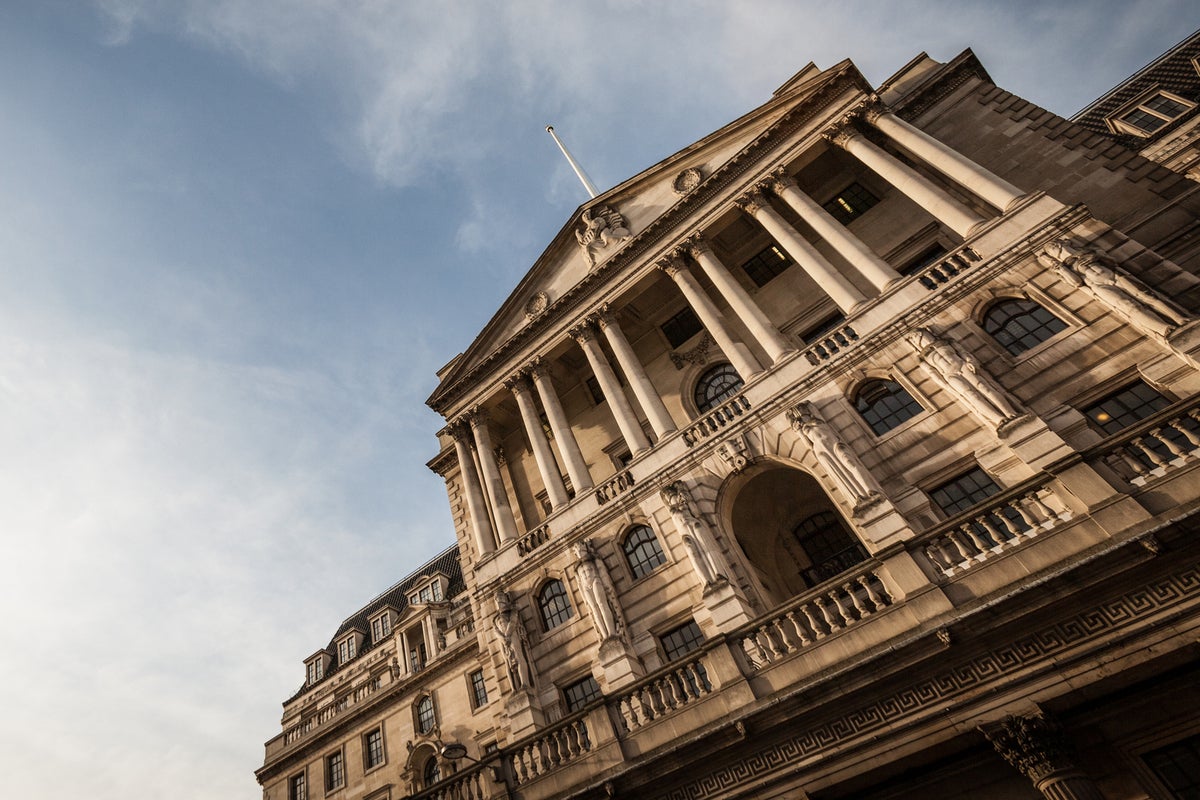
The base rate – sitting now at 3.75 per cent after being cut four times last year – impacts business, consumers and taxpayers through everything from mortgages to loans and savings, so what do experts foresee, both this week and beyond?
Will interest rates be cut?
Rates were cut just before Christmas to the lowest point in almost three years and more was expected to come across 2026.
In fact, up until mid-February there was a strong chance of a rate cut in March or April, with an expected second cut later in the summer. But everything changed with the Iran war which has sent oil prices soaring, raising energy costs and with inflation likely to rise once more.
While rates were near-zero for a long time after the financial crisis, most analysts and economists now expect the “neutral rate” – how low the bank will cut to and then leave it, where the economy continues to grow but inflation is suppressed – will be higher this time, perhaps 3 per cent.
That means only another three cuts might come in total during this cycle, and as we get closer to that rate, the cuts could be spaced out further.
However, events in the Middle East have thrown those expectations into disarray and there is now real uncertainty which way rates will go in the nearer term. Analysts just about expect the rate to be held at 3.75 per cent for this vote, though some have argued for raising rates earlier this time to head off worse inflation down the line.
Interest rates from 2019 to 2026 (Bank of England)
Influential factors
Interest rate decisions take into account multiple factors over long periods of time, as well as expectations about what lies ahead – and 2026 again looks tricky in both regards.
Get a free fractional share worth up to £100. Capital at risk.
The MPC has nine members, and their votes decide whether the base rate is cut, raised, or kept the same.
Among the elements MPC members will have been looking at are job and wages data, the level of inflation across the UK, and economic growth.
Higher inflation is a reason to keep interest rates up, as it can discourage businesses from investing in new projects or hiring – things that in turn raise earnings and spending power. Conversely, fewer jobs and lower wages means less spending power and lower demand, which helps to stem further price rises.
Recent key data has shown salary growth slowing and unemployment rising throughout the year.
These are factors that can see interest rates decrease, while there are also external factors that can affect the UK, which the government and Bank of England can have little or no control over.
UK outlook
As well as the domestic situation of higher-for-longer inflation, there has been rising unemployment across the UK, despite a minor drop last month. Very slow economic growth is another factor to weigh up.
But the big economic impact of the war in Iran is the surging price in oil and gas, which when sending energy bills higher adds to a return of high inflation.
Suren Thiru, ICAEW chief economist, said: “While the economic aftereffects of the Iran war have turned the Monetary Policy Committee notably more hawkish, a policy hold at 3.75% looks locked in given still heightened uncertainty over the ramifications of the conflict.
“Stagflation fears will cast a long shadow over this policy meeting with elevated concerns over inflation possibly pushing at least one of the more hawkish rate-setters to break ranks and vote to raise rates.
“With the Bank’s updated forecasts set to further fuel stagflation fears by projecting notably higher inflation and weaker economic growth, setting policy is likely to become more hazardous for committee members, especially given rising global headwinds.
“The squeeze on demand in the economy from weakening wage growth and a slowing economy should give policymakers sufficient wriggle room to keep rates on hold through this period of elevated inflation.”
Harriet Guevara, chief savings officer at Nottingham Building Society, added: “A hold at 3.75% this week now feels very likely, but the bigger story is how much the outlook has shifted. Just a few months ago, markets were pricing in further cuts. Now, with the conflict in the Middle East driving energy prices higher and inflation expectations rising, markets are pricing that rates are more likely to go up than down.
“For savers, that’s a meaningful change. Savings rates are already competitive, and if the base rate does rise further, there could be even more to come. On the mortgage side, the prospect of rate rises rather than cuts makes this an important time for borrowers to take stock. Anyone coming to the end of a fixed deal in the next six to twelve months should speak to a qualified mortgage broker who can assess their options and help them make the right decision for their circumstances. The market is moving, and professional advice is the best way to make sure you’re not caught out.
“Whatever happens with the base rate over the coming months, the people who tend to come out ahead – whether saving or borrowing – are the ones who act while conditions are in their favour, not the ones who wait and hope.”
Elsewhere, it’s worth remembering that with mortgages in particular, many products are priced using future expectations of the interest rate (swap rates), so changes in that market can already be accounted for.
For savers, though, whether or not an immediate cut to variable rates is coming, it’s always worth checking the best offers on the market to make sure your money is earning as much as it can for you.
Uncertain outlook: the Bank of England governor has repeated the mantra of ‘gradual and careful’ frequently this year (Getty/iStock)
What about the rest of 2026?
The further into the future we look, the more murky the picture is – and it can change rapidly anyway as we saw last year with tariffs, Budget uncertainty, oil shocks and more, and have now witnessed even across the past month in Iran.
Markets have wavered wildly recently between expecting only one cut this year and up to three rises occurring if the situation in the Middle East is prolonged.
The royals touched down at the Joint Base Andrews air base in Maryland, a short distance from Washington, Monday afternoon Eastern Time.
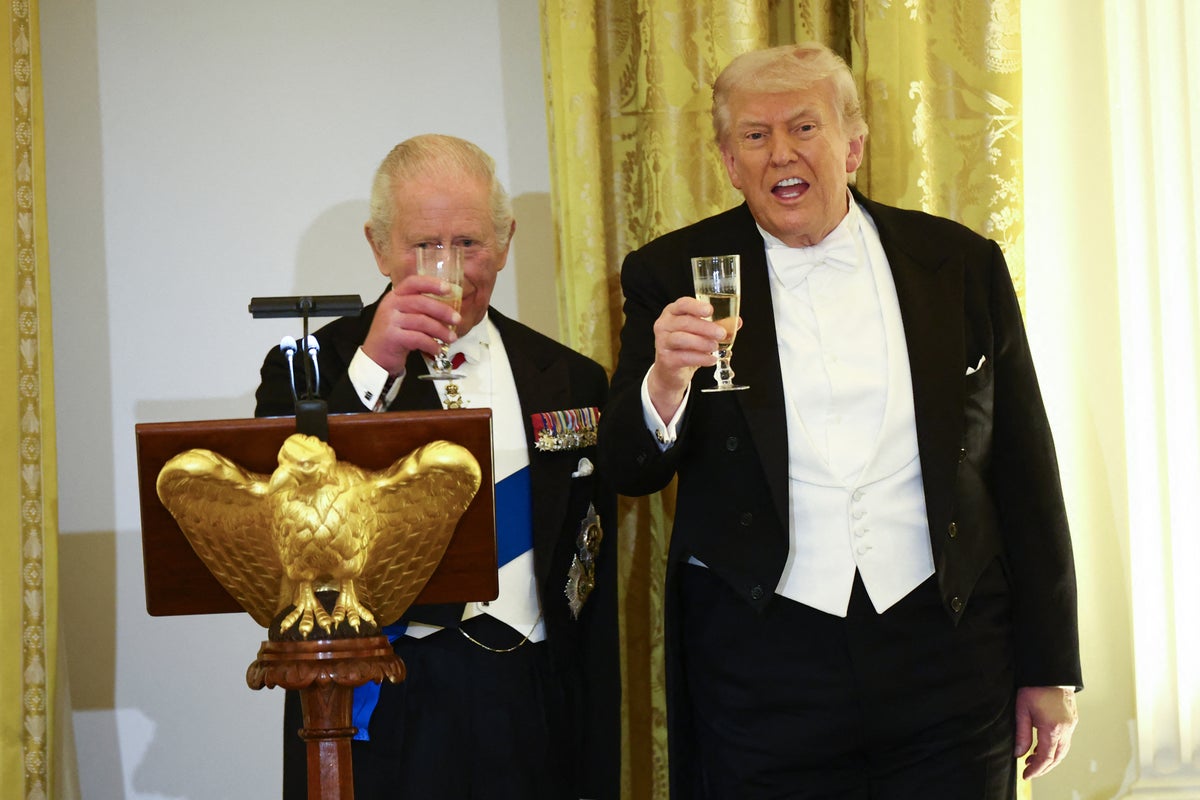
The historic state visit marks the King’s first state visit to the United States as monarch and heralds the start of celebrations marking the 250th anniversary of American Independence. The state visit will also commemorate the 25th anniversary of 9/11.
Reflecting on American Independence as part of his historic speech to congress on Tuesday, Charles emphasised that despite not always agreeing, the two nations had always found a way of coming together.
Charles is the second British monarch to address Congress — his mother, Queen Elizabeth II, being the first to do so in 1991 (Getty)
“With the spirit of 1776 in our minds, we can perhaps agree that we do not always agree – at least in the first instance,” he said, adding: “When we have found that way to agree, what great change is brought about – not just for the benefit of our peoples, but of all peoples.
“This, I believe, is the special ingredient in our relationship.”
Hopes remain that the diplomatic soft power of the royal family will go a long way in rectifying relations between the US and UK after the president branded Britain’s approach to the Iran war “terrible” and repeatedly lashed out at Sir Keir Starmer – at one point describing him as “not Winston Churchill”.
Donald Trump was rushed out of the White House correspondents’ dinner (Reuters)
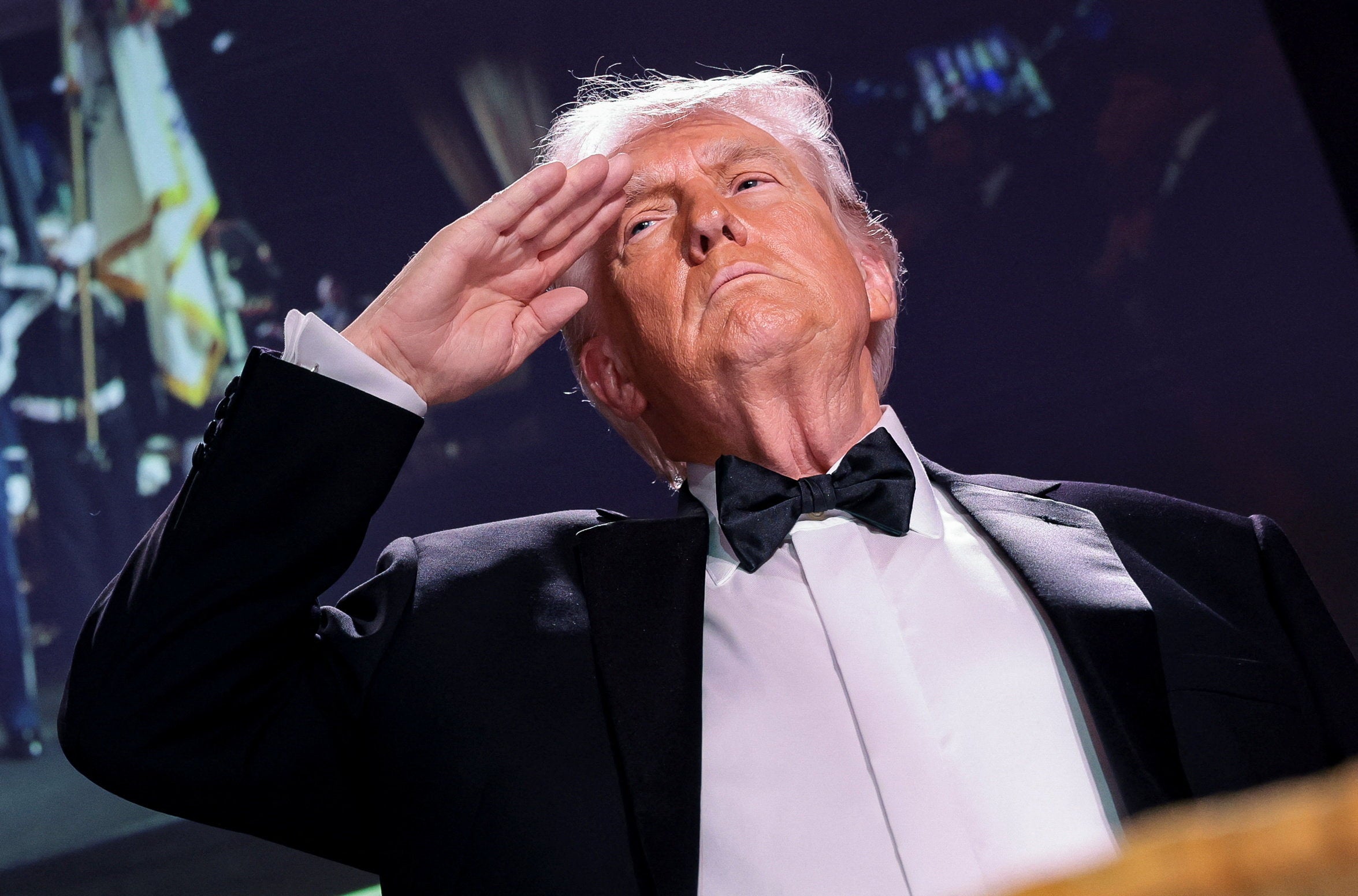
Days prior to the highly-anticipated state visit, a shooting at the White House correspondents’ dinner raised questions as to whether the King would continue his planned journey after Trump and other cabinet officials were rushed to safety out of the black tie gala. Buckingham Palace confirmed on Sunday that the state visit would go ahead as planned.
The suspect shot and injured one law enforcement officer before being detained near the hotel screening area, officials said in the aftermath.
A spokesperson from Buckingham Palace said: “Following discussions on both sides of the Atlantic through the day, and acting on advice of government, we can confirm the state visit by their Majesties will proceed as planned.
The royal couple attend a tour of the White House beehives (Reuters)
“The King and Queen are most grateful to all those who have worked at pace to ensure this remains the case and are looking forward to the visit getting underway tomorrow.”
Here is what we know about the scheduled plans for the King and Queen in the United States.
Wednesday
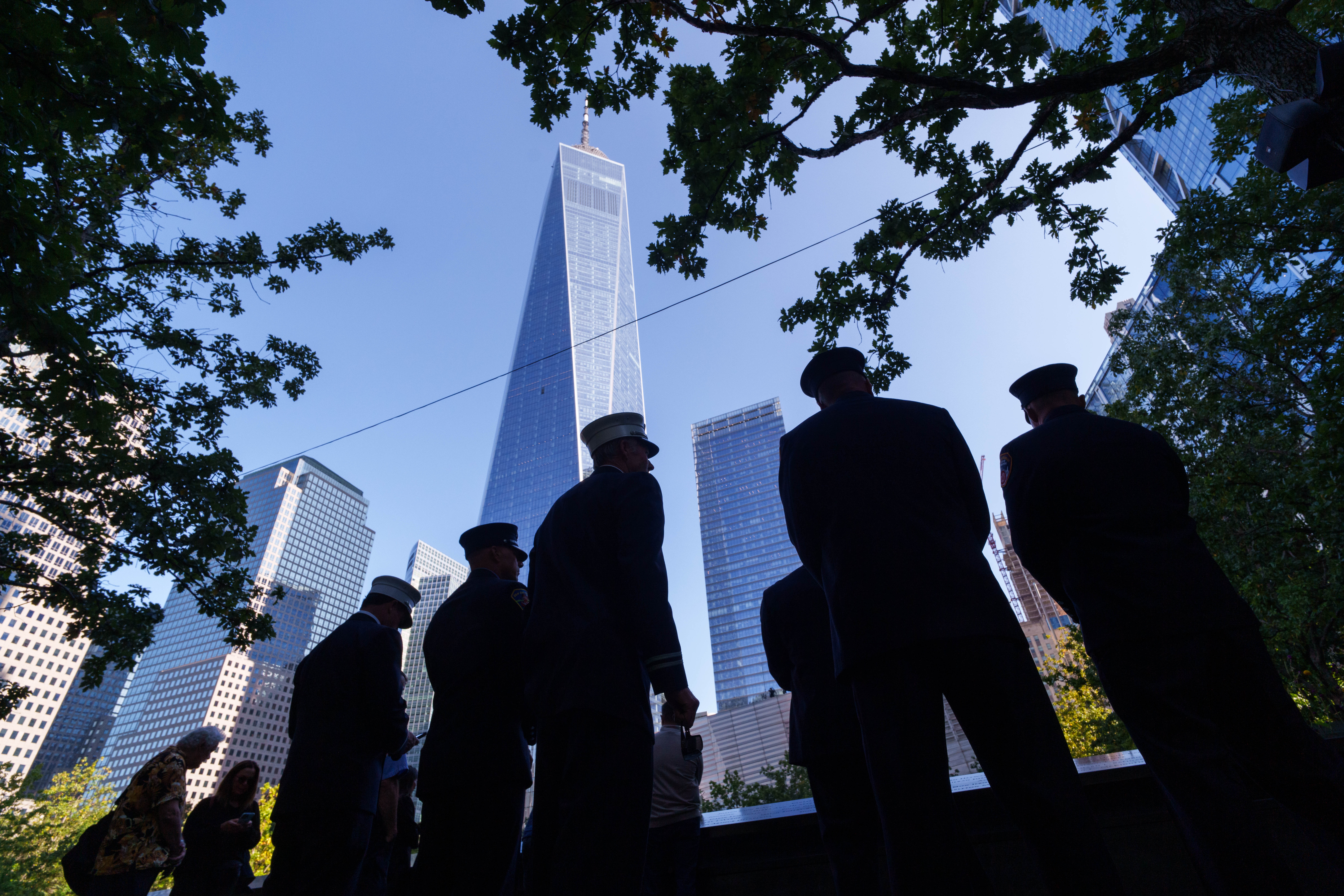
Charles and Camilla are set to travel to New York on the third day of their state visit, where they will visit the 9/11 memorial around 1pm local time (6pm BST) marking the approach of the 25th anniversary of the 11 September attacks. During their visit, they will also meet with first responders and families of those who were killed that day.
This year marks the 25th anniversary of 9/11 (Getty)
As part of a visit to the New York Public Library’s permanent treasures collection at 2pm local time (7pm BST), the Queen will give a specially made toy of Winnie-the-Pooh character Roo to the library to complete a set of the beloved characters in one of the institution’s collections.
The library is home to the teddy bears which belonged to Christopher Robin, son of Winnie-the-Pooh creator A A Milne, believed to have inspired the stories first published in 1926. While Winnie, Tigger, Piglet, Kanga and Eeyore are all on display, the original baby kangaroo toy, Roo, was lost in an apple orchard in the 1930s.
The Roo toy was made specifically for the visit by traditional British teddy bear makers Merrythought, who produced the original toys.
(AFP/Getty)
While the Queen attends the famous library, the King is set to attend a community engagement in Harlem before attending a UK-US trade and business event at 3.25pm local time (8.25pm BST).
Charles and Camilla will reunite at around 5.15pm local time (10.15pm BST) to attend a UK-US cultural reception..
Thursday
The royals will say farewell to the president and first lady on Thursday before heading south to Virginia for a number of community activities. Charles and Camilla are reportedly set to attend a party marking the 250th anniversary of American independence, as well as meeting members of indigenous communities to discuss climate change projects, according to US media.
The King will go on to visit Bermuda following the US state visit.
What has happened so far?
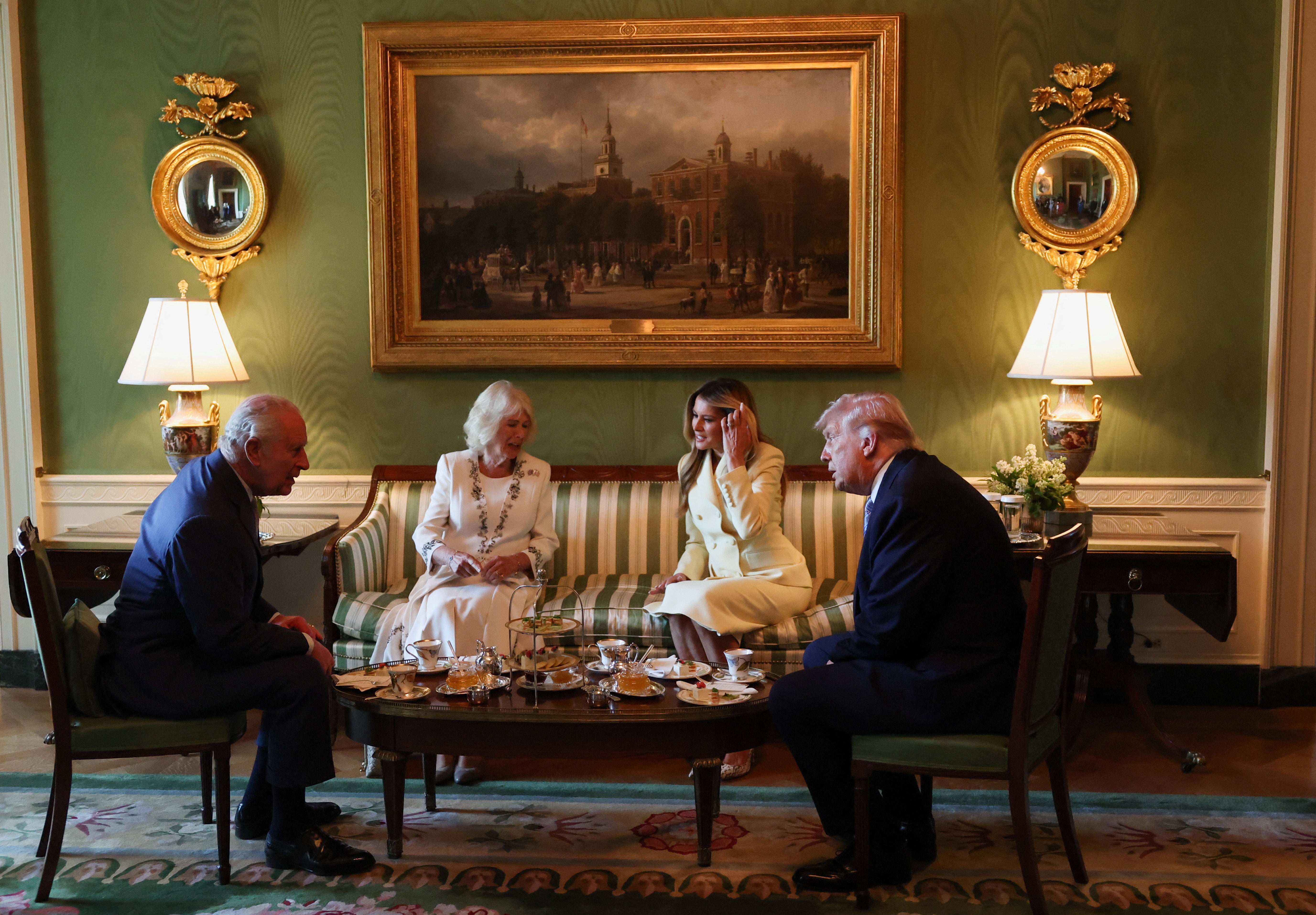
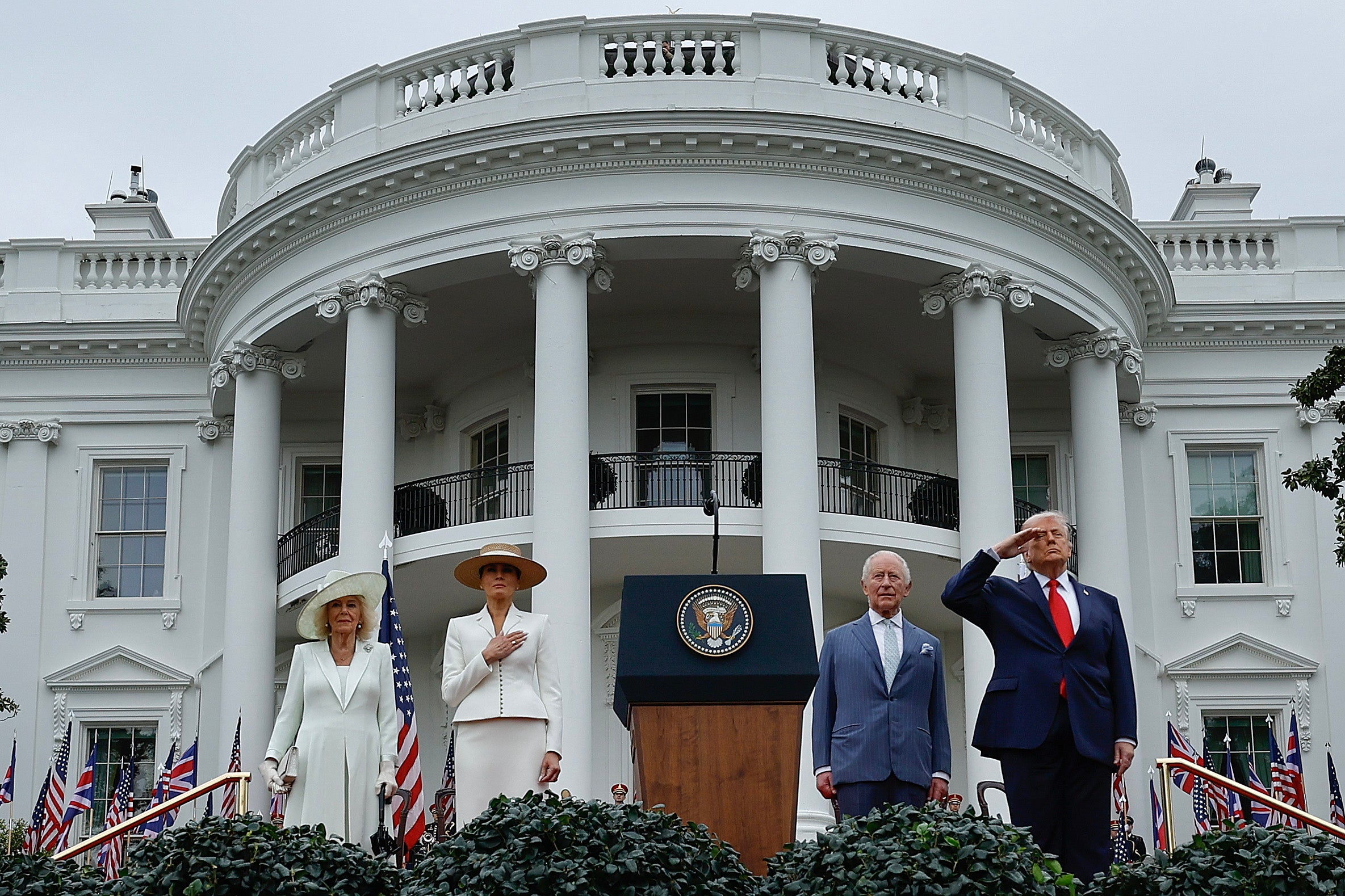
Charles and Camilla were greeted by Mr Trump and first lady Melania Trump at around 4.15pm local time (9pm BST) at the White House’s south portico. The heads of state joined together for a private afternoon tea in the Green Room on the state floor.
President Donald Trump and first lady Melania Trump host King Charles III and Queen Camilla for tea (Getty)
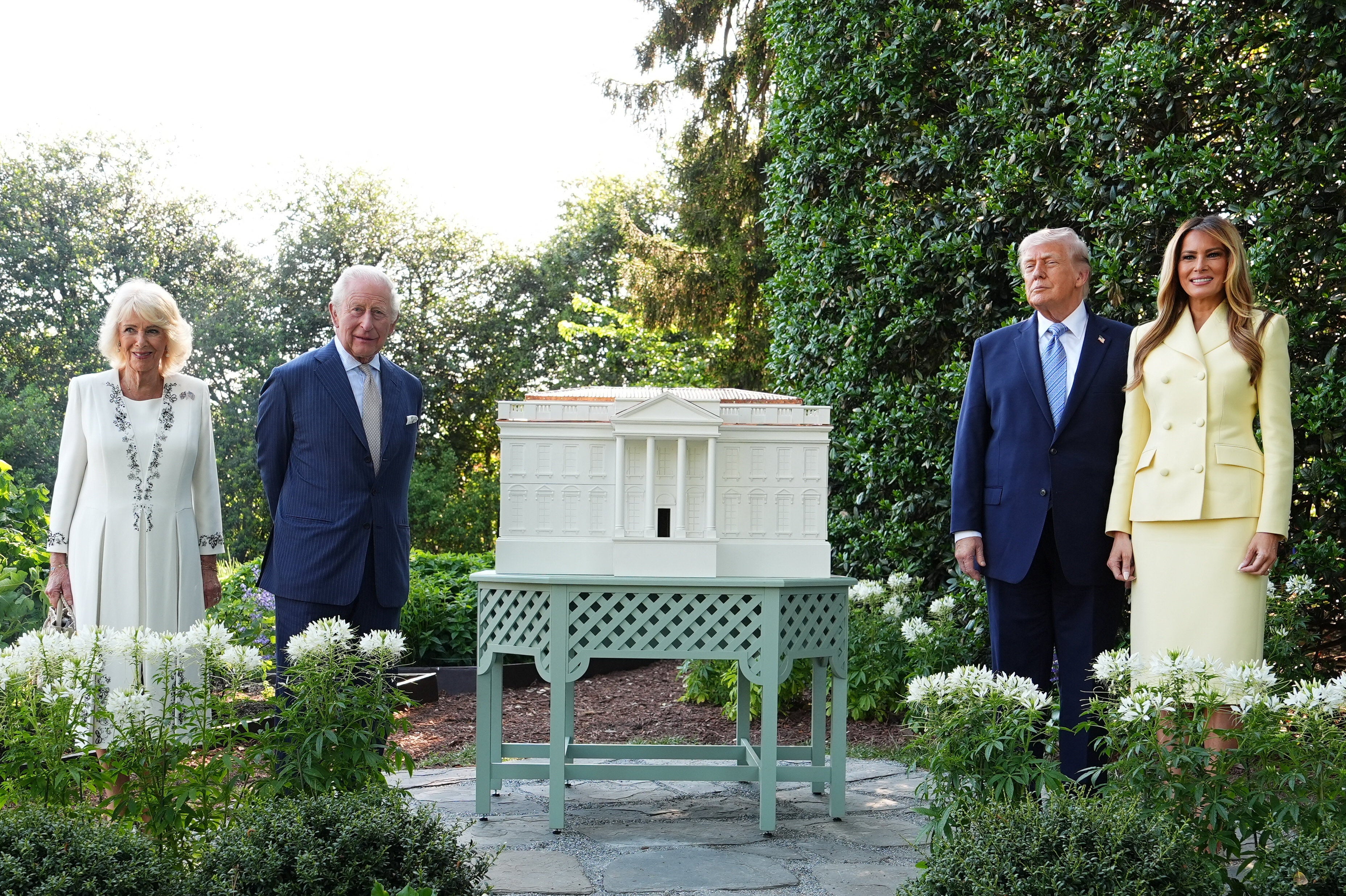
The King and Queen visited the beehives nestled on the South Lawn near the historic building’s kitchen garden. It comes a week after the first lady announced the White House had expanded its long-running honey-making programme, including a new beehive shaped like the president’s official residence.
During the open-air soiree in the gardens of the official residence of Sir Christian Turner, the UK’s ambassador to the US, Camilla chatted to charity bosses working to combat child exploitation and sexual abuse.
The King ended the first day of the much-anticipated visit by chatting to former Olympic diving champion Tom Daley about their shared love of knitting.
The second day of the state visit began with a state arrival ceremony on the south lawn of the White House at 10.35am local time (3.35pm BST) where the King inspected the troops alongside the president. Trump gave a speech in Charles’ honour where he said: “In the centuries since we won our independence, Americans have had no closer friends than the British.”
The King and Queen attended a ceremonial welcome on Tuesday (Getty)
He went on to mention his own mother, Scottish-born Mary Macleod Trump, who had a “crush” on the King when he was younger.
“She really did love the family but I also remember her saying very clearly, ‘Charles, look young Charles, he’s so cute’,” Trump said. “My mother had a crush on Charles – can you believe it?”
The King and Queen went on to sign the White House guest book and exchange gifts with the president and first lady around 11.10am local time. Trump and the King had a bilateral meeting shortly after.
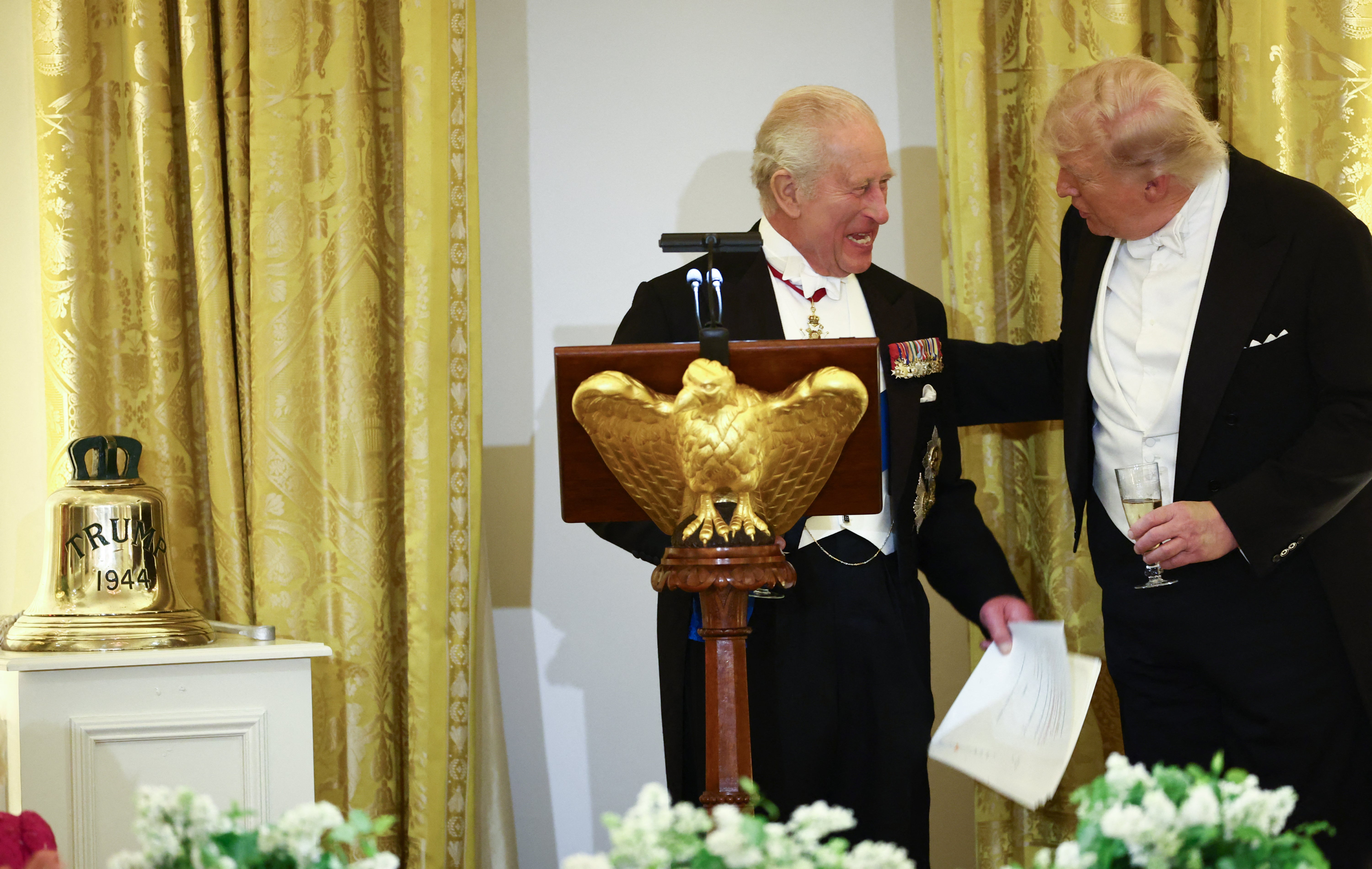
The King gifted President Trump a bell (AFP/Getty)
Charles gave a speech to both houses of Congress later that day which received a standing ovation as he emphasised the “interlinked” destinies of the UK and the US.
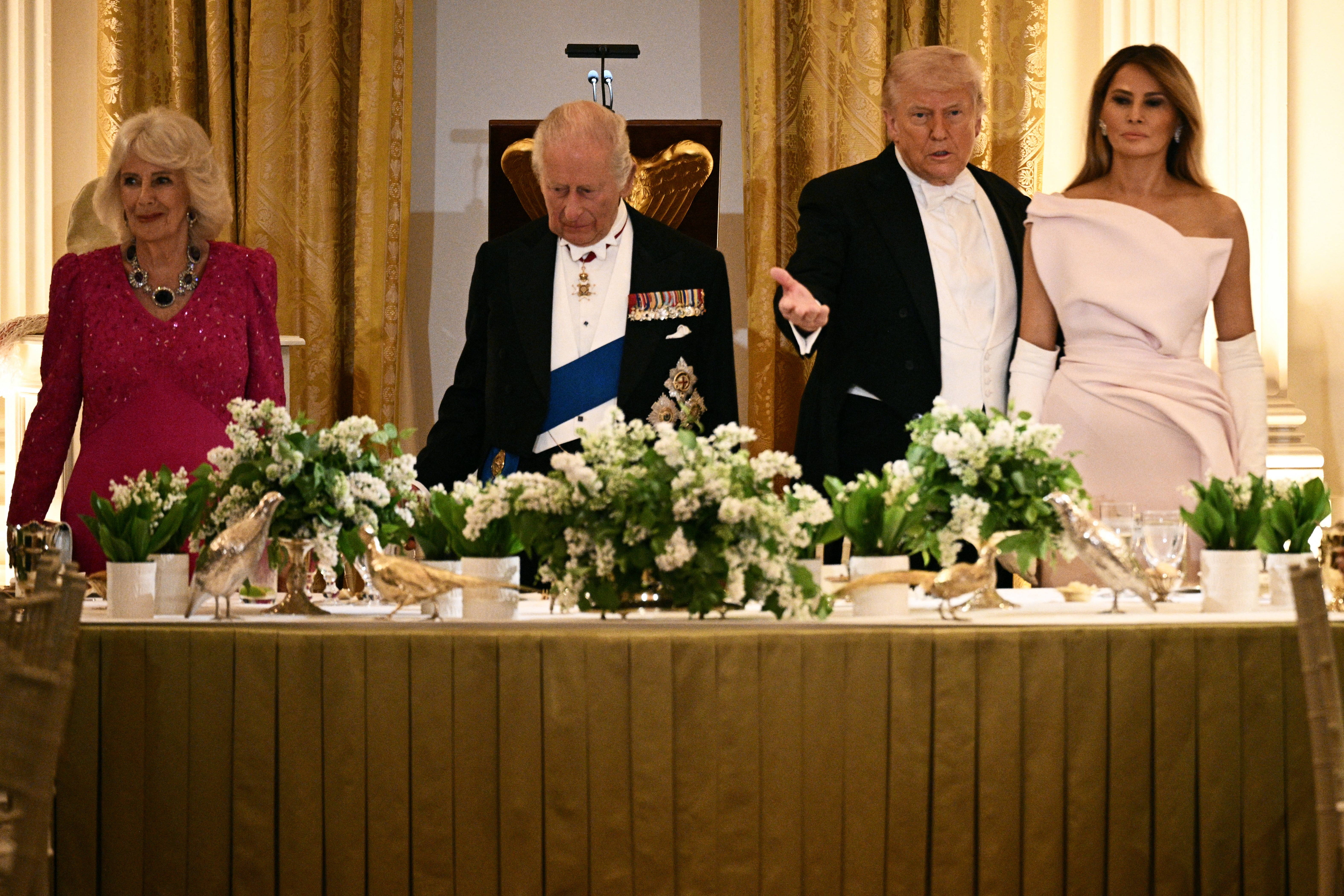
That evening, Mr and Ms Trump greeted the royals again for a tour and document viewing before the state dinner in the East Room.
Trump was presented with a Second World War-era submarine’s bell, polished to a mirror shine, which had once been part of a British submarine that spent more than 20 years in Australia when the Royal Navy maintained a permanent presence there. The boat’s name was H.M.S. Trump.
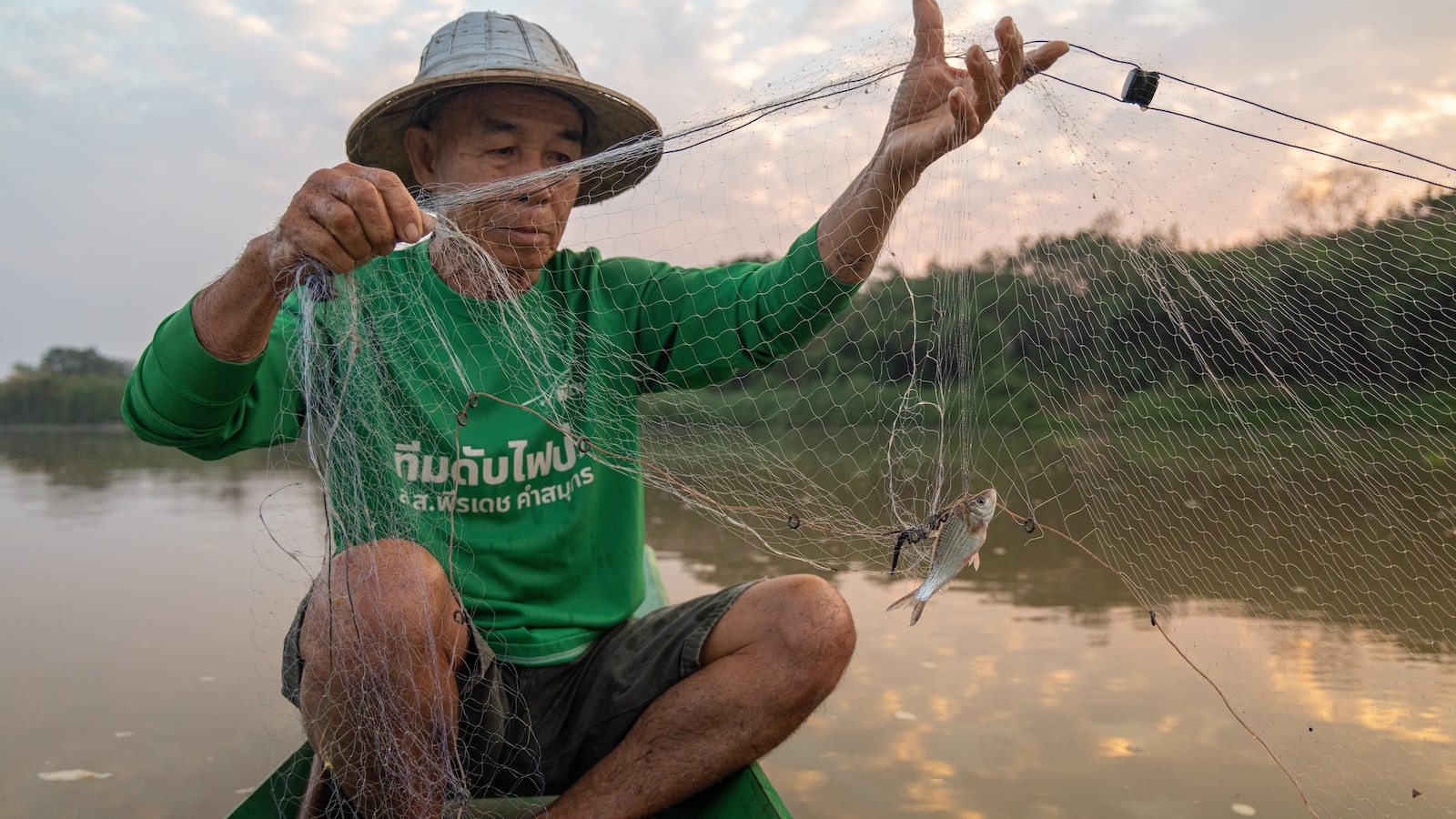
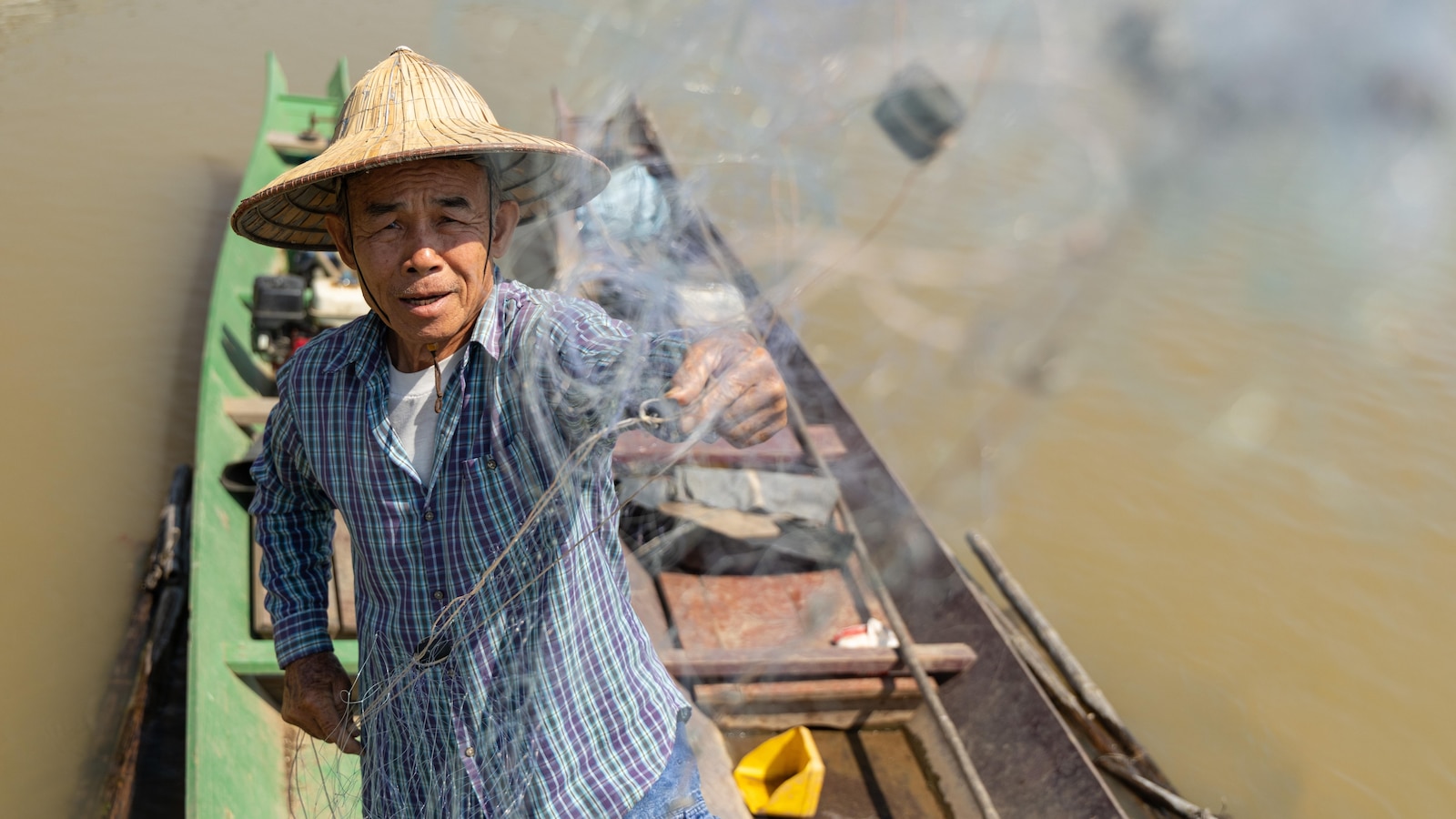
CHIANG SAEN, Thailand — A lone finger-length fish was a disappointing start to 75-year-old Sukjai Yana’s day. He recast his net from the bow of his long-tail fishing boat, slowly drifting towards the confluence of the Mekong and Kok rivers in northern Thailand.
Thailand is bearing the brunt as toxic runoff from rare earth mines in upstream Myanmar and Laos seep into the Mekong Basin, threatening millions who rely on its waters for farms and fisheries.
These heavy metal toxins imperil Southeast Asia’s globally important, multi-billion-dollar produce industry, backbone of its developing economies.
“The Mekong and Kok Rivers are both a source of food and income, which gives life to the people,” said Sayan Khamnueng of the Living Rivers Association. “The river contaminants are the biggest transboundary issue we’ve ever faced.”
Thailand’s response to the spreading problem has been limited to monitoring levels of heavy metals and educating communities about health risks. That raises concerns for Cambodia and Vietnam, downstream.
“If the contamination continues … the new generation (will) have to move to the city because they cannot continue their farmer’s life,” said Sangrawee Suweerakarn of the Romphothi Foundation, an advocacy group for the Shan ethnic group.
___
The Associated Press’ climate and environmental coverage receives financial support from multiple private foundations. The AP is solely responsible for all content. Find AP’s standards for working with philanthropies, a list of supporters and funded coverage areas at AP.org.
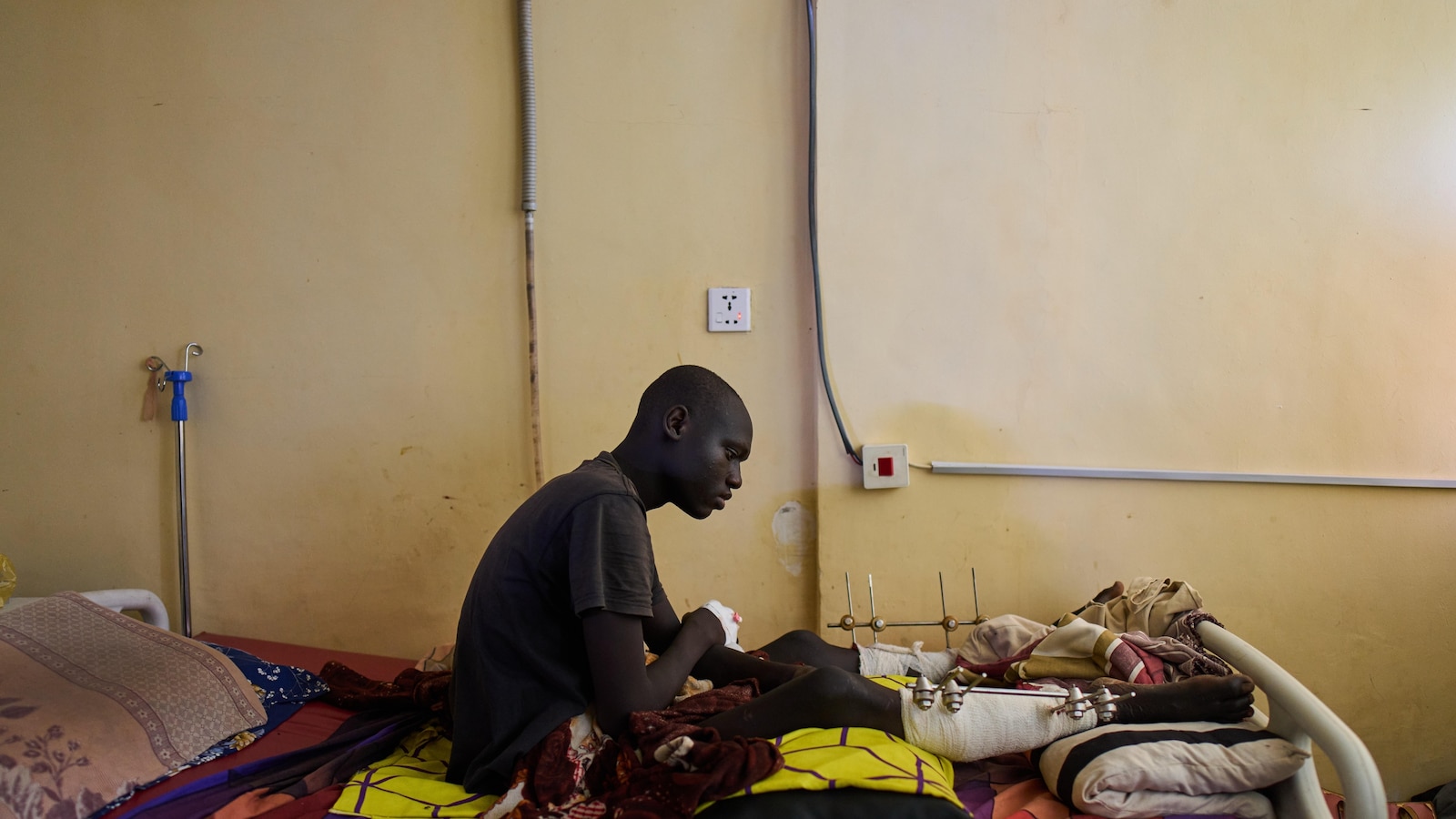
KHARTOUM, Sudan — Khaled Abdulgader noticed children using an unusual object as a football and tried to stop them. He grabbed it, and it exploded in his hand. He lost two fingers, and shrapnel sliced into his chest.
In a hospital for a checkup after last year’s blast, he tried to stay positive.
“I feel like, ‘Thank God it was just my hands,’” Abdulgader said.
He is among hundreds of people who have been injured or killed by unexploded ordnance in Sudan’s three years of war. That includes mines as well as weapons such as bombs, shells, grenades or rockets that failed to detonate, tens of thousands of items in all.
The government and aid groups say it’s a problem particularly in and around Khartoum, where residents, many unfamiliar with the threat, have started to return after the Sudanese military recaptured the capital last year.
Nearly 60 people were injured or killed in Khartoum state last year, over half of them children, and 23 were injured or killed in the first three months of this year, 21 of them children, according to the United Nations.
Decades of conflict in Sudan have left unexploded ordnance scattered across the country, with a combined area of about 7,700 football fields contaminated.
More than half of that is the result of the war that erupted in 2023 between Sudan’s army and the Rapid Support Forces paramilitary group, with new areas such as Khartoum state affected.
Both the Sudanese army and the RSF have been accused of laying mines, according to aid groups, during the war as they fought for control of the capital.
“The presence of land mines and other explosive ordnance is of great concern to everybody,” said Juma Abuanja, the team leader for Jasmar, a Sudanese demining group.
He said it will take years to clear. Demining is a slow, careful process with staff covering 10 to 15 square meters a day.
Khartoum city is still a ghost town, strewn with remnants of fighting. Charred, abandoned buildings are pocked with bullet holes.
Walking through the streets, AP journalists saw a soldier emerge from a house with a small metal object that appeared to be a tail of a rocket-propelled grenade after being summoned by a resident to assess the threat.
A member of the military media accompanied the AP during the visit, including during interviews. The AP retains full editorial control of its content.
Tens of thousands of people have returned to the city and 1.7 million have returned to Khartoum state, according to the U.N.
The U.N. says deminers over nearly the past year have cleared some 7.8 million square meters of land in Khartoum state. They found more than 36,000 items including hundreds of anti-tank and anti-personnel mines.
Those that are safe to move are destroyed away from population areas. Those that can’t be moved are destroyed on the spot.
There is still much to clear as people try to rebuild their lives.
In Khartoum, Jasmar’s demining team has spent eight months clearing a popular park from land mines, one of at least seven identified mine fields in Khartoum state. Some locations are on the outskirts. Others are downtown. Some are near important bridges.
Removing their heavy vests and face shields, team members rested last week under trees between shifts, shielded from the scorching sun.
The clearance of some 123,000 square meters in the park began in August and is expected to be completed in May. So far the group has found more than 160 devices, including anti-personnel and anti-tank mines.
Abuanja said at least one person was killed in the park before they started clearing it. The area is now cordoned off, surrounded by danger signs.
Sudan’s government says it is doing what it can to reduce the threat but says it is strapped for cash and personnel.
A government official told the AP it is trying to raise awareness by speaking at mosques and in the markets and via radio and podcasts, and it is creating educational materials with schools. The official spoke on condition of anonymity because they were not authorized to speak to the media.
Yet several injured people told the AP they hadn’t seen or heard any warnings, which began in late 2024.
Some people said there could be fear of reporting unexploded ordnance to authorities because they could be questioned about why they have weapons. A report earlier this year by Human Rights Watch said security forces have detained civilians for allegedly collaborating with the RSF, especially in areas where the army has regained control.
Others don’t recognize the threat until it’s too late.
Mogadem Ibrahim once picked up a piece of metal thinking it was part of a car. But when it stuck to his hand and he tried to strike it away, it exploded.
The 18-year-old now keeps his bandaged left arm hidden beneath his clothes. The blast outside his home in Omdurman in August took his fingers, and he can no longer work as a laborer.
“I feel depressed and worthless. I was supporting my family and now I’m sitting here and doing nothing,” he said.
The Associated Press receives financial support for global health and development coverage in Africa from the Gates Foundation. The AP is solely responsible for all content. Find AP’s standards for working with philanthropies, a list of supporters and funded coverage areas at AP.org.
CHIANG SAEN, Thailand — Perched on the bow of his long-tail fishing boat, 75-year-old Sukjai Yana untangled a handful of small fish from his net, disappointed by his catch and fretting over whether he can sell them.
Some days Yana earns nothing: demand for fish is falling due to worries over contamination of the Mekong River and its tributaries by toxic runoff from rare earth mines upstream that is threatening millions who rely on those waters for farms and fisheries.
Chiang Saen, a fishing hub in northern Thailand, has been Yana’s family’s home for decades. “I don’t know where else I’d go,” he said.
Yana is one of 70 million people in mainland Southeast Asia who depend on the nearly 5,000-kilometer (3,100-mile) Mekong River. Rising demand for rare earth materials is driving an unregulated mining boom centered in war-torn Myanmar, to the west, that is spreading to Laos, in the east.
The Mekong has long faced mounting pressures, from plastic pollution to hydropower dams hemming it upstream and sand mining devouring its banks. But experts warn that the toxic runoff from the mines could pose an existential threat.
Exposure to heavy metals such as arsenic, mercury, lead and cadmium raises risks of cancer, organ failure and developmental harm, especially for children and pregnant women.
Thailand is bearing the brunt of the mining boom as such toxins imperil its global food exports — from bags of rice in U.S. supermarkets to edamame snacks served in Japan and garlic used in Malaysian kitchens. Responses remain local and limited, while smuggling and Myanmar’s civil war complicate regional fixes, raising concerns for downstream Cambodia and Vietnam.
Agriculture is the backbone of Southeast Asia’s economies, said Suebsakun Kidnukorn of Mae Fah Luang University in northern Thailand’s Chiang Rai, warning that rare earth mines are destroying “the world’s kitchen.”
While cutting banana bunches on a farm in the hilly Thai village of Tha Ton, 63-year-old Lah Boonruang taps his fingers to count the toxin-exposed crops he harvests — rice, garlic, corn, onion, mangoes and bananas.
He irrigates his fields with water from the Kok River, a Mekong tributary that flows into Thailand from Myanmar and is laden with toxins.
“Everyone is afraid of the toxins,” he said. “If we can’t export, a farmer is the first to die.”
Thailand is one of the world’s top rice exporters along with India and Vietnam. It exported over $10 billion worth of rice and fruits in 2024, according to trade figures that rank the U.S. as the top rice importer.
“Our worry is that toxins accumulate in the rice we export. This would make our rice farming industry, which is our culture, collapse,” said Niwat Roykaew, founder of the environmental institute The Mekong School in northern Thailand’s Chiang Khong.
Thai scientists have found elevated heavy metal pollution in other Mekong tributaries, like the Sai and Ruak rivers.
The Mekong starts in China and flows through five Southeast Asian nations before emptying into the sea. Millions rely on fish from the Mekong Basin for protein.
Warnings to ethnic minorities in the hills of northern Thailand to avoid using river water are painful for the Lahu, who are famed as fisher people, said Sela Lipo, 56, a Lahu elder.
“The Lahu’s way of life is always with a river,” he said. “The contaminated river has cut off our lifeline.”
Thailand’s government says it has little leverage against mining operations across the border in strife-torn Myanmar and Laos. The Thai response has also been constrained by limited expertise, information and funds, said Aweera Pakkamart of Thailand’s Pollution Control Department.
Instead, public universities, local governments and regional organizations like the Mekong River Commission, have mainly focused on monitoring levels of heavy metals and educating communities about risks.
Recent water, fish and sediment samples from Mekong tributaries had high levels of dangerous heavy metals, such as arsenic, mercury, lead and cadmium, from rare earth mining, said Warakorn Maneechuket, a researcher at Thailand’s Naresuan University.
In a lab, she uses a scalpel to point out tell-tale signs of contamination — tumor-like growths, discolored scales, and unusual eye coloration — before dissecting a catfish caught from the Kok River.
The accumulation of heavy metals is insidious. Arsenic can cause organ failure. Mercury damages the nervous system. Lead impairs cognition and cadmium harms the kidneys.
To raise awareness of health risks, Tanapon Phenrat of Naresuan University helped develop a smartphone fish safety app, training fishers in Chiang Saen to use it to identify and upload images of suspicious fish. Building a citizen-science database for northern Thailand can help quantify the scale and spread of contamination, he said.
“Each and every sample is very important,” he said.
The ubiquity of rare earth elements means demand keeps rising.
Rare earths are vital to modern technology, from smartphones and electric vehicles to missiles and jets. Despite the name, they are common. It is the costly mining and complex refining process, concentrated in China, that makes them scarce.
The U.S.-based Stimson Center has used satellite photo analysis to identify nearly 800 suspected unregulated rare earth and other mining sites along Mekong tributaries in Laos, Myanmar and Cambodia.
Many in Myanmar are in areas of active fighting. The war has driven a “diversification of mines” geographically, according to Regan Kwan of The Stimson Center, who has tracked expansion of mining to 26 sites along rivers in Laos.
Rare earths are mined by digging up rock or washing chemicals through soil to extract the minerals, creating toxic waste. The physical footprint of this process is recognizable in satellite data, Kwan said.
Myanmar is China’s leading supplier of heavy rare earths, exporting more than $4.2 billion worth of such materials to China between 2017 and 2024, mostly after a miliary takeover in 2021.
U.S. President Donald Trump made securing America’s supply of critical minerals and rare earths a key foreign policy objective. Used in fighter jets like the F-35, submarines, Tomahawk missiles, radar systems and smart bombs, according to the U.S. government, the need for more supplies is growing as the U.S. replenishes and expands military stockpiles drawn down by the wars in Iran and Ukraine.
This is bad news for the river that sustains mainland Southeast Asia.
Conflicts in last century — which include the Vietnam War and the Khmer Rouge genocide — were the most devastating for the Mekong region, but toxic runoff ranks a close second, said Brian Eyler of the Stimson Center, who called it an “atomic bomb” for river basin.
It’s far more damaging than other threats like large dams and “it is not stopping.”
___
Ghosal reported from Hanoi, Vietnam. Freelance reporter Ladawan Sondak contributed to this report.
___
The Associated Press’ climate and environmental coverage receives financial support from multiple private foundations. The AP is solely responsible for all content. Find AP’s standards for working with philanthropies, a list of supporters and funded coverage areas at AP.org.