Millions of motorists who were victims of mis-sold car loans are set to discover how they will be compensated, as the financial regulator unveils its final plans. The Financial Conduct Authority (FCA) is expected to publish its long-awaited decisions on an industry-wide compensation scheme on Monday afternoon.
The regulator had issued draft proposals last year, and significant changes are anticipated following more than 1,000 responses to its consultation. The proposed scheme is set to cover car finance agreements made between 6 April 2007 and 1 November 2024.
The FCA previously estimated that approximately 14 million deals, representing 44 per cent of all agreements since 2007, were unfairly sold and thus qualify for redress. While an average compensation of £700 per agreement has been suggested, the actual amount will vary significantly based on individual circumstances.
This was expected to come at a total cost of £11 billion to the industry, including the total payouts and the operational costs of running the scheme.
Craig Tebbutt, a financial health expert for Equifax UK, said: “It has previously been estimated that average compensation levels could be in the region of £700 per agreement but the final details around the scale, scope and timelines are expected to be confirmed on Monday.
“However, there is nothing to stop consumers checking their paperwork now and getting their details ready in the meantime.”
He said research by the credit reporting firm found that “many consumers don’t know how to check their eligibility and expect the process to be a hassle, with old or missing paperwork being a real barrier”.
Equifax has launched a car finance checker within its new app that lets people see a list of their past agreements and copy the details, with motorists encouraged to send a complaint to their lender using a template on the FCA’s website if they think they’re eligible for a payout.
Lenders and car finance providers had been challenging the FCA’s proposals with some raising concerns that the expected amount of compensation is too high and does not accurately reflect what customers lost.
Get a free fractional share worth up to £100. Capital at risk.
Before that crash, the win looked to be between Piastri and Russell.
Antonelli made a slow start and dropped to the back of the top six as Piastri swept into the lead, and Ferrari’s Charles Leclerc and McLaren’s Lando Norris also passed Russell.
Piastri held the lead confidently as Russell moved past Norris and Leclerc into second place by lap four.
Russell tracked Piastri within a second for several laps and then overtook him into the chicane on lap eight, only for the McLaren to move back past down the pit straight at the start of the following lap.
Russell was never as close again and Piastri’s confidence began to build, and he got on to the radio to his team to say he felt that he could hold on to the win if they could keep him in the lead through the pit stops.
Leclerc started the pit stop period on lap 17, Piastri following him in a lap later and Russell three laps after that.
Piastri was proved right as Russell came out of the pits behind the McLaren. Meanehile, Antonelli, who had moved past Hamilton but no further after the start, cycled up into the lead.
Bearman’s crash happened almost straight afterwards and Russell immediately knew the consequences as he saw the safety car signs alight around the track.
Piastri lost out, too, on what could have been a victory had he managed to hold on ahead of Russell, as the rest of the race suggested he would have.
But a second place finally gets the Australian’s season off the ground, and gives McLaren their first 2026 podium, after he had failed to start the first two races.
The 19-year-old Mercedes driver’s historic championship accomplishment came after he won his second F1 race in a row.
Published On 29 Mar 202629 Mar 2026
Kimi Antonelli of Mercedes won the Japanese Grand Prix on Sunday for his second straight victory as the 19-year-old Italian became the youngest driver in Formula One history to lead the world championship standings.
Antonelli took advantage of a mid-race safety car to leapfrog into the lead after a dreadful start from pole position at Suzuka and eventually led home McLaren’s Oscar Piastri and Ferrari’s Charles Leclerc.
Recommended Stories
list of 4 itemsend of list
He whooped with delight as he crossed the line, telling his team, “The pace was unbelievable today.”
He leads the championship after three races, building on the first Grand Prix win of his career two weeks ago in China.
George Russell of Mercedes, who started the day on top of the championship standings, finished fourth.
Russell battled Piastri for the lead over the first half of the race but pitted just before the safety car to drop back out of contention for the win.
McLaren’s world champion Lando Norris was fifth ahead of Ferrari’s Lewis Hamilton and Alpine’s Pierre Gasly.
Red Bull’s four-time world champion Max Verstappen, who had won in Japan for the past four years, was eighth after starting from 11th on the grid.
Antonelli leads during the Japanese Grand Prix [Andrew Caballero-Reynolds/AFP]
Antonelli recovers from poor start
Antonelli was in pole position for the second straight race, having become the youngest pole-sitter in F1 history in China.
But the Italian had a shocking start, sinking to sixth by the first corner.
Piastri took the early lead ahead of Leclerc, with Norris, Russell and Hamilton all overtaking Antonelli.
Russell moved up the field to sit on Piastri’s tail as the game of cat and mouse began.
Antonelli also made up lost ground, but a crash from Haas driver Ollie Bearman brought out the safety car midway through the race.
Bearman was limping badly as race marshals helped him off the track, and his team later said he had “a right knee contusion”.
Antonelli dived into the pits moments after the safety car was deployed, a stroke of good luck that won him the race as he emerged at the head of the pack.
Russell slid out of contention, first being overtaken by Hamilton before watching Leclerc go past.
Antonelli increased his lead while Russell recovered, but Piastri held on to deny Mercedes a third successive one-two Grand Prix finish.
Haas said initial X-rays showed Bearman had no fractures after his crash, which saw him hit the barrier at high speed.
The 20-year-old had moved up the field after starting from 18th on the grid.
Formula One now takes an extended break until the Miami Grand Prix on May 3.
The Bahrain and Saudi Arabia races scheduled for April have been cancelled because of the war in the Middle East. The 19-year-old Mercedes driver’s historic championship accomplishment came after he won his second F1 race in a row.
Antonelli crosses the finish line to win the Formula One Japanese Grand Prix [Andrew Caballero-Reynolds/AFP]
The article below is an excerpt from my newsletter: Well Enough with Harry Bullmore. To get my latest thoughts on fitness and wellbeing pop your email address into the box above to get the newsletter direct to your inbox.
This week, I’m here to tell you to aim to exercise less. Most of you, anyway.
This might seem like odd advice from a fitness writer, but bear with me – there’s method to the madness.
“Trying to throw the kitchen sink at exercise often doesn’t work or create the best results,” top coach Paddy James recently told me. “To get results, whether it is building muscle, getting stronger or getting fitter, the most important thing is finding [an exercise plan] we can be consistent with.”
Several weekly hour-long workouts might not fit this criteria. If you have work stress, a busy social life, or children to look after, an unmanageable exercise plan might prompt you to throw in the towel after a week or two.
Whereas a more palatable programme of two or three time-savvy sessions each week will allow for greater adherence and offer more fitness perks in the long run.
That’s the theme of this week’s newsletter: exercising to live, rather than living to exercise.
As I wrote in this recent article: “Most of us are not Olympians – for us, fitness is not about being optimal or puritanical in our approach.
“It is simply about doing what we can, when we can, while balancing this with an enjoyable life. The goal? To gradually build a capable and resilient body we enjoy living in.”
And for the vast majority of people, this is a far smaller commitment than you might think.
Paddy prescribes two 45-minute full-body strength training sessions each week. He advises prioritising compound or multi-muscle exercises such as squats, deadlifts, rows and presses for added efficiency, trying to work the major muscles (chest, back, shoulders, quadriceps, hamstrings and glutes) in each session, and aiming to accumulate six to ten working sets per muscle over the course of the week.
Each exercise should be performed with good technique, and each set should feel challenging, taken to a point where your movements are involuntarily slowing down as your muscles tire.
And there it is: what Paddy refers to as the “minimum effective dose” for building a more robust, competent body. There is a sample four-move workout demonstrating this approach in the feature linked here.
If you can underline this with a decent amount of daily movement – walking, swimming, cycling or whatever else you enjoy – you will have a pretty comprehensive fitness plan. If you can add in the occasional Pilates class or similar for a bit of varied movement (twisting, rotating, etc.) then you get an A+ from me.
On this topic, our second featured piece has a routine of varied movement from experienced physiotherapist Alex Morrell, who worked with several professional sports teams before setting up Move Physiotherapy.
The aim is to ease and prevent back pain through establishing mobility through the spine and teaching the body to move as one strong, cohesive unit.
My aim with this newsletter, and all of my articles, is to try and provide people with accessible, actionable and helpful information. Given low back pain affects more than 80 per cent of people in the UK at some point in their lives, according to the NHS, this felt like a good topic to cover.
Morrell’s tips for combatting back pain hit this brief. He suggests regulating our stress levels through breath work (breathing through the nose, five seconds in, five seconds out, for ten rounds), strengthening the surrounding muscles, and monitoring lifestyle factors that might contribute to our discomfort: poor sleep, stress, diet.
I enjoyed this insight in particular: “People overlook the importance of nutrition, hydration, sleep and other lifestyle factors that you take for granted – they underpin everything,” Morrell says.
“If you think about an athlete, coaches will try to optimise everything they do for better performance and recovery. Getting out of pain is a process of improving performance.”
And finally this week, I spoke to Professor Sarah Berry, associate professor at King’s College London and chief scientist at ZOE.
Two friends engage planking (Getty/iStock)
As a slight tangent, I recently looked to lose a bit of fat, but rather than overhauling my diet, I focused on changing the things I regularly do – having one slice of toast rather than two with my scrambled eggs, for example. This way, without doing any weighing of food or meticulous counting, I could be fairly sure I had slightly reduced my calorie intake.
Professor Berry’s advice is handy for achieving this. “On average we get 25 per cent of our energy from snacks, so opting for healthy snacks can be a great simple way to improve our health,” she says.
“Our research has shown that swapping typical UK snacks for almonds can reduce our risk of cardiovascular disease by a predicted 30 per cent,” she says.
“Almonds are an excellent source of fibre, unsaturated fats, vitamin E, magnesium and B vitamins, and they are incredibly beneficial for your long-term health and wellbeing.
“We found that people who reported a higher almond intake reported lower rates of anxiety, and were less likely to report neurodegenerative conditions like dementia or Parkinson’s.”
So, if you can swap your daily sweet treat for a handful of almonds, or simply subsidise part of it with a portion of nuts, the benefits are likely to stack up over time.
Now, on to our conclusion. The body is brilliantly adaptable, and if you make changes in your life, it will change accordingly. But the changes you need to make to see results are rarely as dramatic as most think.
For exercise, diet and beyond, find a health-promoting and (if possible) enjoyable routine you can stick to for the long haul. Then learn from it over time and make subtle fits to suit your goals and lifestyle.
Get the Well Enough newsletter
Get the Well Enough newsletter with Harry Bullmore (The Independent)
To receive Well Enough with Harry Bullmore, simply enter your email address in the box at the top of this page.
Qualifying for the 2026 FIFA World Cup began on Oct. 12, 2023, when countries from the Asian confederation played their first round of matches, and Myanmar’s Lwin Moe Aung scored the very first goal in a 5-1 win over Macau.
Now, with the final spots set to be awarded in the UEFA and intercontinental playoffs, we will soon have the full list of 45 nations that will join World Cup hosts United States, Mexico and Canada to make up the field of 48.
– Europe (12 of 16 qualifiers): England, France, Croatia, Norway, Portugal, Germany, Netherlands, Switzerland, Scotland, Spain, Austria, Belgium
UEFA playoffs: Semifinals on March 26, finals on March 31
PATH A 1. Italy 2-0 Northern Ireland 2. Wales 1-1 Bosnia and Herzegovina (Bosnia and Herzegovina win 4-2 on penalties) Final: Italy vs. Bosnia and Herzegovina
PATH B 3. Ukraine 1-3 Sweden 4. Poland 2-1 Albania Final: Sweden vs. Poland
PATH C 5. Türkiye 1-0 Romania 6. Slovakia 3-4 Kosovo Final: Türkiye vs. Kosovo
PATH D 7. Denmark 4-0 North Macedonia 8. Czechia 2-2 Republic of Ireland (Czechia win 4-3 on penalties) Final: Denmark vs. Czechia
– North America, Central America and Caribbean (3/3): Panama, Curaçao, Haiti
– Africa (9/9): Algeria, Cape Verde, Egypt, Ghana, Ivory Coast, Morocco, Senegal, South Africa, Tunisia
– Asia (8/8): Australia, Iran, Japan, Jordan, Uzbekistan, Qatar, Saudi Arabia, South Korea
– South America (6/6): Argentina, Brazil, Colombia, Ecuador, Paraguay, Uruguay
– Oceania (1/1): New Zealand
– Interconfederation playoff winners (0/2):
Semifinals on March 26, finals on March 31
Semifinal: New Caledonia 0-1 Jamaica Final: Jamaica vs. DR Congo
Semifinal: Bolivia 2-1 Suriname Final: Bolivia vs. Iraq
What is yet to be decided?
– Europe: Eight teams — including Italy, Denmark and Sweden — remain in the running for the four spots available in the UEFA playoffs. They will play the final of their play-off paths on March 31, where the winner will be granted a place at the World Cup and placed into the predetermined group for their pathway (as determined by the World Cup draw in December.
– Intercontinental playoffs: Bolivia and Jamaica won their play-off semifinal ties, meaning they advance to their respective finals, where a win would send them to the World Cup. Those games, which sees Jamaica face DR Congo and Bolivia take on Iraq, will take place on March 31.
Interconfederation playoffs (2 places)
This month’s playoffs will determine the final two qualifiers.
Six countries will take part. Each of the five confederations (apart from UEFA) will provide one country, while the host confederation (Concacaf) receives a second slot.
1 – Africa (DR Congo) 1 – Asia (Iraq) 2 – Concacaf (Jamaica and Suriname) 1 – Oceania (New Caledonia) 1 – South America (Bolivia)
The two nations with the best FIFA World Ranking — DR Congo and Iraq — were seeded and will go straight into one of the two finals. The four other countries were drawn to play a semifinal, feeding through to play a seed for one of the two places at the World Cup.
New Caledonia vs. Jamaica – Winner vs. DR Congo
Bolivia vs. Suriname – Winner vs. Iraq
The playoffs will be held in Guadalajara and Monterrey, Mexico, with each city hosting two games.
Number of World Cup spots: 12 automatic + 4 via confederation playoff Who has qualified? England, France, Croatia, Norway, Portugal, Germany, Netherlands, Switzerland, Scotland, Spain, Austria, Belgium
There are 55 European nations, although 54 competed as Russia remain suspended due to the invasion of Ukraine.
There were 12 groups of four or five teams, playing home and away matches. The group-stage qualifying process ended with a doubleheader in November.
The 12 group winners qualified directly for the World Cup, with the 12 runners-up entering the playoff system.
Qualifying began in March 2025 when most of the European teams who were not in UEFA Nations League (UNL) action played their first matches.
What will be decided in March?
The final four European places at the World Cup will be determined via the UEFA playoffs. There is no path to the World Cup for European teams through FIFA’s interconfederation playoffs.
The UEFA playoffs involve 16 teams: the 12 group stage runners-up, plus the four best-ranked group winners from the UNL who did not finish in the top two in World Cup qualifying. The teams were divided into four pots according to FIFA ranking, with the UNL group winners assigned to Pot 4, and drawn into four routes, each with four teams featuring a one-legged semifinal and a final for a place at the World Cup.
Teams (FIFA ranking): Italy (9) Denmark (20) Türkiye (26) Ukraine (27) Poland (33) Wales (34) Czechia (44) Slovakia (46) Albania (61) Republic of Ireland (62) Bosnia and Herzegovina (75) Kosovo (84) Romania (47, UNL team) Sweden (40, UNL team) North Macedonia (65, UNL team) Northern Ireland (69, UNL team)
Seeding: – Pot 1: Four World Cup qualifying group runners-up with the best FIFA World Ranking – Pot 2: As above, teams fifth to eighth in the FIFA World Ranking list order – Pot 3: As above, teams ninth to 12th in the FIFA World Ranking list order – Pot 4: UEFA Nations League teams
UEFA playoffs: Semifinals on March 26, finals on March 31
PATH A 1. Italy 2-0 Northern Ireland 2. Wales 1-1 Bosnia and Herzegovina (Bosnia and Herzegovina win 4-2 on penalties) Final: Italy vs. Bosnia and Herzegovina
PATH B 3. Ukraine 1-3 Sweden 4. Poland 2-1 Albania Final: Sweden vs. Poland
PATH C 5. Türkiye 1-0 Romania 6. Slovakia 3-4 Kosovo Final: Türkiye vs. Kosovo
PATH D 7. Denmark 4-0 North Macedonia 8. Czechia 2-2 Republic of Ireland (Czechia win 4-3 on penalties) Final: Denmark vs. Czechia
Number of World Cup spots: 3 automatic + 2 enter interconfederation playoff Who has qualified? Panama, Curaçao, Haiti
Usually, Concacaf would have six automatic places in qualifying — but for the 2026 World Cup, three of the six are taken up by the hosts (United States, Mexico, Canada). That leaves three places to be won, plus two spots in the interconfederation playoff path.
Concacaf saw 32 nations enter the race to make the World Cup.
ROUND 1: The four lowest-ranked Concacaf nations battled it out in two-legged ties. Anguilla and British Virgin Islands eliminated Turks and Caicos Islands and U.S. Virgin Islands, respectively, on penalties.
ROUND 2: The top 28-ranked nations, plus the two winners from Round 1, were drawn into six groups of five teams. Teams played each other only once, rather than home and away. This stage was played in two blocks, in June 2024 and June 2025.
The six group winners and six group runners-up moved on to Round 3.
Advanced: Bermuda, Costa Rica, Curaçao, El Salvador, Guatemala, Haiti, Honduras, Jamaica, Nicaragua, Panama, Suriname, Trinidad and Tobago
ROUND 3: The 12 remaining teams were drawn into three groups of four teams. Matches were held from September to November. The group winners qualified for the World Cup, and the two runners-up with the best record went on to take part in the interconfederation playoffs.
Qualified: Panama, Curaçao, Haiti
Advanced to interconfederation playoffs: Jamaica, Suriname
Number of World Cup spots: 9 automatic + 1 enters interconfederation playoff Who has qualified? Algeria, Cape Verde, Egypt, Ghana, Ivory Coast, Morocco, Senegal, South Africa, Tunisia
There were 54 FIFA-affiliated nations in the draw. However, Eritrea subsequently withdrew over fears its players would try to seek political asylum during trips abroad.
Round 1: The teams were in eight groups of six nations, and one group of five (with Eritrea removed).
The nine group winners qualified for the World Cup, while the four best second-place teams moved on to Round 2.
The stage began in November 2023 and was completed in October 2025.
Round 2: The four best runners-up competed in the CAF playoffs (two semifinals and a final) in November. DR Congo emerged victorious and advanced to the interconfederation playoffs
Number of World Cup spots: 8 automatic + 1 enters interconfederation playoff Who has qualified? Australia, Iran, Japan, Jordan, Uzbekistan, Qatar, Saudi Arabia, South Korea
This is by some distance the most complicated route to the World Cup, with a layered qualifying process featuring a dual group stage to find the eight automatic qualifiers. But all of them have now been determined.
Round 1: The 20 lowest-ranked nations played two-legged ties in October 2023: Afghanistan, Bangladesh, Chinese Taipei, Hong Kong, Indonesia, Myanmar, Nepal, Pakistan, Singapore and Yemen advanced.
Round 2: Those 10 winners joined the 26 best-ranked nations. The 36 teams were drawn into nine groups of four teams, with the top two nations going through to Round 3. This stage began in November 2023 and was completed in June 2024.
Advanced: Australia, Bahrain, China, Indonesia, Iran, Iraq, Japan, Jordan, Kuwait, Kyrgyz Republic, North Korea, Oman, Palestine, Qatar, Saudi Arabia, South Korea, United Arab Emirates, Uzbekistan
Round 3: We were left with 18 nations, drawn into three groups of six teams. Matches began in September 2024.
The group winners and runners-up took the first six places at the 2026 World Cup and their campaign is complete.
Japan became the first team to qualify for the World Cup on March 20, followed by Iran, Jordan, South Korea, Uzbekistan and Australia.
Round 4: The six teams in this stage were drawn into two groups of three. They played each other once, so two matches in total per team, in one host country in October. The winners of the groups qualified for the World Cup: Qatar and Saudi Arabia. The runners-up, UAE and Iraq, advanced to Round 5.
Round 5:Iraq kept their World Cup dreams alive in November by defeating UAE in a two-legged tie. After a 1-1 draw in the first match, Iraq scored a game-winning penalty 17 minutes into second-half stoppage time, earning a place in the interconfederation playoffs.
Number of World Cup spots: 6 automatic + 1 enters interconfederation playoff Who has qualified? Argentina, Brazil, Colombia, Ecuador, Paraguay, Uruguay
As in recent qualifying competitions, all 10 nations played each other home and away. The top six nations qualified directly to the finals. The seventh-placed team goes into the interconfederation playoffs in March.
The first qualifiers took place in September 2023, with the league phase completed in September 2025.
Laurens: Italy face tougher test against Bosnia and Herzegovina
Julien Laurens breaks down Bosnia and Herzegovina’s dramatic penalty win over Wales ahead of their World Cup showdown with Italy.
Number of World Cup spots: 1 automatic + 1 enters interconfederation playoff Who has qualified? New Zealand
All 11 members of the OFC region took part.
Round 1: The four lowest-ranked nations played a knockout format (two semis and a final) in Samoa in September 2024.
American Samoa, Cook Islands, Samoa and Tonga were in this round. Samoa beat Tonga 2-1 in the final to advance.
Round 2: Samoa and the seven top-ranked nations were drawn into two groups of four nations, with matches played in October and November 2024. Games were held in Fiji, New Zealand, Papua New Guinea and Vanuatu.
The top two countries in each group — New Caledonia, Tahiti, New Zealand and Fiji — went on to Round 3.
English ivy shows up in a lot of places, quietly. On old brick walls, around balcony railings and sometimes trailing from a simple indoor pot that sits in a corner and gets little attention. Gardeners often mention how quickly it settles into a space, adapting without much fuss. Reportedly, it has been used for centuries in both decorative and practical ways, which says something about its reliability.This is why English ivy is always found in homes and gardens, despite varying weather conditions. It does not require constant upkeep, but it thrives with proper handling.
English ivy growth habits and natural appearance
English ivy (Hedera helix) has a reputation for flexibility. It might grow indoors near a window or spread across shaded outdoor areas with ease. Experts say its climbing nature allows it to attach to surfaces using small aerial roots. This is why it’s often seen covering walls or fences in a dense green layer.Its leaves, usually dark green with subtle variegation in some varieties, create a soft visual texture. The research titled “The Effectiveness of Eight English Ivy Cultivars in Removing the Indoor Air Pollutant Toluene and Xylene and Their Responses to Toluene and Xylene Stresses” explored how different varieties of English ivy (Hedera helix) perform in absorbing common indoor air pollutants under controlled conditions.Light conditions play a role, though not in a demanding way. English ivy prefers bright, indirect light indoors. It can tolerate lower light levels, but growth may slow. Outdoors, shaded or partially shaded areas suit it best. Harsh sunlight can stress the leaves, especially in warmer climates. Watering tends to be straightforward. The soil should feel slightly moist but never soggy.
English ivy care: Soil, fertiliser, and pruning for healthy growth and fuller vines
A well-draining potting mix works best. Nothing overly compact. Roots need space to breathe. Slightly acidic to neutral soil seems to suit English ivy well.Feeding is minimal. A balanced liquid fertiliser during the growing season is usually enough. A monthly application is often recommended by growers. Too much fertiliser can lead to fast, weak growth that looks stretched rather than full. Pruning is not just maintenance. It shapes the plant’s appearance. Left unchecked, English ivy can spread quite freely. Cutting is best done with clean, sharp tools. Early spring or late winter tends to be a suitable time. Removing older or leggy stems gives space for new shoots to develop.
English ivy: Indoor use and placement ideas
Indoors, English ivy often works well in hanging baskets. The vines cascade naturally. Shelves and plant stands also suit it. The trailing effect adds movement to otherwise static spaces. Temperature preferences lean toward cooler conditions that makes typical indoor environments suitable, though sudden heat or dryness can affect growth.One small observation many plant owners make is how placement influences behaviour. Near a bright window, the plant grows more actively. In dim corners, it slows down and becomes more compact.
Common issues that might appear
Yellowing leaves can indicate watering problems. Often linked to excess moisture or poor drainage. Adjusting watering habits usually helps correct this.Pests such as spider mites or aphids may occasionally appear. They tend to settle on leaves that are dusty or neglected. A gentle wash or treatment with insecticidal soap can keep them under control.Fungal problems might occur in overly damp conditions. Good airflow and careful watering reduce the risk. Removing affected leaves early can limit the spread.
Safety considerations for households
According to the study published in ASPCA, English ivy is also known to be toxic to animals if ingested. It can make dogs and cats uncomfortable if they ingest the leaves. It is best kept out of reach in homes where animals are around. English ivy is also linked to stability and continuous growth in some cultures, like Feng Shui. It is often kept in places where there is stagnation, believing that living plants bring balance. Whether or not one believes in such ideas, it is undeniable that green spaces make spaces look softer.
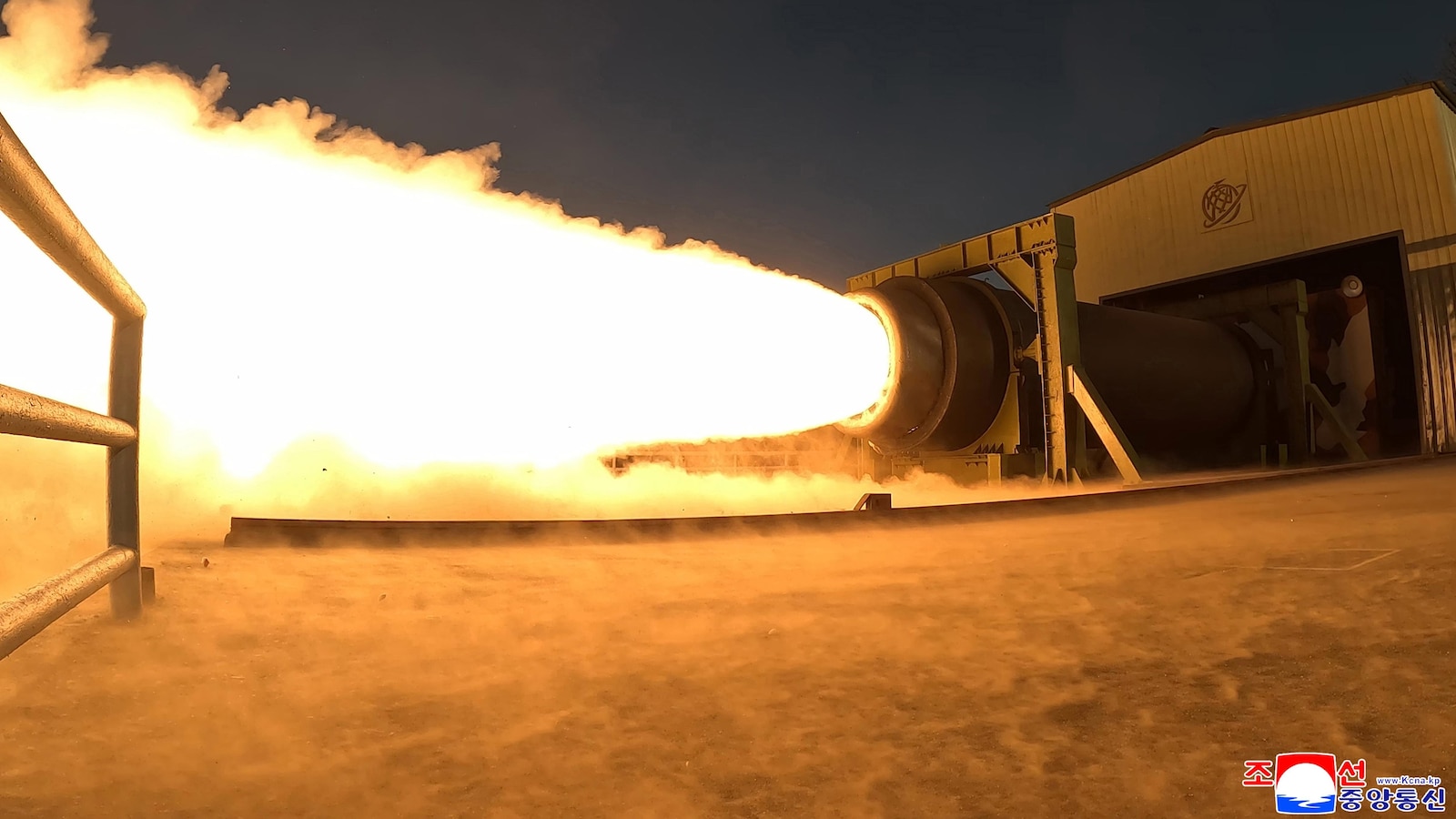
SEOUL, South Korea — North Korean leader Kim Jong Un observed a test of a high-thrust, solid-fuel engine for weapons and hailed it as a development to boost the country’s strategic military capability, state media reported Sunday.
The report on Sunday from Korean Central News Agency came days after Kim delivered a speech at North Korea’s Parliament pledging to irreversibly cement his country’s status as a nuclear power and accusing the U.S. of global “state terrorism and aggression,” in an apparent reference to the war in the Middle East.
Kim watched the ground jet test of the newly upgraded engine using a composite carbon fiber material, according to KCNA, which reported the engine’s maximum trust is 2,500 kilotons, up from about 1,971 kilotons reported in a similar solid fuel engine test in September.
A push to increase the engine power is likely associated with efforts to place multiple warheads on a single missile to increase chances of defeating U.S. defenses, observers say.
KCNA did not report exactly when or where the test occurred.
The test was conducted as part of the country’s five-year military escalation program. The plan’s objectives include upgrading “strategic strike means,” KCNA reported.
The reference is understood to mean nuclear-capable, intercontinental ballistic missiles targeting the continental U.S.
Kim said the latest engine test had “great significance in putting the country’s strategic military muscle on the highest level,” KCNA reported.
In recent years, North Korea has test-fired a variety of ICBMs demonstrating the potential range to reach the U.S. mainland, including missiles with solid propellants that make detection prior to liftoff more difficult. The country’s older liquid-fuel missiles must be fueled before liftoffs and cannot last long.
Some foreign experts say North Korea still faces technological hurdles before it has a functioning ICBM, such as ensuring its warheads survive the harsh conditions of atmospheric reentry. But others dispute that assessment given the number of years the country has spent on its nuclear and missile programs.
North Korea has pushed hard to expand its nuclear arsenal since Kim’s high-stakes diplomacy with U.S. President Donald Trump collapsed in 2019. In a ruling Workers’ Party congress in February, Kim left open the door for dialogue with Trump but urged Washington to drop demands for the North’s nuclear disarmament as a precondition for talks.
As oregano and thyme grow, they may outgrow their containers. Repot them into slightly larger containers, giving them room to grow. You may also adjust their location on the balcony according to seasonal variations in sunlight. This is one of the most significant advantages of container gardening, making it easier to provide plants with perfect conditions for growth throughout the year.
Growing oregano and thyme in balcony containers is one of the easiest and most rewarding ways to bring some greenery into your home, besides adding flavour and zest to your cooking. With the right containers, sunlight, water, and occasional pruning, you can have your herbs thrive even on a balcony. A little attention, and you are rewarded with fresh herbs within arm’s reach.