

CEUTA, Spain — The city of Ceuta, a tiny speck of Spanish territory perched on the northern African coast, normally celebrates its official holiday on Sept. 2 all on its own, ignored by the mainland.
Not this year, not after Ceuta became the epicenter of Spain’s worst border crisis in living memory.
What would’ve been the city’s annual day of celebration is instead overshadowed by a humanitarian crisis that is generating tensions in the tiny exclave, on the mainland and even spilling over into other countries.
In lieu of festivities in Ceuta, a protest is the main event. There are also demonstrations planned in cities across Spain, whose prime minister has alleged — without presenting any evidence to the public — that other nations spread disinformation to cause the crisis.
Last month, about 72,000 people poured into the small Spanish territory neighboring Morocco, with at least 90 dying in the effort to reach Europe.
Most of the migrants quickly returned or were ushered back over the border, but around 5,000, including 1,200 minors, remain in Ceuta weeks later, according to the national government. Difficult questions likewise linger over what caused the mass crossing that the government says was fueled by an online campaign on social media.
The sudden influx of tens of thousands of migrants into Ceuta, which has a population of about 84,000, put a huge strain on resources and angered many residents. Local authorities said that Spain’s central government ignored warning signs before the border was breached.
“What happened to us was not a migratory crisis,” Ceuta’s regional leader, Juan Jesús Vivas, said during an institutional act on Wednesday to mark the holiday. “What happened was the violation of Spain’s territorial integrity.”
Vivas is a member of Spain’s leading conservative Popular Party. The PP and Spain’s far-right Vox party have latched onto the Ceuta crisis and made it the focus of a political fight to oust the left-wing government of Prime Minister Pedro Sánchez in Madrid.
The organizer of Wednesday’s protests scheduled at 8 p.m. in Madrid and more than 200 other towns is the officially nonpartisan Spanish Federation of Municipalities and Provinces. But the protests are being promoted by PP and Vox, which is strongly against irregular migration.
Spain’s minister of territorial policy, Ángel Víctor Torres, told Spanish National Radio on Wednesday that the protests were politically motivated.
“This is not to show support for the city of Ceuta or its residents; it is to attack the government of Spain,” Torres said.
Spain’s government denied criticism it has left Ceuta behind. This week, it earmarked 309 million euros ($357 million) to aid Ceuta’s social services, with special attention to housing migrants, its economy and security.
Many in Spain have asked if Morocco’s government could have done more to prevent the frontier breakthrough.
Sánchez, however, has repeatedly defended the Moroccan authorities, saying they were swift to help in the return of most of the migrants.
“There is no information from any of our intelligence services that points to the participation of Moroccan authorities,” Sánchez told Cadena Ser radio on Monday.
Sánchez, a Socialist who faces an election next year, said that a misinterpretation of a Supreme Court ruling and disinformation spread on social media encouraged people to rush the border.
Sánchez also accused social media accounts linked to Russia and Israel and right-wing groups of exploiting and amplifying the Ceuta crisis after it happened on July 30 and 31.
Both the Israeli and the Russian governments have refuted that claim.
“Without facts, without materials backed up by numbers, dates, names there is simply nothing to talk about,” Russian Foreign Ministry spokesperson Maria Zakharova told reporters.
Sánchez’s government didn’t provide examples of Russian or Israeli disinformation campaigns, instead citing internal reports from its Foreign Affairs Ministry and the European Commission’s diplomatic service.
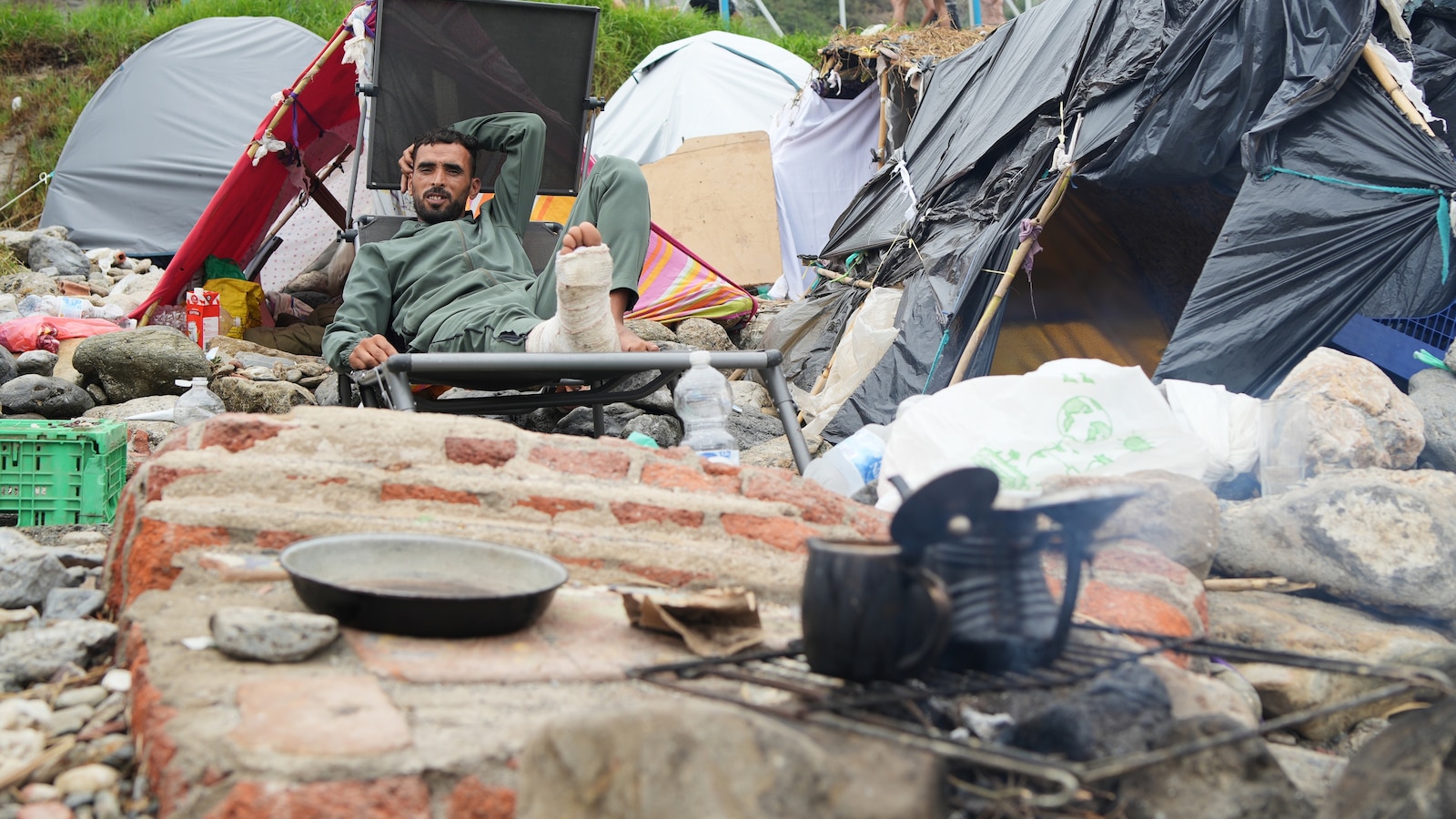
Many migrants, including unaccompanied minors, remain sleeping in the streets and camped on a beach despite authorities’ efforts to shelter, register and deport those who are eligible back to Morocco.
“We’re suffering and we want to get to Europe or find a solution right now. Here, we’re all sleeping on the beach and having a really hard time,” Moroccan Nebil Tazi told The Associated Press. “We’ve been waiting for a month, waiting for a solution here, but there isn’t one.”
Vivas, Ceuta’s leading official, said that the focus should be on getting the autonomous city back to “normality,” as he vowed to continue to pursue the “truth” behind the crisis.
He urged Spain’s central government to reinforce and strengthen the border with Morocco instead of depending on cooperation with its neighbor.
“If we don’t do this, there will always be someone tempted to use migration as a tool for political ends,” Vivas said.
In a recorded video message published Wednesday, Sánchez said his government was putting all resources so Ceuta’s residents could return to tranquility.
The Ceuta holiday commemorates Sept. 2, 1415, when the first Portuguese governor disembarked a few weeks after Portuguese soldiers claimed the terrain. It then passed into Spanish hands in 1580.
___
Joseph Wilson reported and Renata Brito contributed to this report from Barcelona.

