

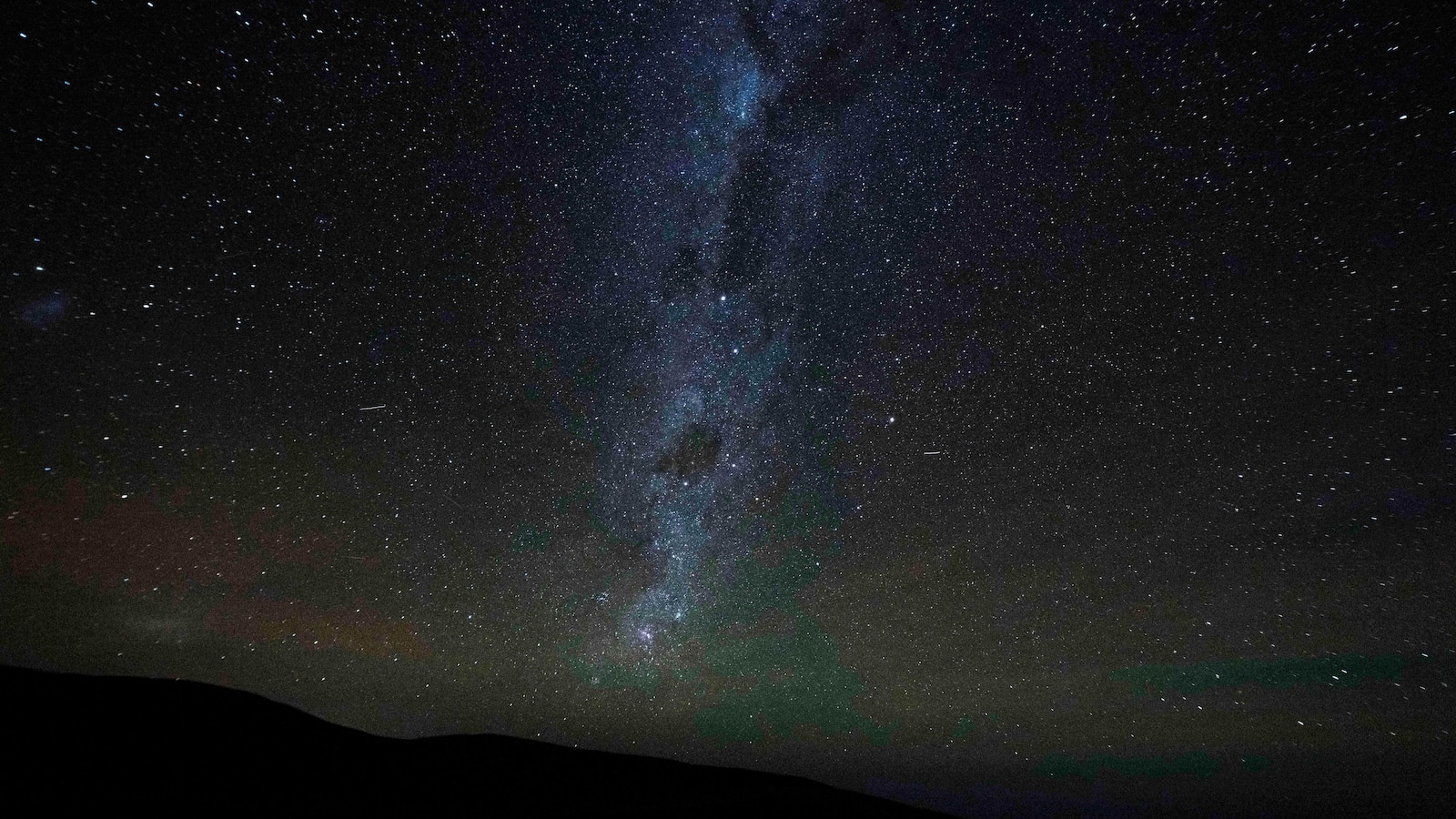

THE ATACAMA DESERT, Chile — It takes a moment for the eyes to adjust. A faint spark appears in the darkness; then another, brighter one. Soon, stars, planets and entire constellations emerge. Before long, a whole galaxy stretches across the sky, visible to the naked eye.
In Chile’s Atacama Desert, the night sky feels infinite. Considered the driest place on Earth, its darkness is also one of the clearest windows to the universe.
A rare combination of dry climate, high altitude and, crucially, isolation from urban light pollution, makes the Atacama an unrivaled hub for world-class astronomy and home to the world’s largest ground-based astronomical projects.
“The conditions in the Atacama Desert are unique in the world,” said Chiara Mazzucchelli, president of the Chilean Astronomical Society. “There are more than 300 clear nights per year, meaning no clouds and no rain.”
But the world’s darkest skies may be at risk.
Last year, the desert became a battleground between scientists and an energy firm proposing a green power complex just kilometers (miles) from the Paranal Observatory. Managed by the European Southern Observatory, ESO, the site also is the future home to what is to be the most powerful optical telescope ever built.
Although the energy project was canceled in January following a massive appeal from astronomers, physicists and Nobel laureates, it exposed deep concerns that existing sky preservation laws are lax, outdated and unclear. Since then, several environmental regulations have come under review, including one from Chile’s science ministry targeting protected astronomical zones.
“We are working to ensure the new criteria are strict enough to guarantee that there will be no impact on astronomical areas,” said Daniela González, director of the Cielos de Chile Foundation, a nonprofit founded in 2019 to protect the quality of Chile’s night skies.
The Associated Press spent three days visiting the Paranal facilities in the heart of the so-called Photon Valley. In this high-altitude corridor, several observatories operate side by side using some of the most sophisticated instruments ever engineered.
“Many of these large facilities are located in Chile, and ESO’s telescopes in particular are the most powerful astronomical facilities on the planet,” said Itziar de Gregorio-Monsalvo, the intergovernmental organization’s representative in Chile.
Paranal is one of nearly 30 astronomical sites in northern Chile, most of which are managed by international organizations. Every year, the Atacama Desert draws thousands of astronomers and scientists from around the world to investigate the origins of the universe.
“We are lucky to be here,” said Julia Bodensteiner, an assistant professor at University of Amsterdam, noting that the chances of being selected as a visiting astronomer at Paranal are just 20% to 30%.
Walking across the Atacama’s rocky, uneven terrain is no easy task. At altitudes exceeding 3,000 meters (10,000 feet), oxygen becomes a luxury, while scorching days give way to relentlessly cold nights. But for space observation and exploration, these more than 105000 square kilometers (40,500 square miles) of desert are the perfect setting.
The exceptional conditions of the Atacama have enabled some of the most ambitious astronomical projects ever conceived, like the Extremely Large Telescope, ELT — a $1.5 billion endeavor by ESO scheduled for completion in 2030.
With 798 mirrors and a light-gathering area of nearly 1000 square meters (a quarter of an acre) , the ELT will be 20 times more powerful than today’s leading telescopes and 15 times sharper than NASA’s Hubble Space Telescope.
All the data compiled at these observatories play a fundamental role not only for life on Earth, but also for the possibilities of its development beyond our planet. Preserving these research spots is essential.
With the ELT, said ESO astronomer Lucas Bordone, “we should be able to see Earth-like planets in what we call the habitable zone, so basically the planets which are candidates towards life.”
Twenty years ago, the Atacama Desert was “an ocean of darkness,” recalled Eduardo Unda-Sanzana, director of the Astronomy Center at the University of Antofagasta. “It was just you and the universe.”
Over the years, however, the landscape has changed drastically.
Driven by urban sprawl, industrial development, and the arrival of mining and wind farms, the desert has become a coveted territory where balance is not always easy to reach.
In Paranal, specialists live like moles in an underground residence designed to keep their presence almost undetectable. Windows must remain covered, hallways stay dark, and any outside movement is guided only by flashlight. Even the faintest light can interfere with the telescopes.
The announcement last year of an imminent green energy project sent shock waves through the international scientific community. Experts pressured authorities to protect Chile’s night sky from the proposed site, which was slated for construction just 10 kilometers (6 miles) from Paranal.
The case raised the alarms due to its impacts, such as increased light pollution, micro-vibrations and dust, as well as greater atmospheric turbulence. These conditions would make astronomical activities unviable.
“If you place the ELT next to a city, it doesn’t matter that its diameter is 40 meters long. It’s just the same as having a tiny telescope,” Gregorio-Monsalvo said.
Although the company canceled the project in late January, scientists warn that without new, updated regulations, similar projects could be proposed at any moment.
“Despite all the media hype in 2025, we find ourselves exactly where we were last year,” said Unda-Sanzana, who is also part of a ministerial advisory commission that recently delivered recommendations to Chile’s government following the incident.
There is no shortage of precedents. The first international heliophysics observatory in Chile — a major solar station operated by the U.S. Smithsonian Institution in the early 20th century — was forced to shut down operations in 1955 due to environmental pollution caused by the expansion of mining activity in the area.
“We’ve had 70 years to learn from history and avoid repeating those same mistakes,” Unda-Sanzana said.
___
Follow AP’s coverage of Latin America and the Caribbean at https://apnews.com/hub/latin-america