Home Blog Page 1021

How debit card fraud can happen without using the card

0
How debit card fraud can happen without using the card


NEWYou can now listen to Fox News articles!

Every so often, we receive an email that stops us cold. Not because it is dramatic. Not because it is careless. Because it feels impossible. 

Sheri M. from Georgia recently wrote to us with this question:

“Yesterday I learned that someone had stolen my debit card information. I was alerted by my bank about 10:00 p.m. last night that someone tried to use my card in Brazil. I am in the Southern United States and have never traveled outside the country. What I have trouble understanding is that this particular debit card has never been used and has never been out of a locked vault. It has been activated, and once activated, I locked it up. No one had access to it, no questions about that. It is just not possible. So how could someone have my card information? I asked this question at my bank, and after speaking to several people, they are at a loss as to what to tell me. I hope you can shed some light on this.”

— Sheri M. from Georgia

GHOST-TAPPING SCAM TARGETS TAP-TO-PAY USERS
 

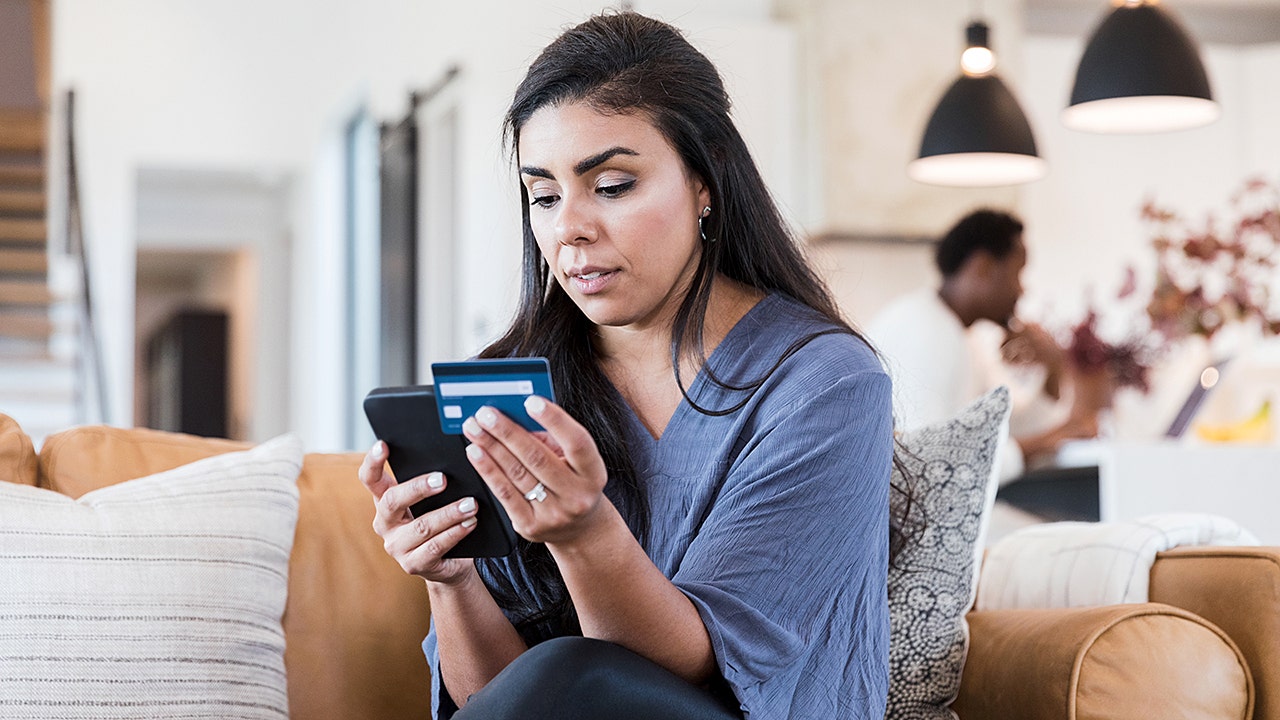
Debit card numbers can be compromised digitally through system breaches or automated number-guessing attacks. (fizkes/Getty Images)

Sheri, first, we are glad your bank flagged it. That alert tells you fraud monitoring worked. Now let’s address the part that feels unreal. How can someone use a debit card that has never left a locked vault?

If you have asked that same question, you are not alone. This type of debit card fraud happens more often than most people realize. And it almost never involves someone physically touching your card.

Sign up for my FREE CyberGuy Report
Get my best tech tips, urgent security alerts and exclusive deals delivered straight to your inbox. Plus, you’ll get instant access to my Ultimate Scam Survival Guide – free when you join my CYBERGUY.COM newsletter.

How debit card fraud happens without using the card

When a card is compromised without being used, the issue is typically digital. Here are the most likely explanations.

1) The number was exposed before you received it

Debit cards move through multiple systems before they reach your mailbox. Third-party vendors manufacture, encode and ship them. That means the card number exists in databases long before you open the envelope. If one of those systems is breached, criminals can obtain card numbers in bulk. They never need the physical card. They never need your home. In that case, it has nothing to do with your vault. 

2) A BIN attack may be responsible

Every debit card starts with a bank identification number. Criminals use software to generate the remaining digits at high speed. They test thousands of combinations using small transactions or foreign authorizations to see which numbers work. This is known as a BIN attack. They are not stealing your specific card. They are guessing valid numbers mathematically. If your card was activated, even if it was never used, it becomes part of the pool that can be tested. A foreign attempt, like one in Brazil, is often a test authorization. It feels personal. In reality, it is automated. 

WEB SKIMMING ATTACKS TARGET MAJOR PAYMENT NETWORKS
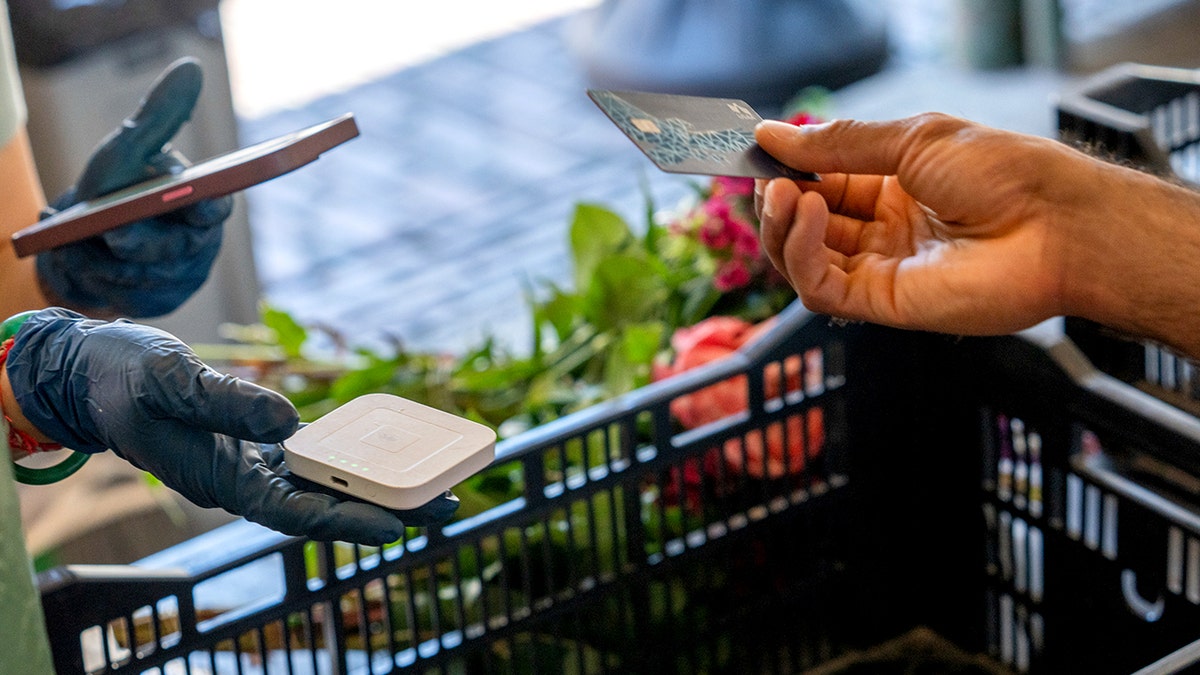
 

A person presents their debit card to pay as a gloved worker holds out a payment terminal.

A customer completes a transaction at Pike Place Market in Seattle, Washington, on May 28, 2025. Financial security specialists recommend canceling compromised cards and monitoring accounts immediately after a fraud alert. (M. Scott Brauer/Bloomberg via Getty Images)

3) A processor or network weak point

Sometimes the exposure does not originate at the bank itself. The weak link can involve:

  • A payment processor
  • A card network
  • A digital wallet backend
  • A servicing vendor

Frontline bank employees often do not have visibility into these system-level issues. Patterns can take time to surface internally. That is why you may not receive a clear explanation right away. 

4) Backend systems assign numbers early

Many banks pre-assign card numbers or connect them to digital systems before you ever swipe the card. If that backend data is exposed, the physical card remaining locked away does not matter. That is why debit card fraud without using the card can still occur.

Why did the transaction show up overseas?

You may wonder why the attempt came from Brazil. Foreign authorizations are often used as test transactions. Criminal groups run small or unusual location charges to see which numbers are active. If the charge clears, they escalate. The good news is your bank blocked it. 

What you should do right now

If this happens to you, act quickly.

  • Cancel the card completely. Do not just lock it. Make sure the number is permanently closed.
  • Request a new card number. Confirm it is not a reissue of the same digits.
  • Monitor your checking account daily for at least 30 days.
  • Freeze your credit with all three credit bureaus.
  • Add identity monitoring to detect broader misuse.

That final step is often overlooked.

WHY SCAMMERS OPEN BANK ACCOUNTS IN YOUR NAME
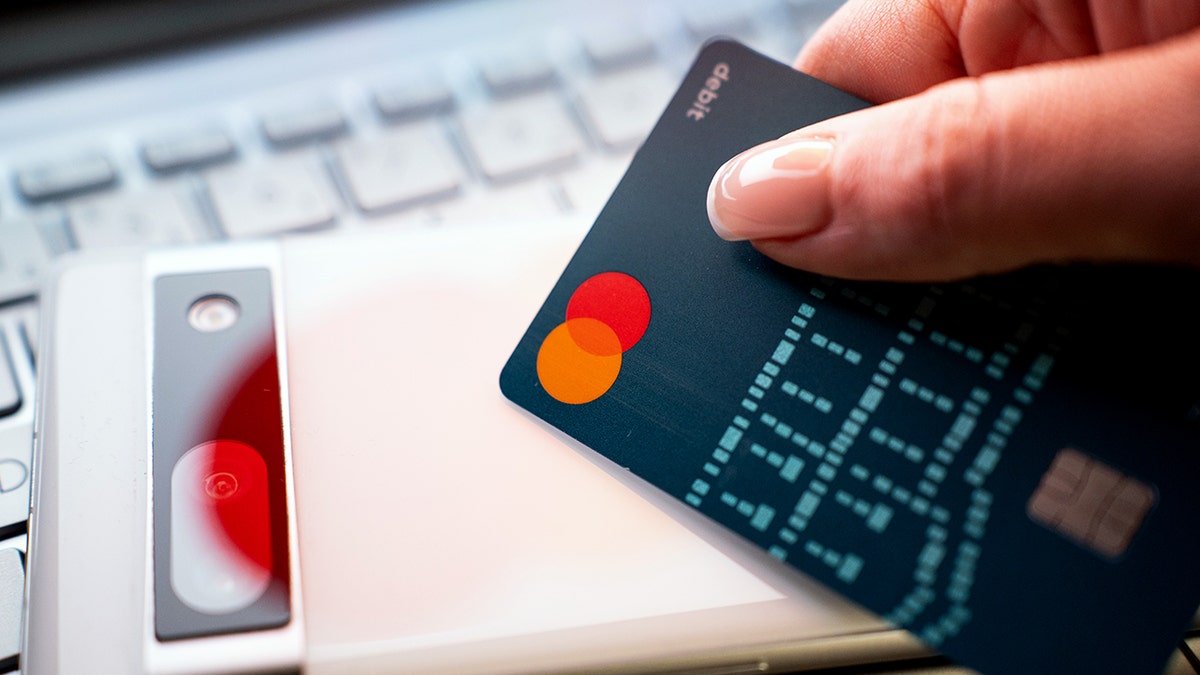
 

A person holds a debit card next to a mobile phone.

Experts say debit card fraud often occurs without the physical card ever being used or stolen. (Nikos Pekiaridis/NurPhoto via Getty Images)

Why identity monitoring matters

Debit card fraud can be isolated. It can also signal a larger data exposure.

If your card number surfaced through a breach or vendor leak, other personal details may be circulating too. Email addresses, phone numbers and Social Security numbers often appear together in stolen datasets. That is where early detection becomes critical.

Our top Identity Theft Protection recommendation monitors credit activity, financial accounts and dark web marketplaces for signs your identity is being misused. You receive fast alerts so you can respond before small incidents turn into larger problems.

Instead of waiting for a late-night fraud alert, you gain earlier visibility.

See my tips and best picks on Best Identity Theft Protection at Cyberguy.com.

Ways to stay safe from invisible debit card fraud

You cannot control global criminal networks. You can reduce your exposure.

  • Keep debit cards locked in your banking app when not in use
  • Turn on real-time transaction alerts
  • Use credit cards for online purchases when possible
  • Freeze your credit as a preventative step
  • Avoid storing debit card details across multiple retail sites
  • Use identity monitoring for broader protection

Layered security gives you more control.

Kurt’s key takeaways

Sheri’s experience feels impossible because she did everything right. The card never left the vault. It was never used. No one had access. Yet the number was still tested from across the world. That is the reality of today’s financial crime. It is automated, remote and system-driven.

If this can happen to a card locked in a vault, what does that say about how secure our financial system really is? Let us know by writing to us at Cyberguy.com.

CLICK HERE TO DOWNLOAD THE FOX NEWS APP

Sign up for my FREE CyberGuy Report
Get my best tech tips, urgent security alerts and exclusive deals delivered straight to your inbox. Plus, you’ll get instant access to my Ultimate Scam Survival Guide – free when you join my CYBERGUY.COM newsletter.

Copyright 2026 CyberGuy.com. All rights reserved.


Source link

“Mr. Nobody Against Putin”: How one Russian teacher confronted Kremlin propaganda

0
“Mr. Nobody Against Putin”: How one Russian teacher confronted Kremlin propaganda


Right after Vladimir Putin’s invasion of Ukraine, Karabash Elementary, like schools across Russia, was ordered to indoctrinate young minds with a so-called “patriotic curriculum.” Pasha Talankin, the school’s videographer, was assigned to shoot it all, to prove to Russia’s government that the school was toeing the line.

But much as he loved his students, Talankin hated the war, and felt trapped. “I love my job, but I don’t want to be a pawn of the regime,” he said.

Talankin also hated the way his colleagues were forced to parrot the state’s propaganda, such as referring to Russia’s “special operation” in Ukraine as “de-Nazification.” So, he decided he would record everything – not just for the government, but to show the world.

His work became the basis of the documentary, “Mr. Nobody Against Putin.” Talankin and the documentary’s American co-director, David Borenstein, spoke to “Sunday Morning” in our London office, ahead of this weekend’s Academy Awards, where their film is nominated for an Oscar.

“When the teacher had to say Ukraine had taken the path of neo-Nazism and neo-fascism, and we must ‘liberate’ it, at that moment I understood that I had no moral right to delete this material,” Talankin said, “because it is part of the evidence of what’s happening in Russian schools today.”

Borenstein said, “I don’t think Pasha even knew, none of us knew, that this film would ever come to anything when we were making it.”

Pasha Talankin recorded the propaganda curriculum being fed to schoolchildren in Russia following the Kremlin’s invasion of Ukraine, which became the basis of a new Oscar-nominated documentary, “Mr. Nobody Against Putin.” 

Kino Lorber


The two met online, and agreed to make a film. So for two years, Talankin kept shooting, while Borenstein directed remotely from Europe. He recorded everything: pro-war student assemblies; Putin’s paramilitary Wagner Group showing up to give weapons training; and the day some of his students were drafted to fight in Ukraine.

“When Pasha picked up the camera, it was because he felt he was trapped in this Kafkaesque system,” Borenstein said. “He says it in the film: ‘Being a propagandist at this school is like walking a tightrope.'”

The stakes were huge. Talankin could have faced life in prison if caught, especially as he kept drawing attention to himself with small acts of rebellion, like playing “The Star-Spangled Banner” instead of Russia’s anthem on the school’s P.A. system.

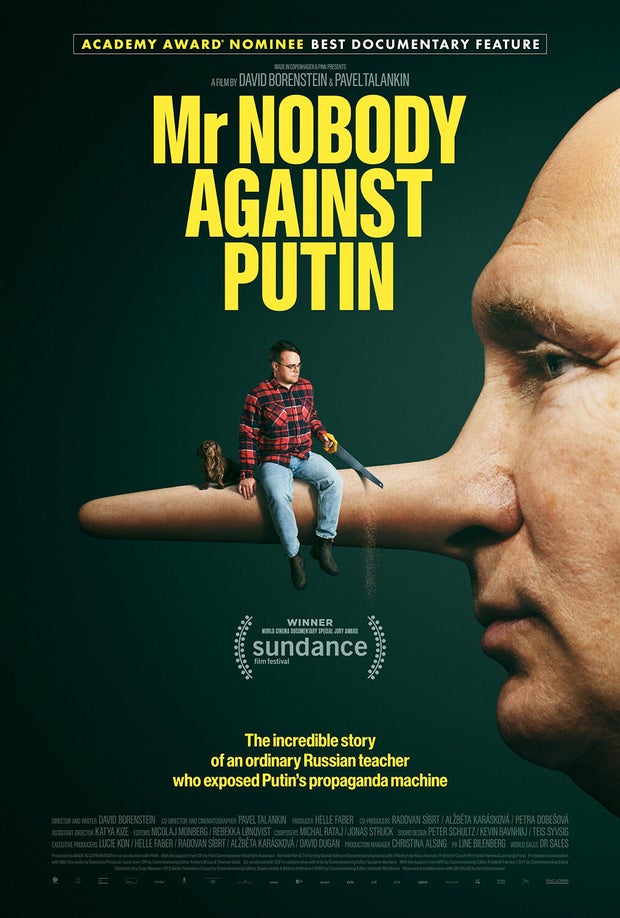
mr-nobody-against-putin-poster-kino-lorber.jpg

Kino Lorber


Asked if he ever thought Russian authorities were onto him, Talankin replied, “Sometimes I thought so. In Russia you never know. No one will call you; no one will knock on your door. They just watch, and then suddenly break the door down, throw you on the floor, and the floor is the last thing you see in your apartment. That’s it; you don’t exist anymore.”

In the West, “Mr. Nobody Against Putin” is a triumph. Most recently it won best documentary at the BAFTAs (the British Oscar). But in Russia, the Kremlin claims it’s just been too busy to watch.

Talankin’s mother, however, a crusty librarian who appears in the film, has managed to see it. “Well, we don’t talk about it directly,” Talankin said when asked about her reaction. “But she did give an interview to the New York Times and said she liked the film and that she’s proud.”

Eventually, though, the whole charade became too risky. Talankin booked a fake holiday to Turkey, and escaped. Now in exile, he is a very public critic of a sometimes vengeful Russian state. Asked how safe he feels, he replied, “Probably 80 percent safe.”

Talankin mourns for the kids he cares about so deeply, and whose future, he fears, has been poisoned by Putin’s nationalist lies. Of the film he says, “This is a very important document, because it shows what Russian society will be like in a few years. Putin may no longer exist, but society will be evil, because propaganda entered schools and was taught to children.”

This film focuses on the children, but it reveals a lot about the cameraman, too. Borenstein said, “It’s also, to me, a story about resistance. Everybody faces a moral choice wherever you are, and this is a story also about what you do when there is a government around you tearing down everything that you have built up.”

When the time came, Pasha Talankin made his moral choice, to resist.  He is “Mr. Nobody” no more.


UPDATE: On Sunday “Mr. Nobody Against Putin” won the Academy Award for best documentary feature. In his acceptance speech, co-director David Borenstein said, “‘Mr. Nobody Against Putin’ is about how you lose your country. And what we saw when working with this footage, it’s that you lose it through countless small, little acts of complicity, when we act complicit, when a government murders people on the streets of our major cities, when we don’t say anything when oligarchs take over the media and control how we can produce it and consume it. We all face a moral choice. But luckily, even a nobody is more powerful than you think.”


To watch a trailer for “Mr. Nobody Against Putin.” Click on the video player below:


Mr. Nobody Against Putin – Official U.S. Trailer by
Kino Lorber on
YouTube

For more info:

        
Story produced by Leigh Kiniry. Editor: Brian Robbins. 


See also: 


Source link

Stair climbing has been included in exercise guidance. Landlords aren’t too happy

0
Stair climbing has been included in exercise guidance. Landlords aren’t too happy


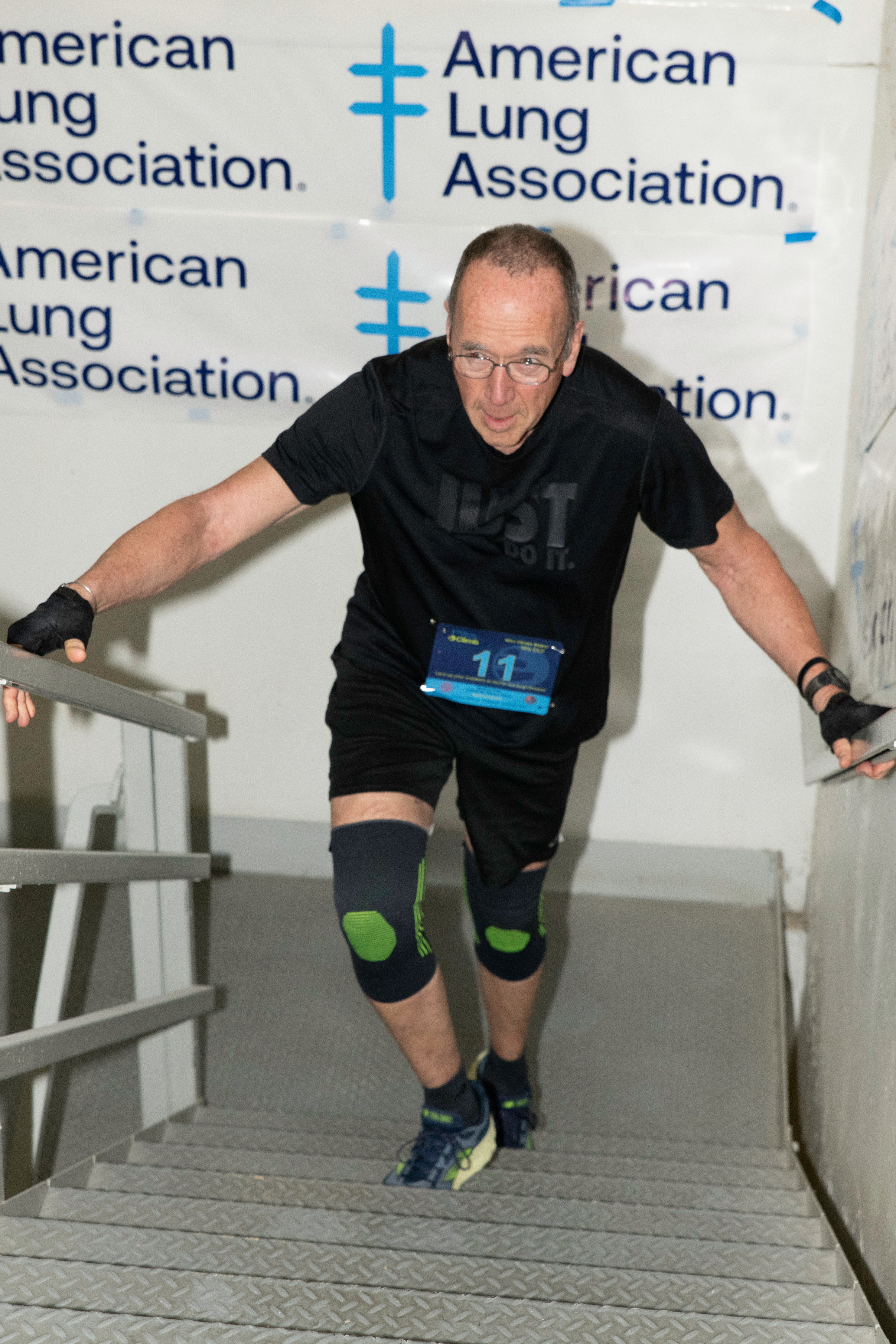
Tom McGee, a 69-year-old market researcher from near Chicago, has found an unusual path to fitness, one that has occasionally put him at odds with hotel security. For two decades, McGee has been climbing stairs as a way to stay off cigarettes, a dedication that has seen him “kicked out of about every hotel in the city” due to his unconventional workout locations. His experience highlights a growing challenge for enthusiasts of this highly effective exercise, as modern office towers increasingly restrict access to stairwells.

Despite these hurdles, stair climbing is increasingly recognised in exercise guidance for its significant health benefits. Dr Luis Rodriguez, a 66-year-old semi-retired paediatric pulmonologist and avid stair climber, champions the activity. “You are working your legs. You are working your heart. You are working your lungs,” he explains, adding, “You can get a lot more benefit than just walking, because gravity is working against you.” This is supported by research indicating that just four minutes of stair climbing offers similar benefits to ten minutes of brisk walking or twenty minutes of slower walking.

The efficacy of short, intense bursts of activity was officially acknowledged in 2018, when federal physical activity guidance began promoting such efforts – like opting for the stairs between floors at work. Stella Volpe, an exercise expert at Virginia Tech, points out that many people “don’t realize that they don’t have to exercise all in one bout for it to be effective,” suggesting that these small efforts accumulate throughout the day. Beyond the physical, Jennifer Gay, a public health researcher at the University of Georgia, notes that stair climbing can also improve mental well-being and boost feelings of energy.

However, experts caution that individuals who may struggle with stairs should always consult their doctor before adopting a regular climbing regimen.

Participants make make their way up 86 flights of stairs during the 35th Annual Empire State Building Run-Up in New York, on Wednesday, Feb. 8, 2012. (AP Photo/Jason DeCrow, File) (AP)

The American Lung Association holds fundraising events each spring in office towers in cities across the country. The “Fight for Air” events are widely regarded as fun, but organizers say the name draws from the shortness of breath people can experience after climbing dozens of floors — or having a lung disease.

Landlords aren’t always so accommodating.

Some law firms tell landlords and building owners that they can he held liable if someone trips or slips on a staircase. Poor lighting, liquid on steps and broken handrails are among the conditions that can be cited in lawsuits if someone falls and gets hurt.

Many building managers have taken such advice to heart, saying stairs can only be used in emergencies.

A study of hospital emergency department visits, published in 2018, concluded that more than 1 million stair-related injuries occur in the U.S. each year, with broken bones more common in older people. More than 60% of the injured were women.

Research suggests there’s very little risk of injuries for people climbing stairs, Gay said. Going down stairs can be riskier and building managers “can’t make it a one-way street,” she added.

For more than a decade, some health advocates have pressed for better access to steps.

In 2013, a California-based health policy nonprofit called ChangeLab Solutions issued a resource guide that urged property owners to open their stairwells, arguing they posed no greater liability risk than other common areas.

Gay and her colleagues have estimated that 60% of U.S. workers do their jobs in multistory buildings with stairwells. But there are no statistics showing what percentage of those buildings have restrictions on stair access.

In this photo provided by the American Lung Association, Tom McGee participates in a fundraising run in the Oakbrook Terrace Tower building in Oakbrook, Ill., on Sunday, March 8, 2026. (Pat Davies/American Lung Association via AP)

In this photo provided by the American Lung Association, Tom McGee participates in a fundraising run in the Oakbrook Terrace Tower building in Oakbrook, Ill., on Sunday, March 8, 2026. (Pat Davies/American Lung Association via AP) (American Lung Association)

Many people who like to climb have stories about trouble finding staircases they can use.

Lisa Bai, a New Yorker who works in real estate, said she’s not able to use the stairs in her office building. It would seem like an easy way to get some exercise, but sometimes “it’s not,” she said.

Bai and others say they find other ways to step up. Fitness equipment such as StairMaster machines can approximate the physical work of stair climbing, although people who participate in tower climbs say it isn’t as arduous as the real thing.

You might have to get creative if you don’t have easy access to stairs at home or in public spaces.

Carmen Erickson and Vivian Dawson, who live in the Detroit suburbs, have been meeting about three times a week to climb stairs, usually in a nearby park, for roughly a decade.

But it can be trickier when they travel. When they vacation together, they make a point to stay on the top floor of tall hotels so they can use the stairs. They also look for hills and hospital parking decks.

They also have negotiated after-hours access to one building’s stairwells, agreeing to sign a waiver and check in with security officers each time.

“If you connect with the right people and tell them what they’re doing and agree to the rules, it hasn’t really been a problem for us,” said Erickson, 53.

But Dawson, 64, added: “You have to really want to do it.”


Source link

Lizzo delivers personal message of finding your voice and trusting yourself in new kids’ book

0
Lizzo delivers personal message of finding your voice and trusting yourself in new kids’ book


Lizzo delivers personal message of finding your voice and trusting yourself in new kids’ book – CBS News


Watch CBS News


Grammy award-winner Lizzo exclusively announced on “CBS Mornings” her latest project, a children’s book called “Little Lizzo Meets Sasha B. Flute.” She spoke with Gayle King about her inspiration for the book and message for young readers.


Source link

A petri dish of human brain cells is currently playing Doom. Should we be worried?

0
A petri dish of human brain cells is currently playing Doom. Should we be worried?


It sounds like the opening of a sci-fi film, but US scientists recently uploaded a copy of the brain of a living fly into a simulation. In San Francisco, biotechnology company Eon Systems created a virtual insect that knew how to walk, fly, groom and feed in its virtual environment. Researchers in Australia, meanwhile, have taught a petri dish containing 200,000 human brain cells to play the iconic 90s shooter Doom. One experiment has pushed a brain into a computer; the other has plugged a computer into brain cells.

Both stories have been hailed as scientific breakthroughs, but have also sparked inevitable fears about the prospects of lab-grown humans and digital clones. Should we be concerned?

It was Australian startup Cortical Labs in Melbourne that taught a dish of lab-grown neurons to play Pong in 2022. Now it has built what it describes as “the world’s first code-deployable biological computer”, running on living human tissue rather than silicon chips, which is happily playing the 1993 shooter Doom.

“In computer-science nerd land, there’s this obsession with getting Doom to run on everything, from calculators to microwaves,” Hon Weng Chong, CEO of Cortical Labs, tells me over Zoom from Melbourne. “As soon as we managed to get Pong to work, the first thing people said was: ‘When are you going to do Doom?’”

The average human brain contains about 86bn neurons – roughly 430,000 petri dishes’ worth. But how do you harvest 200,000 brain cells without resorting to a hacksaw and an ice-cream scoop?

“They’re my brain cells, actually – at least most of them are,” Chong says proudly. “There’s no scraping or brain extraction. It’s a very cool technique that was developed by Professor Shinya Yamanaka, who won the Nobel prize in 2012.”

All you need is 10ml of blood (in this case Chong’s), from which around 100 white blood cells can be harvested. These can then be reprogrammed into induced pluripotent stem cells (iPSCs) – the body’s biological building blocks – which can then be reproduced exponentially.

Close-up of 200,000 neurons on a glass slide the size of a 50p piece. Photograph: Cortical Labs

“Essentially we reverse the biological clock back to an embryonic state, induce them into neurons, and put them on a glass chip roughly the size of a 50p piece,” explains Chong . “Because they’re on a chip – and electricity is the common language between neurons and the computer system – we can interface with them and get them to play Doom.”

Cortical Labs conducted its Pong experiment in-house, but this time it reached out to 24-year-old Singaporean Sean Cole, who has just completed an MSc in artificial intelligence at the University of Sussex, and whose dad happens to be mates with its CEO. Cole wrote the code remotely, which the team then tested on their local machines.

“I was a bit surprised it worked the first time around,” he tells me over Zoom.

So how does a petri dish of brain cells play Doom when it doesn’t have any eyes? Or fingers? “We take a snapshot of the game with information like the player’s health and the position of enemies, pass it through a neural network, convert it into numbers, and send the data,” explains Cole. “This is called encoding – essentially turning the game state into signals the neurons can understand. The neurons then fire an output – move left, move right, walk forward, shoot or not shoot – which the system decodes and converts back into actions in the game.”

“If you think about how humans operate, we have information going into our retina, which is converted into electrical signals, processed in the brain, and then an output happens,” adds Chong. “It’s really no different from that.”

If a computer full of brain cells is playing a video game and making decisions, does that mean it’s sentient? Or is it just behaving like the average Doom player? “People have different perceptions of what sentience is,” says Cole. “I definitely don’t think it’s conscious. At first it didn’t know how to move, aim or even shoot. Then it would shoot the first two enemies and stop – almost as if it was preserving itself. So it’s definitely learning. We’ve managed to control a brain to learn in a very controlled environment. The next step could be something like Neuralink, where you inject a chip into the brain to train someone to learn a language faster.”

Exactly how the cells are learning to play the game is unclear. “We can hypothesise that it might involve things like the free energy principle – the idea that living systems act to minimise free energy – or Hebbian learning, where connections between neurons strengthen when they fire together.” Could we ever use technology like this to instantly learn kung fu, as in The Matrix? “If we find a way to safely connect this technology to humans, that is kind of what the implications might be,” Cole says. “A big concern would be: what if you override someone’s memories?”

‘I don’t think it’s conscious’ … Doom encoded for the biological computer to play. Photograph: Cortical Labs

While Chong says he’d like to try getting the neurons to play Pokémon next, the real future application here lies not in getting trays of human neurons to graduate to playing Minecraft or Grand Theft Auto, but in medicine. “People are looking at it from biomedical research angles, for disease modelling,” he says. “Things like epilepsy, where drugs could be tested on neurons grown outside the body – not just to discover new drugs, but to tailor them at a personal level.”

Meanwhile, in San Francisco, where Eon Systems has scanned a fruit fly brain and recreated it as a virtual insect, the big scientific news is that the team have essentially recreated the creature’s behavioural wiring. The digital insect already knew how to behave like a fly, without any training or prompting. This challenges a central assumption of modern AI: that intelligence must be acquired. In the case of the fly, much of its behaviour appears to be built-in.

“The brain was scanned using electron microscopy. Our head of engineering led a project to emulate that brain, and now we’ve placed the emulated brain back into a body, so it can wander around a virtual world,” Michael Andregg, CEO of Eon Systems, tells me.

A fruit fly’s brain comprises around 140,000 neurons – about five petri dishes’ worth. The virtual fly has 87 joints and can do pretty much anything an actual fly can. But does it realise it’s living in a simulation?

“The fly probably knows something’s off, because we’re not simulating the environment with high fidelity,” says Andregg. “We can’t give very specific taste and smell cues – just that something smells sweet or tastes bitter, but there are no complex aromas.”

Brain emulation, Andregg suggests, could eventually allow humans “to flourish in a world with superintelligence. Our goal is to make the emulation and computed brain and body feel indistinguishable from the natural biochemical body and brain,” he continues. “If it feels different, we’ve done something wrong.”

But we’re still a long way from the upload-yourself-into-the-internet futures imagined in Devs or The Lawnmower Man, mainly because, in this case, the fly’s brain had to be removed from the body first. “Scanning the body was too hard,” says Andregg, which will probably reduce the waiting list for human volunteers willing to try out the technology.

The digital fly, and a map of its 140,000 neurons. Photograph: Eon Systems

Chong, meanwhile, believes biological computing could achieve things that traditional computing has struggled with. “There’s a thing called Moravec’s paradox, which is well known in robotics: what humans find very difficult, computers find easy, and what computers find difficult, humans find easy,” he says.

“Abstract reasoning, mathematics and language are relatively recent in evolutionary terms, which is partly why computers excel at them. But motor control and probabilistic decision-making are things we’ve inherited through millions of years of evolution. Robots may be very good at solving maths problems, but we’re still trying to build robots that can walk properly.” Biological systems like the fruit fly simulation, he says, might eventually power robots, drones and other machines that need to navigate the messy unpredictability of the real world.

For now, humanity’s first biological computer is busy doing what humans have always done with new technology: playing games. And somewhere in Silicon Valley, a fruit fly is living its second life inside a computer, totally unaware that it is living in the insect Matrix.


Source link

Breaking down top moments from the Oscars

0
Breaking down top moments from the Oscars


Clayton Davis, the senior awards editor for Variety, joins “CBS Mornings” to discuss the big moments, winners and surprises at the Oscars.


Source link

“One Battle After Another,” “Sinners” win big at Oscars as Rob and Michele Reiner are honored

0
“One Battle After Another,” “Sinners” win big at Oscars as Rob and Michele Reiner are honored


“One Battle After Another” took home six awards at the Oscars, including Best Picture and Best Director, while Michael B. Jordan won Best Actor for his performance in “Sinners.” Meanwhile, actor Billy Crystal led the in memoriam segment with an emotional tribute to Rob Reiner and his wife, Michele, who were killed last year. Nischelle Turner reports on Hollywood’s biggest night.


Source link

Peloton is launching bikes and treadmills for gyms, accelerating commercial strategy

0
Peloton is launching bikes and treadmills for gyms, accelerating commercial strategy


A Peloton Interactive Inc. logo on a stationary bike at the company’s showroom in Dedham, Massachusetts, U.S., on Wednesday, Feb. 3, 2021.

Adam Glanzman | Bloomberg | Getty Images

Peloton on Monday announced its Commercial Series, the company’s first Bike and Tread products built for high-traffic gym floors.

The move marks the company’s latest push beyond its core at-home business and deeper into the multibillion-dollar commercial fitness market.

“I’ve had the chance of speaking with the CEOs of a number of gyms, gym operators or big-box operators over the last year,” CEO Peter Stern told CNBC in an interview. “The one brand their members asked for, and therefore that they are asking for it, ‘Find a way to get me Peloton equipment.'”

The suite of products is a part of the company’s commercial unit, which it launched in 2025 in partnership with Precor, the fitness equipment maker it acquired in 2021. Peloton already has a presence in major businesses like hotel chains Hyatt and Hilton. The company did not say which gyms specifically would offer its new machines.

The expansion could broaden Peloton’s footprint in the fitness industry. Through its integration with Precor, Peloton now has access to a commercial distribution network spanning more than 60 countries, allowing the company to scale its equipment and digital platform internationally.

Stern did not disclose pricing for the new equipment, but said the products will be “priced competitively,” with more details expected closer to the planned launch in late 2026.

The machines combine Peloton’s digital workout platform and instructor-led classes with hardware engineered by Precor to withstand heavy daily use.

Pedaling uphill

Peloton’s push into gyms could face resistance. Some fitness chains have been reluctant to integrate Peloton equipment, preferring to promote their in-house classes, digital platforms and instructors.

“I need to leave how gyms react to that up to them,” said Stern. “But if you look at a typical gym floor, they’ve got Bikes, Treads and lots of other equipment that’s out there. We’re just now giving them a better experience for customers on those Bikes and on those Treads.”

Peloton has dipped its toes in commercial spaces for several years, including through the hotel partnerships, but has been held back because its hardware wasn’t designed to be used in high-traffic spaces. The company has been the subject of numerous product safety recalls.

Peloton machines have had a tendency to break, and fixing them can be challenging because its infrastructure is different from a traditional fitness manufacturer’s.

When Peloton launched its revamped product assortment last fall, the company also introduced a new line of equipment for its commercial business unit. The hardware is more durable than its consumer machines, but is still only designed for places with smaller gyms, like hotels and corporate wellness centers.

The development comes as Peloton struggles to convince consumers its new AI-driven product line, Peloton IQ, is worth the steep price tag.

When it reported fiscal 2026 second-quarter earnings last month, the company missed Wall Street’s expectations on the top and bottom lines and said it expected sluggish sales to continue in the current quarter.

The weak results, coupled with the soft guidance, were the first clue investors had that Peloton’s product overhaul wasn’t the sales driver the company had hoped it would be, putting more focus on its commercial business unit.

During Peloton’s last quarter, revenue in its commercial business unit rose 10%, even as companywide sales fell about 3%.

Choose CNBC as your preferred source on Google and never miss a moment from the most trusted name in business news.


Source link

Scientists made a breakthrough in the study of whale sounds. Here’s a look at the numbers

0
Scientists made a breakthrough in the study of whale sounds. Here’s a look at the numbers


PORTLAND, Maine — Researchers on Cape Cod, Massachusetts, recently discovered the oldest known recordings of whale sounds and believe the discovery could help understand how the animals communicate.

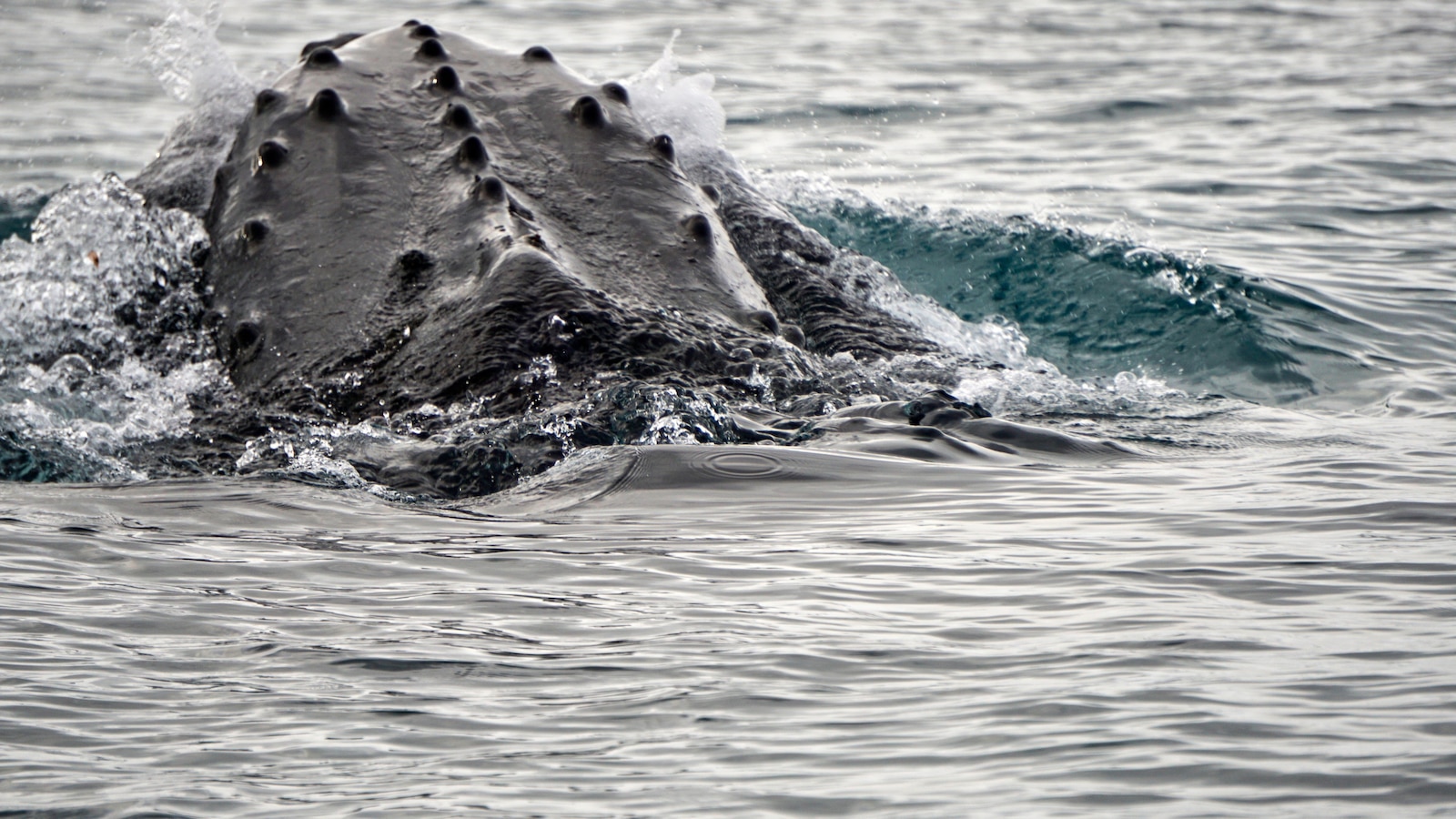
The recording is the song of a humpback whale, a species of large whale known for its complex songs. Researchers at Woods Hole Oceanographic Institution in Falmouth, Massachusetts, said the sounds were recorded in March 1949 off Bermuda.

The recording is important because it documents whale song during a time when the ocean was quieter, scientists said.

Here’s a breakdown by the numbers.

The discovery predates the discovery of whale song by almost 20 years.

The recording predates scientist Roger Payne’s discovery of whale song by nearly 20 years. Woods Hole scientists on a research vessel at the time were testing sonar systems and performing acoustic experiments along with the U.S. Office of Naval Research when they captured the sound.

The sounds were recorded with crude audio equipment, but it was preserved on a plastic disc as opposed to tape. That allowed it to stand the test of time.

More than 90 species of whales, dolphins and porpoises make sounds.

Sound is critical to whales’ survival and important to how they socialize and communicate. Their sounds come in the form of clicks, whistles and calls.

Scientists who study whales say the sounds also allow the whales to find food, navigate, locate each other and understand their surroundings.

Scientists say some parts of the ocean are 10 times louder than they were in the 1960s.

Research from the Scripps Institution of Oceanography in the mid-2000s found that underwater ocean noise off southern California had increased tenfold compared to the 1960s. The subject of ocean noise and its effect on animal life has been the subject of scientific inquiry in the years since.

The recordings discovered by Woods Hole scientists are from a quieter ocean. Scientists said that can help them better understand how new human-made sounds, like shipping noise, affect the way whales communicate.

The humpback whale is possibly the most accomplished vocalist in the ocean, and those songs come from a giant animal that can weigh more than 55,000 pounds (24,947 kilograms). Over the years, humpback whale songs have been recorded for human listening, with many describing the songs as having a haunting, mournful quality.

“Songs of the Humpback Whale,” an album, has sold more than 100,000 copies.

Payne produced the album in 1970, as the environmental movement was beginning to blossom. It’s the best selling environment album of all time.

The record also helped spark a global movement to end the practice of commercial whale hunting.


Source link

Strait of Hormuz: Which countries’ ships has Iran allowed safe passage to?

0
Strait of Hormuz: Which countries’ ships has Iran allowed safe passage to?


During the United States-Israeli war on Iran, Tehran has said the Strait of Hormuz is open to all except the US and its allies. One-fifth of the world’s oil shipments transit through the strait.

On March 2, Ebrahim Jabari, a senior adviser to the commander-in-chief of Iran’s Islamic Revolutionary Guard Corps (IRGC) announced that the strait was “closed” and if any vessels tried to cross it, the IRGC and the navy would “set those ships ablaze”.

The move sent oil prices soaring above $100 per barrel from a pre-war price of about $65.

A barrel of Brent crude, the international benchmark, was up 2.5 percent at $105.70 on Monday. That is more than 40 percent higher than before the war began on February 28.

Iranian Foreign Minister Abbas Araghchi told the US television network CBS on Sunday that Tehran had been “approached by a number of countries” seeking safe passage for their vessels “and this is up to our military to decide.” He added that a group of vessels from “different countries” had been allowed to pass, without providing details.

Here is what we know about which countries’ ships are being allowed to pass through the strait and which nations are reported to be negotiating for safe passage.

Pakistan

A Pakistani-flagged Aframax tanker called Karachi sailed out of the Gulf through the Strait of Hormuz on Sunday, Bloomberg News reported.

India

On Saturday, Iran’s ambassador to India, Mohammad ⁠Fathali, said Tehran had allowed some Indian vessels to pass through the Strait of Hormuz in a rare exception to the blockade that has disrupted global ‌energy supplies.

Fathali did not confirm the number of vessels. However, on the same day, New Delhi said two Indian-flagged tankers carrying liquefied petroleum gas bound for ports in western India had passed through the strait.

“They crossed the Strait of Hormuz early morning safely and are en route to India,” Rajesh Kumar Sinha, special secretary of the Ministry of Ports, Shipping and Waterways, said at a news briefing in New Delhi.

Turkiye

A Turkish-owned ship that had been waiting near Iran was allowed to pass through the strait after authorities received permission from Tehran, Turkish Transport and Infrastructure Minister Abdulkadir Uraloglu said in comments to Turkish media on Friday.

“Fifteen ships [with Turkish owners] were there. We obtained permission from the Iranian authorities for one of them that had used an Iranian port, and it passed,” Uraloglu said.

China

China is in talks with Iran to allow crude oil and Qatari liquified natural gas carriers safe passage through the Strait of Hormuz, the Reuters news agency reported on March 5, quoting three unnamed diplomatic sources.

China, which has friendly relations with Iran and relies heavily on Middle Eastern petroleum supplies, is unhappy about Iran’s decision to paralyse shipping through the strait and is pressing Tehran ⁠to allow safe passage for its vessels, according to the sources.

China receives 45 percent of its oil via the Strait of Hormuz.

France and Italy

The two European nations are understood to have requested talks with Iran about allowing their ships to pass through the strait, the UK’s Financial Times has reported, citing unnamed officials.

What is the naval coalition Trump proposed for the strait?

US President Donald Trump called for a naval coalition to join the US Navy in deploying warships to secure the strait.

“Hopefully China, France, Japan, South Korea, the UK, and others, that are affected by this artificial constraint will send ships to the area so that the Hormuz Strait will no longer be a threat by a nation that has been totally decapitated,” Trump wrote in a Truth Social post on Sunday.

However, the countries Trump mentioned have made no promises to join such an operation.

On Monday, Germany and Greece ruled out military involvement.

A German government spokesperson said: “As long ⁠as this war continues, there will be no participation, ⁠not even in ⁠any effort ⁠to keep the Strait of Hormuz open by military ‌means.”

Greece ⁠will also not ⁠engage in ⁠any military operations ‌in the Strait of Hormuz, government spokesman ⁠Pavlos ⁠Marinakis said.

Despite pressure from the Trump administration to provide support to the US in its war on Iran, United Kingdom Prime Minister Keir Starmer told the media on Monday: “We will not be drawn into the wider war.”

Rodger Shanahan, a Middle East security analyst, told Al Jazeera it is “unlikely” US allies will get involved in securing the Strait of Hormuz as the Trump administration suggested.

Shanahan said because most US allies “opposed this war to begin with”, it makes them “feel relatively less inclined to provide support to it”.

“Besides, there’s a practical issue. If you want naval support for some kind of coalition protection operation, it takes you a long time to get ships to sail to that area. You can’t do this kind of stuff on the fly.”

(Al Jazeera)


Source link