


Google has been fined €890m (£759m) by the EU for allegedly abusing its power by favouring its own apps and services over those from rivals.
It is the first major action against the tech giant under the EU’s Digital Markets Act (DMA), a landmark law aimed at curbing the power of the world’s biggest tech companies.
The Commission argued Google’s practices limited consumer choice and gave its own services an unfair advantage over rivals.
But the firm criticised the decision, arguing the EU’s requirements could damage services used by millions of European customers.
“To comply, we are having to strip away real-time Search features Europeans love – like instant pricing and direct availability for hotels, flights and restaurants – and dismantle safety protections on Google Play,” said Google’s president of global affairs Kent Walker.
“This isn’t fair competition.”
EU officials rejected that argument, saying the measures are necessary to prevent dominant platforms from disadvantaging rivals.
The total fine handed down to Google comprises of two separate breaches of the DMA.
The European Commission imposed a €460m penalty after finding Google favoured its own services for helping people book flights and hotels over competitors in search results.
And it gave the firm a further €430m fine due to its Play Store rules, with regulators saying it didn’t allow people to be shown cheaper offers available outside Google’s own marketplace.

Having begun in 1930 as the British Empire Games, the Commonwealth Games face questions about their place and relevance in the modern world.
England weightlifter Emily Campbell told the BBC the Games are “one of the best things that came out of colonisation” while three-time Olympic swimming gold medallist Tom Dean insists they can be a “force for good” despite the difficult past.
“It is even more reason to push the Commonwealths into the spotlight because it shows the best side of sport,” he told BBC Sport.
However, the Glasgow edition has been hit by the absence of star names.
Injuries, such as those to Olympic gold-medal winning gymnast Max Whitlock and Australia’s Olympic backstroke champion Kaylee McKeown, are unavoidable and unfortunate.
But other athletes have opted to prioritise different events.
Olympic 800m champion Keely Hodgkinson is skipping Glasgow in favour of the European Athletics Championships, which start in Birmingham on 10 August and are arguably the bigger track and field event this summer.
Dina Asher-Smith, the fastest British woman in history, and Olympic 100m champion Julien Alfred of St Lucia have also pulled out. Canadian swimming superstar Summer McIntosh is another notable absentee.
But it is not all doom and gloom.
Josh Kerr, fresh from breaking the mile world record, will return to home soil to race for Scotland, as will McColgan, while Adam Ramsay-Peaty returns to the same pool in which he won two golds in 2014.
The Commonwealth Games remain a pinnacle for sports like netball and there is also an increased focus on Para-sport, with this the most integrated Games ever.
Six of the 10 sports include Para-competitions with a Commonwealth Games record 47 medal events. Golds, silvers and bronzes won in Para-events will, unlike with other multi-sport events, count towards the overall medal total.
“There are not many opportunities for the integration of multi-sports [events],” Paralympic swimming champion Brock Whiston told BBC Sport.
“Without the Commonwealth Games, the smaller countries don’t get the chance to show how powerful that integration is.
“The Commonwealth Games is vital to ensuring there are equal opportunities.”
English swimmer James Guy, another Olympic champion who will be at his fourth Commonwealth Games in Glasgow, told BBC Sport the event remains a crucial part of an athlete’s development.
“It is a bit easier to make than the GB team,” he said.
“It is a really good way to get on there, get on a relay and get a medal and that is really important for development so the younger guys and girls can progress.”

When 72-year-old Michael Roper rides his bicycle to and from the pub he owns in Chicago, he can’t imagine a better way to commute. He’s getting exercise, drifting through fresh air and catching glimpses of neighborhood life — a recently opened coffee shop or a diving owl at night —that he’s convinced he’d miss if he were driving.
If you’ve considered bike commuting but assumed you needed expensive gear and to be in excellent physical shape, or worried about arriving at work disheveled or smelly, there are ways to overcome those hurdles. Cycling can be a healthy, enjoyable and affordable way to a job site, especially at a time of elevated gasoline prices.
“It’s such a great, practical invention that I became enamored with as a little kid, and I find it just as valuable as a 72-year-old,” Roper, owner of the Hopleaf Bar and restaurant, said.
Below, experienced cyclists and bike safety advocates share tips on how to get started and arrive safely at your destination while still looking reasonably workplace-presentable.
Some cyclists splash out on pricey gear such as foldable bikes, premium padded shorts and waterproof bags. Specialty cycling equipment can be fun, but you can spend less and still have a great ride. If you don’t want to purchase a bicycle, consider a bike-sharing program that rents two-wheelers for short rides.
Natalie Frank, 22, didn’t have extra cash when she graduated from college and landed a job as a software engineer in the Boston office of technology company Topsort. She asked her friends if anyone had a bicycle they no longer wanted, and a free road bike was hers a few weeks later.
If the tires need air, she fills them using free pumps located in city parks.
“My commute costs zero dollars. That’s crazy,” Frank said.
Many cyclists reach their workplaces a few minutes early to freshen up and change into work clothes. Some bike commuters leave a spare set at their desks. Like many others, Frank carries clothing in a backpack along with her laptop.
Ellie Dannenberg, 37, a University of Denver math professor, commutes in gym clothes and carries a work outfit in panniers, which are storage bags and baskets that attach to a bicycle. She stashes a pair of work shoes in her office.
“Investing in pannier bags is a really great thing to do, especially for the commute to work when you probably don’t want to show up super sweaty,” Dannenberg said. “Backpacks are heavy, they’re more uncomfortable, and then you end up with a sweaty back when you get there.”
On Denver’s wetter days, Dannenberg wears rain pants and a waterproof jacket that fits over her helmet.
Some office buildings have showers for washing up, but many don’t. Keeping body wipes, rinse-free cleanser or deodorant at work can help you feel polished.
Cyclists and safety advocates strongly recommend wearing a helmet to protect your head in case of a crash. Wearing bright colors or reflective vests and attaching lights and reflectors to the bicycle improves visibility.
Roper wears a yellow-green helmet and has front and rear lights that flash. “You really can’t fail to see me,” he said.
To ensure you’re seen when traveling on smaller roads without bike lanes, ride in the middle of the lane, and if you’re at a stop light, go to the front of the traffic, Dannenberg suggested.
Watch out for black ice in the winter. “If you’re running late and there’s ice on the road, it’s worth it to slow down around the corners,” Dannenberg added.
The League of American Bicyclists has videos on its website covering traffic safety and hand signals, which cyclists can use to communicate when they’re turning or stopping.
New riders may want to find a biking companion who can point out safer, less congested routes.
“It’s nice to have a buddy if you know someone who’s commuting by bike in the vicinity that you’re going,” said Alison Dewey, education director at The League of American Bicyclists. “Maybe the most enjoyable route is just going another half-mile in this direction and getting on a trail instead of a more direct way. Someone who’s more experienced might know that.”
Some riders prefer electric bikes with a pedal-assist feature that provides a boost when they want to keep pace with traffic. After stopping at intersections, e-bikes help cyclists get going again, Dewey said.
When riding next to parked cars, leave space between yourself and those vehicles so you don’t get “doored” — a common cycling collision that happens when someone opens a car door in a moving rider’s path.
The League of American Bicyclists recommends staying four feet away from parked cars, even if it means positioning yourself outside of a marked bike lane. “It’s more important to be out of the ‘door zone’ than to be in the bike lane,” Dewey said.
Scan parked cars to see if anyone’s inside, and if you notice a driver or passenger, move over, because you don’t want to be next to that door when it opens, Dewey said.
If you do get into a crash with a car, call the police, gather information to identify the driver and don’t hesitate to get medical treatment, advised Daniel Flanzig, a lawyer who is board president of the New York Bicycling Coalition, a nonprofit which advocates for bicycle-friendly policies.
“Be vigilant when you’re riding,” he said. “Things can come at you as a cyclist. Whether it’s a car or a pothole or a road defect, there’s a lot of hazards out there that we have to keep our head on the swivel for.”
Starting the day with outdoor exercise helps many riders show up to work refreshed and energized.
“Biking is genuinely probably one of the best parts of my day. I get to listen to music. I get to be by myself. I get to think,” Frank said. “Biking feels like it’s reclaiming some of the autonomy of my day, like the joy and whimsy of moving around, especially in the city.”
Dewey, 52, enjoys views of the Potomac River as she pedals 16 miles to work.
“It brings me a lot of happiness to just ride,” Dewey said. “Being outside is just always good for my emotional health. And honestly, I like being under my own power.”

Amazon’s head of gaming Jeff Gattis has told the BBC he believes the rising cost of tech means people will turn to streaming games online rather than buying new consoles.
He said the tech has developed a lot in recent years, making it more viable than it used to be – but accepted some people will still buy their own hardware.
While cloud gaming has long been billed as the future of video games, previous efforts have failed to gain widespread adoption – leading to the high-profile closure of Google Stadia in 2023.
Many firms already offer this as part of their subscription services, including giants Sony and Microsoft, but people continue to favour installing games on their own machines.
Gattis’ comments come as Amazon has announced it is integrating its cloud gaming service Luna into the Prime Video app to sit alongside its shows and films.
Cloud gaming allows players to stream and play games online from a remote server using a phone, tablet or controller, rather than downloading and running it on a PC or console at home.
Gattis argued there was still a huge untapped audience beyond traditional console owners which Amazon was trying to reach.
“There are somewhere between two-and-a-half and three billion people who play games around the world, but only a fraction of those own dedicated gaming hardware,” Gattis said.
He said streaming games could help people who do not want to spend hundreds – or even thousands – of pounds on a console or gaming PC.
“As hardware becomes more expensive, and as streaming technology continues to improve, I think you’ll naturally see more people asking whether they actually need that dedicated device,” he said.
Recent years have seen the price of gaming hardware climb as the cost of components also rises, with Sony and Microsoft increasing the cost of their consoles and Valve pricing its new Steam Machine from £879.

Pubs, clubs and live music venues in England will be given a 20% cut to business rates from April, which the government estimates will save firms around £1,100 next year.
In his third policy announcement since becoming prime minister, Andy Burnham said: “For too long, governments have stood by while cherished venues have disappeared from our local high streets.”
The cut will cost £100m and will be funded by a review of tax relief on firms such as vape shops which “do not make a positive contribution to local communities”, the government said.
Hospitality bosses welcomed the support, but some pub owners said the package would not go far enough to offset the impact of cost increases elsewhere.
The 20% business rates discount will not apply to the “very largest” live music venues. Details about which businesses are eligible will be announced at Chancellor John Healey’s first Budget in the autumn.
The cut is expected to benefit almost 32,000 venues, the government said.
Iain Hoskins, who owns Ma Pub Group in Liverpool, told the BBC the relief would help “chip away” at rising costs but questioned how many venues would benefit.
It could be “very meaningful”, he said, but “as always, the devil is in the detail”.
His pubs have previously missed out on government business rates support, and “the increases were so huge last year that now we’re sort of chipping away at some of those increases”.
Under previous chancellor Rachel Reeves, the government said last year it would scale back business rate discounts that had been in force since the pandemic and announced that there would be no discount at all from April this year.
That, combined with big upward adjustments to rateable values of pub premises, left landlords with the prospect of much higher rates bills.
Following criticism from the hospitality industry, the government cut business rates for pubs and music venues by 15% earlier in 2026.
The 20% discount will apply on top of the existing support.
Commenting on the cut which comes into effect next year, Steve Perez, founder of soft drinks company Global Brands and an owner of two hotels, said the announcement is “welcome… but this won’t make any material difference to any pub”.
UK Hospitality’s chief executive, Allen Simpson, said Burham’s plans are “a good start” which he said “suggests that his affection for hospitality has survived the trip down the M1”.
But he added that it is “not for everybody in hospitality”.
The change to business rates for some hospitality firms is the latest move in what Burnham hopes will provide “breathing space” for people and businesses.
Earlier this week, the new prime minister announced that the government would cut the 5% VAT charge on electricity bills and would cap bus fares at £2 in England outside London.
But on Thursday, Conservative leader Kemi Badenoch, said: “When I look at the plans that he has announced for the country I find myself asking ‘is that it’?”
She said: “Andy Burnham’s ambitions for Britain are too small.”
As well as reviewing tax relief on firms such as vape shops in order to fund the rate cut, the government also said it will “crack down” on businesses selling through online marketplaces which “do not comply with their tax obligations”.
The Night Time Industries Association’s chief executive, Michael Kill, said the tax break could provide “meaningful relief to businesses facing sustained cost pressures”.
But he said the sector is waiting for more details while questions remain about the exclusion of the largest live music venues.
The Federation of Small Businesses (FSB) said Thursday’s announcement must be “a downpayment on action that reaches across the small business community”.
FSB policy chief Tina McKenzie, said the plans were encouraging and fix the damage caused by past business rates decisions which are “holding back small business growth and jobs in every postcode”.
A good salary is often considered the biggest sign of career success. But for many young professionals today, the bigger question is no longer how much they earn. It is where they want to build their future. That shift in thinking has become a talking point once again after a 26-year-old remote employee shared that even though he earns around ₹4 lakh every month while living in India, he is planning to move to Australia.The employee, identified as Daniel, spoke about his plans during a conversation with personal finance coach Anshuman Sharma on the Fix Your Finance show. While discussing his savings and future goals, Daniel explained why he wants to leave India despite having what many would consider a dream income.
During the conversation, Daniel said he works remotely for a company that pays him in US dollars.Sharing his financial situation, he said, “I work remotely. I am currently earning about $3,700 USD per month. Now the issue is, I have so much money, I just don’t know what to do with it.”He said his monthly income comes to around ₹4 lakh. According to him, he spends nearly ₹1.20 lakh every month and saves the rest.
Daniel said he has already decided that he wants to settle in Australia and is saving money for that move.“I plan to apply end of this year,” he said.After hearing this, Anshuman Sharma suggested that Daniel start investing ₹1.5 lakh every month in a recurring deposit.“Start it today itself. Within the next 7 months, you will have enough money for the PR application,” Sharma said.
During the discussion, Sharma pointed out that Daniel planned to continue doing the same remote job even after moving to Australia. He then asked what was driving the decision.“So you will be doing the same job even after moving to Australia. So why are you moving to Australia?” he asked.Daniel replied that his decision was linked to how he sees the future.“Who wants to stay in India? Because the way I see the country going, I don’t see, I don’t see that there is any hope. So I want to have a good future for my kids that I decide to have,” he said.
Reacting to Daniel’s answer, Sharma said several concerns are making many young people think about settling abroad.“Our petrol has gone bad. Our tax level is so high. Students study their whole lives, only for exams to get cancelled,” he said.He added, “So many people of my generation therefore want to leave India. It’s a big epidemic.”Disclaimer: The views and opinions expressed by individuals in this article are personal and do not necessarily reflect the views of The Times of India. This article is intended for informational purposes only. Thumb image: Canva (for representative purposes only)
Salamanca High School in New York introduces Sally, a 5’2″ humanoid robot, as a teaching assistant for upper grades. Sally features lifelike silicone skin and designed facial expressions. The school district emphasizes that the $57,000 robot won’t replace human teachers and operates on a closed AI system with no student data transmitted to manufacturers.
NEWYou can now listen to Fox News articles!
Ask a robot to put a coffee mug in the cabinet, and you quickly see how complicated an ordinary chore can become. You know where the mug belongs. You can step around a chair, avoid the clutter on the counter and open the right cabinet without giving it much thought. A robot has to work through every part of that process.
That helps explain why today’s robots can look impressive during a demonstration but still struggle with basic jobs around a home or factory. They need experience in many different rooms and situations before they can work reliably. Teaching them everything in the physical world takes time and plenty of hands-on supervision.
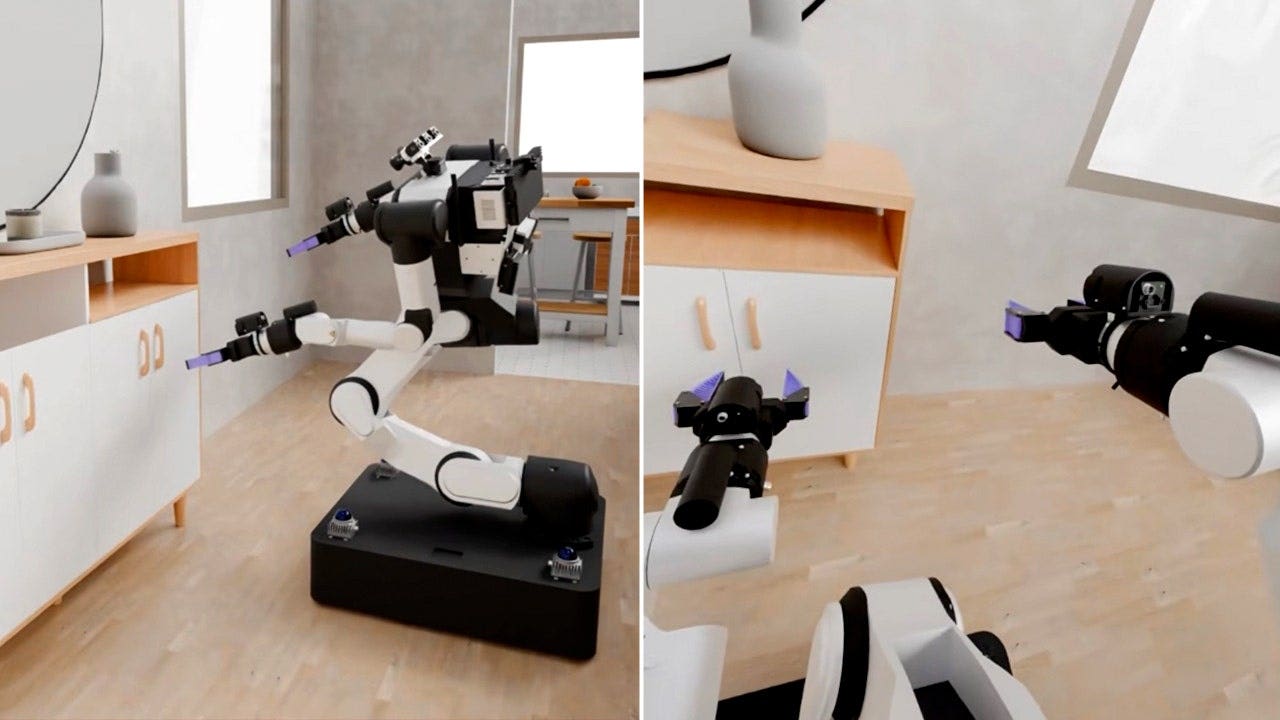
Researchers at MIT’s Computer Science and Artificial Intelligence Laboratory and Toyota Research Institute believe virtual training could help. Their system, called SceneSmith, uses AI agents to create detailed 3D indoor environments from simple text prompts. Robots can then practice tasks and expose weak action plans inside those AI-generated spaces before they enter a real home or workplace.
Sign up for my FREE CyberGuy Report
WOULD YOU TRUST A TINY DENTAL ROBOT?
Robots can test weak action plans inside AI-generated homes before operating around people and property. (SceneSmith)
Robots learn through experience. However, engineers cannot easily stage every room layout or object arrangement a machine may encounter. Physical testing also requires someone to reset the scene after each attempt. A tipped chair or misplaced bottle can change the next test. Meanwhile, a failed movement may damage the robot or something nearby.
Simulation offers a safer alternative. A robot can repeat a task without breaking a dish or tying up a real workspace. Still, many earlier simulation systems created rooms that felt sparse. They often lacked the clutter, movable furniture and physical details found in everyday spaces. SceneSmith makes those training environments feel much closer to the real world.
Other developers are also using AI video technology to speed up humanoid robot training, turning small amounts of real footage into synthetic training environments.
SceneSmith starts with a simple written request. A researcher could ask for a garage with a car and workbench, then add tires in the corner and a ladder against the wall. From there, three AI agents powered by GPT-5.2 work together to build the space. A designer starts creating the room. A critic checks whether everything looks realistic. An orchestrator manages the back-and-forth and decides when the design is ready.
SceneSmith builds each environment one layer at a time. It starts with the floor plan and furniture, then adds objects to the walls and ceiling. Smaller items that a robot can pick up or move come last. The critic also catches choices that feel out of place. For example, it might suggest removing a bathtub from the living room. The orchestrator can even send the project back a few steps when part of the design needs more work.
Once the agents agree, SceneSmith adds the physics that control how objects move and react. The result gives researchers a working virtual room where a robot can open cabinets and handle objects instead of a 3D scene that only looks realistic.
A robot needs more than realistic scenery. It needs objects that respond when touched. SceneSmith can place cabinets with working doors. It can also create movable objects and estimate physical properties such as mass or friction. Those details affect how an item reacts when a robot grabs, pushes or drops it.
For standard objects, the system can use a text-to-image-to-3D process. It retrieves articulated items with moving parts from a curated library. This approach keeps cabinet doors and drawers functional inside the simulator. The system also checks for overlapping objects and lets gravity settle them into stable positions.
Researchers reported that 96% of objects remained stable during simulation. Fewer than 2% of object pairs collided with one another. That work matters because a robot cannot learn much from a virtual kitchen where cups float or furniture sinks into the floor.
Better virtual practice could also support advances like this new AI brain that helps robots move more like humans, especially when a task requires precise hand movements.
HUMANOID ROBOT CLEANS FIRST US APARTMENT
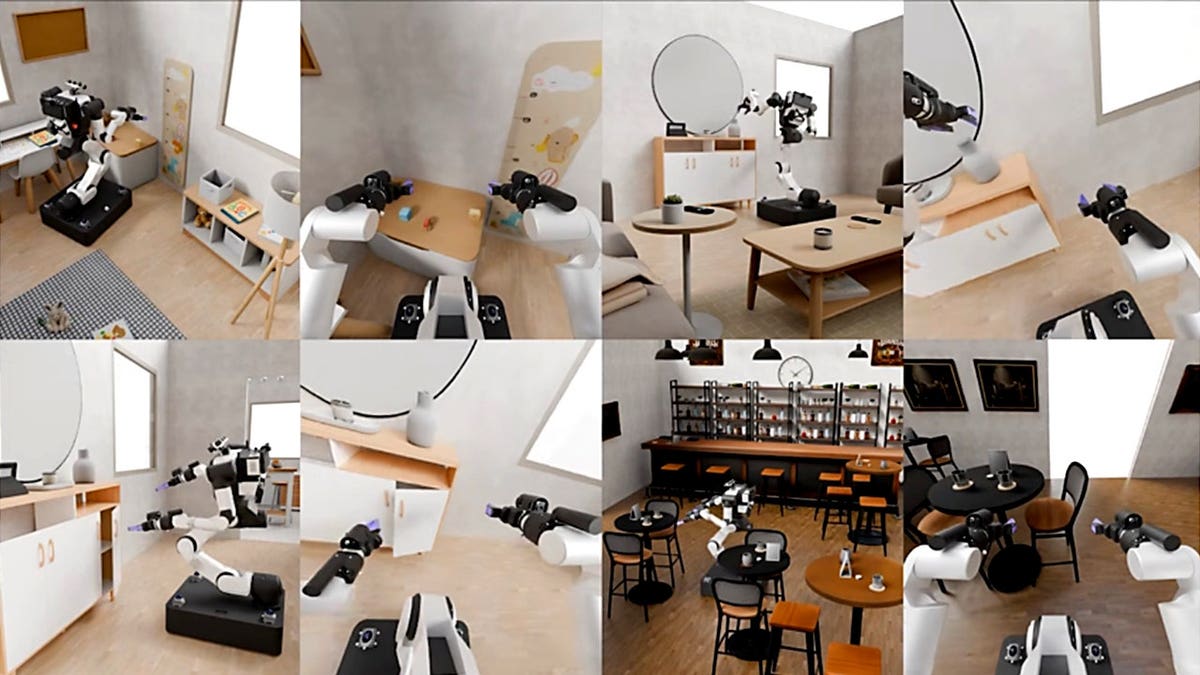
MIT researchers used SceneSmith to generate more than 1,300 virtual spaces, including bedrooms, hotels and cluttered specialty rooms. (SceneSmith)
The researchers used SceneSmith to generate more than 1,300 scenes. The collection included familiar spaces such as bedrooms and hotels. It also produced unusual settings, including a pottery store and a Minecraft-themed gaming room. Some scenes contained up to six times more items than those from earlier methods. As a result, robots can encounter the type of clutter that makes real-world tasks difficult.
A robot might need to move a soda can from a shelf to a table. Another task could involve placing a cup in the sink. Each scene changes the surroundings, so the robot cannot depend on one carefully staged layout. That variety gives engineers a better way to see whether a robot’s plan works beyond a single demonstration.
In robotics, a policy tells a machine how to act based on what it observes. SceneSmith gives researchers a way to test those policies across many environments. The team generated 100 evaluation scenes covering four manipulation tasks. A robot policy attempted each chore in simulation. Then, an AI evaluator checked the result using simulator data and visual observations.
The evaluator reached 99.7% agreement with human labels. That result suggests researchers could use the system to screen robot attempts at scale without manually judging every run. The headline’s phrase “learn from their mistakes” needs one important distinction. SceneSmith reveals where a policy fails. Engineers can use those failures to revise later versions of the robot’s behavior. In this study, the system focused on scene generation and automatic evaluation rather than continuous self-retraining after every mistake.
A virtual room can look realistic to a person and still behave poorly during robot training. Therefore, the team tested SceneSmith through physical interaction inside the simulator. Researchers placed an independently trained robot policy into generated scenes. The policy predated SceneSmith and had never trained on its environments or assets.
In one demonstration, the robot moved an apple from a bowl to a cutting board after receiving a language instruction. The team also teleoperated a robot through the virtual spaces. Researchers guided it as it opened cabinets and put away bottles. These tests showed that the environments could support more than visual inspection. Together, the demonstrations provide early evidence that SceneSmith’s rooms can support useful robotics experiments.
People preferred SceneSmith’s virtual rooms
The researchers asked 205 people to compare SceneSmith with earlier scene-generation methods. SceneSmith recorded an average 92% win rate for realism. It also earned a 91% average win rate for following the original prompt.
In practical terms, participants usually thought its rooms looked more believable and matched the request more closely. Those results support the visual side of the system. However, robot performance remains the more important test. SceneSmith’s ability to combine realistic design with usable physics gives the project its strongest advantage.
ROBOT SOCCER PLAYER DENTS WALL WITH TERRIFYING KICKS
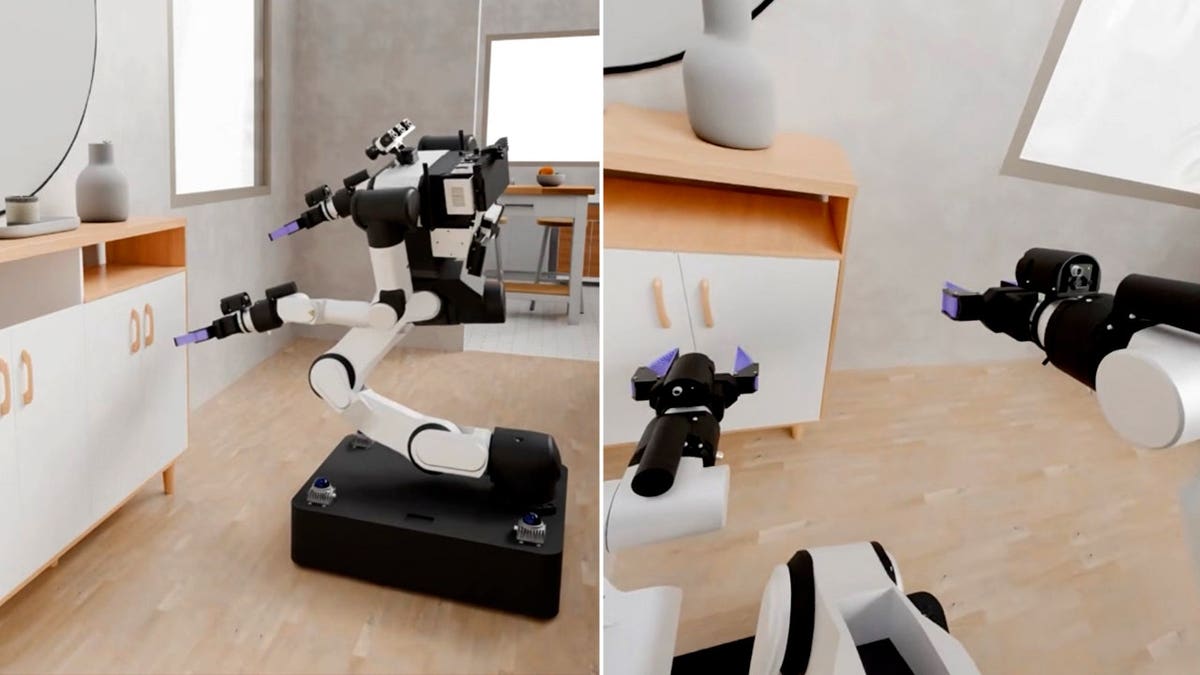
MIT’s SceneSmith uses artificial intelligence to build realistic 3D homes where robots can safely practice everyday tasks. (SceneSmith)
Detailed virtual rooms take time to build. MIT says SceneSmith may need several hours to produce one scene because the AI agents create and inspect many objects. More computing power could speed up that process. Even so, generating a large training library would require substantial resources.
The current system also has limited support for deformable objects such as sponges. These materials change shape when touched, which makes them harder to reproduce in simulation. The researchers hope larger 3D libraries will help them expand that capability.
Real-world testing will still play a vital role. Homes contain unpredictable people and objects that wear down or break. Simulation can reduce risky trial and error, but engineers must still prove that robots behave safely outside a digital room.
A future household robot could practice inside hundreds or even thousands of virtual rooms before it ever rolls into your kitchen. That gives developers more chances to catch a bad move or weak action plan while the robot remains inside a simulator. SceneSmith can also expose a robot to rooms filled with different furniture, objects and layouts. That matters because your kitchen will look nothing like the carefully arranged space where a robot first learned a task.
That kind of preparation could eventually help machines like this home robot designed to cook, clean and handle the clutter and surprises found in everyday homes.
The technology remains in the research stage, and robots will still need plenty of testing in the physical world. Still, SceneSmith tackles a problem robot makers need to solve: How do you prepare a machine for homes where chairs move, counters get cluttered and almost nothing stays in the same place?
SceneSmith gives robots a safe place to get things wrong. Engineers can spot a bad move inside a crowded virtual home before the machine risks damaging something or moving too close to a person. What makes this system interesting is that the rooms actually work like physical spaces. Cabinets open, objects move and robots can interact with what is around them. The biggest drawback is speed. Building one detailed scene can take hours. Still, these AI-generated environments could help developers catch more problems before a robot ever enters your home.
Would you trust a household robot more if it had already made thousands of mistakes inside AI-generated homes? Let us know by writing to us at Cyberguy.com
CLICK HERE TO DOWNLOAD THE FOX NEWS APP
Sign up for my FREE CyberGuy Report
Copyright 2026 CyberGuy.com. All rights reserved.

India’s Cockroach Janta Party has led weeks of protests demanding the education minister’s resignation over repeated exam paper leaks. Spokesperson Ashutosh Ranka says only accountability and structural reforms can fix the country’s ‘rotten’ education system.
Published On 23 Jul 2026

BBC South presenter Jo Kent is on holiday with her family in France, staying at the Lesley Pastourelles campsite in the village of Claouey, next to Lège.
She said multiple people at the campsite who were very anxious about the situation had already left, and those staying have been warned to be prepared to evacuate.
The main road down to the south of the peninsula, which is normally filled with “nose to tail traffic”, is empty and the supermarket is “unnervingly quiet”, Kent added.
In the Var region in south-east France, evacuated residents were told they could go home to assess potential damage to properties on Thursday morning. However, it warned people to limit their movements in the area due to the risk of the fire re-igniting as the wind picks up through the afternoon.
Several French departments have been ravaged by wildfires during a series of unusual and prolonged heatwaves that have swept across Europe this summer.
Interior Minister Laurent Nuñez paid tribute to the two firefighters who died on Tuesday near Bordeaux airport. He posted photos from an event on Wednesday, saying the moment was filled with “immense emotion” as he expressed “infinite gratitude” and “unwavering support” to their families.
Madrid has also been impacted by fires, but overnight most evacuated residents were told they can return to their homes – with the exception of one area in Villa del Prado.
A fire nearby is still burning, and almost 90 personnel and a helicopter have been deployed to get the flames under control. Local authorities continued to warn of an “extreme risk of fires” on Thursday morning.
Spain’s weather service AEMET said temperatures of up to 36C are forecast for the afternoon.
Countries across Europe have seen record temperatures in recent months.
A report released in April by the Copernicus Climate Change Service found at least 95% of Europe saw “above average” annual temperatures in 2025 and identified Europe as the fastest-warming continent.
Wildfire-burnt area and fire emissions both reached record levels last year, the report said.