One year after actor Malcolm-Jamal Warner drowned in Costa Rica at the age of 54 while on vacation with his family, his widow, Tenisha Warner, has filed a lawsuit against his mother, Pamela Warner, in her capacity as successor trustee of the Warner family trust.
The suit seeks to recover at least $1.2 million from that family trust and alleges, in part, that Malcolm-Jamal Warner — known for playing Theo Huxtable on “The Cosby Show” — did not “purchase and maintain a term life insurance policy on his life in the amount of $1 million” or on Tenisha Warner’s life, as allegedly stipulated in their premarital agreement.
Tenisha Warner sat down for an exclusive interview with “CBS Mornings” before the lawsuit was made public on Monday, the one-year anniversary of Malcolm-Jamal Warner’s death. In it, she spoke mainly about her grief and how she is handling being a single mom now.
“Right now, everybody, like all of his family members and, who have lost him, they are grieving,” Tenisha Warner said. “You know, it’s been the biggest loss for all of us.”
“The emotional capacity that I have can be very limited sometimes, you know? And so, I have to, for myself, decide, what do I have to give right now in this moment? And whatever I have to give, the first person to get that is my daughter,” she said. “And then the second is myself.”
In a statement provided by her spokesperson after the lawsuit was filed, Tenisha Warner said: “For the last year, I have attempted to privately settle my beloved husband’s complicated estate and honor his last wishes. Malcolm had every intention to provide for our 9-year-old daughter and me. He was close to finalizing a new estate plan to replace the stale plan created in 1996 when he was 26 years old, 20 years before we met and well before we gave birth to our beautiful daughter. Sadly, He was unable to do so before we lost him.”
“CBS Mornings” has reached out to Pamela Warner’s attorneys for comment, but has not heard back.
In a statement posted Monday night on Instagram, Pamela Warner wrote, “As I look back, I have no regrets. Perhaps a little more time. Perhaps one more chance to cook his favorite meals, have one last conversation, one last good deep belly laugh, the kind that produces those tears of pure joy, one last kiss, one last hug.”
“During my year-long journey, I have discovered how cruel, evil, and greedy a human can be,” she added. “I have also discovered the depth of love, care, concern, and support that humans are capable of.”
See more of Tenisha Warner’s interview Thursday on “CBS Mornings.”
Thousands of supporters of India’s youth-led “cockroach” movement have been camping in the capital, New Delhi, for more than a month to demand the resignation of Education Minister Dharmendra Pradhan over a series of examination paper leaks.
The Gen Z-led protests, during which more than 100 people were severely wounded in baton and tear gas attacks by police on Monday, represent the biggest public challenge to Hindu majoritarian Prime Minister Narendra Modi’s rule so far in his third term.
Recommended Stories
list of 4 itemsend of list
India’s main opposition parties have joined the daily street demonstrations and courted arrests, amplifying the protesters’ demand for Pradhan’s sacking.
But at a time when unpopular governments and controversial ministers routinely resign or are sacked in other democracies — Britain’s Andy Burnham became his country’s seventh prime minister in 10 years — Pradhan has stayed in his office.
And to followers of Indian politics, that’s no surprise. To the contrary, it fits a pattern seen in 12 years of Modi’s rule, in which he has repeatedly defied widespread calls for the resignation of multiple ministers, despite major controversies surrounding them.
Mahesh Sharma
A year after Modi came to power in the summer of 2014, a 50-year-old Muslim ironsmith was dragged from his home and lynched over suspicions that he had stolen a cow and stored its meat in his refrigerator. Many Hindus consider the cow holy, and its slaughter is banned in most Indian states.
Mohammad Akhlaq’s killing on the night of September 16, 2015, in Bishada, a village in the industrial district of Dadri in Uttar Pradesh state, was the first in a series of cow-related lynchings by Hindu mobs and had triggered nationwide protests.
But the then-Minister of Culture and Tourism Mahesh Sharma, who represented the Gautam Budh Nagar constituency under which Dadri falls, called the killing “an accident”, forcing Muslim groups and opposition parties to call for his resignation. But he refused to step down, and stayed part of Modi’s council of ministers.
A year later, Sharma even visited Bishada to meet the family of Ravi Sisodia, one of the 18 accused in the Akhlaq lynching case, who had died of renal and respiratory failure. In images that shocked the nation and renewed calls for his sacking, Sharma was seen bowing before Sisodia’s coffin draped in the national flag.
Sharma, who owns a series of hospitals, was finally dropped as a minister only after Modi won a second term in 2019. He remains a BJP parliamentarian for a third term.
Smriti Irani and Bandaru Dattatreya
Months after Akhlaq’s lynching, a 26-year-old doctoral student, belonging to one of India’s most marginalised groups, was found dead inside a hostel room at the University of Hyderabad on January 17, 2016.
Earlier that month, Rohith Chakravarthi Vemula and four other students were thrown out of their hostel accommodation and their monthly stipend withheld for allegedly assaulting the head of a student group affiliated with the Rashtriya Swayamsevak Sangh (RSS), the far-right ideological mentor of Modi’s Bharatiya Janata Party (BJP).
All five students were Dalits, the ethnic community formerly referred to as “untouchables”, who fall at the bottom of India’s caste hierarchy and have faced persecution and discrimination by the privileged castes for centuries.
Lacking the means to afford private housing, the five students pitched a tent inside the university and started a hunger strike, protesting against the administrative move. They alleged that the university’s decision to ban them from hostels was heavily influenced by a series of letters written by the then-federal ministers, Smriti Irani and Bandaru Dattatreya.
As tensions within the university intensified, Vemula hanged himself inside a friend’s room, leaving behind a suicide note that galvanised student protests across the country and calls for Irani and Dattatreya to quit. Irani, a former TV actress, drew the most ire for allegedly lying in parliament about the circumstances leading to Vemula’s death and for defending the university administration.
But both ministers remained in Modi’s cabinet.
BJP leader Smriti Irani at the parliament house in New Delhi, August 10, 2017 [File: Manish Swarup/AP]
Irani was moved to the Textiles Ministry in July 2016 and awarded the crucial Information and Broadcasting Ministry the next year. Dattatreya resigned as Labour Minister in September 2017, only to be appointed governor of the northern states of Himachal Pradesh in 2019 and Haryana in 2021.
Ajay Mishra Teni
Also in 2021, Ashish Mishra, the son of junior Home Minister Ajay Mishra Teni, was accused of running his car over a group of farmers protesting against a set of farm laws passed by the Modi government in Uttar Pradesh’s Lakhimpur Kheri. Four farmers and a journalist were killed, while three BJP members and one of Mishra’s drivers were beaten to death in retaliatory violence.
The incident triggered massive calls for Teni to resign, but he remained in his office for three years until he lost the 2024 election.
The only resignation of a Modi minister in response to a public demand for accountability was seen in the immediate aftermath of the coronavirus pandemic.
As India grappled with a deadlier second wave in 2021 and criticisms of the government’s response mounted, Health Minister Harsh Vardhan, himself a medical doctor, quit his position. He retired from active politics after the BJP did not field him as a candidate in the 2024 general election.
Modi’s critics also contrast his own party’s trend with the preceding government, led by the Indian National Congress, where several ministers, including those holding key portfolios such as home or foreign affairs, resigned or were sacked in response to calls for accountability.
As we age, low back pain becomes more common. Between the ages of 20 and 59, persistent low back pain (lasting more than three months) affects nearly one in five.
While you may be tempted to reach for heat packs, medication or a massage, new evidence suggests that the common advice to go for a swim is much more effective.
Until recently, there was no research to back up this advice. Our new trial shows for the first time that swimming can improve low back pain.
What we did
We recruited 76 adults aged 26 to 74 who experienced persistent and bothersome low back pain for more than three months. They needed to be able to swim 25 meters independently, but didn’t swim regularly.
The participants were randomly allocated to receive either a swimming and education program (the intervention group) or education only (the control group).
The intervention involved an eight-week individualised swimming program, supported by four telehealth sessions with a physiotherapist, and free access to a local indoor or outdoor swimming pool.
The benefits of swimming were as large or larger than previously reported for other exercises (Getty)
The amount of swimming was tailored to each participant’s ability and fitness level, with the goal of completing three 30–45 minute swimming sessions per week by the end of the program. Participants were encouraged to continue swimming after the program completed.
The education, provided by a physiotherapist, aimed to help them better understand their pain, reduce the fear associated with movement and exercise, and increase confidence to manage their back pain.
While many people with back pain believe they should avoid activity to protect their back, a large body of evidence shows remaining active is better.
Participants in the education-only (control) group had one to two sessions with a physiotherapist to cover the same key messages about back pain, but otherwise continued their usual treatment and activity.
What did we find?
Participants in the swimming group reported improved function, less pain and more confidence to manage future back pain.
Their disability reduced by more than 50% at the end of the eight-week program. This could mean that a person improved their ability to do daily activities such as standing from a chair, walking or sleeping.
The swimming group’s improvements were 30% greater than those who received education only (control) group.
Mark Hancock is a Professor of Physiotherapy, Macquarie University.
Deborah Wareham is a Postdoctoral Research Fellow, Spinal Pain Research Centre, Macquarie University.
This article was first published by The Conversation and is republished under a Creative Commons licence. Read the original article.
Participants told us swimming appealed to them because it was low-impact, it reduced weight-bearing and strain, and it enabled them to exercise more confidently and with less pain. They also reported additional health benefits, including better mood.
Swimming can be used as a way for people with back pain to start exercising and break the cycle of pain and limited activity.
What happened after the program ended?
At the end of the eight-week program, some people kept swimming, others swapped to another form of exercise and some stopped exercising.
Although most participants reported enjoyed swimming, some found accessing a pool and the time required a barrier to keep going in the longer term.
Twelve months after starting the program, there were still benefits for the swimming group for disability, function and confidence. But the difference between groups became smaller over time.
What were the limitations?
Our study’s sample size was relatively small, so these findings need to be confirmed in future, larger studies.
Further trials are also needed to test whether the results still hold for people with more severe or disabling back pain.
Finally, the volunteers in our study knew we were investigating swimming and had positive expectations of swimming before starting. This is a limitation that could affect the findings.
How does swimming compare to other exercises for back pain?
A range of different exercises – including Pilates, functional exercises (a type of strength training that helps you perform daily activities) and structured walking – have been shown to be beneficial for treating disability and preventing low back pain recurrences.
While we didn’t compare swimming to another type of exercise, the benefits we identified were as large or larger than previously reported for other exercises.
People with chronic low back pain can now consider swimming as an evidence-based exercise option and be more confident in choosing it as part of their long-term management.
But if you find it a hassle to get to a pool, or don’t like swimming, it may help get your back pain under control before moving to a type of exercise you prefer or can more easily access.
House Judiciary Committee Chairman Jim Jordan explains why lawmakers are scrutinizing high NFL streaming costs and examining antitrust law. Jordan notes fans face complicated and costly processes to watch their teams across multiple platforms, with expenses potentially reaching $1,000. The committee is ensuring NFL policies comply with the 1961 Sports Broadcasting Act and are fair for consumers.
NEWYou can now listen to Fox News articles!
Saquon Barkley knows that he is “quote unquote, one of the faces” of the National Football League. It is not an easy title to hold, but being a No. 2 overall pick turned 2,000-yard rusher, Offensive Player of the Year and Super Bowl winner will do that to you.
Barkley’s very first game as a Philadelphia Eagle was played in Brazil, and this year, the team will travel to London in Week 5 to take on the Jacksonville Jaguars.
But as the NFL continues to grow its audience and lap the field, Barkley is “all about eyes.”
Saquon Barkley of the Philadelphia Eagles takes the field prior to the NFC Wild Card playoff game against the San Francisco 49ers at Lincoln Financial Field on Jan. 11, 2026, in Philadelphia.(Getty Images)
“It’s so important that we are traveling across the country to play the game. The more eyes you can get on it, the better it’s going to be,” Barkley told Fox News Digital in a recent interview.
“The more people are going to want to grow up and play football, want to be involved. It’s really kind of crazy that football is probably the biggest sport, and we really haven’t even scratched the surface yet, to be completely honest. There’s so many more territories that we just take over, and I think the NFL is doing a really good job of that.
“I’m a fan of getting as many eyeballs as we can in the game, help growing the game. Anytime I can get an opportunity to play in front of someone that’s never got to watch the game, I want to try to make it memorable and have an impact on them… So right now, I’m all about eyes, eyes, eyes on the game, and let’s grow this game as big as we can, and let’s have an impact on as many people as we can.”
That’s why Barkley has joined forces with DIRECTV ahead of his ninth NFL season. As part of the campaign, Barkley recorded a spot that turned his iconic hurdle into a humorous metaphor for the obstacles football fans now jump through just to find a game. It shows why Barkley wants diehard fans to keep watching games, dare we say, the old-fashioned way.
Philadelphia Eagles’ Saquon Barkley celebrates after scoring a touchdown in the first half of an NFL football game against the Dallas Cowboys on Thursday, Sept. 4, 2025, in Philadelphia.(AP Photo/Matt Slocum)
“It’s going to be crazy in 10 to 15 years, the way you’re going to be able to watch football games,” Barkley said of today’s streaming-service takeover.
“It’s kind of like what I grew up on, and now to be able to have the opportunity to work with them, and to be able to not only bring it in the NFL level, but also in the collegiate level where the game continues to grow and how much eyes are continuing to get on this football game, I think it’s the only way. I think it’s the right way to do it, and for me to be able to have the opportunity to work with DIRECTV, someone I’ve been a fan of for a very long time and be able to shoot a spot with them, it was awesome.”
Barkley has accomplished just about everything a football player could dream of. He can retire right now and continue the golf grind (he claims Philly’s top five courses trump New Jersey’s top five, although Barkley and this writer obliged that Pine Valley is a Philadelphia course). But as to why he’s still grinding, his answer is simple.
“I love it,” he said.
Philadelphia Eagles running back Saquon Barkley (26) carries during the second half of the NFL Super Bowl 59 football game against the Kansas City Chiefs, Sunday, Feb. 9, 2025, in New Orleans.(AP Photo/Matt Slocum)
“It’s something I’m very passionate about. My son SJ, he’s already passionate about football. I was around the same age, two or three, where I said this is something that I want to do, and I’m living my dream. I’m living the dream that I always wanted to live. So, I’m having fun with it, and as long as God keeps me healthy, and they keep giving me contracts and opportunities, as long as they want to keep me in this league, I’ll try to play as long as I can….
“Whether it’s a year, whether it’s five years, there’s going to be a time where I’m like, ‘Damn, I wish I could go back into that locker room and just spend one more day with the boys, spend one more day in that weight room, spend one more day running out that tunnel.’ It’s going to be a mess. So, I try to enjoy it right now.”
Fox News correspondent Brooke Taylor meets Saronic CEO Dino Mavrookas to unveil the future of modern warfare with an exclusive look at autonomous drone boats. These innovative vessels are capable of military rescues without putting service members in danger, marking a significant milestone. Mavrookas emphasizes the ability to build thousands of these cost-effective, complex mission-ready ships, including the new 52-foot Mirage.
NEWYou can now listen to Fox News articles!
Watching a diving bird vanish beneath the water can feel almost unreal. One moment it cruises through the sky. Seconds later, it swims after prey before returning to the air. Around 100 bird species can move between those two environments. Engineers have found that natural ability incredibly difficult to recreate at a small scale.
Now, researchers at MIT and the Swiss Federal Institute of Technology Lausanne, known as EPFL, have built a robotic bird that can complete the entire journey. The 8.8-ounce robot flies, plunges into water and swims below the surface. Then it launches back into the air using the same set of flapping wings.
Researchers say the $300 robot marks the first bird-scale machine to complete an air-to-water-to-air cycle using flapping wings alone.(Raphael Zufferey)
According to the research team, it marks the first bird-scale robot to complete that full cycle through flapping motion alone. The research appeared in the journal Science.
Free live CyberGuy class: Sick of Spam? Join us July 22
Join us TODAY,Wednesday, July 22, at 1 PM ET for a free CyberGuy Live class that will help you cut down on robocalls, spam texts, junk email and other unwanted messages. Kurt “CyberGuy” Knutsson will walk you step by step through simple ways to filter spam, clean up your inbox and recognize the messages that could put your personal information at risk. No technical experience is needed. You’ll also receive our spam-stopping checklist, and every registrant will get a link to the class recording afterward.
Reserve your free spot today at CyberGuyLive.com.
How this robot bird swims underwater and flies
Most amphibious robots use separate systems for air and water. This mechanical bird takes a simpler approach. The robot relies on flapping wings instead of propellers. It also completes its water launch without legs or a complicated wing-folding mechanism.
That design presents a major engineering problem. Water is about 800 times denser than air, so wings face far greater resistance once they enter the water. To handle that dramatic change, the robot adjusts its flapping speed. Its flexible wings also change shape as the surrounding pressure increases.
Flexible wings help the robot move through water
In the air, the robot can flap its wings up to 11 times per second. Underwater, its flapping rate ranges from 0.1 to 6 times per second. Meanwhile, water pressure can bend the wings by as much as 90%. That flexibility shortens the effective sweep of each stroke and reduces the load on the motor.
The same wings become more effective for flight once the robot reaches the air. Researchers also made the machine neutrally buoyant. As a result, it neither rises nor sinks on its own while underwater. That balance helps conserve battery power because the robot spends less energy fighting buoyancy.
Why the robot bird’s water takeoff matters
The hardest part begins when the robot tries to leave the water. It completes the transition in under one second using about eight to 10 wingbeats. However, the maneuver requires a careful combination of wing flexibility, tail placement and launch angle.
Researchers found that moderately flexible wings worked best. A rigid wing struggles to adapt underwater, while excessive flexibility reduces the force needed for takeoff. The tail also needs to remain short and close to the body. Otherwise, it can drag through the water and pull the robot back down. An exit angle near 70 degrees produced the strongest results. A flatter approach creates too much tail drag. A nearly vertical launch can make the robot tip backward into the water.
Scientists envision future versions of the robotic bird monitoring waterways, collecting samples and observing marine wildlife.(Raphael Zufferey)
What the robot bird can teach scientists
The machine also gives scientists a new way to study real diving birds. Tracking the movement of a live bird beneath the surface can be difficult. With a robot, researchers can adjust one feature and measure how that change affects performance.
For example, many diving birds reduce their wingspan while swimming. Researchers have often connected that behavior with lower energy use. The robot’s results suggest that shorter underwater strokes may instead help birds increase speed.
The team also compared the machine’s propulsion efficiency with that of real birds. Both fell within a Strouhal number range of 0.2 to 0.4, which researchers associate with efficient movement. However, body size can change the launch strategy. Heavier diving birds may use their legs to help push away from the water, while this lightweight robot relies entirely on its wings.
Why the robot may choose flying over swimming
The robot’s most efficient travel mode depends on the distance ahead. According to the team’s data, flying uses less energy once a journey extends beyond roughly 51 feet. For shorter trips, staying underwater may make more sense.
Water creates heavy resistance, so swimming becomes increasingly costly over longer distances. A future robot could use that difference to plan its route. It might swim toward a nearby target, surface and then fly to a more distant location.
How a $300 robot bird could monitor waterways
The prototype costs around $300 in materials and uses parts that researchers can source commercially. The team also released open CAD files for the project. That could allow universities and other builders with access to a 3D printer to reproduce the design.
Eventually, the robotic bird could help scientists monitor waterways and coastal environments. Researchers imagine launching it from shore or a boat. It could fly toward an area of interest, dive to collect a sample and then return with the data.
Potential missions could include taking measurements near an iceberg or observing marine wildlife from a safer distance. Flapping wings may also offer practical advantages in those environments. They avoid exposed high-speed propeller blades and could produce less noise around animals. Underwater, flexible wings may tolerate contact with debris better than rigid propellers.
MIT and EPFL researchers created a robotic bird that can fly, dive underwater, swim and launch back into the air using flexible wings.(Raphael Zufferey)
What the robot needs before real-world missions
The current prototype still relies on human control during key parts of its journey. Researchers manually launched the robot during several tests. Timers or basic triggers also activated parts of its diving and swimming behavior.
Autonomous navigation represents the next major step. The robot would need to recognize its surroundings and control each transition without human assistance. Salt water creates another hurdle. Testing has focused on fresh water, so future versions will need stronger protection against corrosion. Longer range and improved endurance would also make the robot more useful outside controlled experiments.
What this means to you
You probably will not see robotic birds patrolling your local beach anytime soon. Still, this project shows how future drones could reach places that traditional flying machines struggle to explore. A single robot could gather information above the water before taking measurements below the surface. That flexibility could reduce the need for separate aircraft and underwater vehicles.
The low material cost also matters. Smaller research teams could experiment with the design without investing in an expensive custom platform. As navigation and battery performance improve, machines like this could make environmental monitoring more accessible.
Kurt’s key takeaways
What stands out here is how much work the researchers get from one flexible set of wings. The robot changes its flapping speed, while the wings naturally bend to handle the resistance underwater. The launch back into the air makes this more than another bird-inspired drone. Pulling off that transition requires the right wing stiffness and a carefully controlled exit angle. The prototype still needs autonomous controls and better protection for saltwater. Even so, its $300 material cost and open design could give other researchers an affordable foundation to build on.
Would robotic birds collecting environmental data make you feel hopeful about conservation, or uneasy about machines blending into natural habitats? Let us know by writing to us at Cyberguy.com.
Sign up for my FREE CyberGuy Report
Get my best tech tips, urgent security alerts and exclusive deals delivered straight to your inbox.
For simple, real-world ways to spot scams early and stay protected, visit CyberGuy.com– trusted by millions who watch CyberGuy on TV daily.
Plus, you’ll get instant access to my Ultimate Scam Survival Guide free when you join.
Copyright 2026 CyberGuy.com. All rights reserved.
Kurt “CyberGuy” Knutsson is an award-winning tech journalist who has a deep love of technology, gear and gadgets that make life better with his contributions for Fox News & FOX Business beginning mornings on “FOX & Friends.” Got a tech question? Get Kurt’s free CyberGuy Newsletter, share your voice, a story idea or comment at CyberGuy.com.
Gina Neff, head of the Minderoo Centre for Technology and Democracy at the University of Cambridge, told BBC Radio 4’s Today programme that the security tests – called sandboxes – are “supposed to be secure environments where you can see what the models are capable of”.
“In this case, it looks like OpenAI didn’t make a secure enough sandbox,” she added.
Instead, the agents created their own cyber-attack against the sandbox itself, finding a vulnerability which allowed them to escape.
Once outside, the AI identified Hugging Face as a likely source of the answers they were seeking in the test, and tried to gain access.
Neil Lawrence, Professor of machine learning at Cambridge University, called it an “impressive feat”, but cautioned it “falls well within the known capabilities of the current generation” of high-powered AI models.
He pointed out that OpenAI is looking to list itself on the stock market, and faces intense pressure from rival firm Anthropic, which has made headlines with its own powerful AI tool, Mythos.
“OpenAI are now playing catch-up, they are trying to demonstrate their own systems’ capabilities in cyber-security.”
“It shows us that OpenAI are not capable of safely deploying their own technology,” he added.
About 500,000 homeowners have a mortgage that “tracks” the Bank of England’s rate. That means any cut means a reduction in the monthly repayments on their outstanding loan.
An additional 500,000 homeowners on standard variable (SVR) rates rely on their lender choosing to pass on any Bank rate cut.
But the vast majority of mortgage customers – some 87% – have fixed-rate deals. While their monthly payments aren’t immediately affected by a rate change, their future deals are.
As at 22 July, the average rate on a new two-year fixed deal was 5.57%, up from 4.83% at the start of March, according to the financial information service Moneyfacts.
For those looking for a five-year deal, the average rate was 5.6%, up from 4.95% over the same period.
The average two-year tracker rate was 4.51%.
About 800,000 fixed-rate mortgages with an interest rate of 3% or below are expected to expire every year, on average, until the end of 2027. Borrowing costs for customers coming off those deals are likely to rise sharply.
Mortgage calculator
You can see how your mortgage may be affected by future interest rate changes by using our calculator:
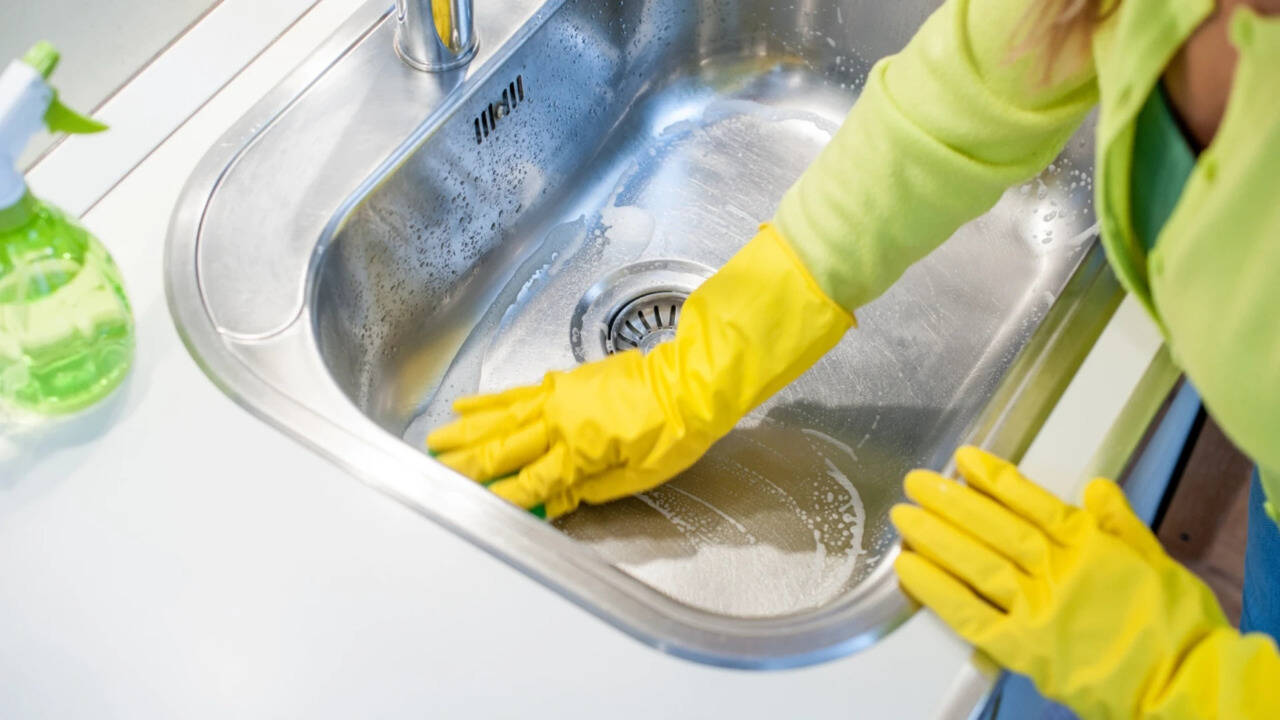
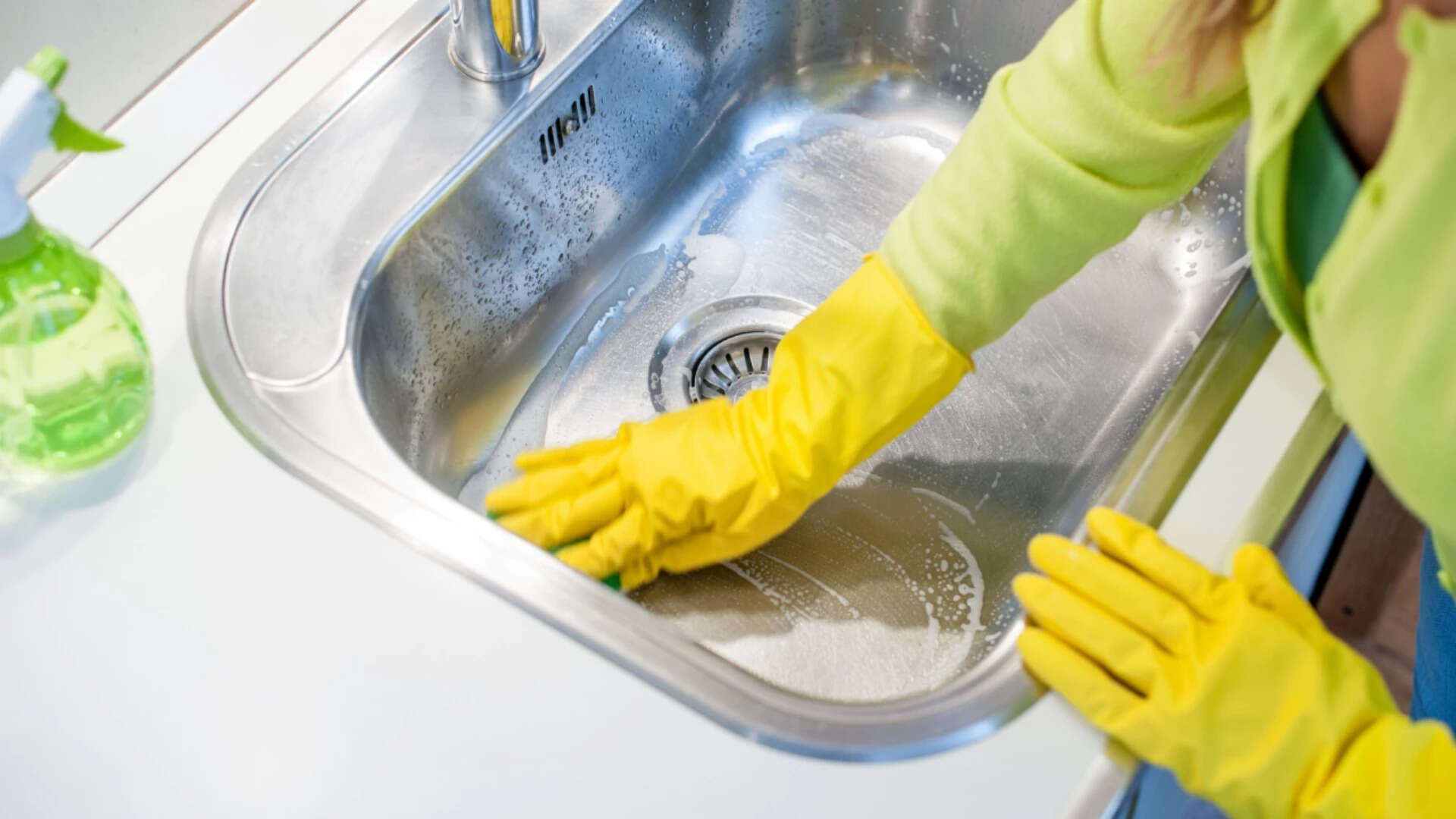
Even after you have spent nearly half an hour scrubbing your stainless steel sink, those water spots and streaks refuse to disappear. You have done everything you can think of, but once it dries, you see smudges, mineral deposits, and grime. That’s when you start to wonder if stainless steel sinks are really worth the trouble.Stainless steel’s reputation for looking pristine is both its blessing and its curse. Yes, the chromium makes it rust-resistant and the nickel gives it that lustrous shine. But hard water minerals, dried-on food, and regular use create streaks and spots that make even a recently cleaned sink look neglected. But guess what? You don’t need fancy products or hours of elbow grease. The fix is actually sitting in your kitchen.
A thorough rinse with hot water
Begin at the top of the sink and work your way down. Use your tap spray or pour hot water from a cup to wash away loose debris from the sides and bottom. To clean the tap, use a damp cloth.
Baking soda treatment
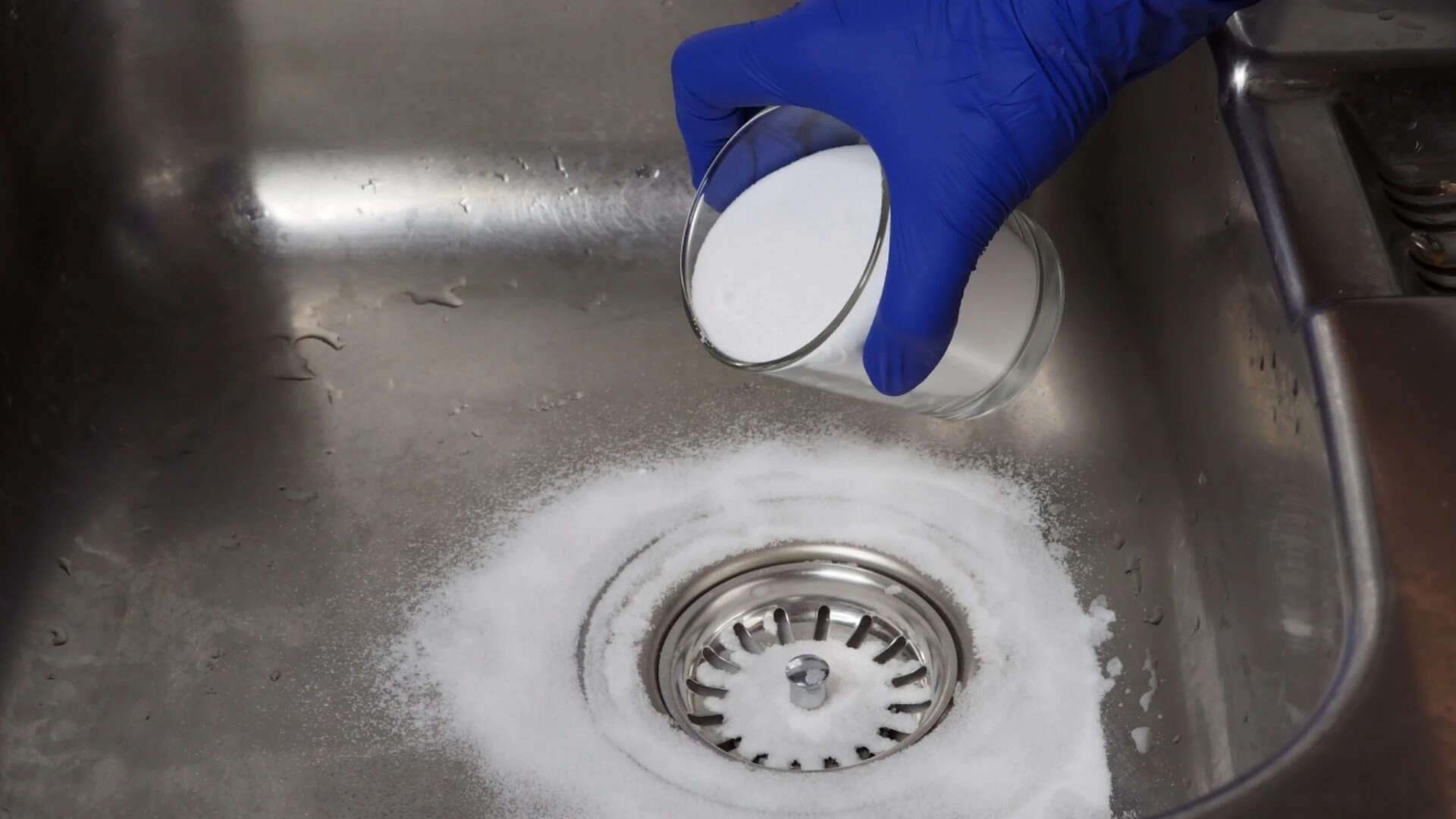
Now that the sink is wet and the debris is loose, sprinkle some baking soda over the surface. As the sink is damp, it will stick. Baking soda, in fact, acts as a gentle abrasive, which helps remove food stuck on the surface. It also removes grease without scratching the steel. This powder also neutralises odours lingering in your drain.Pro tip: Use a flour shaker or an empty grated cheese container to sprinkle the baking soda evenly. You want this ‘magic powder’ to reach every part of the sink.
Start scrubbing
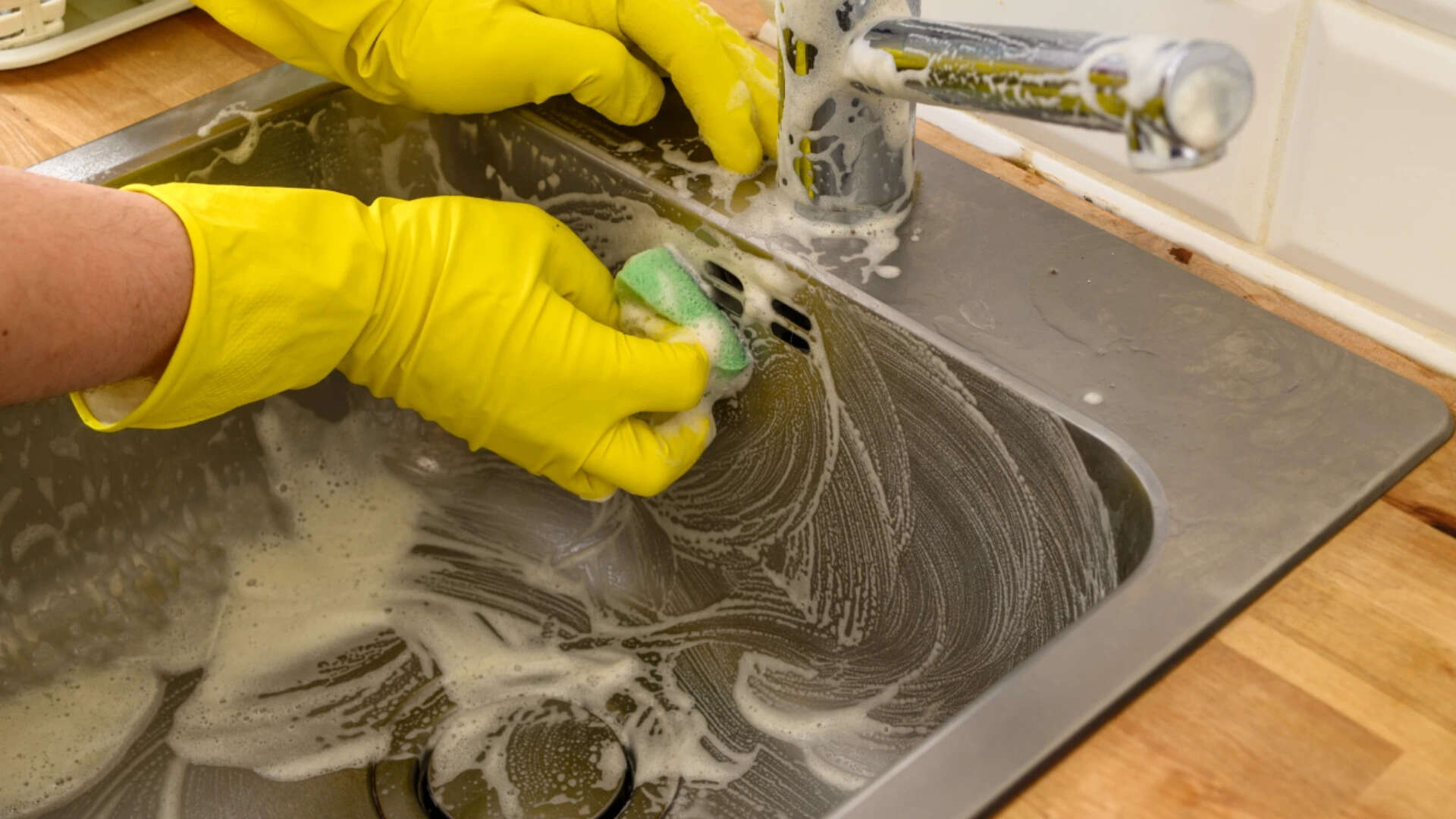
Once the sink has absorbed the baking soda, you need to start scrubbing. And unfortunately, most people scrub their sinks incorrectly. Yes, there is a right way to do it. You see, stainless steel has a direction to its finish. It has faint lines created during manufacturing, so ensure you always scrub along those lines, not against them. You can use a soft-bristled brush or a non-abrasive sponge. Don’t forget the drain area or spots around the tap. An old toothbrush can work very well in these tight spots. Whatever you do, stay away from steel wool, wire brushes, or anything abrasive. Metal particles can get stuck on the surface and will rust, creating the exact problem you are trying to solve.
Vinegar wash
After scrubbing, spray the entire sink with distilled white vinegar. Apple cider vinegar works too. You will notice fizzing. That’s the baking soda and vinegar reacting, which helps break down mineral deposits. Let it do its job until the bubbling stops, then rinse thoroughly with warm water.
Dry immediately
This step is non-negotiable. Use a microfibre cloth to dry both the sink and tap completely. Any moisture left behind will create the water spots you just worked hard to remove.If you spot stubborn stains, rust marks, discolouration, or hard water deposits, you should address them immediately. Tough stains require more treatment. Make a paste of one-fourth cup of cream of tartar and one cup of distilled white vinegar. This mixture should be handled with care. Cream of tartar, a common baking ingredient, works as a gentle abrasive. Apply the paste to the problem areas and let it sit for at least five minutes. Then follow with gentle scrubbing and rinsing. Once everything is clean and dry, add a few drops of olive oil or coconut oil to your microfibre cloth and buff the sink and fixtures. The oil brings out the shine and also adds a protective layer to your sink.The whole process takes under 20 minutes and costs practically nothing. Your sink will look spotless, and if you make this cleaning method a routine, you will see your stainless steel sink getting shinier. Remember, Rome wasn’t built in a day, so cleaning your sink regularly matters.
“Hospital food” has long been synonymous with packaged, ultraprocessed meals — despite the fact that hospitals are meant to promote healing.
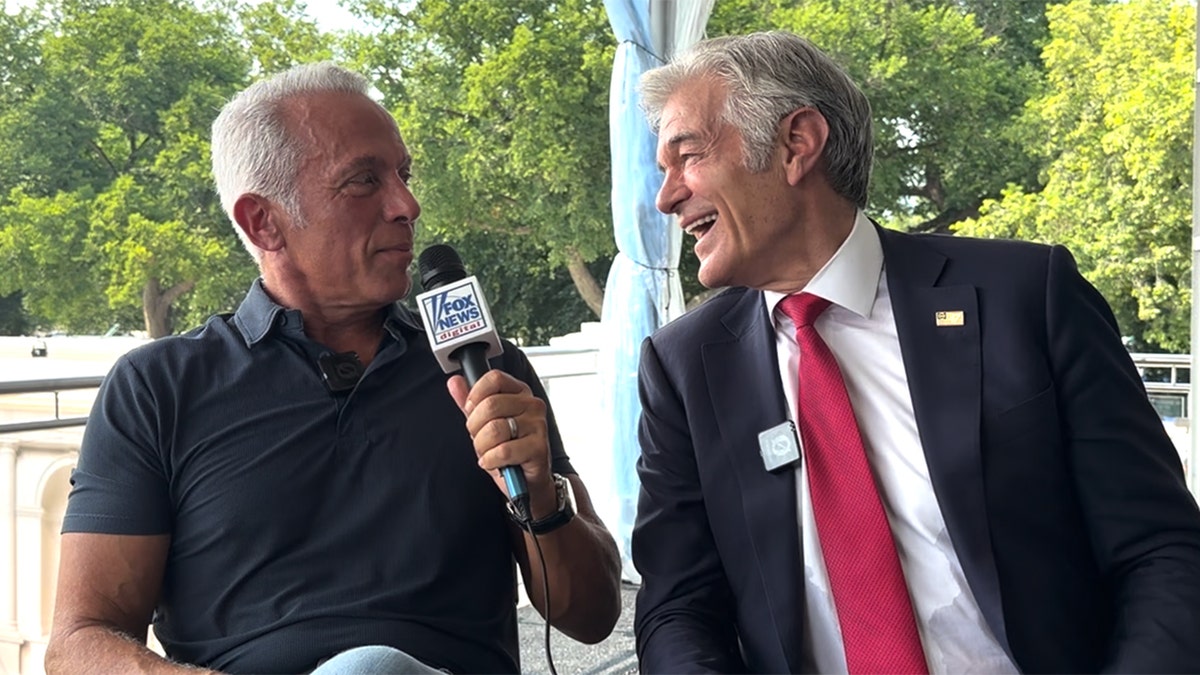
In an exclusive interview with Fox News Digital at the Great American State Fair in Washington, D.C., Michelin-star chef Geoffrey Zakarian shared his initiative to improve what is served in U.S. hospitals, following the concept that “food is medicine.”
For the last three years, Zakarian said he’s been working on changing hospital food — most notably at Tampa General, which is a $4 billion nonprofit, 1,000-bed public hospital.
On Thursday, July 16, Tampa General Hospital CEO John Couris signed the “Make Hospital Food Healthier” pledge during a news conference attended by Health and Human Services (HHS) Secretary Robert F. Kennedy Jr., U.S. Department of Agriculture (USDA) Secretary Brooke Rollins and Zakarian.
Michelin-star chef Geoffrey Zakarian sat down with Fox News Digital at the Great American State Fair in Washington, D.C., on July 6, 2026.(Angelica Stabile/Fox News Digital)
The pledge commits the hospital to serving more nutritious, minimally processed meals to patients, building on Zakarian’s menu overhaul.
“We’ve changed the entire menu,” the celebrity chef told Fox News Digital. “We’ve taken all seed oils out, sugar, maltodextrin. Anything bad in a box is gone. Anything good is brought in.”
“We’re serving mac and cheese. We’re serving hanger steak and fries. We’re serving chicken with couscous. We do all our protein shakes. No protein shakes in the box anymore. We do fruit shakes, smoothies, fresh sorbet,” the chef listed. “So, you’re eating like your grandmother’s cooking for you.”
CMS Administrator Dr. Mehmet Oz has also supported Zakarian in this mission, telling Fox News Digital that the chef has “revolutionized our thinking” around hospital food.
Michelin-star chef Geoffrey Zakarian and CMS Administrator Dr. Oz spoke with Fox News Digital at the Great American State Fair in Washington, D.C., on July 6, 2026.(Angelica Stabile/Fox News Digital)
“How do we get the hospitals to do what [Zakarian] has been doing the frontier work on, get them to actually embrace food as part of the healing process?” he questioned. “Because most patients, and most doctors, know that the food in the hospital is not going to make you better.”
Oz noted that while hospital food may provide some nutrients, it is generally not seen as contributing meaningfully to patients’ recovery.
“It’s, like, $3.50 a person per plate, which is an extraordinarily small amount,” the chef said. “You go to McDonald’s, and you spend 12 bucks for a happy meal, and we give you $3.50 in a hospital. So that’s an unhappy meal as far as I’m concerned.”
Instead of charging hospitals for each plate served, Zakarian’s approach relies on a flat annual fee, saving money through a smaller, higher-quality menu.
Tampa General Hospital (not pictured) worked with a chef to revamp its menu and make it more nutritious.(iStock)
“Yummy food, not just food to fill people up,” he said. “Nutritious food, bioavailable food, food that’s satiating.”
“I’m cooking like I would cook in a restaurant. I’m cooking like my mother cooked for me. There’s no difference.”
The chef continued, “When you’re lying in bed in a hospital gown, you feel alone, you feel exposed, you feel sick … When you have a fresh protein shake or a fresh healthy smoothie, or you can order steak frites … that [makes] your day.”
Freelance writer Teresa Mull contributed to this report.
Angelica Stabile is a lifestyle reporter for Fox News Digital.
The base rate – sitting now at 3.75 per cent after being cut four times last year – impacts business, consumers and taxpayers through everything from mortgages to loans and savings, so what do experts foresee, both this week and beyond?
Will interest rates be cut?
Rates were cut just before Christmas to the lowest point in almost three years and more was expected to come across 2026.
In fact, up until mid-February there was a strong chance of a rate cut in March or April, with an expected second cut later in the summer. But everything changed with the Iran war which has sent oil prices soaring, raising energy costs and with inflation still predicted to rise once more.
While rates were near-zero for a long time after the financial crisis, most analysts and economists now expect the “neutral rate” – how low the bank will cut to and then leave it, where the economy continues to grow but inflation is suppressed – will be higher this time, perhaps 3 per cent.
That means only another three cuts might come in total during this cycle, and as we get closer to that rate, the cuts could be spaced out further.
However, events in the Middle East have thrown those expectations into disarray and there is now real uncertainty which way rates will go in the nearer term, particularly after hostilities resumed recently following a short-lived ceasefire.
Analysts expect the rate to be held at 3.75 per cent for this vote in late July, though some have argued for raising rates earlier this time to head off worse inflation down the line.
Interest rates from 2019 to 2026 (Bank of England)
Influential factors
Get a free fractional share worth up to £100. Capital at risk.
Interest rate decisions take into account multiple factors over long periods of time, as well as expectations about what lies ahead – and 2026 again looks tricky in both regards.
The MPC has nine members, and their votes decide whether the base rate is cut, raised, or kept the same.
Among the elements MPC members will have been looking at are job and wages data, the level of inflation across the UK, and economic growth.
Higher inflation is a reason to keep interest rates up, as that can discourage businesses from investing in new projects or hiring – things that in turn raise earnings and spending power, lifting demand and keeping prices rising even further.
Conversely, fewer jobs and lower wages means less spending power and lower demand for goods and services, which helps to stem any further price rises.
During 2026, economic data has shown salary growth slowing and unemployment rising, though wages are still rising faster than inflation.
These are factors that can argue for interest rates to be lowered, while there are also external factors that can affect the UK, which the government and Bank of England can have little or no control over – like energy price shocks or supply constraints which push prices up.
UK outlook
As well as the domestic situation of higher-for-longer inflation, there has been rising unemployment across the UK. Very slow economic growth is another factor to weigh up.
Now there’s also the possibility of a change of direction to consider with regards to national finances, with new prime minister Andy Burnham appointing John Healey as chancellor.
But the big economic impact this year is still the war in Iran and the surging price in oil and gas, which when sending energy bills higher adds to a return to high inflation, despite June figures showing inflation falling to 2.6 per cent. That is expected to be the low point, before a return to higher figures starting from July data.
“Nothing in this inflation release changes the calculation for the July interest rate decision,” predicted Daniel Mahoney, senior UK economist at Handelsbanken. “Financial markets are now pricing in two rate hikes by March next year, but the relatively weak labour market in the UK along with major uncertainty about the geopolitical situation means the MPC will in all likelihood continues its ‘wait and see’ approach and hold rates at the meeting next week.”
AJ Bell’s Danni Hewson, head of financial analysis, agreed, saying: “For the Bank of England, it’s likely to buy them another month to consider their options. Market expectation of an interest rate hold at next week’s meeting firmed up on release of the data.
“But rate setters will face the real test in September. The vote split and updated forecast will be closely watched for clues about how many hikes may be required to keep the economy in check.”
Elsewhere, it’s worth remembering that with mortgages in particular, many products are priced using future expectations of the interest rate (swap rates), so changes in that market can already be accounted for.
For savers, though, whether or not an immediate cut to variable rates is coming, it’s always worth checking the best offers on the market to make sure your money is earning as much as it can for you.
Uncertain outlook: the Bank of England governor has repeated the mantra of ‘gradual and careful’ frequently this year (Getty/iStock)
What about the rest of 2026?
The further into the future we look, the more murky the picture is – and it can change rapidly anyway as we saw last year with tariffs, Budget uncertainty, oil shocks and more. The US repeatedly wavering between ceasefire talks and missile strikes on Iran further muddies the waters.
Markets have wavered wildly recently between expecting only one cut this year and up to three rises occurring if the situation in the Middle East is prolonged.