
Home Blog Page 45

Michelin-star chef reveals what’s replacing hospital food Americans love to hate

0
Michelin-star chef reveals what’s replacing hospital food Americans love to hate


NEWYou can now listen to Fox News articles!

“Hospital food” has long been synonymous with packaged, ultraprocessed meals — despite the fact that hospitals are meant to promote healing.

In an exclusive interview with Fox News Digital at the Great American State Fair in Washington, D.C., Michelin-star chef Geoffrey Zakarian shared his initiative to improve what is served in U.S. hospitals, following the concept that “food is medicine.”

For the last three years, Zakarian said he’s been working on changing hospital food — most notably at Tampa General, which is a $4 billion nonprofit, 1,000-bed public hospital.

RFK HAILS FIRST US HOSPITAL TO PROMISE HEALTHIER MEALS: ‘WE HAVE A TEMPLATE’

On Thursday, July 16, Tampa General Hospital CEO John Couris signed the “Make Hospital Food Healthier” pledge during a news conference attended by Health and Human Services (HHS) Secretary Robert F. Kennedy Jr., U.S. Department of Agriculture (USDA) Secretary Brooke Rollins and Zakarian.

Michelin-star chef Geoffrey Zakarian sat down with Fox News Digital at the Great American State Fair in Washington, D.C., on July 6, 2026. (Angelica Stabile/Fox News Digital)

The pledge commits the hospital to serving more nutritious, minimally processed meals to patients, building on Zakarian’s menu overhaul.

“We’ve changed the entire menu,” the celebrity chef told Fox News Digital. “We’ve taken all seed oils out, sugar, maltodextrin. Anything bad in a box is gone. Anything good is brought in.”

CLICK HERE FOR MORE HEALTH STORIES

“We’re serving mac and cheese. We’re serving hanger steak and fries. We’re serving chicken with couscous. We do all our protein shakes. No protein shakes in the box anymore. We do fruit shakes, smoothies, fresh sorbet,” the chef listed. “So, you’re eating like your grandmother’s cooking for you.”

CMS Administrator Dr. Mehmet Oz has also supported Zakarian in this mission, telling Fox News Digital that the chef has “revolutionized our thinking” around hospital food.

geoffrey zakarian and dr oz

Michelin-star chef Geoffrey Zakarian and CMS Administrator Dr. Oz spoke with Fox News Digital at the Great American State Fair in Washington, D.C., on July 6, 2026. (Angelica Stabile/Fox News Digital)

“How do we get the hospitals to do what [Zakarian] has been doing the frontier work on, get them to actually embrace food as part of the healing process?” he questioned. “Because most patients, and most doctors, know that the food in the hospital is not going to make you better.”

Oz noted that while hospital food may provide some nutrients, it is generally not seen as contributing meaningfully to patients’ recovery.

TEST YOURSELF WITH OUR LATEST LIFESTYLE QUIZ

The biggest challenge to getting better food into hospital systems has been cost, Zakarian pointed out.

While “everything is fractionalized,” what’s left over after paying for supplies is put toward food, which generally “ain’t much,” he said.

CLICK HERE TO SIGN UP FOR OUR HEALTH NEWSLETTER

“It’s, like, $3.50 a person per plate, which is an extraordinarily small amount,” the chef said. “You go to McDonald’s, and you spend 12 bucks for a happy meal, and we give you $3.50 in a hospital. So that’s an unhappy meal as far as I’m concerned.”

Instead of charging hospitals for each plate served, Zakarian’s approach relies on a flat annual fee, saving money through a smaller, higher-quality menu.

A nurse serves a patient a tray of food in a hospital.

Tampa General Hospital (not pictured) worked with a chef to revamp its menu and make it more nutritious. (iStock)

“Yummy food, not just food to fill people up,” he said. “Nutritious food, bioavailable food, food that’s satiating.”

“I’m cooking like I would cook in a restaurant. I’m cooking like my mother cooked for me. There’s no difference.”

CLICK HERE TO DOWNLOAD THE FOX NEWS APP

The chef continued, “When you’re lying in bed in a hospital gown, you feel alone, you feel exposed, you feel sick … When you have a fresh protein shake or a fresh healthy smoothie, or you can order steak frites … that [makes] your day.”

Freelance writer Teresa Mull contributed to this report.



Source link

Will interest rates go up next week? Key factors and 2026 predictions

0
Will interest rates go up next week? Key factors and 2026 predictions


The Bank of England’s (BoE) next meeting to determine interest rates is on Thursday 30 July and all eyes will be on the Monetary Policy Committee (MPC) and its members’ response to domestic economic pressures, the ongoing Middle East conflict and the early approach of the new prime minister and chancellor.

The base rate – sitting now at 3.75 per cent after being cut four times last year – impacts business, consumers and taxpayers through everything from mortgages to loans and savings, so what do experts foresee, both this week and beyond?

Will interest rates be cut?

Rates were cut just before Christmas to the lowest point in almost three years and more was expected to come across 2026.

In fact, up until mid-February there was a strong chance of a rate cut in March or April, with an expected second cut later in the summer. But everything changed with the Iran war which has sent oil prices soaring, raising energy costs and with inflation still predicted to rise once more.

While rates were near-zero for a long time after the financial crisis, most analysts and economists now expect the “neutral rate” – how low the bank will cut to and then leave it, where the economy continues to grow but inflation is suppressed – will be higher this time, perhaps 3 per cent.

That means only another three cuts might come in total during this cycle, and as we get closer to that rate, the cuts could be spaced out further.

However, events in the Middle East have thrown those expectations into disarray and there is now real uncertainty which way rates will go in the nearer term, particularly after hostilities resumed recently following a short-lived ceasefire.

Analysts expect the rate to be held at 3.75 per cent for this vote in late July, though some have argued for raising rates earlier this time to head off worse inflation down the line.

Interest rates from 2019 to 2026 (Bank of England)

Influential factors

Trading 212 logo

Get a free fractional share worth up to £100.
Capital at risk.

Terms and conditions apply.

Go to website

ADVERTISEMENT

Trading 212 logo

Get a free fractional share worth up to £100.
Capital at risk.

Terms and conditions apply.

Go to website

ADVERTISEMENT

Interest rate decisions take into account multiple factors over long periods of time, as well as expectations about what lies ahead – and 2026 again looks tricky in both regards.

The MPC has nine members, and their votes decide whether the base rate is cut, raised, or kept the same.

Among the elements MPC members will have been looking at are job and wages data, the level of inflation across the UK, and economic growth.

Higher inflation is a reason to keep interest rates up, as that can discourage businesses from investing in new projects or hiring – things that in turn raise earnings and spending power, lifting demand and keeping prices rising even further.

Conversely, fewer jobs and lower wages means less spending power and lower demand for goods and services, which helps to stem any further price rises.

During 2026, economic data has shown salary growth slowing and unemployment rising, though wages are still rising faster than inflation.

These are factors that can argue for interest rates to be lowered, while there are also external factors that can affect the UK, which the government and Bank of England can have little or no control over – like energy price shocks or supply constraints which push prices up.

UK outlook

As well as the domestic situation of higher-for-longer inflation, there has been rising unemployment across the UK. Very slow economic growth is another factor to weigh up.

Now there’s also the possibility of a change of direction to consider with regards to national finances, with new prime minister Andy Burnham appointing John Healey as chancellor.

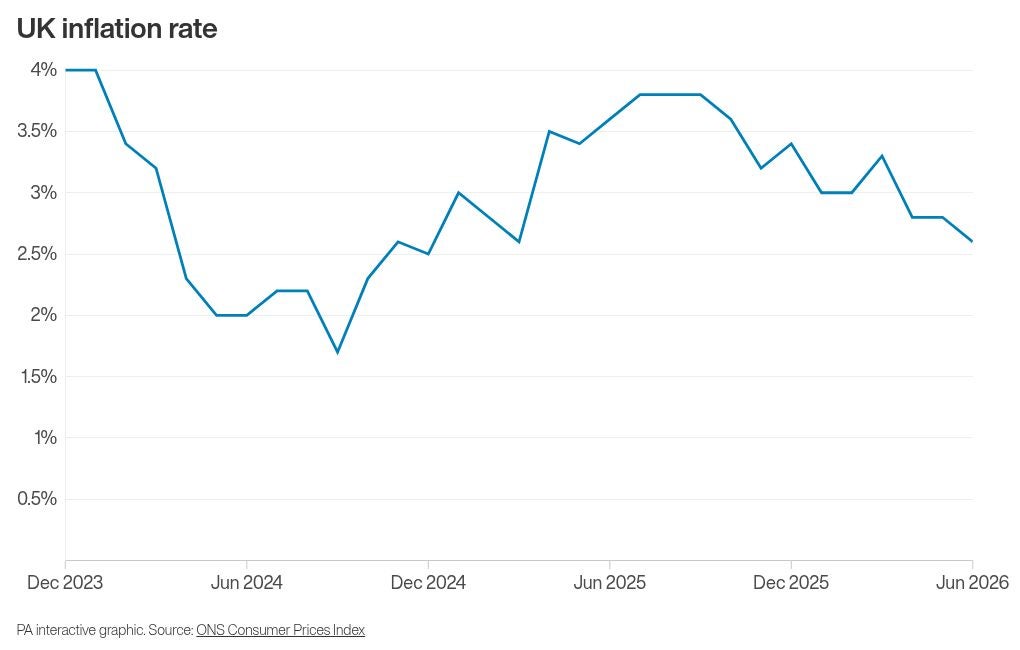
But the big economic impact this year is still the war in Iran and the surging price in oil and gas, which when sending energy bills higher adds to a return to high inflation, despite June figures showing inflation falling to 2.6 per cent. That is expected to be the low point, before a return to higher figures starting from July data.

“Nothing in this inflation release changes the calculation for the July interest rate decision,” predicted Daniel Mahoney, senior UK economist at Handelsbanken. “Financial markets are now pricing in two rate hikes by March next year, but the relatively weak labour market in the UK along with major uncertainty about the geopolitical situation means the MPC will in all likelihood continues its ‘wait and see’ approach and hold rates at the meeting next week.”

AJ Bell’s Danni Hewson, head of financial analysis, agreed, saying: “For the Bank of England, it’s likely to buy them another month to consider their options. Market expectation of an interest rate hold at next week’s meeting firmed up on release of the data.

“But rate setters will face the real test in September. The vote split and updated forecast will be closely watched for clues about how many hikes may be required to keep the economy in check.”

Elsewhere, it’s worth remembering that with mortgages in particular, many products are priced using future expectations of the interest rate (swap rates), so changes in that market can already be accounted for.

For savers, though, whether or not an immediate cut to variable rates is coming, it’s always worth checking the best offers on the market to make sure your money is earning as much as it can for you.

Uncertain outlook: the Bank of England governor has repeated the mantra of ‘gradual and careful’ frequently this year
Uncertain outlook: the Bank of England governor has repeated the mantra of ‘gradual and careful’ frequently this year (Getty/iStock)

What about the rest of 2026?

The further into the future we look, the more murky the picture is – and it can change rapidly anyway as we saw last year with tariffs, Budget uncertainty, oil shocks and more. The US repeatedly wavering between ceasefire talks and missile strikes on Iran further muddies the waters.

Markets have wavered wildly recently between expecting only one cut this year and up to three rises occurring if the situation in the Middle East is prolonged.

Currently, the money markets are pricing in almost two hikes, though note that this is not always the same as economists actually expecting the Bank of England will follow suit – as evidenced by that market dropping rapidly once an initial peace deal was agreed between the US and Iran.

The next MPC vote date is on 17 September.


Source link

Modelling scout linked to Epstein found dead in Paris suburbs

0
Modelling scout linked to Epstein found dead in Paris suburbs


A modelling scout linked to the late convicted sex offender Jeffrey Epstein has been found dead at his home.

Daniel Siad, 69, was discovered on Monday in Colombes, a north-west suburb of Paris, the Nanterre prosecutor’s office confirmed to the BBC.

“An investigation to determine the cause of death was opened on Monday evening following the discovery,” the office said, adding that an autopsy will be carried out.

Siad’s name appeared thousands of times in the Epstein files released by the US government. He had previously denied any knowledge of the threat that Epstein posed.

Epstein victim Anya – not her real name – previously told the BBC Siad had introduced her to Epstein.

Ahead of a BBC investigation published on 18 July, Siad’s lawyer had said he was not available for comment, but he had previously denied knowing that Epstein posed a threat.


Source link

Experts reveal the UK regions where house prices are going up every month

0
Experts reveal the UK regions where house prices are going up every month


Only about one in seven homes across the UK has consistently increased in value annually since June 2022, according to new estimates from property website Zoopla.

The analysis scrutinised individual home valuations, tracking their performance from June 2021 through to June 2026.

Zoopla specifically focused on comparing a property’s value in June of each year against the same month in the preceding year: for example, checking if a home’s value in June 2022 surpassed its June 2021 valuation.

This detailed examination revealed that just 14 per cent of UK homes – a figure representing over four million properties – had experienced an annual increase in value each June from 2022 to 2026.

Just just 14 per cent of UK homes experienced an annual increase in value each June from 2022 to 2026 (Alamy/PA)

While consistent year-on-year growth for individual properties remains uncommon, Zoopla’s broader house price index offers a different perspective.

It indicates that the average UK home value has risen by 15.3 per cent over the past five years, equating to an average increase of £36,100 per property.

The impact of mortgage rate increases

Zoopla said that rises in mortgage rates, affecting borrowers’ costs, will have had an impact over the five-year period.

Richard Donnell, executive director at Zoopla, said: “Housing markets across Northern Ireland, the North and Scotland have seen homeowners keep building equity in their home because the local housing market was less exposed to the affordability pressures that higher mortgage rates bring.

Trading 212 logo

Get a free fractional share worth up to £100.
Capital at risk.

Terms and conditions apply.

Go to website

ADVERTISEMENT

Trading 212 logo

Get a free fractional share worth up to £100.
Capital at risk.

Terms and conditions apply.

Go to website

ADVERTISEMENT

“For homeowners, this analysis highlights why you cannot rely on national or regional averages when assessing what your home is worth.

“Trends vary by property type and at a hyper local level.

“Understanding whether your local area has consistently built equity or flatlined is essential information, if you want to understand what you can afford to buy next or you are actively planning your next move.”

Aneisha Beveridge, research director at Connells Group, said: “The UK’s housing market has become increasingly fragmented over the last five years.

“The strongest performance has generally come from more affordable markets across the north of England, Scotland and Northern Ireland, where lower price points have helped insulate buyers from higher mortgage rates and supported continued demand.

“At the same time, the pandemic sparked a surge in demand for larger homes in commutable areas outside London, driving strong price growth across much of the south between 2020 and 2022.

“However, as mortgage rates rose and stamp duty incentives were withdrawn, that momentum faded and price growth in many of these markets has since come under pressure.

“Despite these headwinds, our research shows the middle market is still moving.

“Most buyers and sellers are driven by life events rather than short-term house price movements, and for homeowners who typically move every 10 to 12 years, modest annual price falls rarely affect their ability to transact.

“The challenge comes when weak price growth persists for many years.”

The UK’s housing market ‘has become increasingly fragmented over the last five years’, Aneisha Beveridge, research director at Connells Group, said
The UK’s housing market ‘has become increasingly fragmented over the last five years’, Aneisha Beveridge, research director at Connells Group, said (John Giles/PA)

Charlotte Harrison, chief executive officer of home financing at Skipton Building Society, said: “Consistent house price growth can help homeowners build equity, but equity alone doesn’t guarantee people can move.

“Our latest Skipton Group home affordability index found the gap between buying affordability and living affordability is the widest it’s been this decade.

“For many households, the challenge is no longer whether their home has risen in value, but whether they can afford the higher ongoing costs of their next property.”

She added: “While sustained house price growth can be positive for existing homeowners, improving access to homeownership remains critical if future generations are to share in those benefits too.”

Nathan Emerson, CEO at property professionals’ body Propertymark, said: “Many purchasers are factoring in the long-term cost of homeownership rather than focusing solely on securing a property quickly.

“At the same time, sellers who price their homes realistically continue to attract strong interest, demonstrating that demand remains resilient where expectations align with current market conditions.”

What the data says

Here are the percentages of homes in regions or nations estimated by Zoopla to have increased in value annually each month of June, covering June 2022 to June 2026 inclusive:

Northern Ireland, 37.9%

North West, 29.7%

Scotland, 22.6%

Yorkshire and the Humber, 22.0%

North East, 20.5%

West Midlands, 19.6%

Wales, 19.1%

East Midlands, 9.8%

London, 4.6%

South West, 4.1%

South East, 3.2%

East of England, 2.6%

Zoopla also identified “top performers” in regions or nations, where property values are particularly likely to have increased each year.

Here are the locations, followed by the percentage of homes estimated to have consistently increased in value annually in each month of June between June 2022 and June 2026 inclusive:

Northern Ireland, Antrim, 60.5%

North West, Dukinfield, 51.1%

Scotland, Bonnybridge, 60.8%

Yorkshire and the Humber, Castleford, 53.6%

North East, Hebburn, 42.6%

West Midlands, Wednesbury, 51.3%

Wales, Tonypandy, 46.6%

East Midlands, Hope Valley, 37.5%

London, Dagenham, 31.6%

South West, Dursley, 15.1%

South East, Bicester, 27.7%

East of England, Witham, 13.3%


Source link

France’s environment minister resigns over emergency bill allowing 2 banned pesticides

0
France’s environment minister resigns over emergency bill allowing 2 banned pesticides


PARIS — France’s minister for the environmental transition is stepping down over a controversial emergency agriculture bill granting temporary exemptions for the use of restricted pesticides that scientists say are harmful to bees.

Monique Barbut, who was appointed in October last year, said she will hand her resignation to French President Emmanuel Macron on Wednesday.

The legislation passed by French lawmakers Tuesday allows the French food, environmental and occupational health agency to exceptionally authorize the use of acetamiprid and flupyradifurone for a few struggling agricultural sectors.

“Over the past nine months, I have defended those who do not march, who do not vote, and who do not shout: the silence of our forests, the quality of our water, the purity of our air, the richness of our soils, and the diversity of life,” Barbut wrote in a message on social media. “Today, I must acknowledge that the forces opposing these goals have become so powerful that I no longer have the means to carry this ambition through.”

The two pesticides, part of a class of agrochemicals known as neonicotinoids, are permitted under European Union rules, but are currently banned in France. They are being authorized for use on sugar beet, apples, hazelnuts and cherries.

“Contrary to the commitments that had been made to me, the government prevented any debate on removing this provision,” Barbut said.

Her departure came a year after France’s highest court blocked a key part of a contentious farming law that would have brought back acetamiprid, a pesticide banned in France since 2018 for its role in harming bees and other pollinators. The court said that the measure failed to protect the environment and future generations.


Source link

Social Security email sent to retirees included

0
Social Security email sent to retirees included


A group of Democratic senators is accusing the Social Security Administration of using a July email to distribute “misleading information” and “a partisan, politicized message,” saying it threatens the agency’s credibility as an independent agency.

The email, titled “Making Life More Affordable for America’s Seniors,” was sent on July 2 by Social Security Commissioner Frank Bisignano. The message was meant to highlight the agency’s efforts to improve Social Security’s customer service, while also touting the impact of the Republicans’ One Big Beautiful Bill Act, or OBBBA, on retirees’ taxes.

“Thanks to President Trump, over 35 million American seniors received an average of $7,500 in relief this tax season,” the email stated. Bisignano also listed recent changes at the agency, including reducing wait times at Social Security field offices and answering beneficiary calls more quickly.

“Put simply, America’s seniors are winning!” he wrote at the end of the email.

The email overstated the OBBBA’s impact on seniors’ finances, the Democratic senators allege in a July 21 letter to Bisignano. The senators — Elizabeth Warren of Massachusetts, Ron Wyden of Oregon, Tammy Baldwin of Wisconsin, Sheldon Whitehouse of Rhode Island and Ben Ray Luján of New Mexico — also claim the email included partisan messaging that does not align with Bisignano’s promise to run the Social Security Administration as an independent agency.

“You have once again disregarded your promise to ‘run the SSA in an independent and nonpartisan manner’ and instead are wasting taxpayer resources while threatening the credibility and trustworthiness of the Social Security program,” the senators wrote, referring to Bisignano’s testimony during his March 2025 nomination hearing.

The claim about the OBBBA’s impact on seniors’ taxes was misleading, the senators said.

When the legislation was approved last year, the SSA claimed it would “eliminate federal income taxes on Social Security benefits for most beneficiaries.” However, the law doesn’t eliminate taxes on Social Security benefits. Instead, it created a new $6,000 tax deduction for taxpayers 65 and older.

In the letter sent to Bisignano, the senators said the $7,500 tax relief figure cited by the commissioner is a “gross overestimate” of the OBBBA’s impact. 

Data from the Treasury Department shows 68% of filers who claimed the enhanced senior deduction had an income under $100,000, while 94% had income under $200,000.

The senators have asked Bisignano to respond to their questions about the email by Aug. 11.

Advocates dispute Social Security’s tax claims

Shannon Benton, the executive director of nonpartisan advocacy group The Senior Citizens League, said that while Bisignano’s claim may represent an average size of the senior tax deduction for older households, the actual tax benefit is contingent on an individual’s taxable income and tax bracket.

“It wasn’t a $7,500 tax refund or $7,500 in direct savings,” she told CBS News in an email. 

Because deductions lower a filer’s taxable income, they reduce a person’s tax burden — but that isn’t the same as a tax refund or direct dollar-to-dollar reduction of owed taxes. The Tax Policy Center last year estimated that seniors would see an average tax reduction of approximately $1,100 from the senior deduction, according to Max Richtman, president and CEO of the National Committee to Preserve Social Security and Medicare, an advocacy organization.

A separate report from the Center on Budget and Policy Priorities released last year pointed out that nearly half of seniors don’t owe any income tax, meaning they are unable to claim the $6,000 deduction.

“The OBBBA did not reduce or eliminate taxes on SS benefits,” Richtman said in an email. “[Mr.] Trump and Bisignano are misleading the public by claiming otherwise.”

Treasury Department figures show that overall, filers earning between $100,000 to $200,000 received an average tax cut of over $1,250, while filers earning $50,000 to $100,000 received an average tax cut of over $815.

Nancy Altman, president of advocacy group Social Security Works, expressed concern about the political nature of Bisignano’s letter, calling it “unprecedented.”

“It is a highly inappropriate use of the Social Security email list, which is intended to share important information about benefits and not for political messaging,” she said in an email.


Source link

Annual UK house price inflation slowed to reach 2.7% in May, says ONS

0
Annual UK house price inflation slowed to reach 2.7% in May, says ONS


The average UK house price increased by 2.7% in the 12 months to May, slowing from a 3.9% annual increase in April, the Office for National Statistics (ONS) has said.

Across the UK, the typical house price in May was £271,000.

Average house prices increased in May to £292,000 (a 2.3% annual increase) in England, £215,000 (4.2%) in Wales, and £196,000 (4.4%) in Scotland.

(PA Graphics) (PA Graphics)

The average house price for Northern Ireland was £198,000 in the first quarter of 2026 – a 7.4% annual increase.

Within England, the North East was the region with the highest annual house price inflation in May, at 5.9%.

London had the weakest annual house price inflation, with prices there falling by 3.7% annually in May.

This is the ninth month in a row with an annual fall in house prices in London, the report said.

Richard Donnell, executive director of research at Zoopla said: “Political change, the World Cup, a scorching summer and elevated mortgage rates have hit housing market activity this summer.

“Zoopla’s very latest data shows 20% fewer buyer inquiries than a year ago and 7% fewer sales agreed.

“This comes as annual house price growth in the ONS index has already slowed to 2.7% in the 12 months to May. We expect activity to pick up in the autumn as the outlook becomes clearer.”

Trading 212 logo

Get a free fractional share worth up to £100.
Capital at risk.

Terms and conditions apply.

Go to website

ADVERTISEMENT

Trading 212 logo

Get a free fractional share worth up to £100.
Capital at risk.

Terms and conditions apply.

Go to website

ADVERTISEMENT

The ONS said that the slowing in the UK annual rate of house price inflation was caused by a “base effect” from the aftermath of stamp duty changes in England and Northern Ireland in April 2025, which was similar to stamp duty effects seen previously.

Its report said: “The annual rate slowed in May 2026 because average UK house prices rose by a smaller amount (0.3%) between April and May 2026 than in the same period a year ago (1.5%).”

The average monthly private rent in the UK was £1,388 in June – £44 (3.3%) higher than 12 months earlier – the ONS said.

The figures were released as the ONS also said that the Consumer Prices Index (CPI) rate slowed reach to 2.6% in June, from 2.8% in May.

This was the lowest level since March 2025, and below a 2.7% rate expected by some economists.

Mark Harris, chief executive of mortgage broker SPF Private Clients, said: “Inflation easing to 2.6% is welcome news as far as interest rates are concerned but renewed tensions in the Middle East mean the inflationary threat has not completely rescinded.

“Although the Bank of England is expected to hold base rate again next week, rising swap rates, which underpin mortgage pricing, have led a number of lenders to increase their mortgage rates, with others expected to follow.”

He added: “The higher cost of living is impacting household affordability, which means those buying a home are being careful as to what they are prepared to spend.”

David Hollingworth, associate director at L&C Mortgages said: “The mortgage market had been moving in a positive direction, with lenders gradually reducing rates and giving borrowers improved choice.

“However, that downward momentum has ground to a halt, as uncertainty in financial markets has pushed lenders’ funding costs higher, prompting a growing number to increase their fixed-rate deals.”

He added: “Borrowers shouldn’t feel they have to panic, but they also shouldn’t delay reviewing their options.

“Mortgage rates can move quickly, as we have seen over the past week, so anyone approaching the end of their current deal or planning to buy a home should consider securing a competitive rate sooner rather than later.

“Most lenders will still allow borrowers to switch to a cheaper deal before completion if rates ease again, giving them certainty now and flexibility if the market moves in their favour later down the line.”

Jason Tebb, president of OnTheMarket, said: “Lenders have started increasing their mortgage rates on the back of higher swap rates, but with inflation easing to 2.6% in the year to June, hopefully the Bank of England will hold base rate again at the next meeting.”

Iain McKenzie, chief executive of The Guild of Property Professionals, said: “With more homes available than we’ve seen for some time, purchasers are spoiled for choice, and sellers face much greater competition.

“In this environment, realistic, evidence-based pricing is essential.

“Homes launched at the right price continue to attract interest and secure sales, whereas properties brought to market too ambitiously are taking significantly longer to sell after price reductions.”

Nathan Emerson, chief executive of property professionals’ body Propertymark, said: “Today’s figures are positive for sellers and show that the housing market remains resilient despite domestic and international pressures.

“However, affordability concerns continue to challenge many buyers, particularly first-time buyers.”

Karen Noye, a mortgage expert at wealth manager Quilter said: “For buyers, the key point is not simply what a lender is willing to offer, but what remains comfortably affordable.

“Stretching to the maximum may feel necessary in a competitive market, but it leaves little room for unexpected costs, income changes or future rate volatility.

“Building in a margin for error can help ensure a purchase remains sustainable even if economic uncertainty persists for longer than expected.”

Sarah Coles, head of personal finance at AJ Bell, said the summer house price figures “could be a tough read, reflecting loss of confidence and stretched affordability after the start of the Iran war”.

She added: “Recent mortgage rate rises could send many buyers back into a ‘wait and see’ pattern.”


Source link

People pinning hopes on an inheritance for their own financial security – survey

0
People pinning hopes on an inheritance for their own financial security – survey


Nearly two-fifths (37%) of people who are expecting to receive an inheritance from their parents say their own finances depend on it, a survey indicates.

But three-fifths (60%) of those expecting to receive something do not know how much money they are likely to get, according to Aviva.

The insurer said the research raises concerns that many households could be making important financial decisions based on assumptions.

This could be particularly the case where an inheritance is expected to help pay for everyday living costs, clear debts and fund their own retirement, it said.

Some people said an inheritance will help them pay off their mortgage, whole some said they would use the money for their children’s education.

The survey also indicated that only around a third (32%) of people have an up-to-date will and know where it is.

And 7% said their will is up-to-date but they do not know where it is, while one in 10 (10%) said their will is out of date.

Only 13% of adults have a power of attorney in place, rising to 17% of those aged 65 to 74 and a third (33%) of over-75s, the survey of 2,000 people across the UK carried out by Censuswide in January indicated.

A power of attorney allows people to help deal with aspects of another person’s affairs.

Get a free fractional share worth up to £100.
Capital at risk.

Terms and conditions apply.

Go to website

ADVERTISEMENT

Trading 212 logo

Get a free fractional share worth up to £100.
Capital at risk.

Terms and conditions apply.

Go to website

ADVERTISEMENT

Lorna Whalley, director of Aviva’s adviser platform, said: “The research shows that there is an absence of family discussions around inheritance and expectations which could have repercussions, especially when considering how much potential beneficiaries are relying on inherited money to fund their day-to-day expenses.

“Even though situations can change, it’s important for people to consider the levels of income they will need in retirement, what contingencies need to be in place and, as a result, be clearer with beneficiaries about what they can expect to receive.

“More than half of people (53%) say they don’t know how much money they will need to support themselves through retirement.

“Understanding this is an important step in avoiding being too generous by helping family out to the detriment of their own financial security, or alternatively, thinking they might need more money for retirement than they do.

“A clear understanding of your financial situation and future needs is the building block for open conversations about inheritance and expectations.

People are relying on inherited wealth to fund essential parts of their lives, but many have no idea how much they are likely to receive.

“This uncertainty could prove disastrous for future financial plans and makes it much harder to take steps now to meet future requirements.”


Source link

Iran launches missiles at Jordan

0
Iran launches missiles at Jordan


DUBAI, United Arab Emirates — Missile alert sirens sounded Wednesday in Jordan’s port city of Aqaba as attacks across the Middle East overshadowed diplomatic efforts in Pakistan to salvage an interim ceasefire deal that has collapsed.

Jordan’s military said it intercepted four missiles in the Iranian attack, while two others fell in “uninhabited areas.” Plumes of smoke could be seen overhead in Aqaba in videos filmed by people in the nearby Israeli city of Eilat.

The U.S. military said earlier Wednesday that it had completed an 11th night of strikes on Iran. Iranian air defenses activated near the capital, Tehran, and Iran’s state-run IRNA news agency reported that explosions rocked Bushehr, East Azerbaijan, Hamadan, Hormozgan, Khuzestan and Sistan and Baluchistan provinces. The U.S. said its targets included aircraft hangars and drone storage sites.

That came after Iran attacked a tanker in the strait Tuesday, forcing the crew to abandon the ship. Iran also kept up attacks against U.S. allies in the region. Iran also launched attacks against Bahrain, Jordan and Kuwait.

Before the latest strikes, Iranian Interior Minister Eskandar Momeni visited Pakistan, a key mediator in the conflict, seeking to revive diplomacy. But it was unclear what new arrangement might be reached to end the war, which lately has become a battle for control over the Strait of Hormuz, a waterway vital to world energy supplies.

Speaking from the Oval Office on Tuesday, Trump gave a dim view on possible talks, saying the U.S. had “no interest in meeting.” He signaled that U.S. forces could soon target an area of Iran close to one of its main sites for enriching uranium.

The previous day, Yemen’s Iran-backed Houthi rebels opened a new front against Saudi Arabia by declaring a naval blockade of the kingdom, threatening the flow of global oil supplies and trade. With the Strait of Hormuz blocked up, Saudi Arabia has been relying on a pipeline to the Red Sea to get millions of barrels of oil out to market.


Source link

The eight best tips to get rid of spiders and flies from your home

0
The eight best tips to get rid of spiders and flies from your home


Homes across the UK are seeing an increase in creepy crawlies as the hot weather sees many people leaving their windows open throughout the day.

Some people won’t mind but many are not keen to share their homes with spiders and flies.

Spiders in homes will commonly be found in rooms with a water source, because they need water and so does their prey.

“You’re most likely to find spiders in your bathroom or kitchen, because their food is attracted to dark, moist areas”, explains Alex Woods from Victorian Plumbing.

“Spiders are attracted to the warmth of a home, particularly when the weather is cold or wet, which we know all too well can be the reality of a British summer. Female spiders tend to stay in the same position for their whole lives, so it may be that there are still spiders in your home who have been hiding away since last autumn.”

False widow, Steatoda nobilis, spider, resting on wooden slats (Getty/iStock)

But although they might be great mini-pest controllers, most people would rather not house-share with spiders. So what can you do to get rid of them, or stop them coming in your home in the first place?

1.  Vacuum regularly

Typically, spiders can be found in dark, quiet, secluded areas in homes and gardens, says Blackhurst, and most of spiders in this country produce webs, which is of course a key way to identify if they’re living in your home.

“Vacuum regularly, high and low,” he advises, “including hidden spots like under furniture, particularly sheltered spots such as beneath worktops, backs of cupboards, and under or behind large furniture. Remove spider webs, especially in corners and on ceilings.”

2.  Seal cracks and openings around windows and doors

Seal gaps in walls, pipes, and doors to discourage entry, advises Blackhurst, and Woods adds: “Spiders have to get in our homes some way, so starting by sealing any cracks or openings around your windows and doors will reduce the chances of an initial invasion.”

3.  Reduce outdoor lighting

Outdoor lights can attract insects that may become spider prey, warns Blackhurst.

4.  Make a natural spider-repellent using essential oils

Home-made spider repellent may help keep spiders away, says Woods. “A drop of essential oil is enough to deter a spider,” she promises.

She suggests mixing around 20 drops of essential oils such as tea tree, lavender, peppermint, citrus or cinnamon with water in a spray bottle. “Spray corners of your bathroom or any moist areas that are likely to attract the insects,” she advises.

5.  Use spider-repellent scents

As well as using the repellent to target specific spider-prone areas, you can use an air freshener or a candle that contains citronella to target the whole room, Woods suggests.

6.  Rub lemon peel over the windowsills

“This is a favourite trick of mine,”  says Woods. “Rub lemon peels all over the windowsills or anywhere spiders may try and perch like behind the toilet or cabinets. The citrus will repel them and will give your room a nice scent.”

7.  Add spider-repelling plants to your rooms

Woods says plants like mint, lemongrass or eucalyptus will not only make your rooms look nicer “but they will help warn off spiders as they hate these kinds of aromas.”

8.   Reduce spider food sources

Keep firewood, garden bags and compost heaps away from the home, as they’ll attract insects and spiders, says Blackhurst. “The most effective way to control spiders is to limit their food source,” he explains. “This should include clearing away dead flies, woodlice, millipedes, centipedes, and other crawling insects.”


Source link