Home Blog Page 684

‘Hegemonic power’: How Modi’s BJP won India’s Bengal for the first time

0
‘Hegemonic power’: How Modi’s BJP won India’s Bengal for the first time


New Delhi, India – Seema Das, a househelp in New Delhi, took on a two-day journey to reach her village in India’s West Bengal state, changing trains to make sure she got home in time to vote in provincial elections.

Das had previously always voted for the All India Trinamool Congress (TMC) party under Chief Minister Mamata Banerjee, a centrist political force that has been in power in the eastern Indian state since 2011. But this time, she said, her mother-in-law had convinced her that “Didi” – a nickname for Banerjee, which translates to elder sister in Bangla  – “favours Muslims”.

Das, a Hindu, added: “Didi has lost the track and only appeases Muslims to stay in power.”

That’s an accusation that Prime Minister Narendra Modi’s Hindu majoritarian Bharatiya Janata Party has long levelled against the TMC, which emphasises religious pluralism and the protection of minority rights. But for 15 years, Banerjee and her party have ruled the state of more than 90 million people, even as the BJP gained ground in a state where it had traditionally been a marginal player.

On Monday, that changed. Modi’s party won West Bengal. Early results from elections to the state’s legislature – which were held in April, but votes were counted on May 4 – show that Modi’s well-oiled election machinery is poised to deliver a thumping majority for the BJP in a state that its ideological founder was from, but that it has never won before. By 4:30pm India time, the BJP had won or was leading in 200 out of the state’s 294 seats, where its previous best performance was 77 seats in 2021. Banerjee’s TMC, meanwhile, was leading or had won just 87 seats.

The West Bengal elections were among five whose results were declared on Monday. In the southern state of Tamil Nadu, actor C Joseph Vijay threw up a surprise, defeating dominant parties to win with his upstart TVK party; in its neighbouring state of Kerala, the Congress party – the largest national opposition party – beat a coalition of left parties. A BJP-led alliance won the self-administered territory of Puducherry, once a French colony. And in the northeastern state of Assam, Modi’s party returned to power with a sweeping majority.

Yet it is the outcome in West Bengal that analysts say is by far the most consequential of the results that were declared on Monday, with the BJP walking the trails of religious polarisation and leveraging underlying anti-incumbency to win, experts told Al Jazeera.

Chief Minister of West Bengal and Chairperson of All India Trinamool Congress, Mamata Banerjee (C), greets her supporters during a rally before the second phase of the legislative assembly elections in Kolkata on April 27, 2026 [Dibyangshu Sarkar/AFP]

Inside Banerjee’s bastion in East

Banerjee founded the TMC in 1998, breaking with the Congress party, disillusioned with its refusal to frontally take on a coalition of communist parties that had ruled West Bengal since 1977.

Rising from a humble background, the lawyer-turned-student-activist-turned-politician finally defeated the communists to win the state in 2011. Since Modi became prime minister of India in 2014, she emerged as a key challenger to the BJP – framing her politics, especially her defence of Bengal’s Muslims, as an act of opposition to Hindu majoritarianism.

She also launched a series of women-centric welfare schemes and pushed back against controversial land acquisition projects sought by big industry.

“There is visible support for Mamta and she remains popular, but there is anti-incumbency against the TMC machinery, and people were not happy with their interference in everyday life,” said Rahul Verma, an election observer who teaches politics at the Shiv Nadar University in Chennai.

He added that the BJP also ran a better-managed campaign this time, noting that he is not “shocked” by the results. “It was a difficult election for the BJP, but not impossible.”

To Verma, “there was a corridor available to them [in West Bengal], and one can now say everything aligned in a way to produce this outcome for them.”

Verma emphasised that “without serious anti-incumbency, West Bengal would not have gotten this kind of result.”

Nearly 68.2 million people voted in the election, or about 92.93 percent, a record high for the state.

Banerjee’s party failed to “offer anything new to the voters and to beat strong anti-incumbency sentiments against it”, said Praveen Rai, a political analyst at the Centre for the Study of Developing Societies, in New Delhi.

“The party system had turned hostile towards the people who did not subscribe to their ideology,” he argued, adding that “the TMC failed to read the growing resentment against economic deprivation and aspirational needs of the common people.”

Rai added that the loss in West Bengal also weakens Banerjee’s hopes of emerging as a national challenger for Modi’s job.

But the implications of the result extend beyond Banerjee, he said. The BJP’s win, and the TMC’s dramatic defeat, would “decrease the political capital of [all] the parties opposed to [Modi]”.

That’s a major shift from two years ago. In the 2024 national elections, Modi’s party had fallen short of a majority, leaving it reliant on allies’ support for survival. The election wins on Monday “offset the electoral setback” suffered in the national vote, Rai said.

“It substantially increases the national standing of Modi’s leadership and extends the hegemonic power of the party [BJP] to govern India,” Rai told Al Jazeera.

bengal
A voter shows her inked finger after casting her ballot during the second and final phase of West Bengal Legislative Assembly elections in Kolkata on April 29, 2026 [Dibyangshu Sarkar/AFP]

‘BJP ran on Hindu-Muslim polarisation’

Neelanjan Sircar, a senior fellow at the Centre for Policy Research in New Delhi, who travelled across West Bengal before the polls, told Al Jazeera that his team identified “a big urban-rural gap among voters’ preferences”.

“We found urban men are very polarised,” he added. “In Bengal, the Muslim population is disproportionately rural, and given the levels of polarisation, the result ended up in a big difference for the BJP.”

Historically, election analysts have argued that due to the BJP’s Hindu majoritarian politics, the party did not stand a chance of winning West Bengal. More than a quarter of the state’s population is Muslim. “That has, of course, not turned out to be true, something we did pick during our research,” Sircar said.

The BJP has not shied from projecting itself as the party of Hindu voters.

Suvendu Adhikari, leader of the BJP in the state and potential chief minister candidate, said, “There has been a Hindu consolidation [of votes].”

He claimed, however, that many Muslims also did not vote for Banerjee’s TMC like earlier, and got swayed towards the BJP. It is impossible to verify the claim until the Election Commission of India (ECI) has released details of the vote count, expected in the next few days.

“I want to thank every Hindu Sanatani who cast their votes in favour of the BJP,” Adhikari said, referring to Banerjee’s TMC as a “pro-Muslim party”. Sanatan Dharma is an endonym for Hinduism.

For the BJP, the win in West Bengal is also deeply symbolic: Shyama Prasad Mukherjee, who founded the Bharatiya Jana Sangh – the forerunner of the BJP – in 1951, was from the state.

Al Jazeera reached out to TMC spokespersons but has not received any response.

SIR
Election officials count votes of the West Bengal state legislative assembly elections, inside a counting centre in Kolkata, India, May 4, 2026 [Sahiba Chawdhary/Reuters]

Pre-poll voter revision in spotlight

Before the polling in West Bengal, the ECI carried out a so-called revision of its electoral rolls through a Special Intensive Revision (SIR), which authorities have conducted in more than a dozen states so far.

The exercise in West Bengal controversially removed more than nine million people – nearly 12 percent of the state’s 76 million voters – from the voting list, snatching their right to cast a ballot in the elections.

Nearly six million of them were declared absentee or deceased, while the remaining three million were unable to vote because no special tribunals could hear their cases in the short timeframe available before the elections.

Banerjee’s TMC and other opposition parties in several states have called out the discrepancies in the revision of the voter list, accusing the ECI of siding with Modi’s BJP. Right activists and observers believe that the exercise disproportionately disenfranchised Muslims before the election.

Banerjee also appeared before India’s Supreme Court, challenging the “opaque, hasty, and unconstitutional” revision process. The top court did not restore the voting rights of millions affected but directed the ECI to publish a list of affected voters.

“Once the question of whether ‘I should be on the voter list’ became the dominant question for vulnerable populations, it’s not politics as usual,” said Sircar. “The level of polarisation that the voter revision caused is something that people outside the state do not really grasp.”

The Modi government also deployed 2,400 companies of paramilitary troops to West Bengal for the elections – a record for such provincial votes. The federal government claimed this was to assist election officials in carrying out the exercise without fear of political violence.

But the TMC and other opposition parties argued that the forces served to intimidate – or influence – voters.

“The heavy presence of security forces could have also created a favourable situation for the BJP,” argued Verma, of Shiv Nadar University. “Those who might be fence sitters and might have been afraid of TMC’s machinery on the ground were moved by this.

“There is no doubt that the trust level between opposition parties in India and the Election Commission of India is very low,” added Verma.

However, the analysts who spoke with Al Jazeera, including Sircar and Verma, agreed that the voter revision exercise alone could not have delivered such a decisive victory for the BJP – and that it reflects several other factors, including anti-incumbency and religious polarisation.

Still, analysts said, Banerjee will likely not go out without a fight.

In her first reaction to the vote counting, Banerjee addressed her party workers in a video statement, calling all workers and leaders not to leave vote-counting booths until the last ballots are counted.

“It’s a total forceful use of central forces to oppress the Trinamool Congress everywhere, breaking offices, and forcibly occupying them,” she said. “We are with you. Don’t be afraid. We will fight like the cubs of a tiger.”

Those aren’t empty warnings, Sircar said. “We are definitely in for drama.”



Source link

9 tribes sue to stop exploratory drilling in Black Hills near sacred ceremonial site

0
9 tribes sue to stop exploratory drilling in Black Hills near sacred ceremonial site


Sioux Falls, S.D. — Nine Native American tribes in South Dakota, North Dakota and Nebraska are suing the federal government in a bid to stop exploratory drilling for graphite near a sacred site in the Black Hills.

A small group of demonstrators has been protesting at the drilling location and at the mining company’s headquarters since they learned ground was broken on the drilling project in late April.

Masked demonstrators sit atop drilling equipment on April 30, 2026, in Pennington County, S.D., with a banner reading Sacred ground not mining bound.

Angel White Eyes / AP


The tribes filed their federal lawsuit Thursday in South Dakota against the U.S. Forest Service and U.S. Department of Agriculture, alleging that the agencies violated federal law by greenlighting a project near a site called Pe’Sla, a meadow in the central Black Hills used for tribal ceremonies, prayer and youth camps year-round.

The project is the latest point of tension between tribes and mining interests in the lush pine-covered Black Hills, which encompass over 1.2 million acres, rising from the Great Plains in southwest South Dakota and extending into Wyoming.

The region is a yearly destination for millions of tourists and boasts such attractions as Mount Rushmore and wildlife-filled state parks. Yet for even longer, it has been sacred to Sioux tribes who call the area He Sapa and consider it “the heart of everything that is,” according to the complaint.

Some of the landscape has already been altered by the gold rush of the 1870s that developed the region and displaced Native Americans. And in recent years, a new crop of miners driven by rising gold prices have sought to return to the landscape.

The complaint said the project by Rapid City-based mining company Pete Lien & Sons would impact the use of Pe’Sla for traditional, cultural and religious purposes by the tribes, and that the Forest Service didn’t consult with the tribes before approving the project.

Parts of Pe’Sla are owned by Sioux tribes after they bought the land in 2012, 2015 and 2018, and an agreement between the tribes and the Forest Service established a two-mile buffer zone on public lands around the site, according to the complaint.

Because Pe’Sla wasn’t included as an affected area and no environmental review was conducted, the approval violates the National Historic Preservation Act and National Environmental Policy Act, the lawsuit alleges.

Pete Lien & Sons, which supplies materials like limestone, sand and gravel, didn’t return email requests or voicemails for comment Thursday and Sunday.

Black Hills Drilling Opposition

A masked demonstrator stands with their fist in the air, wearing a Land Back beanie in front of signs reading Protect Pe’Sla Now on April 30, 2026, in Pennington County, S.D. 

Angel White Eyes / AP


“Historic” moment for the tribes

Frank Star Comes Out, president of the Oglala Sioux Tribe, said in a statement that the lawsuit is “a historic demonstration of unity” among the nine tribes. The tribes are separate, distinct federally recognized tribes sharing cultural and linguistic roots, but each with its own government and land base.

“We as Lakota people have been coming and praying and holding ceremony at these places for over 2,000 years,” said Wizipan Garriott, president of Indigenous advocacy group NDN Collective and a member of the Rosebud Sioux Tribe. “And so us being here is a continuation of countless generations before us. And it’s important that these sacred places be protected for future generations to come.”

The project was granted a permit from the Forest Service in February without conducting an environmental review because the agency said it met the requirements for a categorical exclusion, like having a duration of less than a year and not posing impacts to environmental and cultural sites.

But tribal opponents disagree that those requirements were met and said drilling projects are often a first step leading to future mines.

Besides the lawsuit from the tribes, NDN Collective and other environmental groups filed a request for a temporary restraining order and preliminary injunction to halt the project.

Some of the drilling pads are in the buffer zone around the site, according to NDN Collective. The project calls for the company to drill up to 18 holes down some 1,000 feet into the Earth to collect samples.

On Thursday, opponents demonstrated with signs reading “Protect Pe’Sla” and “Sacred ground not mining bound” near two drilling pads to block access. NDN Collective said the Forest Service told them drilling was paused for the rest of the day and the contractors were sent home.

The Forest Service said in a statement that it had no comment on the project when asked for a response.

“The Forest Service does not comment on the specifics of the case or on issues that are part of ongoing legal proceedings,” the statement said.

It’s unclear when drilling began, but NDN Collective said it noticed drilling pads in operation last week. The group said protest actions will continue as needed to protect Pe’Sla.

“As Lakota, we pray as long as we need to,” Garriott said.


Source link

Vision problem leads to man’s stage 4 lung cancer diagnosis, new drug extends survival

0
Vision problem leads to man’s stage 4 lung cancer diagnosis, new drug extends survival


NEWYou can now listen to Fox News articles!

A former Ironman triathlete was stunned to learn that his vision problems were actually the first sign of stage 4 lung cancer.

Dave Nitsche, 57, was initially given just 12 to 24 months to live – but an experimental drug has helped him surpass that timeframe by several years.

“In 2019, I noticed that I was having trouble seeing with my left eye,” the Canadian man shared during an interview with Fox News Digital. “I went to the optometrist, and they said it was probably a detached retina.”

DOCTOR AND CANCER SURVIVOR GEARS UP TO RUN 7 MARATHONS ON 7 CONTINENTS IN 7 DAYS

After scans revealed fluid buildup and rising pressure, doctors determined that Nitsche had lost vision in the eye — and ultimately removed it. A biopsy of the fluid revealed that it was cancerous.

Next, Nitsche saw more specialists, who extracted fluid from his lungs for more testing. “The next day, the oncologist told me that I had stage 4 lung cancer,” he said. 

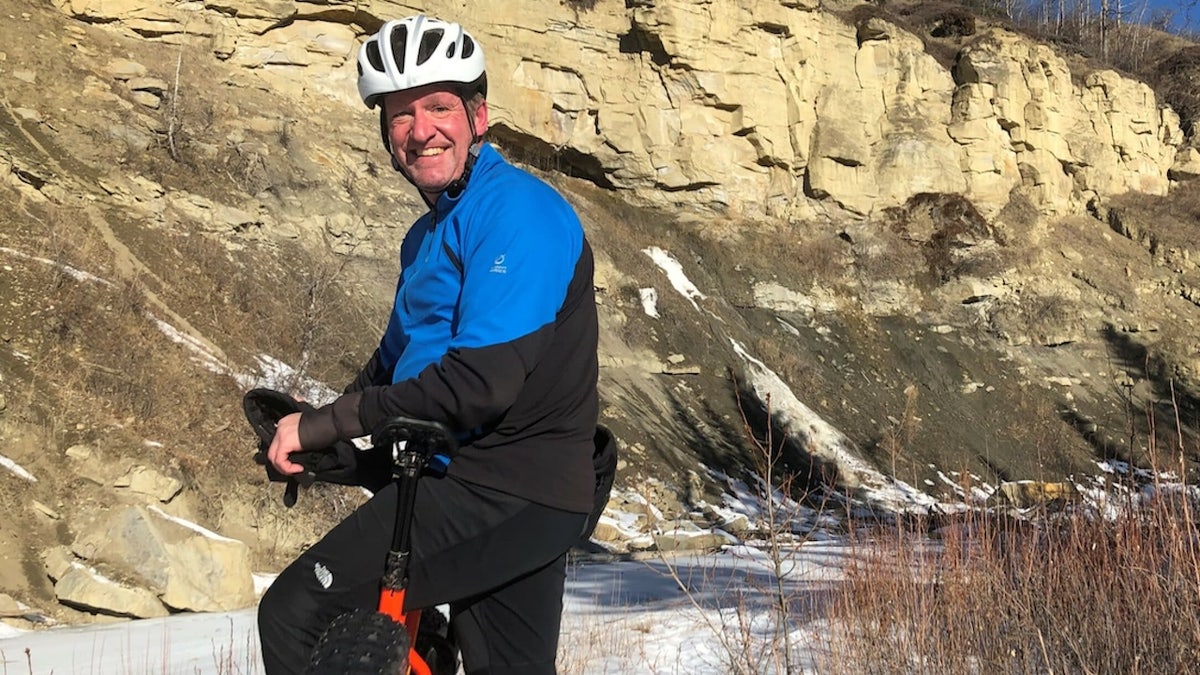
Dave Nitsche, pictured in Calgary, Alberta in 2025, was stunned to learn that his vision problems were actually the first sign of stage 4 lung cancer. (Dave Nitsche)

Nitsche said his doctors were “very shocked” to find that his initial eye issues had stemmed from lung cancer – particularly because he had never been a smoker.

Azam J. Farooqui, M.D., a hematology and oncology physician at Ironwood Cancer & Research Centers in Chandler, Arizona, agreed that Nitsche’s case was “very surprising.”

LUNG CANCER RISING AMONG NON-SMOKERS — HERE’S WHY

“Cancer can find its way to some very odd locations, but the eye is a very, very rare one,” Farooqui, who did not treat Nitsche, told Fox News Digital. “Usually cancer will get there via a nerve channel or blood vessel, but it’s very uncommon.”

Nitsche, an ex-triathlete who has done multiple Ironman races, hadn’t experienced any other symptoms other than the eye issues. “I was running quite a bit at the time,” he shared. “I had a little bit of back pain here and there, but lung cancer definitely wasn’t on my radar.”

Dave Nitsche mountain biking

Nitsche, an ex-triathlete who has done multiple Ironman races, hadn’t experienced any other symptoms other than the eye issues. “I had a little bit of back pain here and there, but lung cancer definitely wasn’t on my radar.” (Dave Nitsche)

His first treatment was a targeted therapy called afatinib, which lasted about three months. When doctors found that the cancer had spread to Nitsche’s brain, he began taking another medication called Tagrisso (osimertinib), which crosses the blood-brain barrier.

HIDDEN FACTOR IN CANCER TREATMENT TIMING MAY AFFECT SURVIVAL, RESEARCHERS SAY

After six years, when those drugs stopped working, Nitsche started taking a chemo drug called Rybrevant (amivantamab), which he receives via IV infusion every three weeks in a supervised medical setting. After a year on the drug, which is manufactured by Janssen Biotech Inc. in Pennsylvania, his scans are looking “very, very good,” he said.

“There are days that you feel strong and there are days that you’re a little weaker, but you just adjust accordingly.”

“Science is catching up to me perfectly with all these drugs that I’m on,” Nitsche said. “Now, we’ll just wait for the next thing to come along, and we’ll jump onto that. But for now, the Rybrevant is working perfectly.”

Dave Nitsche close-up

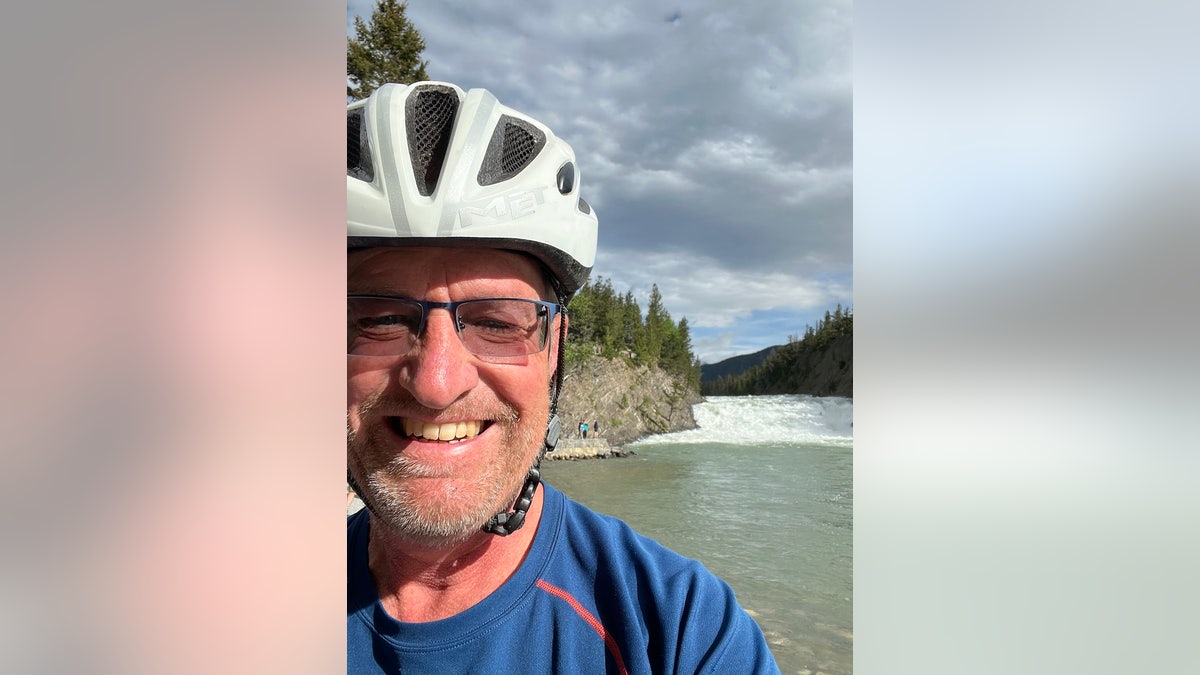
Nitsche has experienced a few side effects, but said for the most part, the drug he is taking is “very tolerable.” (Dave Nitsche)

Nitsche has experienced a few side effects, primarily skin irritation and fingernail infections, but said for the most part, the drug is “very tolerable.”

Compared to the full-dose chemo and other lung cancer treatments, Farooqui agreed that Rybrevant is “very manageable.”

CLICK HERE TO SIGN UP FOR OUR HEALTH NEWSLETTER

Other common side effects can include infusion reactions, muscle and joint pain, mouth sores, swelling, fatigue, nausea, bowel changes, vomiting, cough, shortness of breath and low appetite, according to FDA prescribing information.

In rare cases, serious effects can include lung inflammation, blood clots, severe skin reactions and eye problems. Pregnant women should not take the drug due to fetal risks.

Dave Nitsche lung cancer awareness

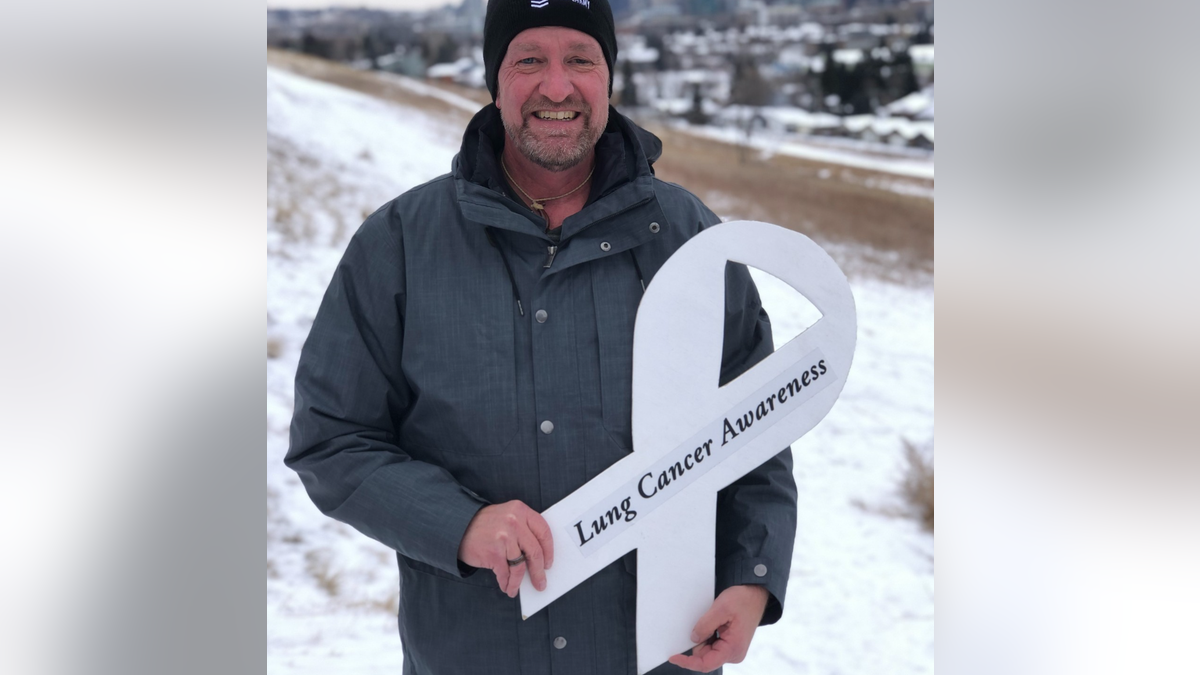
Embracing his role as an advocate, Nitsche now speaks openly about his experience and what others should know. (Dave Nitsche)

“If somebody is having too many side effects, or if it is feeling too aggressive, we can do dose reductions,” Farooqui noted. “In my experience, we’ve had patients do really well on it, and we’ve been able to manage their side effects without any major concerns.”

CLICK HERE TO DOWNLOAD THE FOX NEWS APP

Rybrevant has now been approved to treat certain types of non-small cell lung cancer in the U.S. and Canada, and Nitsche said a few of his friends are also taking the drug.

“Doctors gave me a year to two years – they told me to get my affairs in order. And it’s been seven years now,” he said. “I’ll take it.”

“For almost any type of cancer, a diagnosis is not a death sentence.”

Nitsche is now preparing for a 600-mile biking expedition in June to raise awareness for lung cancer. He credits his endurance training and high fitness level with helping to extend his survival. 

“There are days that you feel strong and there are days that you’re a little weaker, but you just adjust accordingly,” he said.

scan of lung cancer

Rybrevant has now been approved to treat certain types of non-small cell lung cancer in the U.S. and Canada. (iStock)

Embracing his role as an advocate, Nitsche now speaks openly about his experience and what others should know.

“If you have lungs, you can get lung cancer – but at this point, for almost any type of cancer, a diagnosis is not a death sentence,” he said. “They’re doing so much research on it, especially with lung cancer… I’ve known people who have lasted 12 to 18 years, so for me, seven years is great. So I’ll just keep going.”

TEST YOURSELF WITH OUR LATEST LIFESTYLE QUIZ

Farooqui echoed the importance of patients “advocating for themselves and getting the most up-to-date therapy there is.”


Source link

How can you improve your balance?

0
How can you improve your balance?


Chris and Xand continue their conversation with physiotherapist and vestibular rehabilitation specialist, Maggie Stacey.


Source link

Peter Obi and Rabiu Kwankwaso quit ADC and join NDC in major Nigerian political shake-up

0
Peter Obi and Rabiu Kwankwaso quit ADC and join NDC in major Nigerian political shake-up


Peter Obi and Rabiu Kwankwaso, who came third and fourth respectively in the last elections, switch parties.


Source link

David Attenborough at 100: The five secrets to a long and healthy life

0
David Attenborough at 100: The five secrets to a long and healthy life


Sir David Attenborough, the beloved natural historian and environmental advocate, is set to mark his 100th birthday next month on 8 May. This extraordinary milestone not only celebrates a seven-decade career that has profoundly shaped our understanding of the natural world but also prompts reflection on the secrets to a long and healthy life. The BBC will commemorate the occasion with a week of special programming, including a new documentary, Making Life on Earth: Attenborough’s Greatest Adventure, offering a behind-the-scenes look at his seminal 1979 series, Life on Earth.

While human life expectancy has steadily risen over the past two centuries, reaching a century remains a remarkable achievement, sparking widespread curiosity about the factors contributing to such longevity. Dr Mohammed Enayat, a GP and founder of London-based longevity clinic HUM2N, defines this increasingly popular health trend as “an approach that seeks to have your health working for you for as long as possible to ultimately give you the best quality of life for as long as possible.”

He explains that longevity medicine focuses on implementing interventions to prevent the decline, deterioration, dysfunction, and disease often associated with ageing. “It helps identify the processes within you that we need to work on sooner so we can put interventions in place such as supplementation, nutrition, lifestyle modifications, behavioural changes, education, and sometimes smart therapies as well,” Dr Enayat explains.

Dr Enayat highlights several crucial areas for individuals aiming to boost their own chances of living to 100.

King Charles and David Attenborough at the premiere of ‘Ocean with David Attenborough’ (PA)

Regular Exercise

“Movement is a very important pillar of health because we need to make sure we put our body through enough energy expenditure requirements so that it can stay metabolically healthy, but also maintain muscle mass and function of the musculoskeletal system,” Dr Enayat states. To preserve these vital functions into later life, he advises prioritising strenuous exercise. “Try and break a sweat a couple of times a week, because if you’re not breaking a sweat, you’re not using your body to its capacity or training your cardiovascular system and metabolic system to draw on energy quickly,” he adds. He also recommends focusing on posterior chain muscles. “Try and work out your glutes, your hamstrings and your core to maintain muscle activation and muscle size,” advises Dr Enayat. “You could do some planks, squats or ball sits.”

Senior couple running together (Alamy/PA)
Senior couple running together (Alamy/PA) (Alamy/PA)

Avoid Stress

Chronic stress can have profoundly detrimental effects on our health. “Stress drives a massive inflammatory response in the body,” Dr Enayat warns. “It can dysregulate our blood sugar and make us insulin resistance, which causes downstream effects. Stress depletes our stress hormones, which then can cause thyroid and other hormone imbalances, and can also affect our digestive tract and stop us efficiently digesting and absorbing our nutrients. This is all in the short term, so you do that cumulatively, you will find that your orchestral balance will be a disaster internally.” He therefore suggests developing strategies for stress regulation. “I think it’s really important to try and develop some self-awareness about what drives you to mount a stress response and might cause you to be breathless, have racing thoughts and racing heartbeats,” says Dr Enayat. “Develop tools – such as breath work, meditation, prayer or gratitude – to bring your nervous system back to balance.”

(Alamy/PA)
(Alamy/PA) (Alamy/PA)

Sleep Well

“Lots of good things happen in our sleep that help us live longer and healthier,” Dr Enayat explains. “For example, we produce T-cells that help regulate our immune system and produce stem cells that stimulate regeneration and release of growth factors during the deep sleep phase.” From a longevity perspective, he recommends implementing lifestyle changes to improve deep sleep. “Try to avoid stimulation too late at night, particularly blue light,” he advises. “Avoid eating too late because your digestion keeps you up and avoid alcohol because it keeps prevents you from getting into a deep sleep.” Adjusting the sleeping environment can also be beneficial. “Blackout blinds can be good and studies show that cooler environments can help promote deep sleep,” Dr Enayat notes.

(Alamy/PA)
(Alamy/PA) (Alamy/PA)

Good Nutrition

“What we consume through our diet is really important because with bad diet comes inflammation, hormonal imbalance and metabolic dysfunction,” says Dr Enayat. “When you put all those effects together, it becomes a melting pot for chronic diseases such as diabetes, cardiovascular disease and stroke risk.” His primary nutritional advice is to view “food as fuel or food as medicine, rather than food as comfort.” He further recommends prioritising “whole foods over processed foods and to make sure you have adequate protein in your diet, good vegetable intake, and some healthy fats.”

(Alamy/PA)
(Alamy/PA) (Alamy/PA)

Community and Purpose

Beyond the core pillars of physical health, Dr Enayat highlights “indirect drivers of health and disease, which includes a sense of purpose and community.” He points to Sir David Attenborough as a prime example of someone with “a clear sense of purpose, a clear value system and really understands community.” Engaging with others, “talking to each other and sharing experiences with neighbours, family and friends can help people stay active, regulate their nervous system, find purpose and find motivation to start their day. Having people to support you through difficult moments that we all face is really important for improving quality of life,” he concludes.


Source link

I’m a finance expert. Here are five tips to help stretch the summer holiday budget

0
I’m a finance expert. Here are five tips to help stretch the summer holiday budget


As the summer holidays approach, many families face a significant financial squeeze, yet a finance expert suggests that adopting new habits now could help household budgets stretch considerably further during the warmer months.

This advice comes amid growing concerns about the escalating costs of household bills and the broader economic impact of the conflict in the Middle East, leaving many with less disposable income than they had initially hoped.

Chris Henderson, save and pay director at Tesco Bank, said: “As we look ahead to summer, many will be thinking about their social calendar and going on holiday.

“Sustaining an active social life can come with a cost, but it can be achieved with some healthy spending, budgeting and saving habits. Taking small steps now can make a world of difference and ensure you’re in a good financial position to enjoy the summer.”

Summer holidays are often a financial pinch point for families (Getty/iStock)

Here are some suggestions from Mr Henderson for stretching summer budgets further:

1. Prioritise savings pots.

Splitting money across different pots can mean it takes longer to reach individual goals. It may be worth some people considering how urgently they need to achieve a particular goal and whether to prioritise a shorter-term one, such as a holiday, over another goal that is less “time sensitive”.

If someone has a long-term savings goal that is important to them, however, this may still take priority over shorter-term spending.

2. Consider selling items that are no longer needed.

Selling items through online platforms could be a good way to generate some extra money for summer holiday budgets.

3. Try out a budgeting “rule”.

To help stick to a budget, some people may consider aiming to set a percentage of their income to put aside for savings, while also factoring in the proportion they need to set aside to pay essential bills and a percentage to pay for non-essentials.

4. Try automating savings to help remove temptation.

Automatically transferring money directly into savings could help to avoid the temptation to spend it.

Trading 212 logo

Get a free fractional share worth up to £100.
Capital at risk.

Terms and conditions apply.

Go to website

ADVERTISEMENT

Trading 212 logo

Get a free fractional share worth up to £100.
Capital at risk.

Terms and conditions apply.

Go to website

ADVERTISEMENT

5. Consider a “no spend” challenge.

Setting a challenge not to spend on discretionary purchases for a period of time could help some people to reach their savings goals faster. Cancelling subscriptions which are little used could also help to turbo-boost savings.


Source link

Girl reveals emotional reason why her mother never says ‘elaichi’, a story that’s touching hearts online | – The Times of India

0
Girl reveals emotional reason why her mother never says ‘elaichi’, a story that’s touching hearts online | – The Times of India


A short video making the rounds on social media has struck a nerve for a reason that feels both unexpectedly simple and deeply human. In the clip, a girl explains why her mother never says the word “elaichi,” and the answer has left many viewers emotional. At first, it sounds like a small domestic detail, almost the kind of thing people would laugh off. But the reason behind it carries the weight of a memory so personal that even an ordinary word has become impossible to say. Scroll down to read more…According to the girl, her mother avoids the word because her mother-in-law was named Elaichi Devi. What might seem like a harmless family quirk is actually tied to a difficult emotional past. For her, saying the word is not just about cardamom. It is about a name, a relationship, and the feelings attached to both.That is what makes the video so affecting. It shows how language is never always neutral. Sometimes a word is not just a word. It can be a reminder, a trigger, a doorway back into a chapter someone would rather not reopen. In this case, something as everyday as asking for cardamom has been folded into a much larger story of memory and emotion. Viewers related to the moment almost instantly. Many said the clip felt heartbreakingly familiar, because most people carry at least a few words, smells, songs, or places that bring back a flood of feeling. A name once spoken casually can later become loaded with grief, discomfort, or unresolved history. The mind remembers what the mouth tries to avoid. One user summed it up quietly: “the last generation of innocent mothers.What is touching about this story is not just the reason itself, but the tenderness it reveals. There is something quietly poignant about a person reshaping daily speech around an old wound, even decades later. It suggests how deeply certain experiences stay with us, long after the moment has passed.The clip has resonated because it turns a small household detail into something larger and more universal. It reminds people that behind strange habits or odd silences, there is often a private story. And sometimes, the most ordinary word in the language can carry the heaviest emotional baggage. In the end, the video is less about elaichi and more about memory, love, and the invisible ways the past lives on in the present. That may be why so many online found it hard to scroll past.


Source link

Video: Inside The Old Skydiving Plane Hunting Drones in Ukraine

0
Video: Inside The Old Skydiving Plane Hunting Drones in Ukraine


Inside this old skydiving plane, a crew of Ukrainian volunteers is hunting down Russian drones. Russia is sending thousands of its one-way attack drones into Ukraine every month. Many are shot down, but the country’s air defenses can’t stop them all. On the side of the fuselage here, they’ve mounted this American-made machine gun that’s capable of firing up to 3,000 rounds per minute, or 50 rounds per second. And they’re picking off drones one by one. It takes about $500 of ammunition per drone kill — a bargain considering that the Iranian-designed Shahed drones are mass-produced for tens of thousands each, and surface-to-air missiles to counter them can run into the millions. It’s a cost-effective way to combat the new threats of modern warfare. “And came out right here. So someone’s sitting here.” “Yeah.” “And that shrapnel came out right here.” For nine months, Valerey Slipkan has lived on this remote airstrip waiting for missions. After losing his son in the first days of the full-scale invasion, he moved into a trailer on the landing field, and began transforming this old skydiving plane for war. Since mid-2025, Ukraine has allowed and even encouraged civilians exempt from military service to fight drones. Valerey is the only one in the crew with combat experience. Although they are all volunteers, they take their orders from Ukraine’s air defense coordinators. Long waits for missions at a safe house near the airfield have strengthened their bond as a team. Drones aren’t just the most lethal weapon in Ukraine, they are redefining modern warfare. This year, Iran responded to Israeli and U.S. attacks by sending waves of drones across the Middle East. The Gulf’s glitzy cities, once considered a safe haven, suddenly woke up to the threat of cheap, but effective drones. Now, nations are turning to Ukraine for expertise — from interceptors to armed helicopter units, its anti-drone arsenal, forged by necessity, is among the most effective in the world. “And so these mark all of the drones that you’ve downed?” “Yeah, actually we have also this comma. So you can identify how much we did per flight. Valerey’s co-pilot is an aerobatic world champion who once won millions performing seemingly impossible stunts. Timur now flies this Soviet-era AN-28 that had been used as a civilian skydiving plane before Russia’s invasion. “Here’s the door gunner.” Their drone kill count is still just a drop in the bucket against the tens of thousands Russia has launched. However, Timur sees this experimental unit as a blueprint that Ukraine can scale. He’s building his own personal fleet of drone-fighting aircraft to prove a human touch is still needed to kill machines. As a father of five, he’s also exempt from service. But he sold his business and poured his winnings into the project. “You said it’s important for you to shoot these things down over unpopulated areas.” “It’s a law for us. Sometimes we have to accompany it for five or seven minutes. Overfly populated area, then we’re able to shoot it down.” “Would you do this job if you had to point your weapon at a human being?” “Well, I definitely prefer to kill machines.” It’s 1 a.m. The team gets an alert. Drones have been launched across Ukraine. They rush to the airstrip and ready the plane for takeoff. Then they’re told to stand by. “And then it either could be command to take off and do the mission, or we have command standby.” So some nights can be like this. Whatever was seen on radar can be lost. Or they’re told to stand down and over and over and over again. They have to do this. They’re on call 24/7. “I’m constantly reminding myself that it’s good — we’re not flying, it means there’s no massive attacks. It’s exhausting, but it’s part of the job.”


Source link

A North Korean women’s soccer team is set to play in a tournament in South Korea

0
A North Korean women’s soccer team is set to play in a tournament in South Korea


SEOUL, South Korea — A North Korean women’s soccer team is scheduled to play at a regional tournament in South Korea later this month, in a rare sports exchange between the war-divided rivals.

The South’s Unification Ministry, which handles inter-Korean affairs, said in a statement Monday that the Pyongyang-based Naegohyang Women’s FC is expected to face Suwon FC Women on May 20 in the semifinals of the Asian Football Confederation Women’s Champions League in Suwon, south of Seoul.

The Korea Football Association, South Korea’s soccer body, said the AFC notified it that the North Korean team submitted a list of players and staff set to come to Suwon. The KFA said North Korea would be fined by the AFC if the team failed to compete in the semifinals.

North Korea’s state media has not reported on the soccer club’s expected trip.

North Korea last sent athletes to South Korea in December 2018 for a table tennis event, continuing a period of diplomatic engagement highlighted by the participation of North Korean athletes alongside a high-level delegation at the Winter Olympics in the South earlier that year. North Korea also sent its national women’s soccer team to the 2014 Asian Games in Incheon, which was the last time its female soccer players competed in the South.

North Korea’s women’s teams have had recent success in international youth competitions, and are the defending Under-17 and Under-20 World Cup champions.

In the continental club tournament, Naegohyang Women’s FC defeated Suwon FC Women 3-0 in the group stage in Myanmar last November, before beating a Vietnamese club in the quarterfinals in March. The winners of the May 20 semifinals will meet in the final three days later in Suwon, with Melbourne City FC and Tokyo Verdy Beleza facing off in the other semifinal.

While athletes from North and South Korea have previously competed on combined teams and marched together in Olympic ceremonies during periods of warmer relations, sports exchanges have since faded as relations deteriorated, with no inter-Korean activities for years.

North Korea has shunned talks with South Korea and the U.S. since North Korean leader Kim Jong Un’s broader nuclear diplomacy with U.S. President Donald Trump collapsed in 2019 over disagreements on U.S.-led sanctions on the North.

Tensions have been rising lately as Kim ramps up his nuclear and missile program targeting Asian U.S. allies and the U.S. mainland and hardens his stance toward South Korea. Kim has labeled South Korea as his most hostile adversary and has shown sensitivity to South Korean soft power, pushing aggressively to block the influence of South Korean culture and language among his population.


Source link