
Millions could be entitled to compensation as a result of commission arrangements between lenders and dealers.
Source link
Car finance: What happened and how much compensation will be paid?

Mortgage approvals soar as house buyers seek to avoid higher rates

Mortgage approvals for home buyers in the UK surged to a four-month high in March, Bank of England figures reveal. This coincides with a new record for average house prices across the nation.
Some 63,531 mortgage approvals for house purchases were recorded last month, marking the highest total since November 2025, the Bank’s Money and Credit report stated.
It surpassed the monthly average of around 63,200 approvals over the previous six months.
Approvals for remortgaging, which only capture remortgaging with a different lender, also increased, reaching 51,300 in March from 41,200 in February.
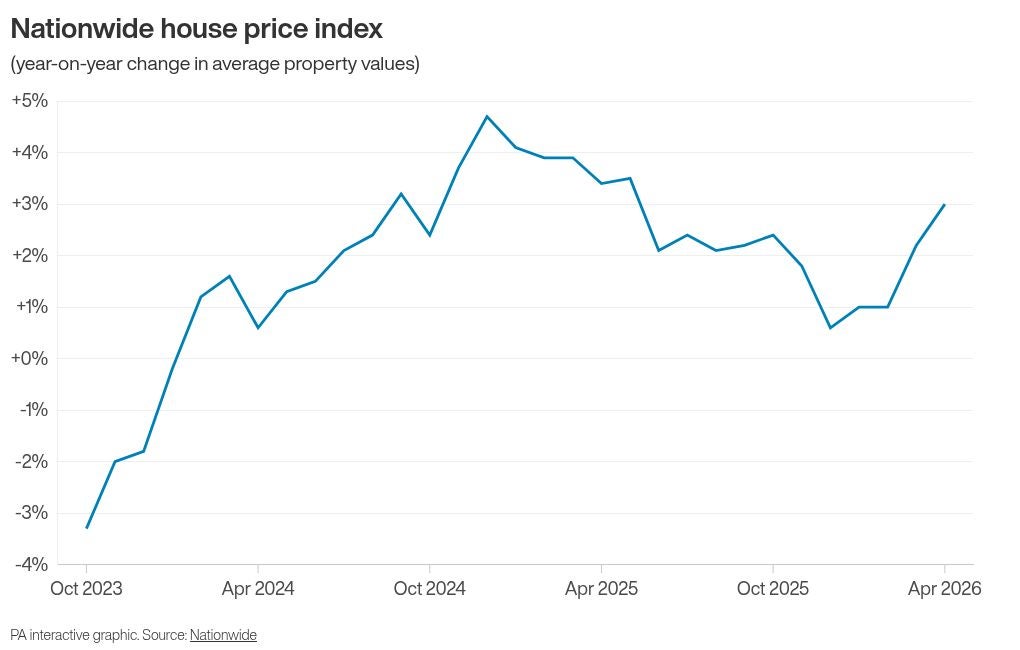
The figures emerged as Nationwide Building Society announced the average house price climbed by 3.0 per cent annually in April, accelerating from 2.2 per cent annual growth in March.
Property values rose by 0.4 per cent month-on-month in April, taking the typical UK house price to £278,880 – a new record high in cash terms, Nationwide said.
Dan Hill, a research analyst at Savills, said: “Much of this data reflects buyers and homeowners acting with urgency to secure a lower rate.”
Karim Haji, global and UK head of financial services at KPMG, said: “The uptick in approvals for house purchases and remortgaging is surprising given the surge in rates during March.
“This may point to some resilience in the market, but overall affordability remains under pressure.”
Jason Tebb, president of OnTheMarket, said: “Our own property sentiment index suggests resilience and optimism among buyers and sellers. Even against a backdrop of ongoing political and economic turbulence, attitudes towards affordability, property values and moving home remain remarkably consistent.”

Get a free fractional share worth up to £100.
Capital at risk.
Terms and conditions apply.
ADVERTISEMENT
Get a free fractional share worth up to £100.
Capital at risk.
Terms and conditions apply.
ADVERTISEMENT
The Bank of England report also said the annual growth rate for all consumer credit accelerated to 8.9 per cent in March, from 8.6 per cent in February.
Within this total, the annual growth rate for credit card borrowing increased to 12.3 per cent, from 12.1 per cent previously.
Households’ deposits with banks and building societies increased by £5.5 billion in March, following net deposits of £6.2 billion in February, the Bank said.
This was partly driven by an additional £4.4 billion of cash flowing into Isas in March, leading up to the end of the tax year.
Also in March, UK non-financial businesses borrowed, on net, £7.0 billion of loans from banks and building societies, including overdrafts, following £4.2 billion of net borrowing in February.
Unitree G1 humanoid robot ice skates and Rollerblades

NEWYou can now listen to Fox News articles!
We’ve seen robots walk, run, climb stairs and even recently finish a half-marathon. What we haven’t seen until now is a robot gliding across the ice like an Olympic skater or spinning on one leg on Rollerblades without losing balance.
That is exactly what Unitree Robotics just showed with its G1 humanoid robot. In newly released footage, the robot moves on Rollerblades and ice skates while keeping its posture steady through coordinated wheel and leg control. It’s pretty amazing to watch.
Sign up for my FREE CyberGuy Report
- Get my best tech tips, urgent security alerts and exclusive deals delivered straight to your inbox.
- For simple, real-world ways to spot scams early and stay protected, visit CyberGuy.com – trusted by millions who watch CyberGuy on TV daily.
- Plus, you’ll get instant access to my Ultimate Scam Survival Guide free when you join.
ELON MUSK TEASES A FUTURE RUN BY ROBOTS
Unitree’s G1 humanoid robot glides on wheels, Rollerblades and ice skates, showing off sharp balance, spins and even a flip. (Unitree Robotics)
What stands out in the Unitree G1 video
When you actually watch the video, a few moments really stand out. It starts with the robot leaning into the motion, almost stepping as it propels itself forward on two wheels, shifting its weight from side to side as if one wheel is leading the next. Its arms move up and down to stay balanced, giving it a rhythm that feels closer to walking than rolling, like it’s constantly adjusting in real time.
Then it pulls off a series of spins and an impressive flip, landing clean on two wheels and continuing without missing a beat. No hesitation.
Next, it switches to Rollerblades and moves with the same level of control. It glides, does some fancy footwork, changes direction and even lifts one leg while spinning and staying balanced like it’s second nature. That alone would be impressive.
But the real wow moment comes at the end. On ice, the robot starts doing smooth twirls, almost like it’s figure skating, while holding its posture without slipping. That’s when you start to see how far these humanoid robots have come.
Why the Unitree G1’s movement feels different
Most humanoid robots face the same problem. Staying upright while doing anything dynamic pushes the limits of control systems. The G1 changes that equation by blending two approaches. It combines wheeled efficiency with legged adaptability. That means it can roll when speed matters and step when terrain gets tricky.
In the demo, the robot transitions smoothly between these modes. It executes continuous motion instead of stopping to rebalance. You see 360-degree turns, controlled spins and even front flips, all without a visible pause.
That level of fluidity points to improvements in real-time control, balance correction and motion planning. These are areas that have held humanoid robots back for years, until now.
ROBOTS LEARN 1,000 TASKS IN ONE DAY FROM A SINGLE DEMO

The Unitree G1 performs spins, turns and a clean flip while riding on wheels and Rollerblades. The demo offers a striking look at how far humanoid robots have come. (Unitree Robotics)
Unitree G1 specs: what’s under the hood
The hardware behind the G1 explains why it can pull this off. Unitree designed the system as a full-stack platform for AI training and deployment. That means the robot collects its own data, learns from simulation and applies those lessons in the real world.
The robot comes in two main versions. The Standard model focuses on stationary tasks. The Flagship version adds a wheeled base that can reach about 3.3 feet per second.
Both variations share a humanoid structure with up to 19 degrees of freedom. Each arm has seven degrees of freedom and can handle about 6.6 pounds. A flexible waist allows wide motion ranges, which helps with balance during dynamic movement.
Vision comes from a binocular camera in the head, along with wrist cameras for close-up work. The system can use different grippers, including dexterous hands for more precise tasks.
At the core, the Flagship model runs on an NVIDIA Jetson Orin NX module with up to 100 TOPS of compute. That level of onboard processing supports real-time decision-making during complex movement.
Battery life can stretch up to six hours, depending on how hard the robot is working.
Why wheels on the Unitree G1 humanoid robot matter
For years, robotics has leaned in two directions. Wheeled machines move efficiently but struggle with obstacles. Legged robots handle complex environments but use more energy and move more slowly.
Unitree’s approach tries to merge both. By adding wheels to a humanoid frame, the G1 can move quickly across flat surfaces and still adapt when conditions change. That hybrid design also reduces wear on joints and improves energy efficiency over long distances.
It also opens the door to new types of tasks. A robot like this could move through a warehouse, switch to precise manipulation at a workstation and then roll to the next job without slowing down.
Take my quiz: How safe is your online security?
Think your devices and data are truly protected? Take this quick quiz to see where your digital habits stand. From passwords to Wi-Fi settings, you’ll get a personalized breakdown of what you’re doing right and what needs improvement. Take my Quiz here: CyberGuy.com.
NEW MOBILE ROBOT HELPS SENIORS WALK SAFELY AND PREVENT FALLS

The Unitree R1 humanoid robot runs on a flat surface. The model is noted for its affordability at $5,900. (Unitree Robotics)
Kurt’s key takeaways
The skating is what grabs you first. It is fun to watch and hard to ignore. What stands out after a few seconds is how steady the robot stays the whole time. It keeps moving, keeps adjusting and never looks close to losing control. That is a big change from the stop-and-go motion we are used to seeing. If this keeps improving, and I know it will, you are going to see robots that can move through real environments without slowing down or needing constant input.
CLICK HERE TO DOWNLOAD THE FOX NEWS APP
So here is the question. If robots can move this fluidly today, how long before they start working alongside you without missing a step and are you OK with that? Let us know by writing to us at CyberGuy.com.
Sign up for my FREE CyberGuy Report
- Get my best tech tips, urgent security alerts and exclusive deals delivered straight to your inbox.
- For simple, real-world ways to spot scams early and stay protected, visit CyberGuy.com – trusted by millions who watch CyberGuy on TV daily.
- Plus, you’ll get instant access to my Ultimate Scam Survival Guide free when you join.
Copyright 2026 CyberGuy.com. All rights reserved.
Iran threatens “painful” retaliation if US launches “final blow” strikes

Iran has warned of regionwide retaliation to U.S. strikes following reports that Washington was considering a “final blow” against the Islamic Republic.
According to reports, the U.S. military presented President Donald Trump with new options against Iran as negotiations to free up the Strait of Hormuz, which Tehran holds captive, have stalled.
Joint U.S. and Israeli strikes on Iran began on February 28. On April 8, a ceasefire was announced through Pakistani mediation, but talks days later in Islamabad failed to yield a breakthrough agreement. As the fragile ceasefire Trump declared remains in place, Iran’s Aerospace Force Commander Majid Mousavi said any further U.S. attack on Iran would prompt “long and painful strikes” on American regional positions.
“We’ve seen what happened to your regional bases,” he said on Thursday, according to local media. “We will see the same thing happen to your warships.”
Mahmoud Nabavian, a member of parliament’s national security and foreign policy committee, said on Friday that Arab rulers in the region would also be at risk if the U.S. launched strikes.
“None of the kings of the Arab countries or their palaces in the region will remain safe, and they will all be sent to hell,” he said, according to independent outlet Iran International, in a warning to countries not to allow military bases to be used against the Islamic Republic.
Newsweek has contacted the White House and the Pentagon for comment outside office hours.
US Options Reportedly Under Consideration
U.S. CENTCOM Commander Admiral Brad Cooper and Chairman of the Joint Chiefs of Staff General Dan Caine have briefed Trump on options that include a “short and powerful” wave of strikes on Iranian infrastructure, Axios reported, citing unnamed sources.
Fox News reported that assessed targets included Iran’s “remaining military assets, leadership and infrastructure.” Another plan focused on taking over part of the Strait of Hormuz to reopen it to commercial shipping in a move that could involve ground forces.
Iran International also reported that options presented to Trump was the deployment of U.S. ground forces to small islands around the Strait of Hormuz. Another involved sending special forces into the Isfahan area to remove Iran’s highly enriched uranium, which the Trump administration says can be used to develop into a nuclear weapon. Tehran says its nuclear program is for peaceful purposes.
Fox News also reported that the Pentagon was considering deploying advanced weapons systems, including a new hypersonic missile known as “Dark Eagle.” The outlet said the system can hit targets up to 2,000 miles away, potentially taking out Iran’s remaining ballistic missile launchers.
The outlet also reported that U.S. B-1B Lancer bombers, which can have up to 5,000 pounds of hypersonics, have been stepped up in the Middle East.
Iranian Supreme Leader Mojtaba Khamenei said on Thursday that Tehran would keep control over shipping through the Strait of Hormuz and maintain its nuclear and missile capabilities.
In its latest analysis, the Institute for the Study of War said the regime in Tehran was unlikely to make any meaningful concessions in its next proposal to the United States.
The think tank also said on Thursday that Iran was trying to sow divisions between the Gulf states and the U.S. to push the Gulf countries to expel American forces from their territories.
5 fashion hacks all of us can steal from King Charles

Looking effortlessly sharp is, ironically, a lot of hard work. It’s the micro-details that push an outfit from ‘fine’ to ‘fantastic.’ Charles has this down to a science.
Take his lapel, for example. He often pins a fresh boutonnière (a flower) to it, which instantly softens up a stiff formal suit. Then there’s the gold signet ring on his left pinky, stamped with his official heraldic crest, which he has worn non-stop since the 1970s. Oh, and word on the street is that his valets actually steam-iron his shoelaces. Seriously! While you probably don’t need to go quite that far, the point stands. Take pride in the little things. Polish those shoes, perfect that tie knot, and watch your whole vibe elevate.
Thinking about peptides? Doctors reveal key dos and don’ts as ‘Wild West’ market grows

NEWYou can now listen to Fox News articles!
The peptide boom is under scrutiny as the FDA weighs easing restrictions on several drugs in the category.
Peptides, which are short chains of amino acids that serve as the building blocks of proteins, have gained popularity among wellness influencers and fitness gurus as a means of building muscle, healing injuries or appearing younger.
Similar to how GLP-1s (glucagon-like peptide-1 agonists) suppress appetite and trigger weight loss, peptides can signal other functions, like the release of growth hormones.
SUPPLEMENT SOLD AT GAS STATIONS SPARKS HEALTH FEARS AS PEOPLE REPORT ADDICTION SYMPTOMS
But unlike GLP-1 drugs — which were extensively studied and regulated — many peptides lack comparable evidence and oversight, said New York endocrinologist Dr. Philip Rabito, adding that some are “not reviewed by the FDA for safety, effectiveness or quality before marketing.”
Peptides under FDA review, including BPC-157, are often marketed for tendon and gut healing, injury recovery and inflammation reduction, despite warnings about the risks of unapproved treatments.
Similar to how GLP-1s, such as Ozempic, suppress appetite and trigger weight loss, peptides can signal other functions, like the release of growth hormones. (iStock)
Even as regulators consider loosening restrictions, the market has been widely described as a “Wild West,” with various versions sold online without a prescription.
In an interview with Fox News Digital, board-certified internist and longevity expert Dr. Amanda Kahn, who prescribes peptides in her own New York practice, confirmed that interest has grown “significantly” across the U.S.
Peptides are popular because they “sit at the intersection of wellness optimization and medicine,” according to the doctor.
STUDY COMPARES ZEPBOUND AND WEGOVY FOR WEIGHT LOSS IN DIRECT COMPARISON
“As a class, they are targeted biosimilar molecules that can influence specific pathways like inflammation, recovery and metabolism in a way that feels more biologically synergistic than traditional pharmaceuticals,” she said.
Most patients spend a few hundred to thousands of dollars on these drugs per month, according to Kahn. Costs can be high because peptides are often custom-made and must meet strict quality and sterility standards.

Peptides are popular because they “sit at the intersection of wellness optimization and medicine,” according to one doctor. (iStock)
“At the same time, patients today are far more proactive and invested in their health,” Kahn added. “They’re not waiting to get sick; they want to feel better, recover faster and age more intentionally.”
CAN’T STOP THINKING ABOUT FOOD? EXPERTS POINT TO AN UNEXPECTED CAUSE
Peptides have evolved rapidly from just a few years ago, when they were largely focused on weight loss, the expert said, with growing interest in energy, post-illness or injury recovery, muscle preservation and sleep quality.
But these drugs are not one-size-fits-all, experts warn, especially when not prescribed by a professional or cleared by a reputable pharmacy.

There is growing interest in peptides for more muscle preservation and sleep quality, an expert said. (iStock)
Peptides dos and don’ts
Experts shared the following guidance on using peptides.
Do use peptides within reason
Kahn recommends using peptides with “a clear, clinical rationale, not just because they’re trending.”
“Think of peptides as part of a broader health plan, not a standalone solution,” she advised.
OPRAH JOINS WAVE OF CELEBRITIES WHO REVEALED DRAMATIC WEIGHT LOSS IN 2025
Kahn said patients often come into her practice focused on weight or appearance, but in-depth testing may uncover underlying issues such as inflammation, metabolic dysfunction, hormonal imbalance or recovery deficits.
“It’s both aesthetic and medical, but the trend in my internal medicine practice has always been toward specific health concerns,” she added.
Do work with a clinician
Dr. Kent Bradley, chief medical officer at 10X Health in California, recommends approaching peptides with “curiosity and rigor” and discussing the science with a physician.
“Work with a clinician who provides a baseline of biomarkers before you introduce peptides,” he recommended during an interview with Fox News Digital. “You will need to know where you’re starting in order to measure the impact.”

Experts recommend working with a physician to determine which peptides are right for you. (Getty Images)
Do find a credible source
Peptides should always be purchased from “reputable compounding pharmacies by prescription,” Kahn emphasized.
CLICK HERE FOR MORE HEALTH STORIES
“While they are powerful signaling molecules, when used appropriately, they can be very safe and effective,” she said. “When used incorrectly, [with] the wrong dose, wrong indication or poor sourcing, they can be dangerous or ineffective.”
CLICK HERE TO DOWNLOAD THE FOX NEWS APP
She added, “The key is clinical oversight, proper selection and individualized use.”
The current peptide ecosystem — including unlicensed providers and “gray market” access — is “more dangerous than the molecules themselves,” Kahn warned.
It’s important to use pharmacies that meet FDA 503A or 503B regulations to ensure consumer safety, the expert added.
Don’t stack peptides without a purpose
Multiple peptides should not be combined without understanding how they interact with each other, nor should they be injected as mixtures, Kahn warned.

Some products marketed as “natural” online may still have the capacity to cause complications, an expert warned. (iStock)
“Don’t treat them as risk-free supplements,” she said. “They are biologically active and should be used thoughtfully.”
“Peptides should be cycled, paused and re-assessed — don’t ‘set it and let it go.’”
Don’t self-prescribe
Dose-response and drug interactions require medical oversight, and peptides should be prescribed by a doctor, according to Bradley. Some products that are marketed as “natural” may still have the capacity to do harm to the body, he warned.
CLICK HERE TO SIGN UP FOR OUR HEALTH NEWSLETTER
Don’t use them as a shortcut or substitute
Fundamental pillars of health, like sleep, nutrition and exercise, should be addressed before using a peptide as a “shortcut” to fix health complications, Kahn said.
Bradley agreed, adding that “the same instinct that drives patients toward unnecessary surgery drives them toward complex peptide stacks when the real leverage is upstream and boring.”

Younger individuals most likely don’t need to take peptides for muscle building, according to a fitness expert. (iStock)
Kenny Santucci, a fitness expert and founder of Strong New York, shared with Fox News Digital that he takes peptides for muscle building himself – but noted that it’s not right for everyone.
Especially for younger individuals, whose bodies are “already working at optimal levels,” peptides may be unnecessary, he said.
TEST YOURSELF WITH OUR LATEST LIFESTYLE QUIZ
“If you take care of yourself — if you’re eating right, sleeping right, working out — you probably don’t need much,” he said.
“I think as you get older, these things start to help out a little bit, or if you suffer from an injury and you want to take something that will help repair the tissue quicker, that’s great.”
Martha’s Rule helplines get more than 1,700 calls from worried NHS staff

The scheme encourages staff and families to seek an urgent second opinion if they fear a patient’s condition is worsening.
Source link
Best children’s savings accounts for 2026 – where to find the top interest rates

Whether you’re teaching your kids how to save their pocket money or investing in their future, opening a children’s savings account can help you access better rates.
Parents in the UK put aside an average of £18,212 for their young ones, according to a study by Flagstone. More than 40 per cent of parents are saving this money for their kids’ education or university, which is why a third plan to hand over the cash when their child turns 18.
But until that day comes, you’ll want to make sure that you’re getting the best possible returns on your child’s cash, outstripping inflation and creating a base for them to build their savings from.
Right now, some children’s accounts are beating the top easy-access savings for adults.
Here are the best options for May 2026 – rates are correct at time of publishing but may be changed or withdrawn at any time.
Nationwide
This easy-access account from Nationwide offers 5 per cent interest on up to £5,000, which is currently the best rate on the market. To open this account, you’ll need a children’s FlexOne Current Account.
Children aged 11 to 17 can sign up for the FlexOne Saver.
However, your child will need to be aged 13 or above for you to open the account online, otherwise, you’ll need to take them into a Nationwide branch.
Kent Resilience
Kent Resilience’s easy-access savings account offers a lower rate of 4.18 per cent, but if you’re looking to save more, this may be a better option as you can deposit up to £25,000.
Additionally, this account has no lower age limit, so it’s a good choice if you want to start saving for your child straight away.
Halifax
Unlike the accounts above, this one from Halifax is a regular saver for kids aged 15 and under.
Get a free fractional share worth up to £100.
Capital at risk.
Terms and conditions apply.
ADVERTISEMENT
Get a free fractional share worth up to £100.
Capital at risk.
Terms and conditions apply.
ADVERTISEMENT
Regular savings accounts encourage you to make monthly deposits in exchange for a higher interest rate, making it a great way to save for your child’s future. At the end of the fixed term, you’ll have both your untouched savings and your interest, which can be reinvested in a new regular saver.
This Halifax Kids’ Saver pays up to 5.5 per cent for the 12 months from when you open the account. You can deposit between £10 and £100 each month using a standing order, which you won’t be able to withdraw until a year has passed.
Saffron Building Society
If you’re looking for a regular saver for younger kids, check out this one from Saffron Building Society. It pays a lower 3.95 per cent, which is variable for 12 months, but it can be opened for children of any age.
The maximum you can pay into the account over a twelve-month period is £1,200, so an average of £100 a month.
You can open the account either in-branch or by post – see Saffron Building Society’s website for more information.
More ways for young people to save

Junior Isa
Investing in a Junior Isa (Jisa) for your child is one of the most effective ways to save for their future.
This works in essentially the same way as an adult ISA, allowing you to earn interest without paying income or capital gains tax.
The limit for regular Isas is £20,000 per tax year however, for a JISA it’s lower at £9,000.
Check if your child has a Child Trust Fund
A Child Trust Fund (CTF) is a tax-free savings account for children that was issued to everyone born between 1 September 2002 and 2 January 2011.
The government initially put £250 in these accounts, then another £250 when your child reached the age of seven.
It’s worth checking if you or your child has a CTF, as 758,000 matured accounts remain unclaimed and hold an average of £2,240. You don’t need to pay a third-party company to track it down, as you can find it yourself for free at Gov.uk.
Turning 18
Once your child turns 18, they will generally become the sole account holder of their investments, savings, Jisa or CTF.
What your child should do next will depend on their individual savings goals. They could shop around for the best savings account or Isa for adults, get a student account, or invest in a Lifetime Isa (Lisa), which allows them to save towards their first home.
With a Lisa, you can deposit up to £4,000 a year and the government will match this by 25 per cent, so £1,000 for every year you max out. Lisas are set to be replaced with a new product after a government review but for now remain a great option – but just be aware of the limits and rules.
When investing, your capital is at risk and you may get back less than invested. Past performance doesn’t guarantee future results.
Americans are increasingly bleak about their own finances, most say using the US military against Iran was a mistake: ABC News/Washington Post/Ipsos poll

Americans are increasingly bleak about their own finances as the U.S.-Israeli war with Iran continues into another week of an uneasy ceasefire, an ABC News/Washington Post/Ipsos poll conducted using Ipsos’ KnowledgePanel finds.
As gas prices have reached a four-year high because of the war, half of Americans expect gas prices to increase even more in the next year, 4 in 10 say they are not as well off as they were when President Donald Trump returned to the White House and nearly a quarter say they are falling behind financially.
Most Americans say that using the U.S. military against Iran was a mistake, are not confident that an agreement with Iran will prevent them from developing nuclear weapons and say that U.S. military action in Iran has increased the risk of terrorism against Americans.
In this photo taken with a slow shutter speed, traffic moves past a sign for a Mobil gas station on April 29, 2026, in Portland, Ore.
Jenny Kane/AP
And a large majority of Americans — including a slim majority of Republicans — had a negative reaction to Trump’s social media post earlier this month saying that “A whole civilization will die tonight.”
Economy
An increasing share of Americans say they are falling behind financially and not as well off as they were when Trump became president in 2025, echoing other recent polling.
The ABC News/Washington Post/Ipsos poll finds 40% of adults saying they are not as well off financially as they were when Trump became president in 2025, up from 33% who said the same in a February ABC News/Washington Post/Ipsos poll. About 4 in 10 (42%) say they are doing about the same and only 17% say they are better off, down 5 points from the February poll.
During much of then-President Joe Biden’s term, over 4 in 10 said they were not as well off financially as they were when he became president. Still, the recent share saying they are not as well off is far above the percentage who said they were not as well off now as they were throughout the presidencies of Barack Obama, George W. Bush, Bill Clinton, George H.W. Bush or Ronald Reagan.
The poll finds nearly a quarter of Americans (23%) saying they are falling behind financially, up from 17% in February. Just over half (52%) say they have just enough to maintain their standard of living and about a quarter (24%) say they are getting ahead, down from 28% in February.
And Americans also predict more pain at the pump. Half say that they expect gas prices to get worse over the next year, while 21% expect gas prices to improve and 15% say they expect gas prices to stay about the same, which are already significantly higher than usual.
Some Americans say they are changing their behaviors because of higher gas prices. Over 4 in 10 have cut back on driving (44%) or cut other household expenses (42%) because of high gas prices. Fewer, 34%, say they have changed travel or vacation plans, while 15% have considered buying an electric vehicle.
High gas prices are affecting Americans in lower-income households more: A majority of Americans with household incomes of less than $50,000 have cut back on their household expenses (59%) and cut back on driving (56%) while nearly half of them say they have changed travel plans because of high gas prices (48%).
More women than men have cut back on driving, household expenses and have changed travel plans.

At a gas station in San Francisco, gas prices top $7/gallon, on April 30, 2026.
KGO
Slim majorities of Democrats say they have cut back on driving and cut household expenses, along with just under half of independents. Just 28% of Republicans say they have done both. Over 4 in 10 Democrats (45%) say they have changed travel plans, along with 38% of independents and 19% of Republicans. About a quarter of Democrats (24%) along with 16% of independents and 7% of Republicans say they have considered buying an electric vehicle because of high gas prices.
Iran
Most Americans say it was a mistake to go to war against Iran and that the conflict will make things worse in America. In addition, Americans are not confident an agreement to end the war with Iran will prevent Iran from developing nuclear weapons.
About 6 in 10 Americans say that the U.S. using military force in Iran was a mistake, while just over one-third say it was the right decision.

A woman hangs laundry in her damaged apartment after returning home with her family in the southern port city of Tyre, Lebanon, April 30, 2026.
Hussein Malla/AP
Today’s 61% saying it was a mistake is far higher than the 26% of Americans who said the U.S. going to war with Iraq was a mistake in a March 2003 ABC/Post poll shortly after the U.S. invasion of the country, but far closer to the 64% who said the same about that conflict after it had gone on for nearly four years in January 2007.
Compared to prior conflicts, fewer, about 4 in 10 said it was a mistake to go to war with Serbia and the former Yugoslavia in April 1999, in an ABC/Post poll and a Gallup poll, respectively. Even fewer said in Gallup polling that it was a mistake to send military forces to Afghanistan in November 2001 (9%), to the Persian Gulf in August 1990 (17%), Vietnam in September 1965 (24%) or Korea in August 1950 (20%).
In the current poll, majorities of Democrats (91%) and independents (71%) say it was a mistake to use military force against Iran while 79% of Republicans say it was the right decision. While Republicans and Republican-leaning independents who say they do not support the MAGA movement are almost evenly split between saying the U.S. military in Iran was the right thing or a mistake, 86% of MAGA Republicans say it was the right decision to use U.S. military force against Iran. By a 9-point margin, (54% to 45%) Americans who served in the armed forces say it was the right decision.
Most Americans see potential risk in the U.S. military’s action against Iran. That includes an increased risk of terrorism against Americans (61%), an increased chance of the U.S. economy going into a recession (60%) and weakening relationships with U.S. allies (56%).
Majorities of Democrats and independents say all three risks have increased due to the U.S. military’s action against Iran. A 43% plurality of Republicans say the risk of terrorism against Americans has increased, while about 3 in 10 Republicans say the chances of recession or weakened relationships with allies have increased.
Americans are almost perfectly split between whether the U.S. should make a peace deal with Iran, even if it results in a worse deal for the U.S. (48%) or push Iran for a better deal, even if it means continuing U.S. military action in Iran (46%).
Most Democrats (76%) and half of independents (50%) say the U.S. should make a peace deal, while most Republicans (79%), including both MAGA Republicans (84%) and non-MAGA Republicans (64%) say the U.S. should push Iran for a better deal. Two-thirds of Americans who served in the U.S. armed forces, reserves or National Guard say the U.S. should push Iran for a better deal, even if it means resuming U.S. military action against Iran.
But even though Americans are split on whether the U.S. should make a peace deal, nearly two-thirds say they are not confident an agreement to end the war with Iran will prevent the country from developing nuclear weapons, a figure that is virtually unchanged from when ABC and the Post last asked in 2015, when then-President Barack Obama’s administration was negotiating a deal with Iran. Back then, most Americans supported the deal, even if they did not think it would work.
Few Americans, only 19%, say U.S. actions in Iran this year have been successful. The remainder are roughly split between saying it has not been successful (39%) and it is too soon to tell (41%).
A slight majority of MAGA Republicans (52%) say U.S. actions in Iran have been successful, while 55% of non-MAGA Republicans say it is too soon to tell. Most Democrats (67%) say it has not been successful and independents are largely split over whether it has been unsuccessful or that it is too soon to tell.
Americans with personal military experience are divided: 30% say it has been successful, 31% say it has not been successful and 38% say it is too soon to tell.
Trump and Iran
Most Americans — including a slim majority of Republicans — had a negative reaction to Trump’s social media post earlier this month saying, “A whole civilization will die tonight, never to be brought back again,” if Iran did not make an agreement with the U.S. Also, by about a 2-to-1 margin, Americans say the president’s actions on Iran are inconsistent with his 2024 presidential campaign position.

President Donald Trump speaks during an executive order signing in the Oval Office of the White House, April 30, 2026 in Washington.
Andrew Harnik/Getty Images
Over three-quarters of Americans, 76%, say they had a negative reaction to Trump’s post threatening Iran. That includes 53% of Americans who say they had a strongly negative reaction to the president’s post.
Even a slim majority of Republicans (53%) had a negative reaction to Trump’s post about Iran, along with 81% of independents and 91% of Democrats. Over 4 in 10 MAGA Republicans had a negative reaction, along with about 8 in 10 non-MAGA Republicans.
Nearly 6 in 10 Americans with military service experience had a negative reaction to Trump’s post (57%).
By about a 2-to-1 margin, Americans say Trump’s actions on Iran are inconsistent (46%) rather than consistent (22%) with his 2024 presidential campaign position on the U.S. getting involved in foreign wars, while 30% are not sure. The only major demographic groups where a majority say Trump has been consistent are those who strongly approve of Trump (69%) and self-described MAGA Republicans (56%). Just one-third of those with U.S. military experience say Trump’s actions on Iran are consistent with his campaign position.
Even more broadly, by more than 2-to-1, Americans oppose Trump using the U.S. military to force changes in other countries rather than support it, 56% to 24%. Support peaks among MAGA Republicans, 66% of whom support Trump using the U.S. military to force change in other countries.
Among Americans with military service backgrounds, 45% oppose Trump using the U.S. military to force changes in other countries, 40% support it and 14% have no opinion.
Israel and the U.S.
A growing share of Americans say the U.S. is too supportive of Israel and just over half say the country had too much influence on Trump’s decision to launch strikes against Iran.
Nearly half of Americans say the U.S. is too supportive of Israel (47%), the highest compared to previous polling conducted by the Pew Research Center since 2012. Just about 1 in 10 say that the U.S. is not supportive enough of Israel and 4 in 10 say the level of U.S. support for Israel is about right.
A majority of Republicans (68%) say support for Israel is about right, while a majority of Democrats (66%) and about half of independents (51%) say the U.S. is too supportive of Israel. More Americans under 50 (53%) say the U.S. is too supportive of Israel than those 50 and older (39%).

An explosion of what appears to be white phosphorus fired by the IDF on the Lebanese side of the Israel-Lebanon border as seen from the Israeli side of the border, April 30, 2026.
Ayal Margolin/Reuters
A slim majority of Americans (52%) say Israel had too much influence on Trump’s decision to launch strikes against Iran, a figure that is higher among Democrats (77%) and Americans under 30 years old (61%). Overall, 37% say that Israel had the right amount of influence on Trump’s decision; just 7% say they had too little influence.
Bringing back the draft
The U.S. military has faced a yearslong struggle to keep up with recruiting goals, though that has changed recently. While the Air Force and Space Force have met their 2026 recruiting targets ahead of schedule, the Pentagon attributes much of the military recruiting shortfall to a smaller pool of qualified applicants. The Army and Navy’s recent successes in meeting annual recruiting goals have been attributed in large part to a program that helps recruits to physically and academically meet requirements; it has also recently increased its maximum recruitment age from 35 years old to 42 to expand its recruiting pool. Starting this December, American men between the ages of 18 and 25 will be automatically registered into the military draft pool, updating an already existing process that depended on individuals to register themselves.
In March, White House press secretary Karoline Leavitt said that while the military draft is not part of a current plan, Trump “wisely keeps his options on the table.”
Americans are widely opposed to bringing back a military draft, 85% of whom say the U.S. should not return to a draft. That’s up from 73% when ABC and the Post last asked about it in 1985 – only 12 years after the military shifted to an all-volunteer force.
Lawmakers have argued whether registration should include women, while others say that the draft should be abandoned entirely.
Today, wide majorities of every demographic group oppose returning to the draft including 9 in 10 Democrats, nearly as many independents and about 8 in 10 Republicans. Nine in 10 adults under 30 oppose returning to the draft, but the share doesn’t drop much among those older – with at least 8 in 10 of older groups opposing the draft as well. Roughly three-quarters of Americans with military experience say the U.S. should not return to a military draft.
When asked if women should be drafted along with young men, there has not been as much of a shift as the overall draft question. Today, 43% say women should be drafted alongside men and 54% say they should not. When ABC and the Post last asked 41 years ago, the numbers were virtually identical.
Now, a slim majority of men (54%) say that women should be drafted along with young men – but 63% of women say they should not be. A larger share of adults under 30 (66%) oppose drafting women than those 30 or older (51%).
Virtually identical shares of Democrats (55%), independents (54%) and Republicans (54%) say women should not be drafted.
Support for drafting women peaks at 59% among Americans who served in the U.S. armed forces, reserves or National Guard.
Methodology – This ABC News/Washington Post/Ipsos poll was conducted among 2,560 U.S. adults overall and has an error margin of +/- 2 percentage points. Error margins are larger among subgroups.
See PDF for full results and detailed methodology.
ABC News’ Liz Schreier and Luis Martinez contributed to this report.
Email [email protected] to be added to ABC News’ polling distribution list.
More ABC News polls can be found at abcnews.com. Media contacts: Van Scott (212-456-7243) or Brooks Lancaster.
Previous release:
Trump’s ‘Economic Fury’ squeezes Iran — but can Tehran outlast the pressure?

NEWYou can now listen to Fox News articles!
As the Trump administration escalates its campaign against Iran through sanctions, naval pressure and financial enforcement, a central question is emerging: Can unprecedented economic strain truly weaken the regime, or will Iran’s rulers once again absorb the pain, suppress unrest and survive?
Treasury Secretary Scott Bessent said in a Tuesday post on X that the “Economic Fury” campaign has already disrupted “tens of billions of dollars in revenue” that would otherwise support terrorism, while arguing Iran’s inflation has doubled and its currency has sharply depreciated under the current maximum pressure campaign.
Bessent also warned that Kharg Island, Iran’s primary oil export terminal, is nearing storage capacity and could soon force production cuts, which he said may cost the regime an additional roughly $170 million per day in lost revenue.
The escalating pressure campaign marks one of the most aggressive U.S. efforts in years to economically isolate Iran. But the central question is whether this strategy can force meaningful concessions from a regime that has historically absorbed economic pain, or whether it risks triggering broader instability — from energy market shocks to regional escalation — before Iran is pushed to a breaking point.
A cargo ship sails in the Persian Gulf toward the Strait of Hormuz on April 22, 2026. (AP Photo)
A senior administration official told Fox News Digital that Treasury is aggressively expanding “Economic Fury” beyond traditional sanctions by targeting Iran’s ability to generate, move and repatriate funds across oil, banking, cryptocurrency and covert trade networks.
The official said Treasury has disrupted billions in projected Iranian oil revenue in recent days alone, including freezing half a billion dollars in regime-linked cryptocurrency, while also escalating pressure on Chinese “teapot” refineries, foreign banks and sanctions-evasion networks facilitating Tehran’s trade.
The Treasury has also warned financial institutions in China, Hong Kong, the United Arab Emirates and Oman that continued facilitation of Iranian illicit commerce could trigger secondary sanctions, while signaling that foreign companies — including airlines — may also face penalties if they support prohibited Iranian activity.
But Alireza Nader, an Iranian independent analyst based in Washington, is skeptical that economic pressure alone will force a strategic breaking point.
“It looks like a game of chicken and I think the regime thinks that it can win this game of chicken with President Trump,” he told Fox News Digital.
“I don’t see this economic blockade … leading to some sort of breaking point for the regime,” Nader added, arguing that Iran’s leadership has repeatedly shown it is willing to let ordinary citizens bear extraordinary suffering to preserve power.
“The regime cares about staying in power,” he said, warning that public hardship does not necessarily translate into vulnerability.
“The economic clock is moving much faster on Iran than on its adversaries.”
That skepticism stands in stark contrast to Miad Maleki, a former Treasury sanctions analyst, who argues Washington may now hold its greatest leverage over Iran since the 1979 revolution.
“We’ve never had the level of leverage that we have today with Iran in the history of our conflict … since 1979,” Maleki said.
NEXT MOVE ON IRAN: SEIZE KHARG ISLAND, SECURE URANIUM OR RISK GROUND WAR ESCALATION

A senior administration official said Treasury has disrupted billions in projected Iranian oil revenue in recent days alone. (CENTCOM)
For Maleki, what makes this moment different is not sanctions alone, but the convergence of sanctions, naval blockade and aggressive secondary enforcement.
He said Iran’s already fragile economy — marked by 104% food inflation and a roughly 90% collapse in purchasing power — could face roughly $435 million in daily economic losses if maritime restrictions hold.
“Iran’s economy relies on the Strait of Hormuz more than any other economy,” Maleki said, arguing that disruption around the strait may ultimately hurt Iran faster than its adversaries.
If restrictions are fully enforced, Maleki warned, “crude onshore storage shortages in about 7 to 14 days, then they can buy a few weeks with filling up a dozen tankers already in the Persian Gulf, but they have to start dropping oil extraction now in anticipation of running out of storage. They are also facing gasoline shortages in matters of days or a few weeks, forced oil-production cuts, and eventually banking or salary strain.”
Independent shipping intelligence from shipping intelligence firm Kpler suggests Iran’s oil bottleneck may already be intensifying, though perhaps on a slightly longer timeline than some sanctions advocates predict.
Before the conflict, Iran exported roughly 2 million barrels of oil per day, Court Smith, Kpler’s head of engagements and partnerships, told Lauren Simonetti at FOX Business, but current exports appear closer to 1 million barrels daily, leaving an estimated 1 million barrels per day accumulating in storage.
Smith estimated Iran may have roughly 30 days before shoreside storage faces severe capacity constraints under current conditions, while warning that older fields or marginal wells could already be facing early shut-in pressures.
To buy time, Iran has reportedly begun pulling decades-old tankers out of storage for temporary floating capacity, a sign of mounting logistical strain.
Former Israeli national security adviser Yaakov Amidror argues the blockade should not be judged by whether it forces immediate capitulation, but by whether Washington has the patience to let time erode Iran’s strength.
“Blockade is one of the oldest forms of warfare,” Amidror said. “Blockade equals time.”
In his view, the strategy’s advantage is precisely that it imposes relatively low costs on the United States while gradually exhausting Iran’s economy.
“The siege does its work. It weakens Iran,” he said, describing it as one of the cheapest long-term methods of pressure available.
Amidror also pushed back forcefully against claims that modern enforcement is unrealistic.
“I don’t buy the idea that the U.S. Navy in the 21st century can’t monitor the 35 kilometers of blockade,” he said, arguing that American surveillance, satellites and naval assets are more than capable of controlling the choke point over time.
Danny Citrinowicz, a nonresident fellow with the Atlantic Council’s Middle East Programs, offers a far more skeptical view.
“The blockade won’t force Iran to capitulate,” Citrinowicz said.
BLOCKADE 101: AMERICAN SEA POWER ON DISPLAY AS TRUMP CORNERS IRAN AND WARNS OFF CHINA

Treasury Secretary Scott Bessent said in a Tuesday post on X that the “Economic Fury” campaign has already disrupted “tens of billions of dollars in revenue” that would otherwise support terrorism. (U.S. Navy/Handout via Reuters)
“This country is under sanctions since 1979 … they know how to make adjustments,” he added.
“The regime isn’t just dependent on oil and energy exports to survive, it has other means of income,” Nader argued, “Oil and natural gas are its biggest sources of income, but I think this regime has made a calculation that it can withstand even months of economic siege because it may think that the Trump administration is more vulnerable to political pressure.”
“Look,” he added, “American voters vote in the president and vote out the president. In Iran, nobody’s voted in and out. The regime maintains power through brutal force. If there are public disturbances, if there are new uprisings, the regime will try to deal with them as it has in the past to mass violence, killing thousands of people. That’s how this regime stays in power.”
Citrinowicz warned that Iran may escalate regionally or exploit global energy vulnerabilities long before economic collapse forces surrender, potentially driving oil prices sharply upward and creating international political pressure before Tehran truly breaks.
“In the pain game … the world will feel that before,” he said.
That leaves the administration facing a strategic endurance contest: Can economic warfare degrade Iran faster than the regime can adapt, repress and weaponize global pain?
Nader believes Iran’s rulers may still calculate that they can outlast U.S. patience through repression and resource management.
Maleki believes the economic “clock is moving much faster” on Iran than on its adversaries.
Amidror argues time itself may be Washington’s greatest weapon.
CLICK HERE TO DOWNLOAD THE FOX NEWS APP

A senior administration official told Fox News Digital that Treasury is aggressively expanding “Economic Fury” beyond traditional sanctions by targeting Iran’s ability to generate, move and repatriate funds across oil, banking, cryptocurrency and covert trade networks. (Petty Officer 3rd Class Tajh Payne/U.S. Navy/Reuters)
And Citrinowicz warns that if the United States expects quick capitulation, it may be underestimating both Iran’s resilience and its willingness to escalate.
Fox News Digital has reached out to the Iranian mission to the U.N., CENTCOM and the Pentagon for comment.