

Home Blog Page 697

ACTING LABOR SECRETARY SONDERLING: A fast-track way to get a job without college debt

0
ACTING LABOR SECRETARY SONDERLING: A fast-track way to get a job without college debt


NEWYou can now listen to Fox News articles!

Hollywood actor Patrick Ball recently made headlines for calling his $80,000 in student loan debt a “huge burden.” In an interview with Cultured magazine, Ball said he believes he would have died in debt if not for landing a starring role in the award-winning drama “The Pitt.”

Ball lucked out, but for most Americans, there’s no such happy ending. More than 42 million Americans have student loans, bringing the total outstanding federal-student-loan debt to over $1.6 trillion. The average borrower has an outstanding balance of around $40,000.

Pursuing a college degree makes sense for many individuals, but it’s not a one-size-fits-all solution. Too many students graduate to discover a drought of job prospects in their field while simultaneously struggling to afford student-loan payments. Even if they manage to land a job, the average annual salary of a recent college graduate is barely enough to sustain one person, let alone a family. The result is paralyzing debt and a stalled future.

But it doesn’t have to be this way. Under President Donald Trump’s leadership, the Department of Labor (DOL) is working hard to create alternative pathways for Americans seeking secure, family-supporting, in-demand careers. As we celebrate National Apprenticeship Week, we’re spotlighting programs that offer hands-on training, strong mentorship opportunities, and credentials that benefit workers and employers alike.

TRUMP HAS SET THE STAGE FOR AN AMERICAN COMEBACK AFTER BIDEN’S DISMAL ECONOMY

Acting Labor Secretary Keith Sonderling chats with electrical, hydro-electrical, and operations apprentices at the Hoover Dam. (Department of Labor)

Last year, Trump issued an executive order titled “Preparing Americans for High-Paying Skilled Trade Jobs of the Future” and set a goal of securing more than 1 million active apprentices. To achieve this mission, DOL partnered with the Departments of Commerce and Education to develop America’s Talent Strategy.

For too long, there’s been a mismatch between the training workers receive and the skills that employers seek. America’s Talent Strategy aims to change that by meeting the needs of employers and preparing more Americans to access high-wage careers. We’re realigning federal workforce programs with investments in private sector training and evolving skill demands as well as partnering with American businesses who are dedicated to employing new apprentices as key pieces of their talent pipelines.

That’s not all. The Labor Department has committed $3,500 incentive payments to partner employers for every registered apprentice hired. Under Trump’s leadership, we’re also streamlining the process for potential partner companies and slashing the red tape that discourages organizations from creating similar programs.

DAVID MARCUS: MAGA’S H-1B ‘CIVIL WAR’ IS EXACTLY HOW POLITICS IS SUPPOSED TO WORK

Additionally, we’re breaking down the silos that have hampered how America prepares its workforce. Last year, DOL signed a historic partnership agreement with the Department of Education. Under this arrangement, DOL can support and influence a broader set of workforce programs previously spread across federal agencies. That means cutting redundant efforts, shrinking bloated government bureaucracy and giving more flexibility to states.

All of this has empowered the Labor Department to add more than 386,000 apprentices and more than 3,300 new Registered Apprenticeship programs since Trump took office last January. Apprentices enjoy an “earn while you learn” model, and those who complete their program can land an average starting salary of $86,000 per year — $20,000 more than that of recent college graduates.

These are significant steps toward closing our nation’s skills gap of approximately 700,000 jobs. But it’s also significant because of the lives we’re impacting.

CLICK HERE FOR MORE FOX NEWS OPINION

Brent Davis is one such example. For years, Brent struggled to provide for his family — until a friend urged him to apply to the Norfolk Naval Shipyard Apprenticeship Program in Virginia. Brent was accepted as a boilermaker apprentice, eventually becoming a journeyman in the shipyard and then an official Shop 41 Boilermaker. Brent graduated with glowing marks across the board for his workmanship. Thanks to his hard work and dedication, he was nominated for the Department of Labor and Industry’s Division of Registered Apprenticeship Outstanding Apprentice of the Year.

Last year, Trump issued an executive order titled “Preparing Americans for High-Paying Skilled Trade Jobs of the Future” and set a goal of securing more than 1 million active apprentices. 

Shane Siler of Wyoming has a similar story. For 15 years, Shane worked in the food industry and dabbled in drilling and construction. But after he became a single father, he realized he needed to pursue a more stable and promising career path. Shane was attracted to the trades because they  offered the opportunity to earn a full-time wage while still attending school. He joined a Registered Apprenticeship Program, and today he works as an Industrial and Heavy Commercial Electrician. The Registered Apprenticeship Program has empowered Shane to build a better life for himself and his son.

CLICK HERE TO DOWNLOAD THE FOX NEWS APP

These stories are exactly what National Apprenticeship Week is all about. Our task is to equip Americans to find their place in an evolving economy so that testimonials like Brent and Shane’s are the standard — not the exception. Registered Apprenticeships have the power to strengthen our supply chains, fill skill gaps in industries critical to our national security, and ensure America stays on the cutting edge of innovation and industry.

Most of all, they empower hardworking Americans to achieve the American Dream. That’s something truly worth celebrating.



Source link

Could the FCC yank ABC’s TV licenses amid Trump spat with Kimmel?

0
Could the FCC yank ABC’s TV licenses amid Trump spat with Kimmel?


The Federal Communications Commission would face major obstacles in stripping Disney of broadcast licenses for its ABC television stations, according to legal experts.

The FCC on Tuesday ordered an early review of the ABC licenses, saying it is investigating the network as part of its ongoing probe into Disney’s diversity, equity and inclusion practices. ABC owns eight TV stations, including WABC-TV in New York and KABC-TV in Los Angeles.

The timing of the expedited review is drawing scrutiny, as it occurred the day after President Trump called for Jimmy Kimmel’s firing. This followed a joke Kimmel made on his late-night ABC talk show that angered Mr. Trump and his wife, Melania Trump. 

“This is a way to put pressure on Disney and ABC to achieve different programming and to get them to fire Jimmy Kimmel,” Katie Fallow, deputy litigation director of Columbia University’s Knight First Amendment Institute, told CBS News, adding that the timing of the FCC’s action is “highly suspect.”

Blair Levin, a policy analyst with investment adviser New Street Research who previously worked at the FCC, said in a report that the “timing of the order is strong evidence that the motive for the early renewal process relates to the president’s call to fire Kimmel, not an ABC employment action.”

FCC allegations against Disney

Launched in March 2025, the FCC’s probe into Disney centers on whether the company’s DEI policies violated federal anti-discrimination rules. In a letter to then-Disney CEO Robert Iger last year, FCC Chairman Brendan Carr claimed that ABC’s mandatory “inclusion standards” may have caused racial and identity quotas at every level of production. 

The agency also accuses ABC of using race-based hiring practices and of restricting corporate fellowships to selected demographic groups. The Disney investigation occurred during a broader effort by the Trump administration — already underway at the time — to roll back DEI initiatives across employers, federal agencies, universities and other organizations. 

Disney did not respond to a request for comment. In a statement shared with CBS News earlier this week, a spokesperson for the entertainment company said it has a “long record” of operating in full compliance with FCC rules.

“We are confident that the record demonstrates our continued qualifications as licensees under the Communications Act and the First Amendment and are prepared to show that through the appropriate legal channels,” the spokesperson said.

The FCC also declined to comment, referring CBS News to Carr’s remarks at a press conference on Thursday. Asked by a reporter if the FCC’s move to ask Disney to file early license renewal applications for its ABC stations was connected to Kimmel’s joke, Carr instead focused on the agency’s allegations of discrimination.

“You can go all the way back to more than a year ago, in March of last year, where I wrote a letter to Disney saying that there was evidence… or allegations indicating that Disney, through this sort of invidious form of DEI discrimination, was creating, as I specified in a letter to them, racially segregated spaces inside the company,” he said. 

Carr also noted that the FCC earlier this week ordered another broadcaster, Bridge News, to file early license renewal applications for its TV stations.

“We’ve been very clear that we’re holding broadcasters accountable to their obligations — not just public interest standards, but [equal employment opportunity] obligations,” Carr said, without commenting on Kimmel. 

Rarely used sanction

The FCC has only rarely denied broadcast license renewals. In 1975, however, the agency denied renewal of five radio station licenses after finding that the parent company’s owner instructed stations to provide favorable coverage of two men running for Senate, according to a research paper from Chad Raphael, a communications professor at Santa Clara University.

The National Association of Broadcasters said in a statement on Wednesday that the license renewal process must be grounded in “predictability, fairness, and transparency.” 

The FCC’s “nearly unprecedented request for one company to quickly reapply for all of its licenses — rather than utilize its traditional enforcement process — runs contrary to these principles and creates significant uncertainty for all broadcasters,” the trade group said.

High legal bar

The FCC can challenge broadcasters’ licensing in two ways. First, the agency can decline to renew a license, which involves a lengthy legal process during which the broadcaster can continue operating. Second, the FCC can revoke a license, a more severe sanction that effectively forces a broadcaster off the air. 

The agency did not state in its order to Disney on Tuesday that it would take either measure. Yet while the FCC has the authority to revoke broadcast licenses, both actions face a high legal bar, Andrew Jay Schwartzman, a public interest lawyer specializing in media, told CBS News. 

“There’s no way they would try to revoke the license. The legal standard is insurmountable,” he said. “Revocation places the entire burden on the FCC to demonstrate that the broadcaster is engaged in the most gross forms of abuse of rules and misconduct.”

Due to these guardrails, the FCC has almost never exercised its power to revoke a TV station’s license; Schwartzman notes that the last such case was several decades ago.

The FCC could also deny renewal of ABC’s broadcast licenses, which are granted for eight-year terms, legal experts said. Yet that also could require a nettlesome legal process that could drag on for years. 

The agency would have to document how Disney’s diversity policies are discriminatory and present its case before an administrative law judge, said Robert Corn-Revere, chief counsel at the Foundation for Individual Rights and Expression, a nonprofit organization focused on protecting free speech. The judge would then have to issue a decision on each ABC station license, which could all be appealed.

Robert Corn-Revere, chief counsel at the Foundation for Individual Rights and Expression, a nonprofit organization focused on protecting free speech, said the FCC’s allegations of discrimination against Disney seem too flimsy to challenge ABC’s licenses. 

“If they’re really just noticing issues on DEI, then they would not be able to get into the programming issues,” Corn-Revere said. “And if they do list programming issues, they buy themselves a whole lot of trouble under the First Amendment.”


Source link

5 research-backed skills for open dialogue and conflict resolution

0
5 research-backed skills for open dialogue and conflict resolution


The world can feel like it’s getting ever-more polarised. Televised debate is shrill. Social media is both siloing us off into echo chambers and creating daily outrages on which instant opinions must be formed and battlelines immediately drawn. But it doesn’t need to be like this. Diverse communities can hold diverse opinions and still co-exist happily. As a society, we can have free speech, reasoned dialogue and diversity of thought if we learn to disagree well.

Encouraging this kind of respectful, attentive dialogue has always been one of the key roles of the nation’s universities, which is one of the reasons that University College London (UCL) has expanded its Disagreeing Well programme, an initiative designed to promote the kind of careful listening and thoughtful dialogue that enables all of us to challenge our assumptions and open up our minds to new perspectives.

A centrepiece of the programme is the Disagreeing Well Video Skills series, written and hosted by Mia Forbes Pirie, international conflict mediator and UCL alumna, in which she explores five fundamental skills for open productive discourse.

Mutual respect and curiosity

Disagreeing Well is based on mutual respect, which is harder to achieve than it sounds. It means accepting that we can’t and shouldn’t control the person who we are talking to and that it’s ok for them to have different opinions. For us to genuinely respect somebody’s opinion we should be curious as to why they hold it, which involves getting to know them and opens up the possibility of authentic connection. New research in psychological science also indicates that individuals often perceive those who disagree with them as poor listeners, even when attentive. This misperception underscores the importance of mutual respect and curiosity in discussions.

Understanding is different to agreeing

For us to genuinely respect somebody’s opinion we should be curious as to why they hold it (Sam Robinson)

One of the main barriers to disagreeing well is the increasingly pervasive contest-style approach to conversation in which there has to be a winner and a loser. A study published in Language and Cognition examined how individuals respond to one-sentence assertions, focusing on understanding and agreement. The findings indicated that participants often provided evaluative responses (agree/disagree) regardless of their understanding of the statement, suggesting a tendency to conflate comprehension with agreement. If we approach conversations as a way of getting a more complete vision of the person’s opinion, we are more likely to find common ground. If we can’t, we can still recognise that someone’s opinion can be worthy of respect even if we disagree with it.

Distinguishing between the person and their opinion

In the overwhelming majority of cases it’s possible to make a distinction between the whole person – their capacity for joy and kindness –  and their opinion on a given topic. Not least because opinions can change and are almost always held for an understandable reason of some kind, whether it’s cultural or based on particular experiences.

Authentic listening requires attention, humility, and a willingness to encounter things that you might not want to hear
Authentic listening requires attention, humility, and a willingness to encounter things that you might not want to hear (Sam Robinson)

Preparing to listen

Authentic listening is hard. It requires attention and humility. It involves being fully present, which requires preparation and a willingness to encounter things that you might not want to hear. Crucially, when you listen openly and attentively to someone else, they are much more likely to listen similarly to you. A psychological study by the University of Bath found that reflecting on personal values before discussions can promote intellectual humility, leading to more harmonious interactions.

Preparing to speak

There is no point speaking if no one is listening. How then do you encourage the person you’re talking to, to actually listen while you’re talking? Preparing to speak in an open, impactful way is not about producing ‘gotcha’ lines, it’s about being calm, connecting with the person you’re talking to and creating an environment which is conducive to them actually hearing what you’re saying.

UCL’s Disagreeing Well Skills Video Series

Find out more

Do you find certain topics difficult to talk about? Are there things you wish you could communicate better? Or are you simply looking to refine your conversational skills?

UCL has developed a video series with international mediator and coach, and UCL alumna, Mia Forbes Pirie. Mia shares key skills to help you to disagree better and empower you to have more difficult conversations.

Discover Mia’s tips on key themes, such as preparing to listen, dealing with triggers, and thinking for yourself here.

For further free-to-all public resources, visit UCL’s Disagreeing Well website.


Source link

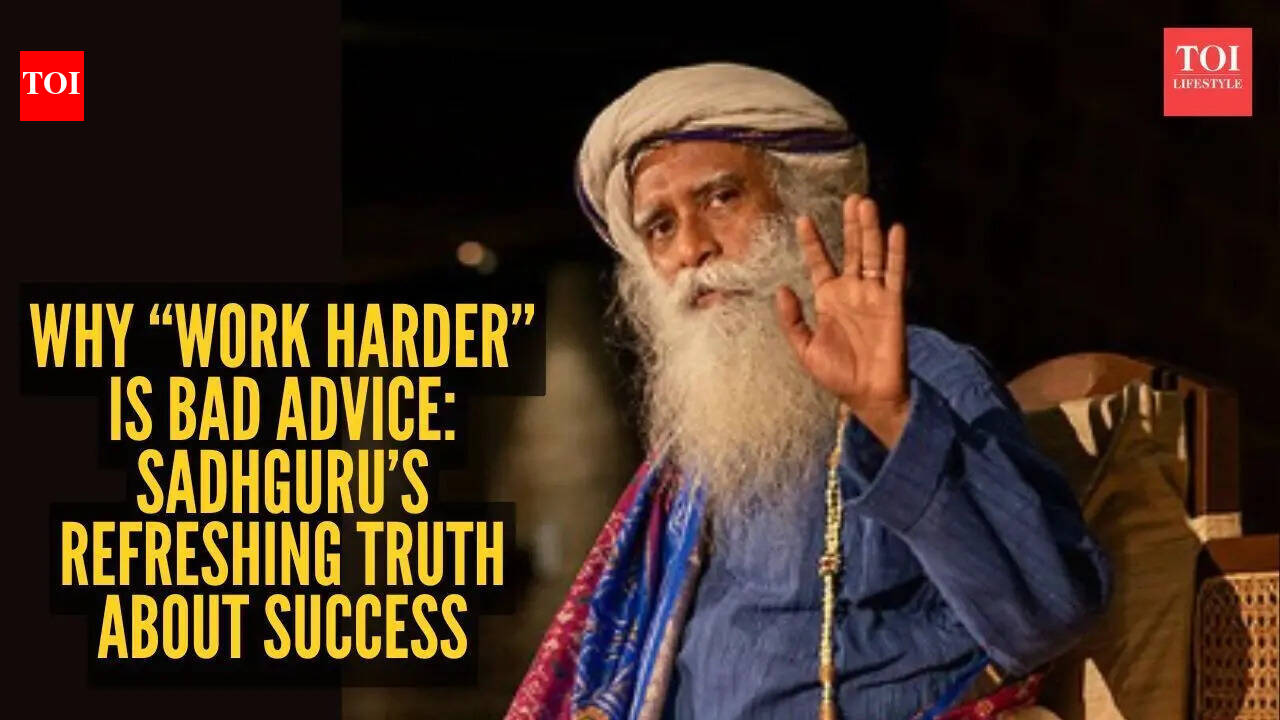
Why “work harder” is bad advice: Sadhguru’s refreshing truth about success – The Times of India

0
Why “work harder” is bad advice: Sadhguru’s refreshing truth about success – The Times of India


Since we were young, we’ve been told that success is born from pressure: study hard, hustle hard, grind until you drop. Teachers tell students, “Just a little more effort, you’ll get there.” Parents echo, “Work hard now, relax later.” That same mindset quietly follows us into adulthood, where long hours, tight deadlines, and “sleep when you’re rich” become the default language of career success.Over time, that constant pressure turns into burnout. We start complaining about everything—traffic, Wi‑Fi, delays, even small inconveniences—because our inner tank is empty. Joy gets replaced by resentment, and hard work becomes a cage, not a ladder. Now, Sadhguru has stepped in with a radically gentle reminder: what if success isn’t about pushing harder, but about aligning your mind, body, and heart?

Sadhguru on “hard work”

In a recent Instagram video, Sadhguru shines a light on how both parents and professionals have glorified the idea of doing everything “the hard way.” Students are pushed to study until they’re exhausted, and professionals overwork to prove their worth. We’ve turned “hard work” into a badge of honour, even when it costs us our peace.Sadhguru points out that when we force ourselves like this—studying without joy, working without love—we don’t just burn out; we start complaining about everything in life. The strain leaks into small things: a delayed meal, a miscommunication, a missed opportunity. He urges us to reconsider this pattern. Instead of “hard work,” he invites us to “study joyfully” and “work lovingly.” Because when you love what you’re doing, effort transforms into energy, not exhaustion. When you don’t, even success feels heavy.

When the mind is at peace, the work soars

Sadhguru doesn’t just speak from philosophy; he grounds his words in the simple science of the human body and mind. When you’re calm, content, and in a pleasant state of mind, your focus sharpens and your capacity expands. A student who’s relaxed and joyful can actually retain more, understand deeper, and enjoy the process of learning. A professional who feels at ease can think clearer, speak better, and deliver stronger outcomes.He highlights that when the mind and body are aligned—when you’re not in constant survival mode—your work naturally improves. Whether you’re revising for a school exam or pitching a high‑stakes project at the office, the quality of your performance rises when your inner world is relaxed. Joy isn’t a distraction from discipline; it’s the fuel that makes discipline sustainable.

How the internet responded

Sadhguru’s video struck a chord because it names something many people have felt but never dared to question. One viewer shared, “This has been true in my experience. I am at my best when I am relaxed and joyful.” Another wrote, “A generation rooted in survival sees everything as hard. What they endured, others are also expected to go through.” Others simply called his words “wise,” as if they’d finally heard permission to soften the whip they’d been holding over themselves.These comments reflect a quiet shift happening in how people think about success. It’s no longer automatic to glorify suffering. More and more people are realising that sustainable achievement doesn’t come from endless pressure, but from a healthy balance of effort, awareness, and inner ease.What are your views on success and hardwork? Do you think relaxing is as important as hardwork in life? Tell us in the comments section below.


Source link

What you can do today to tackle debt and ward off personal insolvency

0
What you can do today to tackle debt and ward off personal insolvency


More and more of us are experiencing personal insolvency, which is when you just can’t pay your debts. In England and Wales in March, 12,252 individual insolvencies were registered, which was 30% higher than in March 2025 and 3% higher than in February 2026.

“We are seeing more people using credit to get through the month. When that’s the approach people are taking, debts can really build up quickly,” says Matthew Sheeran, collaborations partner at Money Wellness and trained debt advisor. He says it’s largely down to the rising cost of living, recent fuel prices and the economic impact of the past few years.

For many, “disposable income has just dropped significantly. And it doesn’t take much to drag people to a point where they might need debt advice or debt solution,” he explains. “We’re seeing that people just don’t have the resiliency they used to have to absorb financial shocks.”

But do not despair. If you feel like you are struggling with debt, there’s lots you can do immediately – today even – that will help. “You don’t need a perfect plan. You don’t have to have everything mapped out from point A all the way through to the end,” says Sheeran. “Just get that plan started.”

So, see if you can ring-fence a morning to work your way through these six simple steps, which could help dig you out of a financial hole…

STEP 1: Lay it all out

“Get clear on what you owe to different creditors. So many people will understandably bury their heads in the sand and not know exactly what they owe and who they owe it to, so get a list together of everyone that you owe money to,” says Sheeran. “How much do you owe to those lenders and how much are they asking for each month? Jot down what the interest rates are as well, to help you make a better informed decision on which to prioritise.”

This, he says, will help you “unclutter your mind” and start “unpicking” what needs to be tackled and in what order. “That first step can often be painful, addressing it is hard, but once you’ve done it, everything just feels that little bit more clear.”

STEP 2: Check your priority bills

Before paying off any other debts, “make sure your priority bills are covered. So make sure you’ve got enough money for your rent, your mortgage, council tax, your energy,” says Sheeran. “They’re the ones that need to be accounted for first. That’s going to really allow you to get a sense of what you’ve got left to put towards your non-priority debts.”

STEP 3: Boost your income (where possible)

Get a free fractional share worth up to £100.
Capital at risk.

Terms and conditions apply.

Go to website

ADVERTISEMENT

Trading 212 logo

Get a free fractional share worth up to £100.
Capital at risk.

Terms and conditions apply.

Go to website

ADVERTISEMENT

“Are there additional benefits you’re entitled to that you weren’t aware of?” asks Sheeran. “A lot of people that receive Universal Credit are actually eligible for different elements of Universal Credit. It’s making sure you get everything you’re eligible for, like council tax support. Different councils have their own discretionary funds, so it’s just trying to tick all of those boxes, because it might be that you’re entitled to more than you think.”

An online benefits calculator is a very swift way to do this, like Turn2Us’s. “For the average person we’ve supported, we’ve noticed they’re eligible for an additional £250 a month for benefits, so it’s not like £30,” says Sheeran. “It’s an amount of money that can make a real difference to repaying your debts.”

STEP 4: Access any grants you might be eligible for

“Try to receive any extra grants you might be entitled to, especially if you’ve got debts within priority bills,” continues Sheeran. “A lot of utility providers have schemes and grants that can actually clear your debt if you’re in financial hardship. So tap into those resources. If you’re able to address big energy debt, that’s going to make everything else a little bit easier.”

STEP 5: Speak to your lenders

“If you’ve got a number of non-priority debts (like credit cards etc.), it’s about getting a plan in place that’s suitable for those lenders,” says Sheeran. “Just by picking up the phone and speaking to your creditors, there is actually more they can do to make your payments more affordable. They might be able to freeze interest and charges, and give you a break from payments for a certain period of time.”

He recommends speaking to every lender directly to set up a plan with each that you can genuinely afford, “then that’s going to give you a long-term plan to become debt free”.

STEP 6: Don’t take on more debt

“I’ve seen it in customers I’ve supported that maybe don’t realise they can’t catch up, and they take out additional debt, thinking things will get better. But once your debt becomes unmanageable, that’s not a sign to take out additional credit,” warns Sheeran. “It’s a sign to get support with the debt you’ve already got.”

Overwhelmed? Speak to a professional

“If debt’s becoming unmanageable, or you see a significant change in your circumstances, pick up the phone and speak to a free debt advice organisation who will just be able to give you that starting point,” says Sheeran.

Money Wellness, National Debtline and StepChange all offer free support.


Source link

Timberwolves eliminate Nuggets as Knicks demolish Hawks in NBA playoffs

0
Timberwolves eliminate Nuggets as Knicks demolish Hawks in NBA playoffs


The Minnesota Timberwolves eliminated Nikola Jokic’s Denver Nuggets while the New York Knicks put on one of the most dominant displays in NBA playoff history, destroying Atlanta to advance, and the surging Sixers beat the visiting Celtics again to force a decisive Game 7.

Sixth-seeded Minnesota will play the San Antonio Spurs in the Western Conference semifinals after completing a 110-98 win on Thursday for a 4-2 series upset of third-seeded Denver.

Recommended Stories

list of 4 itemsend of list

Three-time NBA Most Valuable Player Jokic top-scored for Denver with 28, but it was not enough to fend off the dogged Timberwolves, who were playing without star man Anthony Edwards due to injury.

The clash in Minneapolis was tight throughout, with no team gaining a double-digit lead until the game’s dying moments.

The Timberwolves edged the first half, leading 57-50 at the break.

Jokic roared to life. The Serbian superstar scored 14 points in the third quarter alone to ensure a nail-biting finish.

Having already been ejected for unsportsmanlike conduct from Game 4 after a shoving match, Jokic enraged the home crowd by sparking another brawl with Jaylen Clark.

With his Timberwolves leading by five with 90 seconds remaining, Jaden McDaniels sank a long jump-shot for two to rouse the home fans and force a Nuggets timeout.

When play resumed, Denver could only turn over the ball again. McDaniels closed out the win with two free throws, ending his night with a career-high 32 points, to top-score overall.

“It’s a great night. It’s a great victory for us. Hopefully … we’ve got 12 more to go,” said Minnesota coach Chris Finch.

“We came into these playoffs not trying to beat Denver, but trying to win a championship.”

A visibly crestfallen Jokic, whose side last won the NBA championship just three years ago, said they “just didn’t do a good job”.

“I needed to play better. I must play better,” he added.

Edwards – out with a bone bruise and hyperextended left knee – could return for the Timberwolves’ series with the high-flying Spurs.

Knicks crush Hawks in record-setting rout

Elsewhere on Thursday, the Knicks routed the Atlanta Hawks 140-89.

It was the most points scored and the biggest win by the Knicks in a playoff game, setting up an Eastern Conference semifinal with either the Celtics or the 76ers, who are tied 3-3 after a Philadelphia win.

The Knicks wrapped up their 4-2 series victory in emphatic style, leading the Hawks by as many as 61 points before benching their starters for the final quarter.

New York’s 47-point half-time lead, at 83-36, was the widest in NBA postseason history.

OG Anunoby top-scored with 29 points, including 26 in the first half, before he was rested. None of New York’s starters played more than 29 minutes.

“We can’t just meet the moment, we’ve got to exceed it, and I thought we did a great job of doing that tonight,” said Karl-Anthony Towns, who recorded a triple-double with 12 points, 11 rebounds and 10 assists.

Anunoby in action against the Atlanta Hawks at State Farm Arena [Brett Davis-Imagn Images via Reuters]

Having finished third in the Eastern Conference, the heavily favoured Knicks had been down 2-1 early in the playoff series, before roaring back.

They are the first team to advance to the East’s semifinals – their fourth straight year of reaching that stage.

The Hawks briefly led at the start of the game, going up 11-9 before the wheels dramatically came off. They trailed 40-15 at the end of the first quarter.

The final 51-point margin of defeat was not quite the largest in playoff history, which stands at 58 points.

“Obviously, you hate to lose anything. And to lose the way we did, I think, particularly given the enthusiasm and support that we’ve had from the people in this building … disappointed on a lot of levels,” said Hawks coach Quin Snyder.

Sixers dump Celtics again to send series to Game 7

The Celtics-76ers playoff series is headed for a decisive Game 7 in Massachusetts after Philadelphia beat Boston 106-93.

The Celtics had held a 3-1 series lead, but the 76ers proved dominant on their home court to make it 3-3.

Tyrese Maxey top-scored with 30 points. Paul George added 23, and 2023 Most Valuable Player Joel Embiid poured in another 19, plus 10 rebounds and eight assists.

It is the 23rd playoff series between the two historic rivals – an NBA record.


Source link

A citizen campaign returns iconic kiwi birds to New Zealand’s capital after a century-long absence

0
A citizen campaign returns iconic kiwi birds to New Zealand’s capital after a century-long absence


WELLINGTON, New Zealand — The kiwi, New Zealand’s sacred national bird, vanished from the hills around Wellington more than a century ago. Now the capital’s residents are waging an improbable citizen campaign to return the endangered flightless birds to the city.

“They are a part of who we are and our sense of belonging here,” said Paul Ward, founder of the Capital Kiwi Project, a charitable trust. “But they’ve been gone from these hills for well over a century and we decided as Wellingtonians that wasn’t right.”

On a hill wreathed in mist above the dark sea that runs between New Zealand’s North and South Islands, Ward and others crossed rugged farmland late on Tuesday night, carrying seven crates in silence by dim red torchlight. Inside each one nestled a kiwi, including the 250th bird relocated to Wellington since the Capital Kiwi Project began.

The kiwi gives New Zealanders the name by which they’re often known. It’s a shy and odd-looking bird with underdeveloped wings and a whiskery face.

Spiritually significant for many New Zealanders, the kiwi’s image appears everywhere, including on the tail of the country’s air force planes — curious for a bird with no tail which can’t fly.

It’s thought that there were 12 million of the birds roaming the landscape before humans arrived in New Zealand. Today only about 70,000 kiwi are left across the country, with the population dropping 2% each year.

In the hills where Wellington’s kiwi now live and breed, the only late-night sound on Tuesday was the whoosh of wind turbines. Ward and his friends set their crates down in pairs, slid them open and gently tilted the boxes.

Some in the small group of hushed onlookers were tearful. One man chanted a karakia, a Māori prayer.

From each crate, a long, curved beak eventually protruded as kiwi took their first tentative steps into the shadowed landscape, then sped to a run and disappeared into the darkness.

One place kiwi had never set foot until this week was inside New Zealand’s Parliament. Hours before Wellington’s seven newest residents were transported to their hillside home, they were carried into Parliament’s grand banquet hall by handlers for a celebration of the 250th kiwi’s arrival in the city.

Lawmakers and schoolchildren alike expressed whispered delight at seeing the timid, nocturnal birds up close, many for the first time, as conservation workers cradled the large birds like human babies, with their gnarled feet outstretched.

“This animal has given us as a people so much in terms of our sense of identity,” Ward told The Associated Press. “We want to challenge our civic leaders, our politicians and say this is a relationship we need to honor.”

New Zealand is home to some of the world’s strangest and rarest bird species. Some have only survived because of against-all-odds conservation programs, at times with uncertain funding.

Initiatives decades ago saw all surviving birds of some species moved onto offshore, predator-free islands or into sanctuaries where they could be carefully monitored and protected, but where few New Zealanders would ever see one.

Ward and his group had a different dream: that New Zealand’s iconic national bird could flourish alongside people in a bustling capital city, where human encroachment and introduced predators had wiped out the kiwi before.

“Where people are is also the places where we can bring them back because we’ve got the means to do that guardianship,” Ward said.

Although unmanaged kiwi populations are shrinking, their numbers have thrived in carefully managed wild bird sanctuaries — so much, in fact, that some of these protected areas have run out of room for them.

That’s prompted their relocation to places like Wellington, where groups such as Ward’s rally residents to embrace their new neighbors. Kiwi have been spotted by late night mountain bikers and on backyard security camera footage in the capital, he said.

“They’re living and calling and being encountered on the hills surrounding our city,” Ward said.

That’s taken work. Over the past decade, efforts between landowners, the local Māori tribe and the Capital Kiwi Project have produced a sprawling, 24,000-hectare tract of land where kiwi can roam.

It’s dotted with more than 5,000 traps for stoats, the main predator of kiwi chicks. So far, the Wellington population has a 90% chick survival rate.

The kiwi initiative is part of New Zealand’s quest to rid the island nation of introduced predators, including feral cats, possums, rats and stoats, by the year 2050. Since a previous government established the target in 2016 its chances of success have been debated, but community groups have taken up the work in earnest.

Parts of Wellington are now entirely free of mammalian predators apart from household pets, and native birds flourish. Volunteers monitor suburbs with military precision for the appearance of a single rat.

“When I think of endangered species globally, for the most part you can’t do much other than campaign or donate money,” said Michelle Impey, chief executive of Save the Kiwi. “But we have this incredible movement throughout the country where everyday people are taking it on under their own steam to do what they can to protect a threatened species.”


Source link

Myanmar ex-leader Aung San Suu Kyi moved to house arrest, military says

0
Myanmar ex-leader Aung San Suu Kyi moved to house arrest, military says


The Nobel Peace Prize laureate has been in detention since she was ousted in a military coup in 2021.


Source link

Oil Companies’ Huge Profits Revive Calls for Temporary Windfall Taxes

0
Oil Companies’ Huge Profits Revive Calls for Temporary Windfall Taxes


For oil and gas companies, it has been a profitable war.

The energy shock caused by the conflict in Iran, missile attacks on oil and gas facilities in the Persian Gulf and, most crucially, the halt on shipping traffic in the Strait of Hormuz have produced a spectacular bonanza as energy prices have soared.

The British oil giant BP, citing an “exceptional” performance, more than doubled its profits in the first three months of this year over last. TotalEnergies, based in Paris, raised its dividends and doubled its share buybacks after announcing $5.4 billion in net profits for the first quarter.

Around the world, the bumper returns have revived calls for taxes on oil and gas companies’ sudden jackpots.

Finance ministers from Austria, Germany, Italy, Portugal and Spain, as well as a raft of advocacy groups like Oxfam and the World Wildlife Federation, have asked the European Commission to tax excessive profits.

In a letter sent jointly to the European Union’s climate commissioner, the finance ministers wrote that a tax would “send a clear message that those who profit from the consequences of war must do their part to ease the burden on the general public.”

The spike in prices has also prompted Australian lawmakers to discuss raising the tax on the country’s offshore deposits of oil and gas.

The contrast between companies’ exceptional gains and the exceptional pain that soaring oil and gas prices are causing is stark.

The debate over such a tax, though, involves difficult and complex questions. What is the best way to ease the economic strain on struggling households and businesses during an energy shock, while continuing to promote energy investment and combat climate change? How should gains and hardships from global developments be shared equitably between citizens and investors?

The idea behind a tax on windfall profits is that the unusual gains are a result not of any business acumen, hard work or investment decisions, but of unpredictable events.

The last time a war triggered a global energy crisis and prompted calls for a windfall profits tax was in 2022 when Russia invaded Ukraine. That year, the world’s oil and gas suppliers more than doubled their net income compared with 2021.

Then, the industry’s extraordinary returns caused most members of the European Union to introduce a temporary tax on “surplus profits” and use the money to reduce consumers’ energy bills.

Britain, under a conservative government, also enacted a special “Energy Price Levy” of 38 percent on excess profits that is still in effect.

In the United States, President Joseph R. Biden Jr. called for an end to “war profiteering” and threatened to impose a new windfall profits tax on oil and gas companies unless they expanded production or reduced prices, though no legislation passed.

The prospect of a windfall tax sends chills through the industry. In 2022, Exxon Mobil sued to try to block the European Union’s temporary windfall tax. This week, BP’s new chief executive, Meg O’Neill, said a broader windfall tax would be a “highly flawed response” to the war in Iran.

Tax Foundation Europe, a research organization that tends to oppose tax increases, has also criticized the resurgent interest in windfall profit taxes, arguing they discourage investment, which in turn reduces supply and raises prices.

Policymakers are caught between competing goals. They want more tax revenue to give consumers and businesses a break from crushing prices while simultaneously pushing them to use less energy.

They also want to quickly increase the supply of oil and gas to ease fuel shortages, while aiming to phase out fossil fuels in the long run to slow devastating climate change.

Creating an effective tax is challenging. The European Union raised $26 billion between 2022 and 2024 from the temporary windfall tax, way below expectations.

The French economist Gabriel Zucman said France had raised 69 million euros instead of an estimated €3 billion. Why? Because companies shifted profits either to offshore tax havens or to countries where the oil was produced instead of where it was refined or consumed.

Britain’s energy levy raised $3.5 billion in the 2022-23 fiscal year, $4.86 billion in 2023-24 and $3.92 billion in 2024-25 from energy extracted within the country. But the tax does not apply to overseas profits, so most of the billions earned from oil trading during the war in Iran would be exempted.

One answer, Mr. Zucman said, is to tax global windfall profits, which would end the loopholes, and then redistribute the revenues to households in a lump sum. He pointed to the annual check that Alaskans receive from their state’s Permanent Fund, which is supplied by oil and mining revenue.

The United States has not been hit as hard by energy price increases as countries in Asia and Europe, but gasoline prices this week hit a new peak since the start of the war. The increase has raised the cost for drivers 44 percent, according to the AAA motor club.

Democratic lawmakers and dozens of environmental and advocacy groups have called for a windfall profits tax, but the prospect of action is unlikely.

President Trump has courted the oil and gas industry. While campaigning in 2024, he promised energy executives supersized returns if they raised $1 billion to help him win the election.

When oil prices started climbing in March, the president celebrated.

“The United States is the largest Oil Producer in the World, by far,” Mr. Trump wrote on Truth Social, “so when oil prices go up, we make a lot of money.”


Source link

The methods and mind of Wrexham’s composed icon Phil Parkinson

0
The methods and mind of Wrexham’s composed icon Phil Parkinson


They have not always gone their way, but Wrexham are no strangers to crunch moments.

And given their astonishing track record of late, why change a winning formula?

Following their gut-wrenching 5-4 National League play-off semi-final loss to Grimsby Town at the end of Parkinson’s first season in charge of Wrexham in 2022, the club has enjoyed a rapid rise.

They won an enthralling encounter with title rivals Notts County 3-2 just 12 days prior to officially securing a return to the Football League by beating Boreham Wood 3-1 in north Wales in 2023.

That was followed by further automatic promotions from League Two and League One, the latter in which they claimed an emphatic 3-0 victory over Charlton Athletic in their final home game to clinch a spot in the Championship.

“They’re in a great position, so why would you change?” added Tozer.

“They won’t drift too far away from what’s been getting them success.”

Despite exuding a calm exterior in the midst of the talk of play-offs and permutations, the fire will no doubt be burning inside Parkinson, particularly after referee Oliver Langford blows his whistle to kick-start proceedings against Middlesbrough.

It is that blend of composure and passion from the boss that fills even the most experienced members of the Wrexham squad with supreme confidence.

“From the gaffer’s point of view, he’s so experienced, he’s got so many games under his belt,” said 34-year-old midfielder Matty James.

“He’s just a calming figure around the place. He’ll be there and he’ll come alive on Saturday, I’m sure.”


Source link