
Several warning lights are flashing that have some wondering whether we are in the foothills of another financial crisis.
Source link
A financial crisis may be coming – it won’t be like last time

New miscarriage care could save 10,000 babies and NHS millions

Routinely offering women further tests after their first miscarriage – rather than waiting until their third – could prevent more than 10,000 losses a year in the UK, a study suggests.
The additional measures are effective and can be achieved “without significant additional workload for NHS teams”, according to pregnancy and baby charity Tommy’s.
The move could also spare thousands of families each year trauma, experts said.
Currently, the NHS will run tests after a third miscarriage in most cases.
This leaves families “unsupported” with their “grief unrecognised”, a new report by Tommy’s said.
The pilot study by researchers at Tommy’s National Centre for Miscarriage Research and Birmingham Women’s Hospital trialled a so-called graded model of miscarriage care.
This involves the NHS intervening at an earlier stage, with women offered a one-to-one consultation with a specialist nurse after their first loss to discuss health before conception and during pregnancy.
The hormone progesterone may also be offered in future pregnancies if a woman has experienced early vaginal bleeding.
After two miscarriages, patients would be offered tests for anaemia and abnormal thyroid function. If they go on to have a third, women would be offered the current standard NHS care.
Professor Arri Coomarasamy, director of Tommy’s National Centre for Miscarriage Research, said: “If the graded model were implemented across the UK, our study indicates it could prevent around 10,075 miscarriages every year.
“That’s more than 10,000 families bringing their babies home instead of suffering the trauma of a pregnancy loss.”
The trial included 203 women with a history of one or more miscarriages who were given early intervention, along with 203 who had the usual care.
Of the women who had the graded model of care, 86% had one or more factors detected that could increase their risk of future miscarriages, compared to 58% in the group who had standard care.
According to the study, women treated using the graded model had a 4% lower risk of a pregnancy after miscarriage ending in another loss.
The measures could also save the NHS more than £40 million after one year, the report suggests.

Elsewhere, among women who had two losses, one in five were found to have either thyroid problems or anaemia which were picked up in blood tests they would not usually be offered at that stage.
Kath Abrahams, chief executive of Tommy’s, said: “NHS care and support for women who experience a miscarriage in the UK is inconsistent and generally involves no follow-up or tests until after a third loss.
“The three-miscarriage wait means women and families are left without early access to services that could help prevent future losses and reduce the debilitating feelings of isolation and hopelessness that we know affect so many who experience pregnancy loss.
“Our pilot study indicates that providing support after a first miscarriage, with escalating care after further losses, is not only effective but achievable without significant additional workload for NHS teams who are already working extremely hard to deliver good care.
“Put simply, it is the right thing to do.”

Tommy’s estimates there are about 250,000 miscarriages in the UK each year.
Ms Abrahams said Scotland has already embedded the new model into its miscarriage care pathway and called on policymakers in England, Wales and Northern Ireland to do the same.
She added: “We will do all we can to drive that change across the UK, so that more women and families are supported after every miscarriage.”
The Government has pledged to review miscarriage support in the new Women’s Health Strategy.
Baroness Merron, parliamentary under-secretary of state at the Department of Health and Social Care, welcomed the study and said its findings “will be carefully considered”.
She added: “Pregnancy and baby loss can have a devastating impact on women and families, who too often feel they have been left without the care and support they need.
“Research like this is crucial, and our renewed Women’s Health Strategy puts women’s voices and experiences at the heart of care.”
City regulator reviewing whether APRs help consumers understand borrowing costs

Annual percentage rates (APRs), which indicate yearly borrowing costs to consumers, are being reviewed by the City regulator amid evidence that they do not always allow people to understand the true cost of credit.
The Financial Conduct Authority (FCA) is looking into whether APRs help people to understand borrowing costs and is seeking views on whether it should change the way these are communicated in credit advertising.
APRs indicate the yearly cost of borrowing, including interest and fees.
Current rules require representative APRs in most credit advertising.
A representative APR means at least half of consumers receive that rate or better.
The FCA said research indicates APRs are useful for comparing products, but additional information such as total repayment figures can also help consumer understanding.
However, it said providing different information tailored to different products can sometimes make comparisons harder and confusing.
The FCA said research showed that, among people shown the APR alone, 80% of people correctly identified the cheapest product when the lower APR meant a lower repayment.
The regulator is also proposing to simplify parts of the consumer credit rule book on credit advertising, aiming to remove duplication and outdated requirements where the consumer duty already sets clear expectations.
The consumer duty came into force in July 2023 and, where it applies, firms must consider how their communications deliver good outcomes for consumers, including by supporting customer understanding.
Get a free fractional share worth up to £100.
Capital at risk.
Terms and conditions apply.
ADVERTISEMENT

Get a free fractional share worth up to £100.
Capital at risk.
Terms and conditions apply.
ADVERTISEMENT
The FCA’s Financial Lives Survey 2024 found that 79% of UK adults, equating to 42.5 million people, held at least one or more regulated credit or loan products in the previous 12 months.
The regulator said that technology is also transforming the sector, with firms developing innovative products and offering an increasing array of digital communications channels.
Alison Walters, director of consumer finance at the FCA, said: “Clear information advertising credit helps people shop around.
“But there’s evidence that APRs do not always allow people to understand the true cost of credit. To help people navigate their financial lives, we’re asking for views on whether there’s a better way.”
The closing date for the discussion and consultation paper is June 17.
James McCaffrey, a spokesperson for TotallyMoney, said: “APRs can provide a benchmark for comparing products, but the truth is it’s often much more complicated than that – especially when you add 0% introductory periods, fees, flexible borrowing, and varying offer lengths to the mix.
“On top of that, loans, cards, buy now pay later and other credit agreements all work differently to one another, which means comparing all your options is even harder.”
Paul Matthews, senior risk director at banking and credit advisory firm Broadstone, said: “APRs have long been the cornerstone of credit advertising, but the regulator’s research reinforces a well-known challenge – they are not always a reliable proxy for the true cost of borrowing, particularly where product structures differ.
“The FCA’s willingness to revisit how borrowing costs are communicated is therefore welcome, especially at a time when affordability will be critical to a well-functioning credit market.
“There is a strong case for complementing APRs with clearer, more tangible measures such as total repayment or pounds and pence cost, provided this is done in a consistent way that preserves comparability.
“Consumers tend to focus on monthly repayments and overall cost, so aligning disclosures with these behaviours will be key to improving outcomes.”
Feds have rejected 15% of businesses’ tariff refund claims

Roughly 15% of tariff refund requests have been rejected since a government reimbursement portal launched on April 20, according to U.S. Customs and Border Protection (CBP).
As of April 26, the federal agency had received more than 75,000 refund requests from U.S. businesses and other importers. More than 47,000 claims encompassing some 11 million tariff payments were properly filed, CBP official Brandon Lord said in a filing with the Court of International Trade on Tuesday.
The agency launched the Consolidated Administration and Processing of Entries tariff refund system, known as CAPE, to comply with an order issued following the Supreme Court’s February ruling striking down emergency levies imposed by President Trump.
The agency launched the new tariff refund hub, known as CAPE, for Consolidated Administration and Processing of Entries, to comply with an order following the Supreme Court’s February ruling striking down emergency levies imposed by President Trump.
Nick Richards, a partner at law firm Greenspoon Marder who has advised clients seeking tariff refunds, told CBS News that some businesses are likely making errors in their claims submissions. In the first phase of the refund process, CAPE is only accepting applications for tariffs that have been finalized by CBP or estimated duties that can still be estimated.
Additionally, businesses may only seek refunds for tariffs imposed by the Trump administration under the International Emergency Economic Powers Act.
“There are parameters, and I would imagine some of the submissions are outside of that scope,” Richards said.
Apart from some glitches when CAPE launched last week, the portal is running smoothly, according to CBP.
“Since the opening of CAPE on April 20, 2026, the only time during which the CAPE functionality was not available for use by importers and their brokers was an 18-minute period on April 20, 2026, when CBP briefly paused the ability to submit declarations to reconfigure resources and optimize the processing of CAPE declarations,” Lord said in the filing.
Despite some hiccups, Richards said the process appears to be going smoothly. “I was amazed at the speed with which Customs put up this portal, so kudos to them,” he said. “They’ve done an amazing job rolling this out.”
10 rapidly-growing trees for immediate privacy and long-lasting beauty | – The Times of India

Trees are vital natural resources that not only enhance the aesthetic appeal of the landscape but also provide significant social and economic benefits. Beyond acting as environmental “lungs” to sequester carbon, purify air, and reduce urban heat, they have historically fueled national development, timber production, and more. But the biggest drawback for many homeowners is time. Agree?Traditional trees can take decades to mature, leaving landscapes looking sparse for years. The good news is that certain trees can create privacy screens for your home by quickly establishing a dense, vertical barrier of foliage that blocks sightlines between properties.How fast-growing trees are effective for quick privacy?According to the USDA Forest Service, fast-growing trees can quickly improve shade coverage and even help cool surrounding areas. With thoughtful selection, they work better than fencing and have even shown signs of long-lasting beauty.In addition, their environmental impacts are never negligible. A study by TNC shows that a simple walk among the trees in a city park led to an impactful drop in anxiety and depression. Another study in Louisville, Kentucky, found that planting 9,000 trees improved neighbours’ health conditions linked to heart disease, stroke and some types of cancer.Fast-growing trees for quick privacyWhen building natural screens, it is essential to consider their annual growth and mature size to ensure they fit your space. Now, without further ado, scroll down for a list of trees that will transform your landscape.01) Weeping WillowKnown as one of the fastest-growing trees, the weeping willow (Salix babylonica) is known for its graceful, cascading branches. The ornamental tree is also grown for wood production and shelterbelts. Going by its name, the deciduous trees with weak wood drop many small and large branches quite frequently, making it relatively easy to propagate.Lifespan: 30–50 yearsMature size: Grows 6 to 8 feet annually, often reaching 35 to 50 feet tall and 5 to 50 feet wide in just a few years.Zones: 4–10 (USDA), and ideal for wet areas.Planted in: Spring seasonOther requirements: Full sun exposure, acidic, neutral, and moist soil, as well as moderate watering.02) American Sweetgum

Series of American Sweetgum in the backyard. Image credit – Gemini
Known for their glossy, star-shaped leaves and dramatic fall colour, American sweetgum (Liquidambar styraciflua) trees are often found in wetter areas. However, their spiky seed pods that fall on the ground between December and April and their aggressive rooting system, damaging the sidewalks, can be a drawback for some homeowners.Lifespan: 150–300 years, though they can live up to 400 years under ideal conditions.Mature size: Grows 2 to 3 feet per year, often 60 to 80 feet tall and 40 to 60 feet in width.Zones: 5-9 (USDA) in wet areas.Planted in: Late winter to early springOther requirements: Full-sun conditions, deep, moist, acidic, loamy soils, and consistent moisture.03) Crape MyrtleFor year-round privacy, evergreens such as Crape Myrtle are a standout tree for smaller yards. Horticulturists note that it grows quickly and produces vibrant blooms that last from summer into fall.Lifespan: Typically 20 to 50 years, and retains its leaf colours for the entire summer.Mature Size: Grows 2 to 3 feet per year, with the standard varieties reaching 20 to 30 feet tall and 10 to 15 feet wide. In addition, there are exceptionally old and giant species, as well as semi-dwarf and shrub Varieties.Zones: 7 to 9Planted In: Late winter or early spring.Other requirements: Full Sun, clay and alkaline, well-drained, moist soil with a slightly acidic to neutral pH, regular watering and 2–4 inches of organic mulch04) River BirchRiver birch (Betula nigra) stands out for its peeling, cinnamon-colored bark that becomes no less than a visual interest. It is ideal for low-lying or flood-prone areas due to its ability to tolerate wet soils.Lifespan: 50 to 75 yearsMature size: Grows 1.5 to 3 feet per year, reaching 40 to 70 feet tall x 40 to 60 feet wide.Zones: 3 to 9Planted in: Late summer or winterOther requirements: Full to partial sun; well-draining soil; moderate watering05) CrabappleThe small to medium-sized deciduous trees with their cherry blossoms are perfect for your home yards and porches. Besides their unparalleled curb appeal, Crabapple trees (Prunus) can also be prone to diseases such as powdery mildew and fire blight. It is advisable to plant these trees with a pest-resistant species.Lifespan: 30 to 70 yearsMature size: Grows 12 to 24 inches per year, often reaching 15 to 25 feet tall and 10 to 20 feet wide. They also have dwarf and large varieties.Zones: 4 to 8Planted in: Spring or fallOther requirements: Full sun; well-draining, slightly acidic soil; moderate watering06) Paper BirchPaper birch (Betula papyrifera) is one such deciduous tree that offers multiple interests in varying seasons. Its white exfoliating bark turns yellow in autumn. In spring, the tree produces small flowers, followed by cone-like fruits in late summer.Lifespan: 50 to 80 yearsMature size: Grows 2 to 3 feet per year in early stages, often reaching 50 to 70 feet tall and 25 to 50 feet wide.Zones: 2 to 6Planted in: Cool, moist, well-draining soil throughout the year.Other requirements: Partial sun, protection from heat stress, consistent watering07) Japanese Flowering CherryThese trees create a seasonal show with their soft pink and white blossoms during spring. While Japanese Flowering Cherry (Prunus serrulata) grows relatively quickly, they have a shorter lifespan than slower-growing species.Lifespan: 15 to 20 yearsMature size: Grows 1 to 2 feet per year, often reaching 15 to 25 feet tall and 15 to 25 feet wide.Zones: 5 to 8Planted in: Fall or early springOther requirements: Well-draining soil, full sun exposure, moderate watering, protection from strong winds, regular pruning for structure08) Tulip PoplarTulip poplar (Liriodendron tulipifera), with its surreal, plant-like structure, is one of the fastest-growing native hardwood trees. Known for its tall, straight trunk and tulip-shaped flowers, it quickly adds a visual appeal in large landscapes.Lifespan: 100 to 300 yearsMature size: Grows 2 to 3 feet per year, often reaching 80 to 120 feet tall and 30 to 60 feet wide.Zones: 4 to 9Planted in: Early spring or fallOther requirements: Full sun exposure, deep, well-draining, slightly acidic soil, regular watering in early years, and mulch to retain soil moisture09) Eastern RedbudThe ornamental Eastern redbud (Cercis canadensis) is another plant ideal for smaller spaces. This fast-growing tree not only fits well in residential landscapes but also has early spring blooms that create a striking visual effect. According to horticulturists, this tree also supports pollinators, making it a valuable addition to eco-friendly gardens.Lifespan: 50 to 70 yearsMature size: Grows 1 to 2 feet per year, often reaching 20 to 30 feet tall and 25 to 35 feet wide.Zones: 4 to 9Planted in: Spring or fallOther requirements: Fertile, well-draining soil, partial to full sun exposure, regular watering and annual pruning10) Blue SpruceNative to the Rocky Mountains, the Blue Spruce (Picea pungens) is known for its silvery-blue foliage, pyramid shape, and longevity. These slow-to-moderate growing evergreen trees are also often referred to as the Colorado Blue Spruce.Lifespan: 150 to 300 yearsMature size: Grows 1 to 2 feet per year, often reaching 30 to 60 feet tall, 10 to 20 feet wideZones: 3 to 7Planted in: Early spring or fallOther requirements: Full sun, consistent moisture during establishment, low-humidity environments, well-draining soil, slightly acidic conditionsApart from the above list, trees such as Dawn Redwood, White Pine, Crabapple, Leyland Cypress, Thuja Green Giant, Citrus, Mango, Avocado and Peach, among others, also take a major place on the list of fast-growing windbreak or fruit species.Planting guidelinesTo maximise the effectiveness and health of your natural privacy screen, here are some strategic planting tips:Spacing: Plant trees close enough that their mature canopies will slightly overlap to create a seamless wall. However, avoid overcrowding, which can create damp, swampy areas leading to disease.Layering: For a more natural look and better pest resistance, plant a mixed screen of different species rather than a single row.Location: Maintain a distance of at least 12 feet from foundations or power lines to prevent damage from roots or tall branches.Maintenance: Fast-growing trees often have weaker wood. However, regular pruning helps establish a strong structure and prevents storm damage.
How Republican Florida redistricting map could backfire on Trump

Governor Ron DeSantis‘ new congressional map, drawn in secret and announced on Fox News on Monday morning, is designed to give Republicans up to four additional House seats while reducing Democrats to just four members of Florida‘s delegation.
But the strategy carries a risk: by aggressively targeting Democratic-held districts, Republicans may have weakened some of their own safest seats.
The map, expected to pass quickly through the Republican-controlled Legislature, drastically reshuffles Democratic strongholds. Representative Debbie Wasserman Schultz’s district is effectively split across three seats. Darren Soto’s district is broken into four. Kathy Castor’s district shifts from a five-point Democratic advantage to a 10.5-point Republican lean.
Those gains come with tradeoffs. Representative Mario Diaz-Balart’s district, once a stronghold that President Donald Trump carried by 35 points in 2024, would have favored him by just 18 points under the new lines—a 17-point swing that could make the seat more competitive.
“I think the Legislature needs to be very cognizant of the fact that if they get too aggressive, you could put incumbent members at risk,” Representative Greg Steube, a Sarasota Republican, told Politico in March. Seats previously won by eight or nine points, he said, could shrink to four- or five-point advantages, putting them within reach in a strong Democratic year.
Former Florida House Speaker Daniel Webster offered a similar warning. “Don’t do it,” he told Punchbowl. “I’ve been around enough reapportionments to know it’s a slippery slope.”
A report from the Civic Data & Research Institute reached a similar conclusion, finding that more aggressive redistricting in Florida “may paradoxically increase Republican vulnerability to adverse electoral conditions.”
Risky Business
Those concerns have intensified following Democratic special election wins in March, including a surprise flip in a Palm Beach County district that includes Trump’s Mar-a-Lago resort. The result suggested potential shifts in Florida’s political landscape that could make aggressive redistricting more dangerous.
House Minority Leader Hakeem Jeffries of New York quickly signaled that Democrats would contest the new map, pledging at least $20 million in challenges.
“We will crush House Republicans in November if DeSantis tries to gerrymander the Florida congressional map,” Jeffries said on social media Tuesday.
Nationally, the broader redistricting push tied to Trump has produced mixed results for the GOP. An analysis by the University of Virginia’s Sabato’s Crystal Ball found that Democrats have largely broken even or slightly outperformed Republicans in recent redistricting battles. Still, DeSantis appears confident that the strategy will deliver gains, though the outcome ultimately depends on electoral conditions this year.
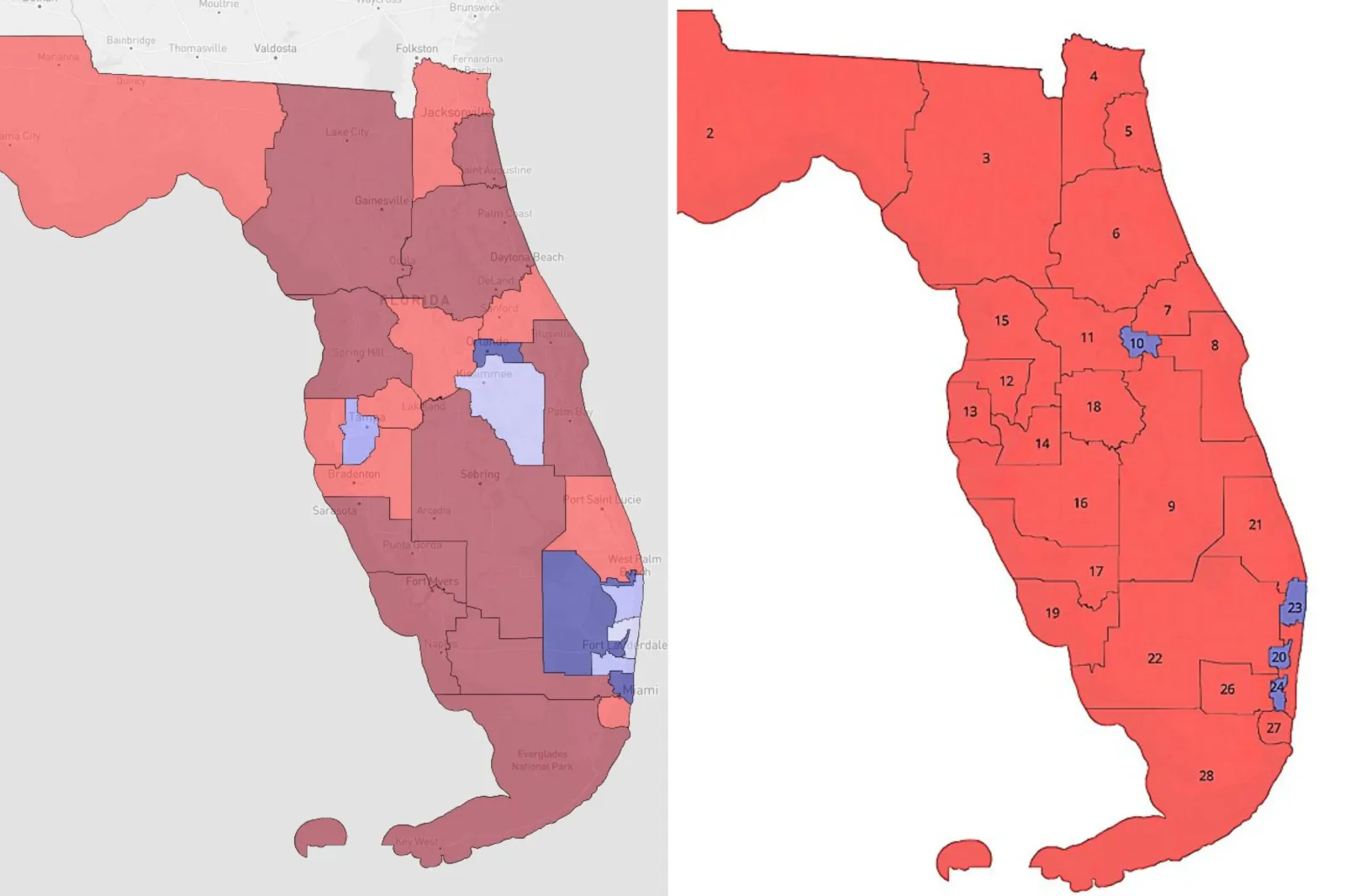
The map is designed to deliver Republicans 24 of Florida’s 28 congressional seats, up from 20. Whether that holds depends heavily on turnout and political conditions—whether the electorate resembles 2024, when Trump won Florida by double digits, or 2020, when the margin was about 3 points.
“Is it going to be that really, really friendly electorate to Trump or is it going to be more competitive?” Shawn Donahue, a political science professor at the University at Buffalo, told Newsweek.
Even some Republicans are urging caution. GOP strategist Mary Anna Mancuso warned in a Miami Herald op-ed that mid-cycle redistricting introduces unnecessary uncertainty.
“When Republicans are urging restraint, it’s worth paying attention,” she wrote. “Mid-cycle redistricting creates uncertainty in a map that has already proven favorable to the GOP.”
Democrats in Flux
The reshuffling puts several Democratic incumbents in difficult positions.
Wasserman Schultz, first elected in 2004, appears to be a central target. Her current district has been carved up, leaving her most likely to run in a newly drawn, heavily Democratic seat that Vice President Kamala Harris carried 68-31 in 2024. But that district is already drawing multiple candidates, including former Broward County Commissioner Dale Holness, rapper Luther Campbell and Sheila Cherfilus-McCormick, the former congresswoman awaiting trial on fraud charges.
Representative Jared Moskowitz is expected to run in a newly configured district stretching from Miami Beach to Boca Raton. The area leans Republican—Trump won it 54-45—but Democrats see a possible pickup opportunity in a favorable cycle, albeit an expensive one.
Castor has said she will seek reelection in her Tampa-area district despite its shift to a Republican lean. Trump would have carried the redrawn seat 54.5 percent to Harris’ 44 percent. Democrats believe her name recognition could still carry her through, but the race is expected to be close.
Soto faces the most uncertainty. His district has been divided into four, leaving him without a clear path. One option, a Republican-leaning seat with a 13-point GOP advantage, already has a well-funded Democratic candidate. Other nearby districts lean even more heavily Republican.
“Soto’s best hope for remaining in Congress will be if the Florida Supreme Court steps in and determines the map is unconstitutional,” ABC News’ Jim DeFede reported.

Republicans at Risk
The new map could also expose several Republican-held seats in South Florida, potentially undermining the GOP’s intended gains.
Districts held by Representatives Maria Elvira Salazar, Carlos Gimenez and Diaz-Balart may become targets for Democrats, particularly as party strategists reassess Latino voting trends.
Some Republicans warn that the party may be overestimating its recent gains with Latino voters. Economic pressures, including inflation and industry-specific challenges, could make those voters more volatile.
“Redistricting to create short-term advantages could have the opposite effect,” Mancuso wrote. “In the GOP’s quest to gain a seat or two, Republicans could put several at risk.”
Recent polling shows Republican support among Hispanic voters slipping to 27 percent, compared to 43 percent for Democrats. Latino strategist Mike Madrid attributed the shift to dissatisfaction with Republican governance.
“This is 100 percent about the Republicans,” Madrid told Newsweek. “This is all anger and upset with the Republicans. Not that the Democrats are doing anything right. It’s that the Republicans are doing everything wrong.”
Diaz-Balart acknowledged the risks of overreach. While he said Republicans could likely gain one or two seats, pushing further could backfire.
“After that, you’re really, really risking a very large overreach,” he said.
Gimenez’s district remains largely unchanged on paper, but economic factors—including the impact of tariffs and immigration policies on the commercial fishing industry—could introduce new vulnerabilities in a place Trump won by 25 points.
However, Salazar’s district, long a Democratic target, became more competitive. The congresswoman has been warning about slipping GOP support among Latinos, with the Cook Political Report recently shifting her district from “Solid Republican” to “Likely Republican.”
“Salazar has voted in lock-step with the D.C. policies that have led to higher bills at the grocery store, higher health care costs, and higher gas prices,” said Madison Andrus, a spokesperson for the Democratic Congressional Campaign Committee. “Now she’s panicking because she knows South Florida is watching.”
Some incumbents have also expressed concern that the uncertainty surrounding the new map could complicate their reelection efforts, forcing them to campaign in unfamiliar territory or defend newly competitive districts.
Martin Lewis explains how to get car finance payout quicker

Martin Lewis has urged those who think they may be owed car finance compensation to complain now, as they will get a quicker payout.
“The big thing to understand about mass redress – firms must try to seek out everyone who was mis-sold, even if they haven’t complained. Yet – complaining now, if you haven’t already done it… will mean you get paid out quicker,” the Money Saving Expert founder explained on his ITV show on Tuesday (28 April).
Payouts are due on about 12.1 million mis-sold motor finance deals from an array of lenders at an average of £829 each, the Financial Conduct Authority has said.
Dementia risk rises with common food type millions eat every day, study suggests

NEWYou can now listen to Fox News articles!
It’s well-known that ultraprocessed foods (UPFs) are not good for overall health — but new research has uncovered further evidence that this diet could negatively impact the brain.
The study, published in the journal Alzheimer’s and Dementia by the Alzheimer’s Association, revealed that UPFs are linked to more than 30 adverse health outcomes, including several dementia risk factors, like cardiovascular disease, type 2 diabetes and obesity.
Researchers from Australia’s Monash University analyzed more than 2,000 dementia-free Australian adults between the ages of 40 and 70, comparing their diets to cognitive function.
BLOOD PRESSURE AND DEMENTIA RISK SHARE SURPRISING LINK, STUDY SUGGESTS
They found that each 10% increase in UPF intake was associated with lower attention scores and higher dementia risk, regardless of whether the adults typically followed a healthy diet, like the Mediterranean diet.
There was no significant link found between UPF consumption and memory.
Each 10% increase in ultraprocessed food intake was associated with lower attention scores and higher dementia risk, the study found. (iStock)
By identifying food processing as a contributor to poorer cognition, the study “supports the need to refine dietary guidelines,” the researchers concluded.
DR NICOLE SAPHIER ON ULTRAPROCESSED FOODS IN AMERICA: ‘PEOPLE PROFIT OFF ADDICTION’
As the data was self-reported, this could pose a limitation to the strength of the findings, the team noted.
In an interview with Fox News Digital, Dr. Daniel Amen, a California-based psychiatrist and founder of Amen Clinics, discussed how diet has a “powerful impact” on the brain.

“[The brain] uses about 20% of the calories you consume, so the quality of those calories matters,” Dr. Daniel Amen told Fox News Digital. (iStock)
“Your brain is an energy-hungry organ,” he said. “It uses about 20% of the calories you consume, so the quality of those calories matters.”
Food is either “medicine or poison,” according to the doctor, who called out ultraprocessed foods like packaged snacks, soft drinks and ready-made meals that tend to be higher in sugar, unhealthy fats, additives and low-quality ingredients.
DEMENTIA RISK FOR PEOPLE 55 AND OLDER HAS DOUBLED, NEW STUDY FINDS
These foods can promote inflammation, insulin resistance, poor blood flow and oxidative stress, all of which are “bad for the brain,” according to Amen.
The brain expert noted that the study revealed even a 10% increase in ultraprocessed food intake – equivalent to roughly a pack of chips per day – was linked to a “measurable drop in attention, even when people had otherwise healthy diets.”
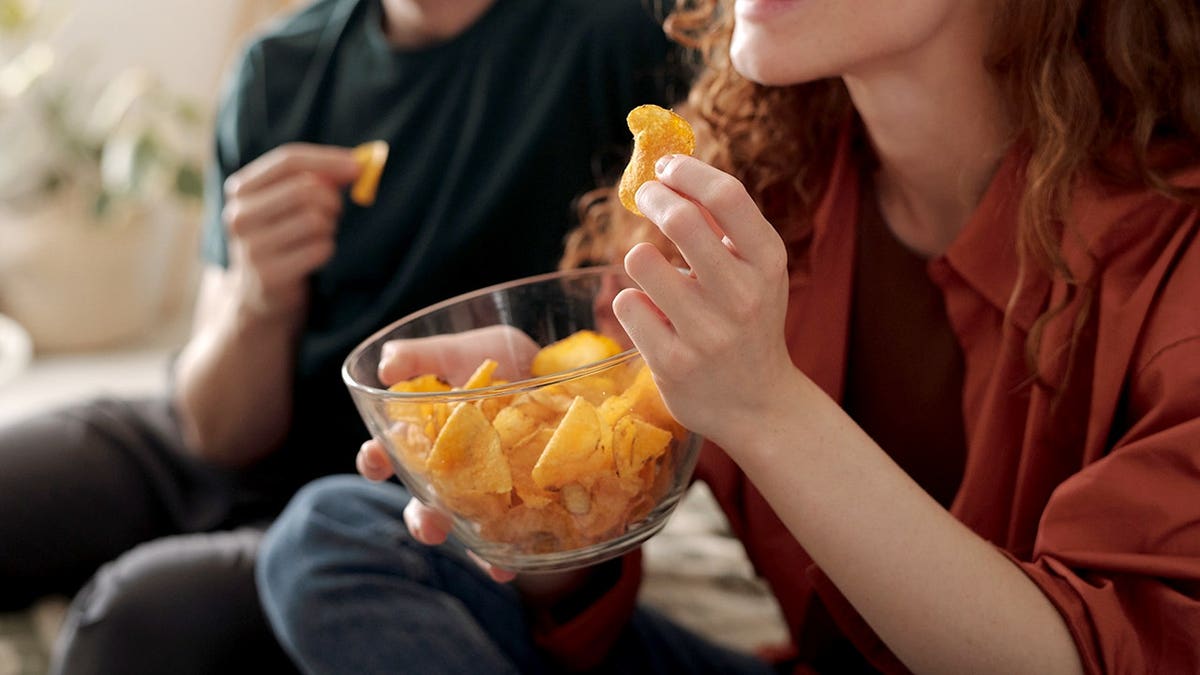
About one package of chips per day can result in cognition changes, according to the study findings. (iStock)
“Attention is the gateway to learning, memory, decision-making and problem-solving,” Amen said. “If you can’t focus, you can’t fully encode information.”
CLICK HERE FOR MORE HEALTH STORIES
The “big takeaway,” according to the doctor, is to “love foods that love you back.”
“You may love the taste of chips, cookies and candy, but they don’t love you (or your brain) back,” he said. “Ultraprocessed foods may claim to be sugar-free, low-carb or keto-friendly, but researchers noted that ultraprocessing can destroy the natural structure of food – and can introduce additives or processing chemicals that may affect cognition.”
CLICK HERE TO SIGN UP FOR OUR HEALTH NEWSLETTER
Amen suggests sticking to real food that grows on plants or animals, instead of food “made in plants.”
“Build meals around colorful vegetables and fruits, clean protein, healthy fats, nuts, seeds and high-fiber carbohydrates,” he recommended. “Start by replacing one ultraprocessed food per day with a brain-healthy option.”
That might mean swapping out chips for nuts, soda for water or unsweetened green tea, and packaged sweets for berries. “Small choices done consistently can change your brain and your life,” the doctor emphasized.
As UPFs have been shown to worsen several dementia risk factors, Amen stressed that people at risk of cognitive decline should “get serious about prevention as early as possible.”
CLICK HERE TO DOWNLOAD THE FOX NEWS APP
“If you have a family history of dementia, memory concerns, diabetes, high blood pressure or weight issues, your diet is not a side issue – it’s a primary brain-health intervention,” Amen said.
“Remember, you’re not stuck with the brain you have. You can make it better, and it starts with the next bite.”
TEST YOURSELF WITH OUR LATEST LIFESTYLE QUIZ
Fox News Digital reached out to the study researchers for comment.
Lions star files lawsuit claiming NCAA, conferences unlawfully profited from his likeness

NEWYou can now listen to Fox News articles!
Jameson Williams may have signed an $83 million deal before this past season, but he’s aiming for more.
The Detroit Lions wide receiver is reportedly suing the NCAA, Big Ten and SEC, claiming they have used his name, image and likeness without compensating him for it.
Before being the 12th pick of the 2022 NFL Draft, Williams starred at Alabama where he shot up draft boards. He had been with Ohio State prior to playing for the Crimson Tide.
CLICK HERE FOR MORE SPORTS COVERAGE ON FOXNEWS.COM
Detroit Lions wide receiver Jameson Williams reacts after scoring a touchdown during the first half of an NFL game against the Philadelphia Eagles in Philadelphia on Nov. 16, 2025. (Matt Rourke/AP)
“To date, Williams has received no fair compensation from Defendants for the full commercial value of his name, image, and likeness. Defendants continuously financially benefit from Jameson Williams’ name, image and likeness rights, while also doing so without providing him with just compensation,” the suit says, according to The California Post.
Williams also reportedly wants the earnings he “would have received” from social media, as well as some of “the game telecast group licensing revenue.”

Alabama’s Jameson Williams is stopped during the first half of the College Football Playoff championship game against Georgia in Indianapolis on Jan. 10, 2022. (Paul Sancya/AP)
BROWNS DRAFT ANOTHER QUARTERBACK, MAKING SHEDEUR SANDERS’ STARTING JOB EVEN LESS SECURE
Williams was drafted into the NFL just months after college athletes were finally able to receive NIL money. However, he is claiming that the parties engaged in anti-competitive collusion, predatory pricing, monopolistic practices and deceptive branding in violation of the Cartwright Act, Unfair Practices Act, Sherman Antitrust Act and Lanham Act.
“Plaintiff received less — zero — than he otherwise would have received for the use of his name, image, and likeness in a competitive marketplace, and was thus damaged, and seeks to recover those damages,” Williams’ lawsuit reportedly says.
Williams’ NFL career did not get off to the most convenient of starts, as his torn ACL in the 2022 national championship hurt his draft stock slightly. After returning from the injury at the end of his rookie season, he was then suspended in 2023 for gambling violations.

Alabama wide receiver Jameson Williams runs down the sideline on a long pass reception against New Mexico State during the first half of an NCAA college football game in Tuscaloosa, Alabama, on Nov. 13, 2021. (Vasha Hunt/AP)
CLICK HERE TO DOWNLOAD THE FOX NEWS APP
Since then, however, he has proven to be one of the game’s best playmakers, recording 123 catches for 2,118 yards and 15 total touchdowns over the past two seasons.
Follow Fox News Digital’s sports coverage on X, and subscribe to the Fox News Sports Huddle newsletter.
King Charles III visit live updates: Loud applause after Charles’ comments on checks to executive power

King Charles emphasized the importance of the NATO alliance as he spoke about how the U.K. answered the call after the terror attacks against the U.S. on Sept. 11, 2001.
“Today, Mr. Speaker, that same unyielding resolve is needed for the defense of Ukraine and her most courageous people,” Charles said. “It is needed in order to secure a truly just and lasting peace from the depths of the Atlantic to the disastrously melting icecaps of the Arctic.”
Britain’s King Charles III addresses a joint meeting of Congress in the House Chamber of the U.S. Capitol in Washington, April 28, 2026.
Kylie Cooper/AP
“The commitment and expertise of the United States Armed Forces and its allies lie at the heart of NATO, pledged to each other’s defense, protecting our citizens and interests, keeping North Americans and Europeans safe from our common adversaries,” he said.
His comments come amid Trump’s criticism of NATO after several allied countries refused to back the U.S. war in Iran.