
The case over OpenAI’s history and public commitments could have major implications for the future of AI.
Source link
Musk says basis of charitable giving at stake in OpenAI lawsuit against Altman

World Service – Listen Live – BBC Sounds

Workers train AI to identify everyday objects by labelling items in photos and videos.
Source link
Tech Life – The workers in the engine room of big tech – BBC Sounds
Available for over a year
We look at revelations about outsourced tech workers in Kenya, and try to find out why more than a thousand of them have been made redundant.
Also this week: are you getting the best out of artificial intelligence? Could changing “how” you communicate with AI make a difference? We speak to an author and put his recommendations to an AI test. And we hear from a company turning lamp-posts into data centres.
Presenter: Chris Vallance
Producer: Tom Quinn
(Image: The words “Meta AI” are displayed on a smartphone screen. The phone is resting on a laptop keyboard. Credit: Reuters)
Amazon touts a ‘major expansion’ with OpenAI as Microsoft ties loosen
SAN FRANCISCO — Amazon announced what it called a “major expansion” of its partnership with ChatGPT maker OpenAI on Tuesday, a day after the artificial intelligence company said it was loosening its ties to longtime backer Microsoft.
OpenAI CEO Sam Altman said the collaboration with Amazon’s cloud computing division, Amazon Web Services, would involve co-developing a new platform for AI agents that can do computer-based work on people’s behalf.
Altman spoke via prerecorded video message to an Amazon event in San Francisco at the same time as he was appearing in federal court across San Francisco Bay in Oakland for a civil trial brought by rival OpenAI co-founder Elon Musk.
Microsoft had said Monday it will no longer pay a share of its revenue to ChatGPT maker OpenAI, the latest move to untether a close partnership that helped unleash an artificial intelligence boom.
OpenAI relied exclusively on Microsoft’s investments in cloud computing services to build the technology that helped make ChatGPT a household name. Microsoft, in turn, relied on OpenAI’s technology to build its own AI assistant Copilot.
But the partnership has evolved as San Francisco-based OpenAI, founded as a nonprofit, has shifted to a capitalistic enterprise on a path toward an initial public offering on Wall Street and has balanced its reliance on Microsoft with other cloud partners like Amazon, Google and Oracle.
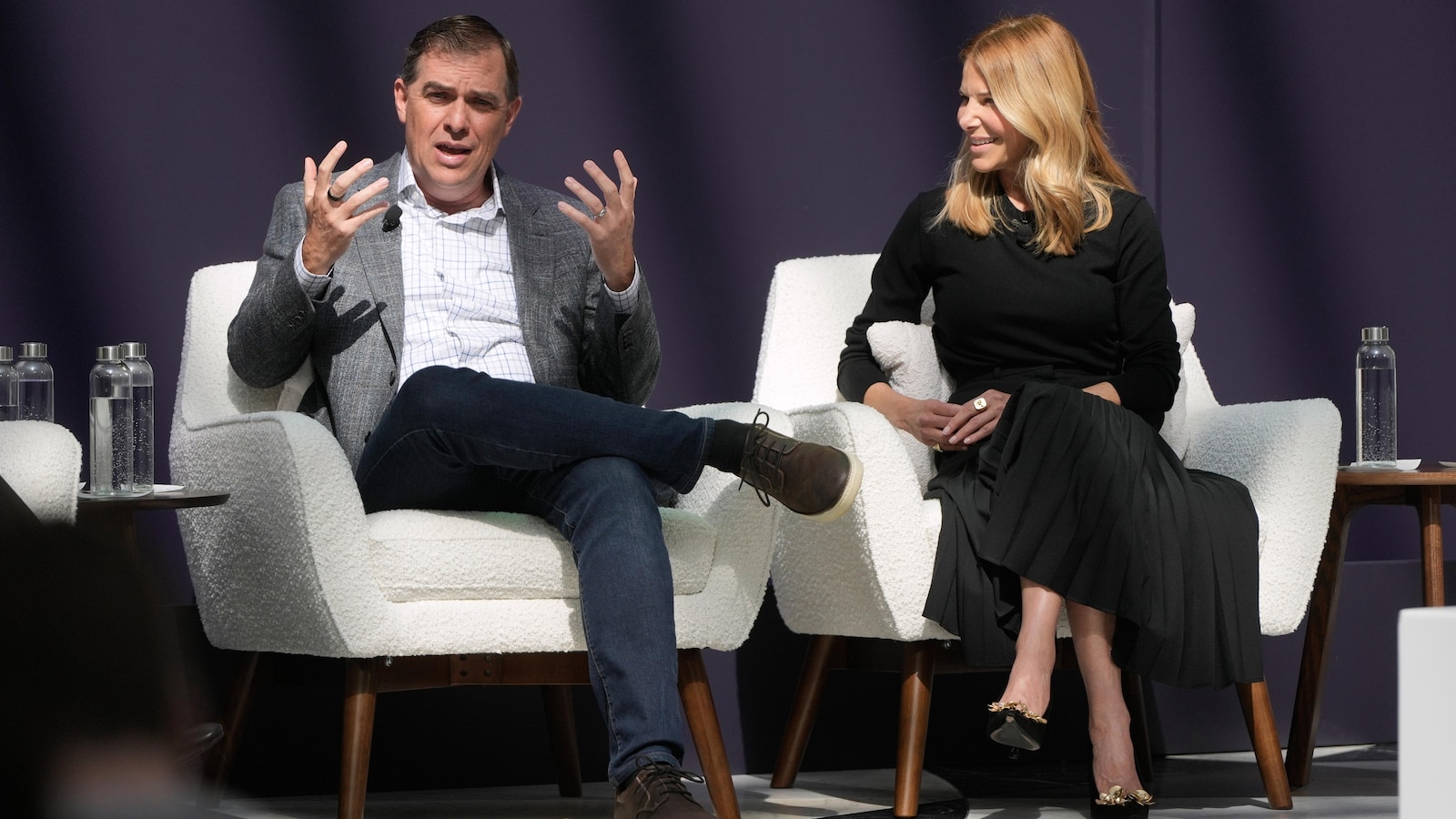
OpenAI said Monday it will continue to pay Microsoft a share of its revenue through 2030, though the rate will be capped. OpenAI has been on a race to boost sales of its AI technology by focusing on big business customers. Its chief revenue officer, Denise Dresser, also spoke at the Amazon event.
Microsoft remains the primary cloud computing partner for OpenAI, and products made by the AI company will ship first on Microsoft’s cloud platform, called Azure, “unless Microsoft cannot and chooses not to support the necessary capabilities,” both companies said.
Altman suggested in his remarks Tuesday that Amazon had those capabilities.
“These systems need to run reliably and robustly,” Altman said. “They need to be secure, they need to scale, and they need to fit in the environments where companies already run their businesses. And they need infrastructure that customers already trust for their most important workloads. That’s what makes this partnership with AWS so important.”
Sam Neill shares major health update four years after stage three cancer diagnosis

Sam Neill has issued an “extraordinary” update about his health, four years after he was diagnosed with stage three cancer.
The Jurassic Park alum, 78, was diagnosed with angioimmunoblastic T-cell lymphoma, a rare type of non-Hodgkin lymphoma, in 2022. He’s been open about his treatment, writing in his 2023 memoir, Did I Ever Tell You This?, that he was taking a “brutal” form of chemotherapy every month.
During a new interview with Australia’s 7News, Neill reflected on the challenges of living with the disease for so many years.
“I was on chemotherapy and the pretty miserable business but it was keeping me alive,” he said. “Then the chemo stopped working. I was at a loss and it looked like I was on the way out, which wasn’t ideal, obviously.”
However, his condition started to change after he discovered CAR T-cell therapy, which 7News said is a treatment that “genetically modifies patients’ blood cells” and is only being used in clinical trials in Australia.
“I’ve had a scan just now, and there is no cancer in my body. This is an extraordinary thing,” Neill revealed.
Hematologist Miles Prince shared more details about the treatment, explaining: “[We] turbocharge those cells to then be able to now recognize the myeloma, which was not visible to the immune system before and then jump on it and kill it.”
Neill continued to applaud the CAR T-cell therapy before sharing what could be next for his career. “It’s science at its best,” he said.
“It’s time I did another movie.”
Neil starred in the period drama The Piano, which won best original screenplay at the Oscars in 1993. Prior to that, Neill was nominated for a Golden Globe for his role in the Eighties series Reilly, Ace Of Spies.

He was nominated for an Emmy Award for the titular wizard in the 1998 mini-series, Merlin, featuring Helena Bonham Carter and the late James Earl Jones, and later portrayed Major Chester Campbell in the 2013 BBC crime drama Peaky Blinders, alongside Cillian Murphy.
The actor has previously spoken about the ups and downs of his cancer treatment. During a conversation with Kate Thornton, for a 2024 episode of her White Wine Question Time podcast, he said he was “hard at work and enjoying life immensely,” after he took a short break from acting.
“I’m in remission,” the Event Horizon and Possession star said. “I’m very grateful for not just the wonderful care I’ve had from doctors and nurses and so on, but also the strides that have been made in treating these things in the last few years.”
“If this had happened to me 20 years ago, I wouldn’t be around to talk to you. I go in [for treatment] once a month now,” he added. “But it used to be three times a month and it’s down to once a month now. You have sort of three or four horrible days afterwards, and then all is well and you cheer up and I go to the gym and all that.”
Fifa approves red cards for footballers covering mouths

Players at the World Cup could face a red card if they cover their mouths when speaking to opponents during confrontations.
The decision was taken during a special meeting of the Fifa Council in Vancouver, Canada, on Tuesday, where two Fifa-proposed law amendments were approved.
Players who leave the pitch in protest at a referee’s decisions could also now face a red card, following ugly scenes at the Africa Cup of Nations final between Morocco and Senegal.
Both law changes have been approved as competition opt-ins by the International Football Association Board (Ifab).
Fifa has confirmed they will be adopted at this summer’s World Cup.
The issue of players covering their mouths became high profile in February when Benfica winger Gianluca Prestianni raised his shirt while speaking to Real Madrid’s Vinicius Jr during a Champions League game.
The Argentina international was accused of racist abuse and provisionally banned for one match. Following a Uefa investigation, Prestianni was found guilty of homophobic conduct and banned for six matches – three of which were suspended.
The issue was discussed at the Ifab annual general meeting in Wales later that month where it was agreed the matter would be on the agenda at the Fifa Council.
The decision remains at the absolute discretion of the referee, who will consider all circumstances before issuing a red card.
Over half of Americans say their finances are worsening, Gallup poll finds

A record 55% of Americans say their financial situation is worsening, with many expressing anxiety about covering monthly bills and making minimum credit card payments, according to a new Gallup poll.
That percentage is the highest Gallup has recorded since it began asking Americans about their finances in 2001, showing consumers are less optimistic than they were during the COVID-19 pandemic in 2020 and the Great Recession in 2008. The survey is based on interviews with 1,001 adults conducted April 1-15, Gallup said.
Although surging gasoline prices since the start of the Iran war in February have fueled public frustration, Gallup’s polling underscores that affordability concerns have been building for years, including longstanding issues such as the rising cost of health care and education.
“Overall, affordability concerns dominate this year’s list, with combined mentions of inflation, energy, housing and health care costs — along with college expenses, transportation costs and childcare — far exceeding all other types of financial concerns,” Gallup said.
Recent increases in consumer prices have caused financial hardships for about 55% of those polled, according to the survey. About 13% cited rising oil and gas prices as a concern, up 10 percentage points from a year earlier.
“Americans feel these prices acutely — we interact with them on a frequent basis and they’re largely necessary,” NerdWallet senior economist Elizabeth Renter told CBS News. “In other words, it’s tough to escape current rising prices, and paired with the uncertainty of how long this spate of inflation will last, it’s unsurprising that consumers’ outlooks are bleak.”
Gas prices on Tuesday hit their highest level since the Iran war started, with the average price rising 7 cents overnight to $4.18 a gallon, according to AAA.
Scarier than dying?
Americans also expressed more financial anxiety about long-term issues such as saving for retirement and paying for their children’s college educations, Gallup found. For instance, about 62% of respondents said they feared not having enough money for retirement, up 3 percentage points from a year earlier.
To be sure, funding retirement has long been a worry for Americans, but the rising cost of living is driving new concerns about outliving one’s retirement savings, according to a recent report from the Allianz Center for the Future of Retirement, part of Allianz Life.
The financial firm’s 2026 retirement study found that 67% of Americans say they are more worried about running out of money than dying, an increase of 10 percentage points from a year earlier.
Near-term issues are also weighing on consumers, with Gallup finding that 28% of those surveyed are worried about paying the minimums on their credit cards, up 2 percentage points from last year and 11 percentage points from 2021.
“A tight budget can become unmanageable fairly quickly when things like gas and groceries get more expensive,” Renter said.
Young Palestinian artists in Gaza exhibit their impressions of war as a fragile ceasefire holds

BUREIJ, Gaza Strip — Young Palestinian artists in Gaza staged an impromptu exhibit on Tuesday, seeking another way to show the world what has happened during war and a fragile ceasefire.
The row of paintings, like much of Gaza life itself, was displayed outdoors, open to the weather and curious stares. There was a painting of a dove, a bullet hole, a person’s silhouette in a territory where the war between Israel and Hamas has killed well over 70,000 people.
It was a sunny day in Bureij in central Gaza. Children shouted and played as admirers of the paintings took photos and reflected.
“They painted their feelings, their ambitions, their hopes, their visions, over four months during a continuous workshop in my studio,” said Ghanem Al-Din, who organized the exhibit of dozens of paintings.
Obay Al-Qarshali, 21, was one of the artists. He said he fled his home in Gaza City in late 2023 after the war began, sparked by the Oct. 7 Hamas-led attack on southern Israel. He took only what he could in his hurry, leaving over 30 of his paintings behind.
They are now lost in the bombing and destruction, he said.
His painting on display showed broken glass, cars topped with mattresses and other belongings and the debris of buildings. All are too familiar for him and hundreds of thousands of fellow Palestinians who have been displaced, often more than once.
Al-Qarshali said he had changed locations at least seven times in the war.
“Because of how much we were displaced and suffered in moving and carrying our belongings, the tents, the crowds, and so much more, I wanted to express something that deeply troubled me: that we left our homes and our safe places, forced to flee, scatter, and change our location. This piece expresses so much,” he said.
The timing of next steps in Gaza’s ceasefire is unclear. The disarming of Hamas is a major challenge before the territory’s shift in governance, stabilization and reconstruction can begin in earnest.
Reconstruction likely will cost over $70 billion and take a decade, a report by the United Nations and the European Union said last week.
It said Gaza’s economy has contracted by 84%. More than 371,000 housing units have been destroyed. Over half of Gaza’s hospitals are “non-functional.” Nearly all schools are destroyed or damaged in the territory of over 2 million people.
While large-scale fighting has eased since the ceasefire took effect in October, Israeli forces have continued near-daily strikes and fire around military-held zones, killing over 800 Palestinians, according to Gaza’s Health Ministry. The ministry, part of the Hamas-led government, maintains detailed casualty records that are seen as generally reliable by U.N. agencies and independent experts. It does not give a breakdown of civilians and militants.
On Tuesday, an Israeli airstrike hit a car in Gaza City, killing four men, according to Shifa Hospital.
The strike happened away from the so-called Yellow Line that separates Israeli-controlled areas from the rest of Gaza. Israel’s military said it struck a “terrorist” in the location, with no details.
The bodies were wrapped in white and placed on the ground, outdoors, so a crowd could mourn.
89-year-old man allegedly opens fire with shotgun in Greek capital, injuring 4

NEWYou can now listen to Fox News articles!
An 89-year-old gunman allegedly opened fire inside two Athens government buildings Tuesday, wounding at least four people in a rare outbreak of violence that rattled Greece’s tightly controlled gun landscape and ended with his arrest hours later.
Police said the suspect first stormed a social security office, went up to the fourth floor and fired, striking an employee in the leg. Officials said the gunman warned one worker to duck before pulling the trigger, though he didn’t appear to specifically target the employee he hit.
“He went in, went up to the fourth floor, raised his shotgun, told an employee to duck and hit another one,” Alexandros Varveris, head of Greece’s National Social Security Fund, told state broadcaster ERT radio.
The wounded man was treated at the scene, but the suspect fled and later opened fire again inside a courthouse in another part of the city, where several people were wounded.
NINE DEAD, 13 IN SECOND TURKISH MASS SHOOTING IN TWO DAYS
People gather outside a courthouse in Athens after a gunman opened fire, leaving several wounded on Tuesday, April 28, 2026. (Petros Giannakouris/AP)
Authorities said at least three women, all court employees, suffered minor injuries from ricocheting pellets, while media reported that a fourth woman was taken to a hospital as a precaution.

People leave a courthouse after a gunman opened fire, wounding at least four, in Athens on Tuesday, April 28, 2026. (Petros Giannakouris/AP)
Surveillance video aired by local media showed a man calmly walking down the street carrying what appeared to be a short-barreled shotgun.
SYNAGOGUE IN LONDON TARGETED IN ATTEMPTED ‘ANTISEMITIC HATE CRIME,’ UK POLICE SAY
Police later arrested the suspect near the city of Patra, about 130 miles west of Athens, and recovered the weapon.

A policeman speaks with a woman outside a courthouse in Athens after a gunman opened fire, wounding several people, on April 28, 2026. (Petros Giannakouris/AP)
CLICK HERE TO DOWNLOAD THE FOX NEWS APP
The motive remains unclear, though state media reported the man left documents behind at the courthouse outlining his grievances.
The Associated Press contributed to this report.
Personality test: Cup, guitar, or clock? What you choose first reveals if you are creative, a nurturer or planner – The Times of India

Have you ever noticed how two people can look at the exact same picture and pick totally different things? One person spots the cozy cup of tea/coffee, another sees a guitar in the corner, and a third is checking the clock to see if they’re running late. And depending on what you choose first, a lot can be decoded about your true nature and hidden strength. Interesting, isn’t it?Our brains are essentially giant filters. We don’t see the world as it is; we see it as we are. This quick little exercise isn’t meant to be a psychological diagnosis, but it’s a fun way to see which of your “inner programs” is currently running the show. And so, such images are aptly called personality tests.Take a second and look at these three things: A cup, a guitar, and a clock. Which one did you notice first? Don’t overthink it—just go with your gut.
If You Saw the Cup
If your eyes went straight to the cup, you’re likely the “heart” of your circle. You value warmth, comfort, and real-deal connection over just about everything else. You’re the person friends call when they need to vent because they know you’ll actually hear them.Your Superpower: High empathy.The Trap: You might end up spending all your energy filling other people’s cup, while yours stays empty.The Vibe: Being the person everyone feels safe around.
If You Saw the Guitar
You’ve probably got a bit of creative fire under your hood. You don’t necessarily have to be a musician, but you definitely dance to your own rhythm. You hate the idea of being “boxed in” and probably have a few half-finished projects lying around because your brain is always onto the next big idea.Your Superpower: Authenticity.The Trap: You might get frustrated when the world moves a little too slow.The Vibe: Spontaneous road trips and bold choices.
If You Saw the Clock First
If the first thing you noticed was the clock, you’re likely the one who actually knows where their passport is. You value structure, efficiency and making sure things actually get done. While others are dreaming, you’re calculating the logistics to make those dreams happen.Your Superpower: You are super focussed.The Trap: Sometimes you’re so focused on the next “tick” that you forget to enjoy the “tock” you’re currently in.The Vibe: Five-year plans, color-coded notes, and the quiet satisfaction of crossing the last thing off a to-do list.
Why Does This Even Matter?
There’s a concept in psychology called perceptual bias. Basically, your subconscious is always looking for symbols that reinforce your identity. If you’re currently in a “nurturing” phase of life, you’ll see the cup. If you’re feeling ambitious, the clock jumps out.None of these are “better” than the others. In fact, a perfect team (or a perfect relationship) usually needs a bit of all three: someone to keep it organized, someone to keep it exciting, and someone to keep it kind.So, which one was it? Did it catch you off guard, or did it basically just confirm what you already knew about yourself? Whatever the result, use it as a little reminder to lean into what you’re good at today.