The ancient world was full of strange creatures and legends, the most famous being the Blemmyes. Historians like Pliny the Elder and Herodotus chronicled the supposed existence of these ‘headless’ beings; they were described as being seen in the Nubian deserts with human eyes and mouths on their chests. As evidenced by medieval bestiaries, the Blemmyes were depicted as monstrous beings. Medieval bestiaries depict the Blemmyes as monstrous beings. Modern historians suggest that the Blemmyes were a nomadic group involved in military campaigns. Their distinctive military uniforms, including tunics and shields held close to their faces, might have made them seem monstrous from a distance. The transformation of the Blemmyes from a real desert culture into an imagined, monstrous entity is a notable example of cultural misunderstanding. Herodotus is the first to mention the story of the headless men in Western literature.
When ancient historians believed in ‘headless men’ as real
Herodotus is the first person to include the story of the headless men in the Western literary canon. According to the Library of Congress, he referred to these mythical creatures as ‘akephaloi’ and claimed they lived in eastern Libya. The Roman historian Pliny the Elder would solidify this claim by naming them ‘Blemmyes’ and describing them as having no heads, with their eyes and mouths located on their chests. For many centuries, explorers treated these ancient accounts of the Blemmyes not as fabricated folklore, but rather as factual accounts of biological certainty; they were terrified of what lay beyond the ‘edges’ of the known world.
When the monstrous Blemmyes conquered Upper Egypt
The Blemmyes were a very real and powerful nomadic ethnic group that lived in the Eastern Desert (in the modern-day territory of Sudan and Southern Egypt). As per the book ‘A Guide to the Egyptian collections in the British Museum’, they were also an ever-present military threat to the vast Roman Empire, with continuous historical records of Blemmyes invading the Roman province of Egypt (Upper Egypt) throughout the 3rd to 5th centuries CE. Blemmyes even took part in Upper Egypt (of which Thebes was the capital city) as a result of military campaigns directed against the Romans. Far from being ‘monsters,’ the Blemmyes were sophisticated enough to unite as a kingdom and enter into negotiation treaties with such Roman Emperors as Diocletian.
How desert heat and armour created a ‘headless’ warrior
Recent researchers argue that ‘headless’ forms originated due to military camouflage and uniforms. High-waisted garments worn by Blemmyes often obscured the cervical profile in the heat of battle when using large shield-sized long weapons for protection; holding the shield in this manner while charging would block off or cover the wearer’s neck so that over long distances against a haze of heat from the desert the visual appearance was that of a head and neckline being obscured by the width of the weapon.
How a desert tribe became a global monster
According to the British Library, the image of Blemmyes has continued to be used as an illustration of extraordinary creatures in Mappa Mundi and bestiary illustrations since they were representatives of an outsider, illustrating the perils of unknown territory in the east and Africa, and showing in exotic detail what could be dangerous near the region. In addition to maps and bestiaries, Blemmyes have also been documented in works such as the Nuremberg Chronicle and Sir Walter Raleigh’s accounts from 1595 about ‘men with eyes on their shoulders’; these accounts indicate how a misunderstanding about an actual tribe has transformed over large geographic distances into depictions of ‘monsters.’
The U.S. government will allow a Russian tanker full of crude oil to reach Cuba, effectively easing a blockade that has pushed the island into an energy crisis, according to a report.
The Russian-flagged tanker, the Anatoly Kolodkin, was headed for Cuba on Sunday, carrying an estimated 730,000 barrels of oil, The New York Times reported, citing a U.S. official who had been briefed on the matter.
The tanker Anatoly Kolodkin was just off the eastern tip of Cuba on Sunday, ship tracking data showed.
“We have a tanker out there. We don’t mind having somebody get a boatload, because they need … they have to survive,” President Donald Trump told reporters on Sunday when asked about the report.
The U.S. government has temporarily eased some sanctions on Russian oil shipments to help stabilize global energy markets amid disruptions in the Strait of Hormuz following U.S. and Israeli military strikes on Iran that began last month.
President Donald Trump had sought to restrict oil shipments to Cuba in an effort to pressure its government.(Mark Schiefelbein/AP Photo)
The Anatoly Kolodkin, which departed from Primorsk, Russia, could soon dock at the Matanzas port in Cuba if it remains on its current path, according to tracking services MarineTraffic and LSEG.
The oil would provide significant relief to Cuba, where President Miguel Díaz-Canel has said fuel shortages have persisted for months, forcing strict gas rationing and deepening the island’s energy crisis.
The U.S. capture of then-Venezuelan leader Nicolás Maduro in January stripped a key Cuban ally who had been providing oil to the island on favorable terms.
Cuban President Miguel Díaz-Canel has said fuel shortages have persisted for months.(PABLO PORCIUNCULA/AFP via Getty Images)
The Trump administration then blocked all Venezuelan oil shipments to Cuba and vowed to impose punitive tariffs on any third country that supplied shipments to the island, forcing Mexico to stop its exports to Cuba.
Another ship, the Hong Kong-flagged Sea Horse, was also carrying about 200,000 barrels of Russian fuel to Cuba, but was rerouted to Venezuela.
ABOARD AIRFORCE ONE — President Donald Trump on Sunday night said he has “no problem” with a Russian oil tanker off the coast of Cuba delivering relief to the island, which has been brought to its knees by a U.S. oil blockade.
“We have a tanker out there. We don’t mind having somebody get a boatload because they need… they have to survive,” Trump told reporters as he flew back to Washington.
When asked if a New York Times report that the tanker would be allowed to reach Cuba was true, Trump said: “I told them, if a country wants to send some oil into Cuba right now, I have no problem whether it’s Russia or not.”
Tracking data shows the oil tanker carrying approximately 730,000 barrels of oil, was just off the eastern tip of the island on Sunday night and slated to arrive in the city of Matanzas by Tuesday. Journalists working for Cuban state media also reported the on the boat’s expected arrival, though Cuban officials did not immediately respond to a request for comment.
The vessel, Anatoly Kolodkin, is sanctioned by the United States, the European Union and the United Kingdom following the war in Ukraine.
Trump, whose government has come at its Caribbean adversary more aggressively than any U.S. government in recent history, has effectively cut Cuba off from key oil shipments in an effort to force regime change. The blockade has had devastating effects on the civilians Trump and Secretary of State Marco Rubio say they want to help, leaving many desperate.
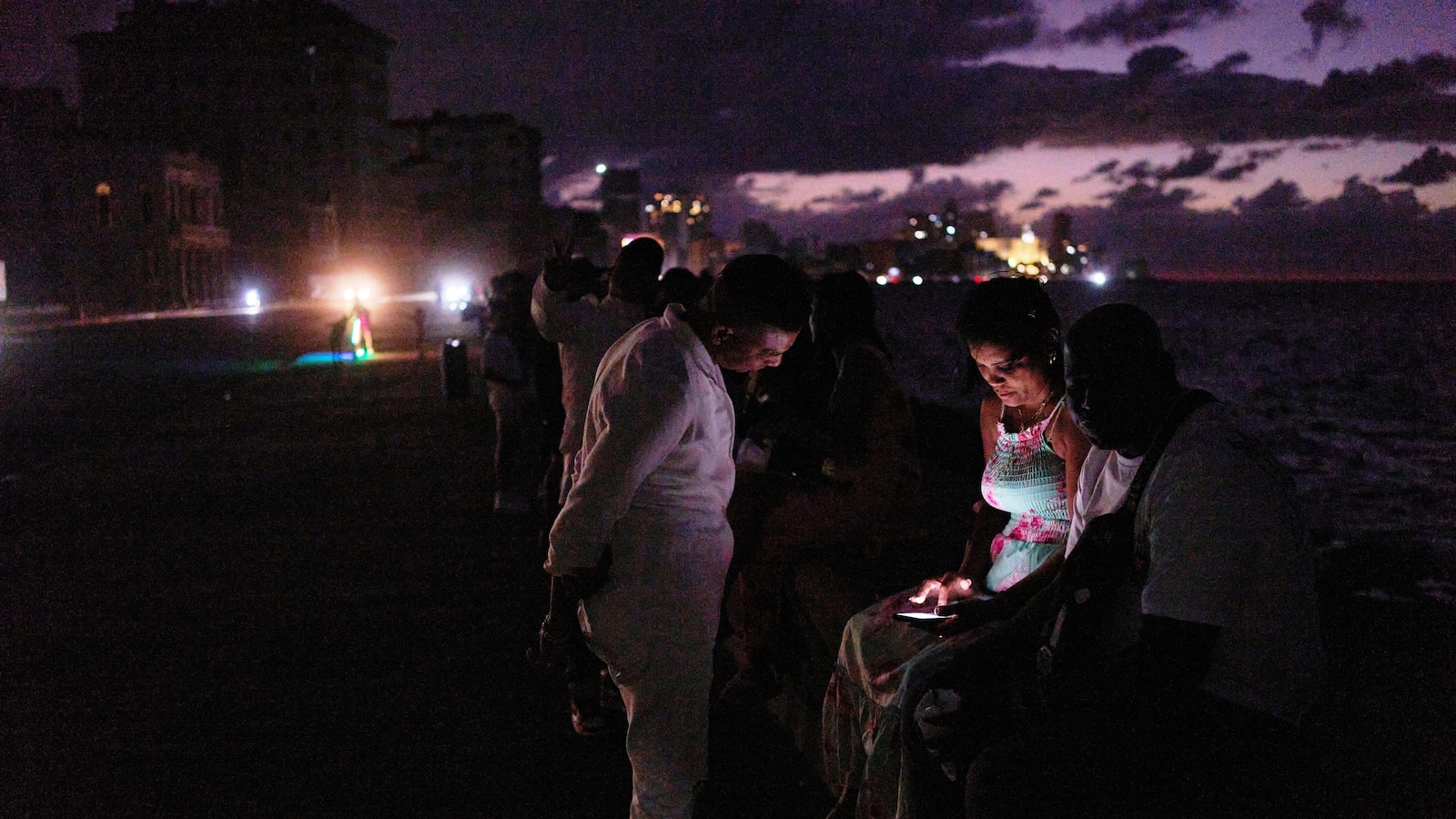
Island-wide blackouts have roiled Cubans already grappling with years of crisis, and lack of gasoline and basic resources has crippled hospital and slashed public transport.
Experts say the anticipated shipment could produce about 180,000 barrels of diesel — enough to feed Cuba’s daily demand for nine or 10 days.
Island-wide blackouts have roiled Cubans already grappling with years of crisis, and lack of gasoline and basic resources has crippled hospital and slashed public transport.
Cuba has long been at the heart of geopolitical tug-of-war between the U.S. and Russia, dating back decades. Trump on Sunday dismissed the idea that allowing the boat to reach Cuba would help Russian President Vladimir Putin.
“It doesn’t help him. He loses one boatload of oil, that’s all it is. If he wants to do that, and if other countries want to do it, it doesn’t bother me much,” Trump said. “It’s not going to have an impact. Cuba’s finished. They have a bad regime. They have very bad and corrupt leadership and whether or not they get a boat of oil, it’s not going to matter.”
He added: “I’d prefer letting it in, whether it’s Russia or anybody else because the people need heat and cooling and all of the other things.”
——
Associated Press reporters Megan Janetsky contributed to this report from Mexico City and Andrea Rodríguez contributed from Havana.
Humans are returning to the Moon – hear all about it on the BBC’s space podcast. 13 Minutes Presents: Artemis II is following Nasa’s mission to loop around the Moon, with a new episode every day. Starts on Monday 30 March 2026. Search for 13 Minutes Presents: Artemis II wherever you get your BBC podcasts. Follow or subscribe now so you don’t miss an episode.
Nasa plans to return to the Moon for the first time in more than half a century. Its Artemis II mission aims to send four astronauts to loop around the Moon. They are planning to go further from Earth than any human in history.
The story of Artemis II will be told by space scientist, Maggie Aderin and British astronaut, Tim Peake, with regular guest, US space journalist Kristin Fisher.
13 Minutes is the BBC’s space podcast, telling epic space stories, including the first Moon landing, Apollo 13 and the space shuttle. Theme music by Hans Zimmer and Christian Lundberg and produced by Russell Emanuel, for Bleeding Fingers Music.
With dishes like chocolate hummus and sweet potato falafel sweeping social media, chef Jad Youssef says he’s concerned that “Lebanesefood is losing its identity”.
Lebanon-born Youssef moved from his home country in 1999 and has lived and worked all over the world – including Oslo, Hong Kong and now Surrey, where he runs his restaurant Lebnani.
Before establishing Lebnani, he says: “I started to feel like Lebanese food was losing its identity – not only in the UK, but in Europe and even in Lebanon.
“Sometimes I watch influencers – not chefs or authors of cookbooks, but influencers – trying to make meat shawarma with halloumi.”
Youssef accompanies this statement with a half-joking eye roll, continuing: “When you say shawarma or donor, it’s meat. Or when you say falafel – we know what falafel is, it’s fried, so it’s crispy on the outside, nice and fluffy on the inside, with a nice whipped tahini cream. But now you see baked falafel, or falafel with sweet potato, or falafel with beetroot.”
These “twists” on classic recipes are to “fit the Western palate”, Youssef suggests, adding: “It doesn’t make me angry, but makes me sad.”
That’s why Youssef set up his own restaurant, and is now releasing his debut cookbook, also called Lebnani – which means to be Lebanese.
“I want to focus on the classics and tradition, and make them the right way – how we do it back home, how my mum used to do it, and my aunties, and now my sisters,” he explains.
A cookbook rooted in memory, not trends, and unapologetic about doing things properly (Meze)
In the cookbook, there are traditional recipes for everything from hummus and kafta (meat skewers) to falafel and tabbouleh – and you can be sure his recipe for knefe, a sweet dish made with warm cheese, pastry and orange blossom, absolutely does not contain corn flakes (yes, that is something he’s seen an influencer do online).
“It’s [enough] to drive you mad, what these people are doing,” he says. “OK, it’s good to be creative – but don’t ruin the tradition and the beauty of these nice dishes. We were all born with it and live with it. Each time I go back home, I only ask for those classic dishes to eat – that’s what I want, because I miss them.”
Lebanese food has gone global, but what do people tend to get wrong about it?
“I think when you say Lebanese, [people] straight away get an image that it’s mezze and grill only, but there’s a lot behind it,” Youssef says.
“It’s not only hummus or a tabbouleh salad, or falafel or kafta. We have over 200 dishes of mezze between vegan, vegetarian and meat, and they’re quite seasonal as well.”
That’s why the book also contains some lesser-known dishes that are staples in any Lebanese home, like fraké nayyé – a southern-style spiced lamb tartare, usually eaten in springtime with fresh warm bread and a glass of arak.
There’s also hindbeh b’zeit – a dish of sautéed wild dandelion greens with caramelised onions – and baba ghanouj, but not as people might know it. When you order baba ghanouj at a restaurant, more often than not you’ll get a smoked aubergine dip with tahini – but that, according to Youssef, is not actually baba ghanouj, but something called mtabbal.
“Baba ghanouj, it’s charred aubergine with vegetables inside it – so it has garlic, chopped parsley, spring onion, fresh mint, lemon juice and olive oil – no tahini.”
Years in the kitchen, but it’s his mother’s cooking that still sets the standard
Born in 1977, two years after the Lebanese Civil War started, Youssef admits that war shaped his family’s approach to food. He suggests food was a uniting force amongst turmoil, saying: “Whatever happens, we still sit around the table and we’re going to eat.”
As the youngest of six siblings, Youssef says his older brothers and sisters were all encouraged by their parents to leave the country to “go somewhere safe”.
With the majority of his siblings studying or working out of Lebanon, it was down to Youssef to help his parents. He helped his mother with all the cooking at home, while also lending a hand at his father’s pastry shop in Beirut.
Youssef, who says he was part of “the war generation”, remembers months at a time when school would be cancelled, meaning he would accompany his mother to the market every day to help pick out ingredients for meals. This “opened my eyes” to food, he says, learning from his mum how to pick the best tomatoes, or what to look for at the butchers.
“This is where I learned about how to choose,” he says. “To work with good ingredients, good spices, good olive oil… I was born surrounded by food.”
Youssef says it was inevitable he would become a chef: “I had no chance,” he laughs. “Lebanese people, they love food, they have a passion for food.
“I go home, and in the morning, I wake up, I take a coffee, and my mum asks me, ‘So, what do you want to have for breakfast?’ Then breakfast finishes, and [my mother and my sister] are talking about what they’re going to cook for lunch. After lunch – [then what’s] for dinner…
“It’s absolutely constant.”
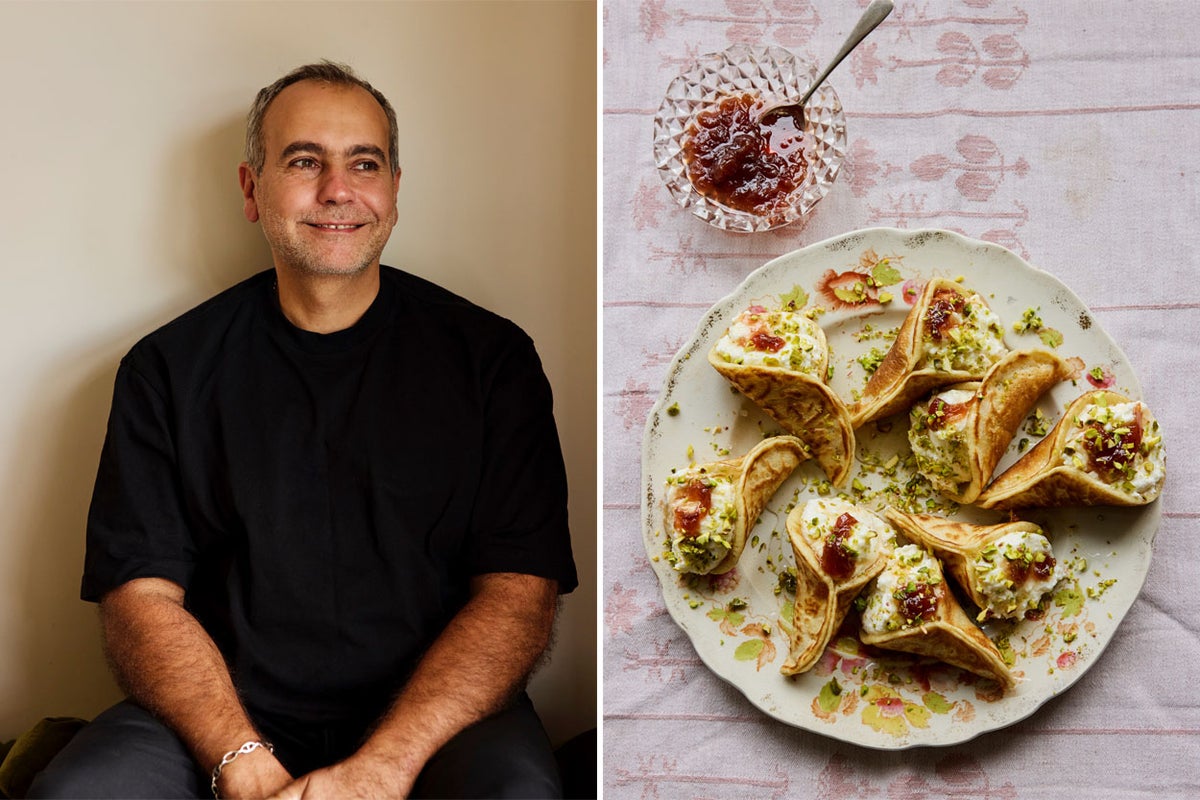
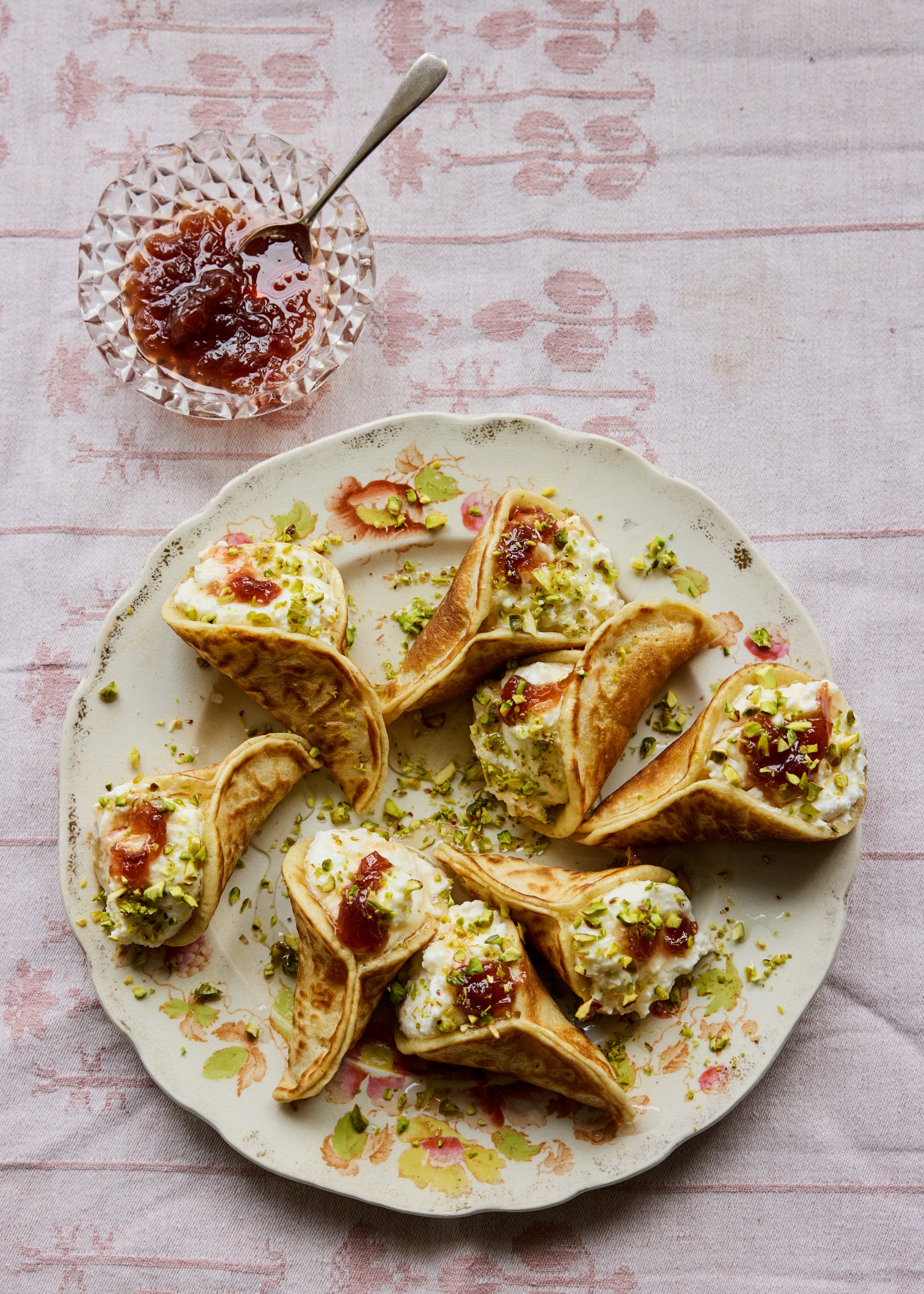
Stuffed Lebanese pancakes with fresh clotted cream and orange blossom syrup
No shortcuts, no swaps, just the kind of dish that tastes like it should (Matt Lincoln)
“Atayef were always a treat we looked forward to – especially around Ramadan or on Sunday afternoons when visitors dropped by unannounced,” says Youssef.
“The smell of the hot saj (pan) as the batter bubbles and sets, the sight of the ashta filling being spooned in generously, the syrup dripping slowly over the soft folds – it’s simple, sweet Lebanese hospitality in a bite.
“We couldn’t resist pinching some from the tray before they made it to the guests. My mother always knew, but she let us get away with it.”
Serves: 6-8 (makes about 18-20)
Ingredients:
For the syrup:
200g caster sugar
120ml water
1 tbsp lemon juice
1 tbsp rose water
1 tbsp orange blossom water
For the ashta:
1.2L whole milk
4 tbsp white vinegar or lemon juice
1½ tbsp cornflour
1 tbsp caster sugar
1 tbsp rose water
2 tbsp orange blossom water
200g ricotta cheese (optional but recommended)
For the atayef:
300g plain flour
1 tsp dried instant yeast
1 tsp caster sugar
1 tsp bicarbonate of soda
Pinch of fine sea salt
100ml whole milk
350-400ml lukewarm water
For the garnish:
80g finely chopped pistachios
1 tbsp rose petal jam
Method:
1. To prepare the syrup: Combine the sugar and water in a small saucepan. Bring to a boil, then add the lemon juice. Lower the heat and simmer for eight to 10 minutes until slightly thickened. Add the rose and orange blossom waters, stir, and then remove from the heat. Cool to room temperature.
2. To prepare the ashta: In a saucepan, bring one litre of the milk to a simmer. Add the vinegar or lemon juice and stir gently until the milk curdles and separates. Strain and discard the whey, keeping the curds. In a clean saucepan, mix the remaining 200 millilitres of milk with the cornflour and sugar. Stir over medium heat until it thickens to a soft custard. Add the rose and orange blossom waters. Now mix the custard with the curds and ricotta (if using). Let the ashta cool completely and chill for at least an hour.
3. To prepare the atayef: In a large bowl, whisk together the flour, yeast, sugar, bicarbonate of soda, and salt. Slowly whisk in the milk and water, adjusting the quantity to get a smooth, pourable batter. Cover and leave to rest for 30-45 minutes until slightly bubbly.
4. Heat a non-stick pan over medium heat. Stir the batter gently and pour or ladle small rounds (about eight centimetres diameter) into the dry pan. Cook on one side without flipping them – bubbles will appear on top, and the surface will set. Set aside on a clean towel and keep covered so they don’t dry out.
5. Place about a spoonful of ashta in the centre of each pancake. Fold them into half-moons and pinch one edge firmly to seal, leaving the other edge open so the cream peeks out.
6. Arrange the atayef on a platter, drizzle with the syrup and sprinkle with crushed pistachios and rose petal jam. Serve immediately or chill lightly before serving.
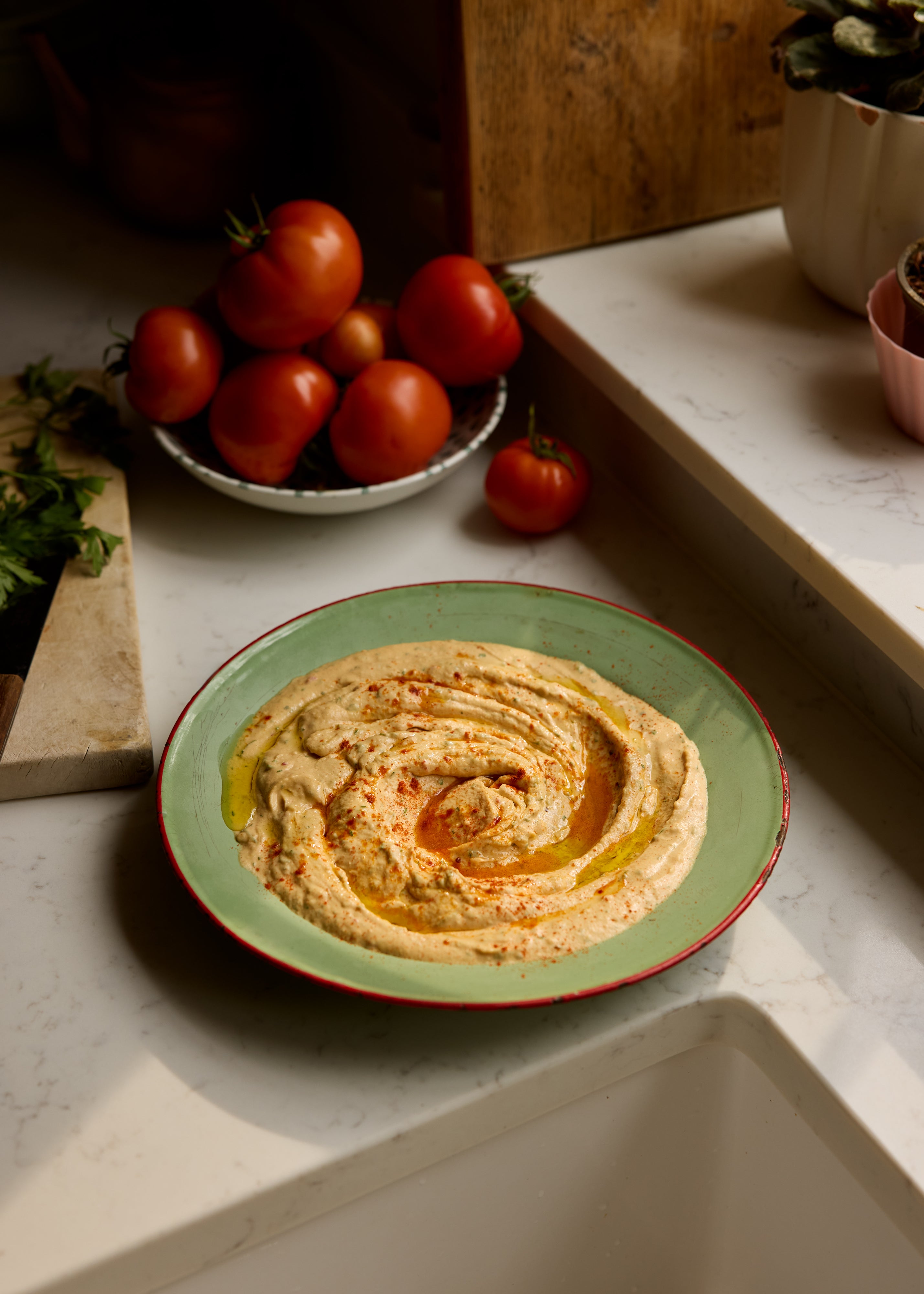
Hummus Beiruti
Proof that simple ingredients, done well, rarely need reinventing (Matt Lincoln)
“In Beirut, every café and home has its own version of hummus, but hummus Beiruti always stands out,” says Youssef.
“It’s the cheekier cousin of the classic. I remember wandering through Basta and Zarif in Beirut as a teen, hungry after school, drawn into corners of smoky cafés by the smell of lemony hummus mixed with sizzling garlic.
“This version is my own spin – garlic confit for sweetness, charred chilli for a gentle fire. The texture? Always smooth. The taste? Bright, deep, and distinctly Beiruti.”
Serves: 4-5
Ingredients:
500g creamy hummus (see below)
5-6 confit garlic cloves (see below)
1 medium red chilli
1 small handful flat-leaf parsley (about 10g), picked, washed, and finely chopped
1 tsp smoked paprika
½ tsp Aleppo chilli flakes, or to taste
Fine sea salt, to taste
1 tbsp lemon juice (optional, to balance)
Extra virgin olive oil, to loosen if needed
For the garlic confit:
5-6 garlic cloves, peeled
100ml olive oil
For the hummus:
250g dried chickpeas
1 tsp bicarbonate of soda (for soaking and boiling)
1½ tsp fine sea salt, or to taste
2 small garlic cloves
2-4 small ice cubes (or use ice-cold water)
200ml tahini
60ml fresh lemon juice (about 4 tbsp – always fresh!)
2-4 tbsp chickpea cooking liquid
Extra virgin olive oil, for serving
Paprika, cumin, parsley, or whole chickpeas to garnish (optional)
Method:
1. For the hummus: Start by rinsing the dried chickpeas under cold water. Soak overnight (no tinned chickpeas!) in a large bowl with plenty of water and half the bicarbonate of soda – this softens the skins.
2. The next day, drain and rinse the soaked chickpeas. Place them in a large pot, cover with fresh water (about 10 centimetres above the chickpeas), and add the remaining bicarbonate of soda. Bring to a boil, skimming off any foam that rises. Simmer gently for one to one-and-a-half hours, until the chickpeas are extremely soft – you should be able to mash one effortlessly between two fingers. Skim off any foam or skins floating on top during cooking.
3. Before draining, reserve 220–240 millilitres of the cooking liquid (this is your secret weapon for extra flavour and creaminess). Drain the rest and set the chickpeas aside. While still warm, rub the chickpeas gently between your hands or in a bowl of cold water to remove some of the skins – this step is optional but creates that ultra-smooth finish. Set aside a small handful of whole chickpeas if you’d like to use them for garnish later.
4. Add the cooled chickpeas, salt, garlic cloves, and two ice cubes to a food processor. Blend into a fine paste for two to three minutes. Open the lid and scrape around the sides, then add the tahini and lemon juice and blend again for two to three minutes.
5. Now, slowly drizzle in two to four tablespoons of the reserved chickpea cooking liquid with the processor running, followed by one or two of the remaining ice cubes (or an equivalent amount of ice-cold water). Blend until the hummus becomes silky, fluffy, and pale in colour.
6. The cold shock from the ice helps emulsify the tahini. Taste and adjust the seasoning. You’re looking for balance – not too lemony, not too garlicky, with a mellow, nutty base from the tahini. Chill for 30 minutes before serving if possible – this helps the flavours settle.
7. Spoon the hummus into a shallow bowl or plate, swirl the surface with the back of a spoon, and drizzle generously with extra virgin olive oil. Garnish with a few whole chickpeas, a sprinkle of paprika or cumin, and maybe a touch of fresh parsley.
8. For the hummus Beiruti: First, make the garlic confit. Place all the peeled garlic cloves in a small saucepan and cover with the olive oil. Simmer gently on the lowest heat for about 25–30 minutes, or until the garlic is soft and lightly golden. Let it cool in the oil. Mash three to four cloves for this recipe and store the rest in a clean jar, covered with the oil, in the fridge for up to one week.
9. Next, char the red chilli directly over a gas flame or under a hot grill, turning until blackened all over. Place in a bowl and cover with a plate or foil for five minutes to help loosen the skin. Peel off the charred skin, remove the seeds, and finely chop half the chilli for this recipe. Keep the other half aside to add extra heat if you like.
10. In a bowl, fold the mashed garlic confit, charred chilli, chopped parsley, smoked paprika, and Aleppo chilli flakes into the creamy hummus base. Season with salt, and lemon juice if needed. Add a little olive oil to loosen the texture if it feels too thick.
11. Spoon the hummus into a serving dish, make a small swirl with the back of a spoon, then garnish with a drizzle of olive oil, a sprinkle of chopped parsley, and a touch more chilli or paprika. Serve with warm khobez and let everyone dive in.
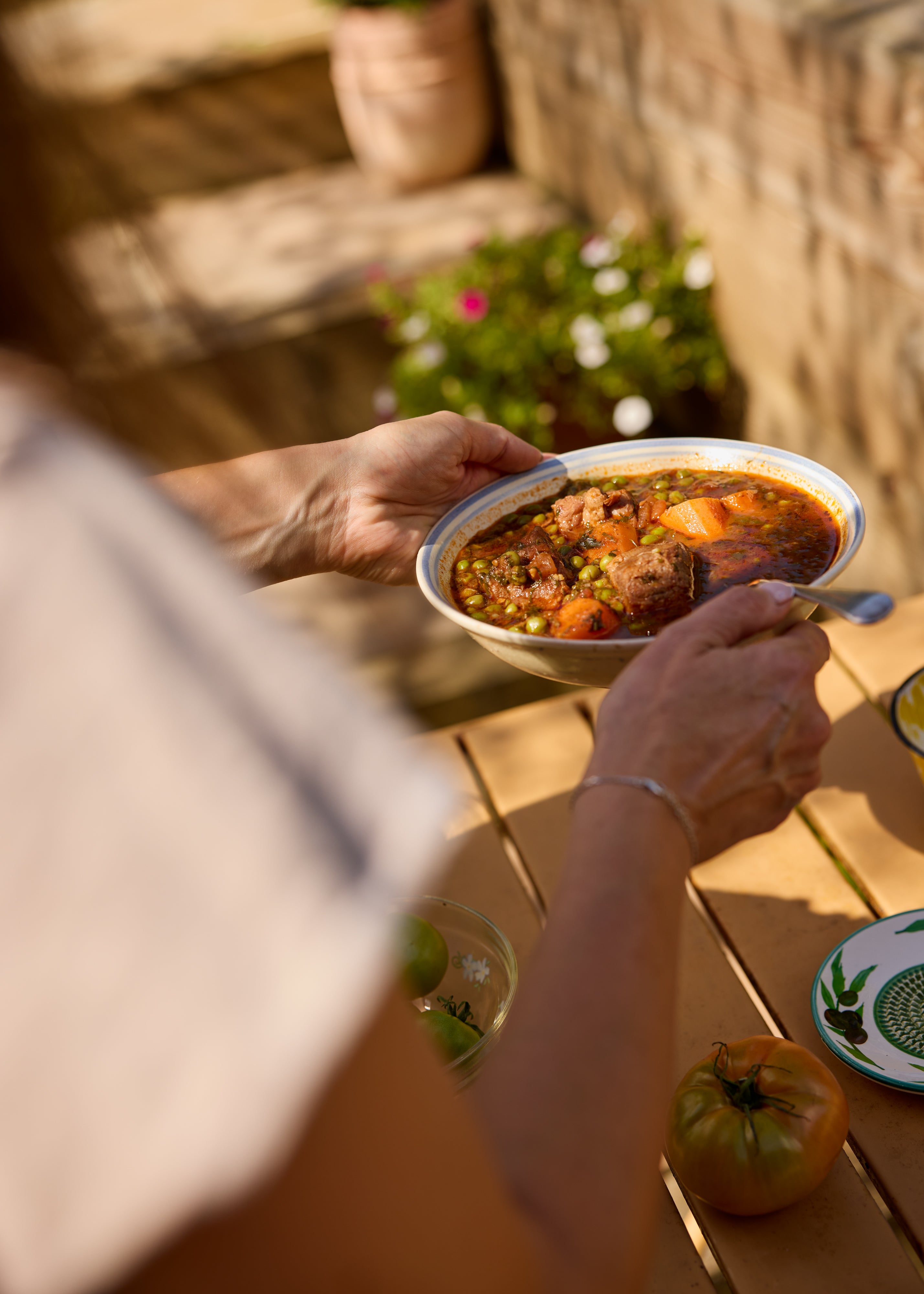
Bazella b’lahmé
The sort of recipe that makes you wonder why anyone tried to improve it (Matt Lincoln)
“Bazella b’lahmé is one of the most loved and familiar tabkha across all of Lebanon,” says Youssef.
“It is a true family dish, often the first stew children learn to eat. In the South, in Beirut, in the mountains, every home makes its own version, but the essentials remain the same: tender lamb or beef, a rich tomato broth, sweet peas, and soft carrots.
“Some families like a lighter broth, others a thicker one to spoon over rice. In our house, my mother always added plenty of coriander which gave the dish a bright, unmistakable flavour.
“In season, she used fresh peas from the market but for everyday cooking, good-quality frozen peas make it an easy and delicious dish all-year round.”
Serves: 4-5
Ingredients:
60-80ml olive oil
600g lamb shoulder or beef shin, cut into large cubes
1 medium brown onion (about 200g), finely chopped
8 garlic cloves, finely grated
3 tbsp tomato paste
5 large ripe tomatoes (about 750g), peeled and finely chopped or grated
1 large bunch fresh coriander, washed and finely chopped
1 tbsp fine sea salt, or to taste
½ tsp freshly ground black pepper
1 tbsp Baharat (Lebanese 7 spices)
1.5-2L water
4 large carrots (about 300g), peeled and diced or sliced into thin rounds
600g frozen peas (or 800g shelled fresh peas when in season)
Method:
1. Heat the olive oil in a large pot over medium heat. Add the lamb or beef and brown well on all sides. Add the finely chopped onion and sauté until soft and golden, then add the garlic and sauté gently for a minute until fragrant.
2. Add the tomato paste and stir well for two minutes, coating the meat and onions. Now add the fresh tomatoes. Cook gently for about five to seven minutes, until the tomatoes have softened and the sauce begins to come together.
3. Add the chopped coriander directly into the pot. Stir to combine it with the tomato mixture and cook gently for a minute or two, allowing the coriander to release its aroma into the sauce.
4. Add the salt, black pepper, and Baharat, then pour in the water. Stir and bring to a gentle boil, skimming off any foam if needed.
5. Lower the heat and simmer gently, covered, for about one-and-a-half to two hours, stirring occasionally. The meat should be tender and the broth rich and well-flavoured.
6. Add the diced carrots to the pot and simmer for about 15 minutes. Then add the peas and simmer for a further 15-20 minutes, until both the carrots and peas are tender and have absorbed the flavour of the sauce.
7. Taste and adjust the seasoning as needed. The sauce should be balanced, rich with tomato and coriander, and just loose enough to coat the rice beautifully. Serve hot alongside Lebanese rice, warm khobez, radishes, pickles, and lemon wedges.
The skies over Western Australia took on a deep red and orange hue ahead of a tropical cyclone as powerful winds whipped up iron-rich dust, blanketing some areas in a crimson haze.
The skies over Western Australia took on a deep red and orange hue ahead of a tropical cyclone as powerful winds whipped up iron-rich dust, blanketing some areas in a crimson haze.
Lionel Richie knows the fame game can be a challenge, and issued a warning to rising celebrities after Chappell Roan faced backlash following a negative fan encounter.
During a sit-down with his son-in-law, Joel Madden, the Good Charlotte frontman admitted he hadn’t once heard his father-in-law complain about fans approaching him in public.
“I was invisible once,” Richie explained, before acknowledging that he has a difficult time ignoring fans. “They want to say something to you. And you can see it on their face. They want to say something. And for me to ignore them, would be the worst.”
Lionel Richie warned celebrities about valuing fan support.(C Brandon/Redferns/Getty images)
He added, “Sometimes you meet the person you idolize the most, and you’re sorry you met them.
The “All Night Long” singer said, “I made a promise to myself – I’m never going to be that. Never.”
Richie noted that star status isn’t for everyone.
“The thing that happens a lot of times is, I tell people when they get into the business, there’s one thing you didn’t calculate,” he said. “I hope you like people.
“Because if you don’t like people, here’s how it’s going to sound. You spend the first half of your career going, ‘Look at me, look at me, look at me, look at me, look at me.’ And then you finally get famous. ‘Don’t look at me. Don’t look at me. Don’t look at me.’”
He added, “The universe gave you what you asked for. Now what is it about people that you don’t like, or you want to be famous and rich without the people? It doesn’t work like that. You have to be able to engage.”
While in town last week to perform at Lollapalooza Brazil, the “Pink Pony Club” singer allegedly directed security to scold his daughter after she spotted Chappell having breakfast at the hotel in São Paulo, according to professional soccer star Jorginho Frello.
Chappell, 28, addressed the incident on Instagram stories and later denied the fan encounter after the “very upsetting” situation caught the eye of Rio de Janeiro Mayor Eduardo Cavaliere.
In a statement shared on X, Cavaliere said that Chappell was no longer welcome to perform in his city.
“I mean that as long as I’m in charge of our city — this young lady @ChappellRoan will never perform at Todo Mundo No Rio,” he wrote in a statement translated from Portuguese. I doubt that Shakira would do that! By the way, @FrelloJorginho, your little one is already the guest of honor from the organization in May!”
The “Good Luck, Babe!” singer jumped on social media Sunday morning to explain her “half of the story” while lying in bed.
“I didn’t even see. I didn’t even see a woman and a child. No one came up to me. No one bothered me,” the musician confided in her followers while lying in bed. “I was just sitting at breakfast in my hotel, I think these people were staying at the hotel as well.”
“I did not ask the security guard to go up and talk to this mother and child. They did not come up to me. They weren’t doing anything.”
Chappell Roan was banned from performing in Rio after a negative fan encounter went viral online.(Dimitrios Kambouris)
She added, “I do not hate people who are fans of my music. I do not hate children. Like, that is crazy.”
“I am sorry to the mother and child that someone was assuming something, that you would do something and that if you felt uncomfortable, that makes me really sad. You did not deserve that.”
Jorginho, a midfielder for Campeonato Brasileiro Série A club Flamengo, wrote on Instagram stories that his family went through a “very upsetting situation” involving Chappell prior to her Lollapalooza Brazil set.
He claimed online that his 11-year-old daughter was reprimanded by Chappell’s security for looking at the singer.
“The worst part is she didn’t even approach her,” he wrote. “She simply walked past the singer’s table, looked to confirm it was her, smiled, and went back to sit with her mum. She didn’t say anything, didn’t ask for anything.”
Chappell Roan denied her involvement in a fan encounter.(Valerie Macon / AFP via Getty Images)
Jorghino wrote that after his daughter walked by, “A large security guard came over to their table while they were still having breakfast and began speaking in an extremely aggressive manner to both my wife and my daughter, saying that she shouldn’t allow my daughter to ‘disrespect’ or ‘harass’ other people.”
He added, “It’s sad to see this kind of treatment coming from those who should understand the importance of fans. At the end of the day, they are the ones who build all of this. I sincerely hope this serves as a moment of reflection. No one should have to go through this, especially not a child.”
Tracy Wright is an entertainment reporter for Fox News Digital. Send story tips to [email protected].