
Home Blog Page 889

Sanders, Ocasio-Cortez push bill to impose AI data center moratorium

0
Sanders, Ocasio-Cortez push bill to impose AI data center moratorium


WASHINGTON — Two high-profile progressive lawmakers introduced a bill Wednesday that would pause new data centers in the United States until national safeguards are in place to protect workers and consumers and ensure the technologies don’t harm the environment.

The legislation by Democratic Rep. Alexandria Ocasio-Cortez of New York and independent Sen. Bernie Sanders of Vermont is unlikely to advance in either the House or Senate, but it shows the deep concerns many progressives share about the growing impact of data centers and artificial intelligence.

Communities across the country have seen a backlash against data centers over fears about rising electricity prices and concerns about pollution and water consumption. Opposition to rising power prices was also a key factor in Democratic wins last year in elections in states including Georgia, Virginia and New Jersey.

Although advances in artificial intelligence are seen by President Donald Trump and other leaders as critical to the nation’s economic and national security, their growing energy needs are threatening to overwhelm the power grid. Trump has sought to deflect public concerns about AI, inviting major technology companies to the White House earlier this month to commit to developing their own power generation.

“They need some PR help because people think that if a data center goes in there, electricity prices are going to go up,” Trump said.

Voters need far more than voluntary assurances from “Big Tech oligarchs” as they confront “the most profound technological revolution in world history,” Sanders said Wednesday.

Changes from AI and robotics will impact the U.S. economy and American democracy as well as “our privacy rights, our emotional well-being, our environment and even our very survival as human beings on this planet,” he said at a news conference at the Capitol, adding, “Congress is way behind where it should be in understanding the nature of this revolution and its impacts.”

A moratorium will give lawmakers, business leaders and others time to understand the risks of AI and data centers, protect working families and democracy and ensure the technology works for all Americans, Sanders and Ocasio-Cortez said.

U.S. electricity consumption hit a record high in 2024 and is expected to keep rising as data centers continue to expand at a rapid pace. A typical AI-focused data center consumes as much electricity as 100,000 households.

Ocasio-Cortez said big tech companies are seeking “endless energy” and “are now so desperate to profit off the AI boom that they are racing to construct thousands of giant AI data centers and jacking up the utility costs of everyday Americans to pay for it.”

“Congress has a moral obligation to stand with the American people and stop Big Tech from ruining their communities,” she said.

Most lawmakers of both parties have rejected the idea of a moratorium.

Democratic Sen. John Fetterman of Pennsylvania said he agreed with Interior Secretary Doug Burgum’s warning that a moratorium on data centers amounts to waving a “surrender flag” to China. “I refuse to help hand the lead in AI to China,” Fetterman wrote on X.

The Data Center Coalition, an industry group, said data centers “power modern life — from telehealth and digital classrooms to banking, air travel, financial transactions and online shopping.”

A moratorium “would limit internet capacity, slow critical services, eliminate hundreds of thousands of high-wage jobs, drain billions in local tax revenue and raise costs for American families and small businesses,” said Cy McNeill, the coalition’s senior director of federal affairs.

The White House said last week that Congress should “preempt state AI laws” that it views as too burdensome, laying out a broad framework for how it wants Congress to address concerns about AI without curbing growth or innovation in the sector.

The legislative blueprint outlines a half-dozen guiding principles for lawmakers, focusing on protecting children, preventing electricity costs from surging, respecting intellectual property rights, preventing censorship and educating Americans on using the technology.

Companies that committed to Trump’s pledge to protect ratepayers include Google, Microsoft, Meta, Oracle, xAI, OpenAI and Amazon. The companies agreed to build or buy new sources of power generation for their data centers and cover the expense of infrastructure upgrades.



Source link

Parents see hope in back-to-back rulings that social media providers failed to protect young users

0
Parents see hope in back-to-back rulings that social media providers failed to protect young users


Walker Montgomery was just 16 when someone pretending to be a teenage girl messaged him through Instagram and seduced him into cybersex.

Within hours he was dead. Caught up in a sextortion scheme, the Mississippi teen killed himself.

—-

EDITOR’S NOTE — This story includes discussion of suicide. If you or someone you know needs help, the national suicide and crisis lifeline in the U.S. is available by calling or texting 988.

—-

His father, Brian Montgomery, will never get over losing his son but he was among many parents celebrating this week as social media giant Meta lost two court cases where juries in different states ruled the platforms hook young users without concern for their well being.

Montgomery sees it as a reckoning.

“We’re talking about the most financially sound business that the planet has ever known. This will set an expectation,” said Montgomery on Wednesday after juries in New Mexico and Los Angeles found social media providers failed to protect young users.

And he isn’t alone.

Other parents agree: There have been too few safeguards, and kids are suffering.

The first blow came Tuesday when jurors in New Mexico sided with state prosecutors who argued that Meta — which owns Instagram, Facebook and WhatsApp — prioritized profits over safety and imposed a $375 million penalty.

Then on Wednesday, jurors in a separate case in Los Angeles found that Meta and Google-owned YouTube designed their platforms to hook young users without concern for their well being. The companies issued statements vowing to explore their legal options, which includes appeals.

The verdicts illustrate a growing shift in the public’s perception of social media companies and their responsibilities in keeping young people safe on their platforms.

For years, social media companies have disputed allegations that they harm children’s mental health through deliberate design choices that addict kids to their platforms and fail to protect them from sexual predators and dangerous content. This year, several state and federal court cases are heading to trial, and while the details may vary, they all seek to hold companies responsible for what happens on their platforms.

Montgomery, not a plaintiff in either case, said the next step is legislation. “They’ve proven,” he said of the social media industry,” that they can’t regulate themselves.”

He said his son — an athlete who loved the outdoors — went to bed happy before encountering a scammer from Nigeria.

“We didn’t get to see him the next morning,” the farmer and crop insurance salesman said, a picture of his son, taken during a duck hunting trip just months before his Dec. 1, 2022, death, displayed on his desk.

He is struck now by a mix of joy and sadness, knowing the change he sees coming is too late for his family. “Walker’s not coming back,” he said.

In Dedham, Massachusetts, on the outskirts of Boston, Deb Schmill, understands all too well the messy mix of emotions the rulings bring. Her daughter, Becca Schmill, was 18 in September 2020 when she died of fentanyl poisoning from drugs she purchased through a social media platform.

“That’s the painful part of all of this,” said Schmill, also not a plaintiff in the lawsuits. “If this could have been done five years ago, 10 years ago. Things would be so different.”

Her daughter’s overdose happened after the teen was sexually assaulted by someone she met online and then became a victim of revenge porn.

“She was a wonderful child, but she was just tortured,” said her mother.

Like Montgomery, she has advocated for a bill aimed at protecting kids from the harms of social media, gaming sites and other online platforms. Called the Kids Online Safety Act, it has passed the U.S. Senate two years ago, but not the House.

With appeals and any settlement discussions, the cases against social media companies could take years to resolve. And unlike in Europe and Australia, tech regulation in the United States is moving at a glacial pace.

“We know, the parents know better than anyone that when we are unable to hold the social media companies accountable, children die,” she said. “And it’s just absurd that this is happening in our country.”

Parents less hard-hit by tragedy are also growing wary. As Charles Halley dropped his son off at an Alameda, California, school, he explained that the fifth-grader doesn’t have a phone because of concerns that social media is harmful for kids.

“The divisiveness, the beauty standard, consumerism, just everything that’s wrong with society kind of packaged up and marketed to kids,” he said.

He said parents are fed up and organizing in an effort to curtail the harms, although he isn’t certain they can be stopped altogether.

“People my age, younger, older, have seen what social media has done to our behavior, the way we deal with each other,” he said, describing crashes caused by people who can’t stay off their phones. “And I would just assume that the effect is magnified for kids whose brains are still developing, and it’s just a shame to see them exposed that way.

“That’s why I’m keeping my kid off social media.”

——

Terry Chea contributed from Alameda, California.


Source link

EU targets Snapchat over child safety and accuses porn sites of failing to block minors

0
EU targets Snapchat over child safety and accuses porn sites of failing to block minors


LONDON — European Union regulators are investigating Snapchat over concerns the platform isn’t doing enough to protect kids and exposing them to risks such as increased vulnerability to child predators or recruitment by criminals.

The 27-nation EU’s executive Commission said Thursday it was opening a formal investigation into Snapchat under the bloc’s sweeping rule book known as the Digital Services Act that’s designed to protect internet users.

The European Commission said that Snapchat requires users to be at least 13 to use the platform but it suspected that the company’s “age assurance” system is “insufficient” at keeping them off.

Regulators said the system is also not properly checking whether a user is under 17, which it needs to do in order to give them an “age appropriate” experience. They also worried that age checking systems aren’t preventing adults from posing as minors.

The commission suspects Snapchat isn’t doing enough to protect minors from being contacted by “users with harmful intent, such as sexual exploitation or recruitment for criminal activities.”

Snapchat’s systems also aren’t good enough at preventing underage users from seeing information about illegal or restricted products like drugs, vapes or alcohol.

Snapchat “appears to have overlooked” the DSA’s “high safety standards for all users,” said Henna Virkkunen, the commission’s executive vice president for tech sovereignty, security and democracy.

The investigation will scrutinize Snapchat’s compliance with EU legislation, she said.

Snapchat has “fully cooperated” with the Commission by “engaging proactively, transparently and working in good faith to meet the DSA’s high safety standards – and we will continue to do so throughout this investigation,” the company said in a statement.

User safety and well-being is a “top priority” and the platform is designed with “privacy and safety built in from the start, including additional protection for teens,” it said.

The probe adds to pressure that social media companies are facing on both sides of the Atlantic over the welfare of young people. On Wednesday, a California jury awarded millions of dollars in damages to a 20-year-old woman after deciding that Meta and YouTube designed their platforms to hook young users without concern for their well being.

A day earlier, a New Mexico jury handed a $375 million penalty to Meta after determining the company knowingly harmed children’s mental health and concealed what it knew about child sexual exploitation on its platforms.

Meanwhile, the EU accused TikTok earlier this year of breaching the DSA with “addictive design” features that lead to compulsive use by children, and has been investigating Facebook and Instagram since 2024 over child protection shortcomings.

Also Thursday, Brussels accused four of the world’s biggest pornographic websites, Pornhub, Stripchat, XNXX and XVideos, of failing to protect children from adult content on their websites, following an investigation opened last year.

The Digital Services Act requires internet companies and online platforms to do more to protect European users from things like harmful content and suspect merchandise, or risk hefty fines worth up to 6% of annual revenue.

Pornhub, Stripchat, XNXX and XVideos did not respond immediately to requests for comment.

In preliminary findings, regulators said the site operators failed to “diligently identify and assess” risks to children and didn’t use effective measures to stop them from accessing their services.

“Children are accessing adult content at increasingly younger ages and these platforms must put in place robust, privacy-preserving and effective measures to keep minors off their services,” Virkkunen said.

The porn sites now have chance to respond to the accusations before the commission issues a final decision.


Source link

URC: Forget URC – Scarlets face a Test match in Dublin

0
URC: Forget URC – Scarlets face a Test match in Dublin


Leinster: Jimmy O’Brien; Tommy O’Brien, Ringrose, Osborne, Kenny; Byrne, Gibson-Park; Porter, Sheehan, Furlong, Joe McCarthy, Deeny, Deegan, van der Flier, Doris (capt).

Replacements: Gus McCarthy, Cahir, Slimani, O’Tighearnaigh, Soroka, Gunne, Prendergast, Henshaw.

Scarlets: Murray; Rogers, J Roberts, Williams, Mee; Hawkins, Blacker; Mathias, Harry Thomas, Holz, Lousi, Douglas, Taylor, Davis, Anderson (capt).

Replacements: G Roberts, S O’Connor, Henry Thomas, Ball, T Davies, A Hughes, I Jones, Page.

Referee: Aimee Barrett-Theron (SARU)

Assistants: Peter Martin (Ireland), Chris Lough (IRFU)

TMO: Quinton Immelman (SARU)


Source link

From meeting on ‘Uri’ sets to secretly marrying in Himachal:’Dhurandhar’ filmmaker Aditya Dhar and actress Yami Gautam’s heartwarming love story

0
From meeting on ‘Uri’ sets to secretly marrying in Himachal:’Dhurandhar’ filmmaker Aditya Dhar and actress Yami Gautam’s heartwarming love story


When it was the time to tie the knot on June 4, 2021, they skipped the five-star hotels and international destinations. Instead, they chose:
Yami’s family home in the serene hills of Himachal Pradesh. Their wedding was completely intimate, surrounded by nature and only their closest family. And ditching big designer labels, Yami chose to wear her mother’s vintage red saree and her grandmother’s dupatta.

“We just knew we wanted to get married,” Yami later shared. No elaborate proposal, no paparazzi—just a deep-rooted love for their Hindu traditions and a desire for simplicity over glitz.


Source link

UK facing biggest hit to growth from Iran war out of G20 economies

0
UK facing biggest hit to growth from Iran war out of G20 economies


The OECD downgrades forecasts for many of the world’s biggest economies due to the US-Israel war with Iran.


Source link

Why Salah beats Ronaldo, Henry as Premier League’s greatest

0
Why Salah beats Ronaldo, Henry as Premier League’s greatest


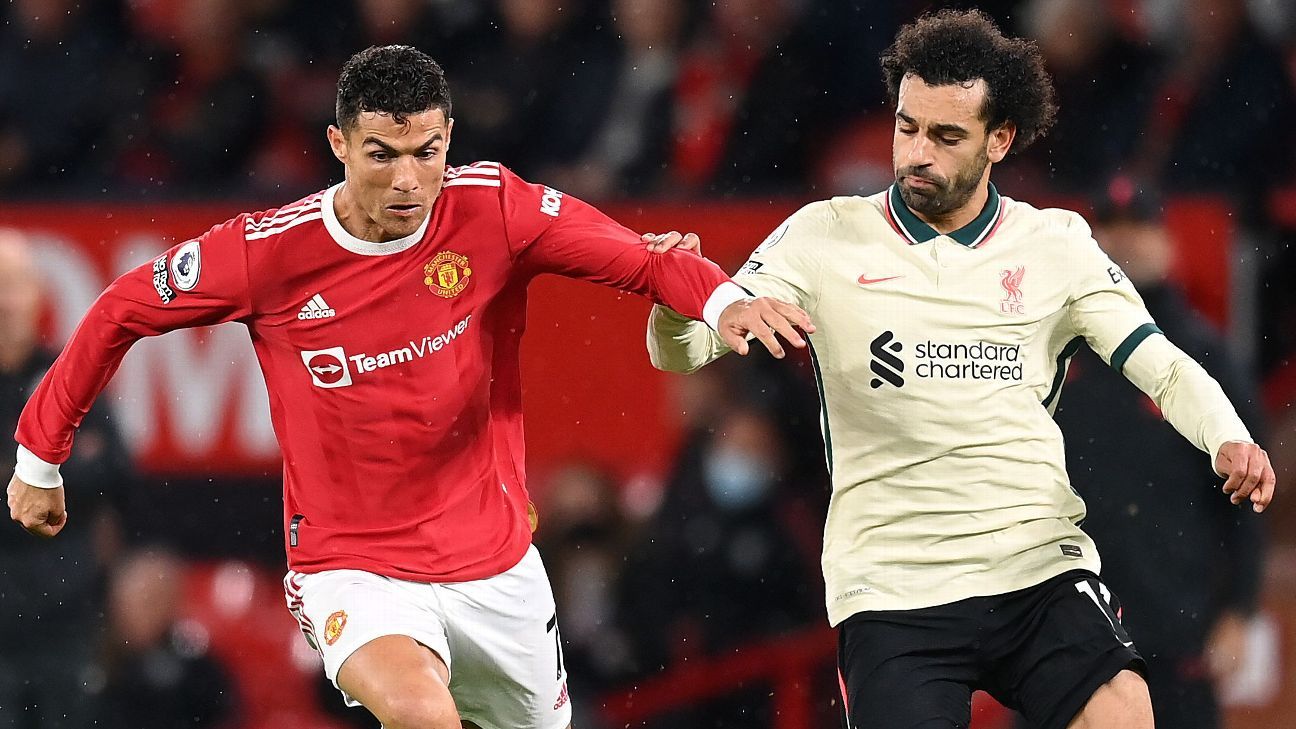
Mohamed Salah will leave Liverpool this summer as one of the greatest players to have played in the Premier League. He might even be the greatest.

Yes, Salah has earned his place at No. 1 in the Premier League’s all-time list ahead of Wayne Rooney, Kevin De Bruyne, Ryan Giggs, Cristiano Ronaldo and even Thierry Henry.

Now, these lists are always subjective, and the mere suggestion that Salah places above Henry or De Bruyne will be met with a mixture of righteous indignation and ridicule by Arsenal and Manchester City supporters respectively. Manchester United fans will also dismiss any notion that club legends Rooney, Giggs and Ronaldo could have been eclipsed any player outside of Old Trafford.

Salah’s Premier League legacy greater than Ronaldo – Carragher
Salah will get the Liverpool farewell, but he leaves a void to fill
That time Salah won Puskás Award with his ‘7th-best’ goal of the year

To be classed as the greatest, a player must have achieved incredible success — individually and with their team — and done so over a sustained period. Many players can claim to have enjoyed success and longevity, but the best of them take their game to another level by being a team’s catalyst, even providing the X factor to take their side to glory, and Salah ticks all of those boxes.

Still, so do Rooney, De Bruyne and Henry, while Giggs’ greatness was down to his ability to perform at the top level for two decades, winning multiple trophies with United and evolving from a teenage winger to a creative midfielder. So how can we separate Salah from his iconic contemporaries?

Let’s start with Rooney. The former United and England forward is often overlooked when the greatest Premier League player is debated, but he is certainly worth his place in the top bracket. He was a teenage superstar, making his debut at Everton aged just 16, before becoming the world’s most expensive teenager when he joined United aged 18 in a £27 million transfer in 2004.

Rooney had it all — pace, strength, game intelligence and the ability to score crucial and spectacular goals. He is one of only three players — alongside Alan Shearer and Harry Kane — to score more than 200 Premier League goals and he won 12 major trophies at Old Trafford, including five Premier League titles and a UEFA Champions League. But as good as Rooney was, he was a great player among other greats at United and Sir Alex Ferguson never quite relied as heavily on Rooney as Liverpool have on Salah. He was United’s most important player for perhaps two seasons following the departure of Ronaldo in 2009, but Salah has never had anything other than top billing at Anfield.

How about De Bruyne? For a decade, the Belgium midfielder dominated the Premier League with City, winning 16 major honors including six league titles and a Champions League. He was unquestionably the player that first Manuel Pellegrini, and then Pep Guardiola, really couldn’t be without.

De Bruyne’s total of 119 Premier League assists is bettered only by Giggs (162), and he shares the single-season record of 20 with Henry. He also scored an impressive 72 goals from midfield, including 15 in the 2021-22 season alone. But De Bruyne’s fitness record during his decade at City denies him top spot as the league’s best-ever. In 10 seasons, De Bruyne made 285 Premier League appearances for City, missing almost 100 games in that time — the equivalent of 2½ seasons.

To be the greatest, you have to be available, and Salah’s fitness record has been incredibly consistent since arriving at Liverpool in 2017. Liverpool have played 335 league games in that time and Salah has been unavailable for just 25 of them, with 19 of those due to Africa Cup of Nations duty with Egypt. Overall, Salah has missed just six Liverpool games in nine years because of injury.

Ronaldo was similarly robust during his first spell at United between 2003-2009, missing just eight games due to injury in that six-year spell. He was unquestionably a phenomenon during the formative years of his career at United. He won all the major honors at least once and was arguably the most important player in Ferguson’s team during their three-in-a-row title success between 2007-2009, but Ronaldo scored fewer than 100 goals in that first spell and his real impact was only over three seasons, meaning he lacks the longevity of Salah.

That leaves Henry, the Arsenal “Invincible” who often tops the “greatest Premier League player ever” lists for good reason.

Henry was a devastating goal scorer — a player of grace, pace and breathtaking audacity. He was as cool off the pitch as on it, an advertising agency’s dream, and his carefully cultivated image made him the face of the Premier League during the early-2000s. And although Arsène Wenger’s great team was stacked with star performers including Patrick Vieira, Dennis Bergkamp, Robert Pires and Ashley Cole, Henry was the irrepressible force that opponents truly feared.

Henry’s 175 goals in 258 Premier League appearances puts him ahead of Salah in terms of goals-per-game — Salah has 191 in 323 appearances — but Arsenal were already a great side when Henry arrived. Wenger had led the Gunners to a league and FA Cup double just 12 months earlier, so the France international simply slotted into a winning machine.

Salah was different. He arrived at Liverpool when the club was approaching 30 years since its last league title in 1990 and when it had lifted just one trophy — the 2012 League Cup — in 10 years. He helped drag Liverpool to success, while Henry signed for a club that had already made that journey. And when Henry left the Gunners for Barcelona in 2007, he did so having failed to win the Champions League — something Salah, De Bruyne, Ronaldo and Rooney were all able to do.

Salah was Liverpool’s inspiration during their run to Champions League glory in 2019 with 10 goals and five assists as Jürgen Klopp’s team made the club champions of Europe for the sixth time. He was also the key player during Liverpool’s two Premier League title successes in 2019-20 and 2024-25, and now stands alongside Anfield greats Kenny Dalglish and Steven Gerrard among the club’s greatest-ever players.

Like Henry, Salah has registered a 20-goal Premier League season five times — only Shearer, Kane and Sergio Agüero have done that more often. He is the only player to win both the PFA Player of the Year and FWA Footballer of the Year awards three times.

So let’s recap: Salah has won every major club honor worth winning at least once, he has maintained his peak form at Liverpool for just short of a decade, his fitness record is one step short of immaculate and he has scored goals — in the biggest games, too — ever since arriving at Anfield from AS Roma nearly nine years ago. So when he leaves the Premier League stage at the end of this season, Salah will have nobody ahead of him in the league’s pantheon of greats.

He has been that good.


Source link

Health alert issued for dengue outbreaks spreading in travel hotspots

0
Health alert issued for dengue outbreaks spreading in travel hotspots


NEWYou can now listen to Fox News articles!

The U.S. Centers for Disease Control and Prevention has issued a warning about dengue fever in over 15 countries.

The “Level 1: Practice Usual Precautions” alert was published on Monday.

“Dengue is a year-round risk in many parts of the world, with outbreaks commonly occurring every two to five years,” the agency stated. “Some countries are reporting increased numbers of cases of the disease.”

CDC WARNS OF POLIO RISK IN OVER 30 COUNTRIES AS SPRING BREAK TRAVEL RAMPS UP

The announcement comes as Americans continue their spring break travels. Countries such as the Maldives and Cooks Island in New Zealand are among those listed in the warning.

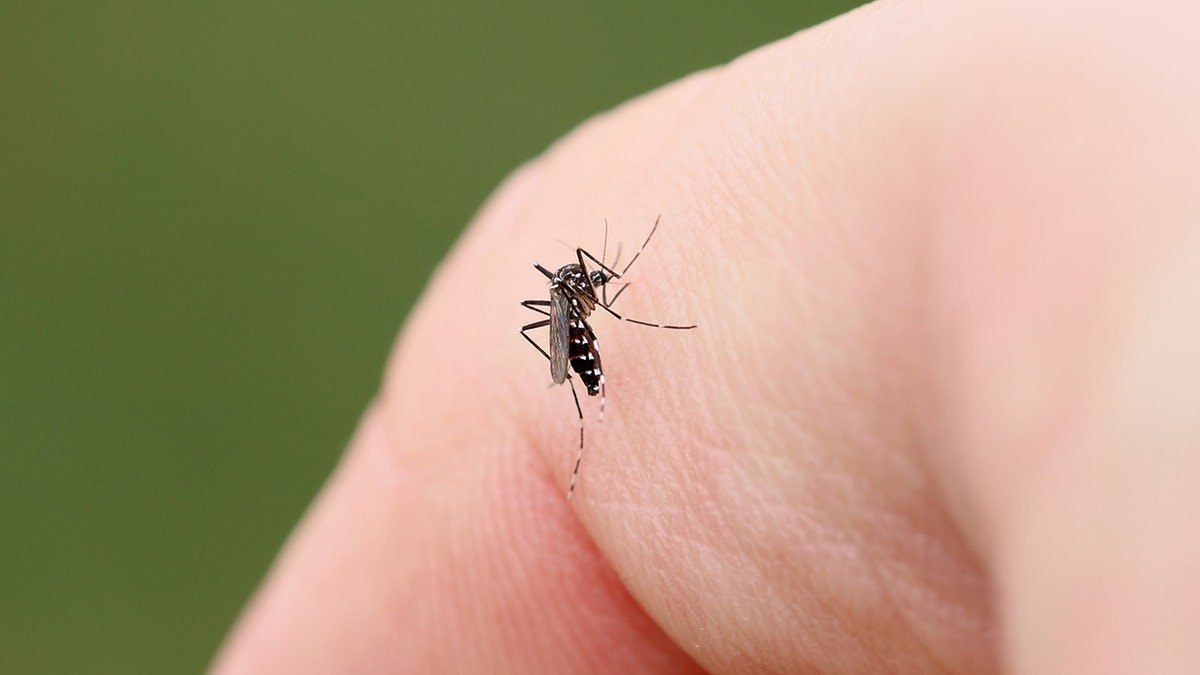
Dengue fever is a virus spread through bites from an infected mosquito, which typically causes aches, pains, nausea, vomiting and rashes, according to the CDC.

The CDC has issued a Level 1 dengue fever warning to 16 countries – including the Maldives (pictured).  (iStock)

The fever is common in tropical and subtropical areas of the world. It is typically found in the Americas, Africa, the Middle East, Asia and the Pacific Islands, as well as many Caribbean destinations.

Symptoms and treatment

Typical symptoms of dengue include aches and pains (in the eyes, muscles, joints or bones), nausea, vomiting and rash — usually experienced within two weeks of being bitten, per the CDC.

Most people experience symptoms for two to seven days before recovering.

CLICK HERE TO SIGN UP FOR OUR LIFESTYLE NEWSLETTER

“It’s typically a more mild illness, but can be severe, causing headaches, joint pain, fever, abdominal pain and even death,” Dr. Mark Fischer, regional medical director of International SOS, a leading medical and security services company, previously told Fox News Digital. 

Severe cases of dengue can lead to bleeding from the nose or gums and vomiting of blood. One in 20 people who contract the fever develop severe dengue, according to the CDC.

Mosquito on someone's skin, dengue cases rising causing concern during spring break season

Dengue fever is spread by mosquito bites. The fever is common in tropical and subtropical areas of the world. (iStock)

There is not currently any medication to treat dengue. Infected people are advised to rest, take acetaminophen for pain and fever, stay hydrated and see a doctor.

There is a vaccine available for U.S. children between 9 and 16 years of age who have previously tested positive for dengue and are living in areas where the infection is common.

Prevention of mosquito-borne disease

Travelers returning from dengue-endemic areas are urged to take precautions to prevent mosquito bites for three weeks. If dengue symptoms develop within two weeks of return, travelers are advised to seek medical evaluation.

CLICK HERE FOR MORE LIFESTYLE STORIES

Experts also recommend eliminating standing water where mosquitoes breed. Some examples include buckets, water-catching plants (such as bromeliads), small containers, planters, rain barrels and even cups left outside.

TEST YOURSELF WITH OUR LATEST LIFESTYLE QUIZ

Fischer added, “It’s important to wear insect repellent that contains DEET, picaridin or lemon and eucalyptus oil, as these ingredients are the most effective at repelling mosquitoes and other insects.”

“Those who live in areas with mosquito populations should try to wear long-sleeved shirts and long pants, especially at dusk and in the evening, when mosquitoes are most active, to avoid getting bitten on exposed skin.”

Woman resting on a couch with a blanket, holding a tissue to her head and appearing fatigued at home.

Dengue fever typically causes aches, pains, nausea, vomiting and rashes, according to the CDC. (iStock)

Keeping screens on windows and doors is also a good way to prevent insects from entering and potentially causing the spread of disease, he said. 

CLICK HERE TO DOWNLOAD THE FOX NEWS APP

“If you live in an area that has a high level of mosquito-borne diseases, you should use mosquito nets when sleeping and eliminate any standing water in and around the home, since still bodies of water are breeding grounds for the insects,” Fischer added.


Source link

More than 90% of Iranian missiles intercepted, but a dangerous imbalance is emerging

0
More than 90% of Iranian missiles intercepted, but a dangerous imbalance is emerging


NEWYou can now listen to Fox News articles!

EXCLUSIVE: As U.S., Israeli and allied forces continue to intercept the vast majority of Iranian missiles and drones, a new report and expert analysis reveal a growing concern behind the headline success: the cost and sustainability of the defense itself.

More than 90% of Iranian projectiles have been intercepted during the war, according to a report obtained by Fox News Digital from the Jewish Institute for National Security of America (JINSA), thanks to a layered regional air defense system built during years of coordination.

But beneath that success lies a widening imbalance that could shape the next phase of the conflict.

The report highlights a critical trend: Iran’s least expensive weapons are proving the most disruptive and are draining costly U.S. and Israeli interceptors.

IRAN’S REMAINING WEAPONS: HOW TEHRAN CAN STILL DISRUPT THE STRAIT OF HORMUZ

U.S. Central Command released footage showing strikes on Iranian mobile missile launchers. (@CENTCOM via X)

The current air defense architecture, integrating U.S., Israeli and Arab systems, has proven highly effective at stopping incoming threats. Early warning systems, shared radar coverage and pre-positioned assets have allowed multiple countries to work together to defeat Iranian missiles and drones.

During a press briefing on Wednesday, press secretary Karoline Leavitt said, “More than 9,000 enemy targets have been struck to date … Iran’s ballistic missile attacks and drone attacks are down by roughly 90%,” she said, adding that U.S. forces have also destroyed more than 140 Iranian naval vessels, including nearly 50 mine layers.

A surge of U.S. assets before the war, including Terminal High Altitude Area Defense (THAAD), batteries, Patriot systems, two carrier strike groups and roughly 200 fighter aircraft, helped absorb Iran’s opening salvos and maintain high interception rates, according to JINSA’s report.

But Ari Cicurel, associate director of foreign policy at JINSA and author of the report, said focusing only on interception percentages misses the bigger picture.

“Overall high missile and drone interception rates have been important but only tell part of the story,” Cicurel told Fox News Digital. “Iran came into this war with a deliberate plan to dismantle the architecture that makes those intercepts possible. It has struck energy infrastructure to upset markets and used cluster munitions to achieve higher hit rates.”

IRAN’S DRONE SWARMS CHALLENGE US AIR DEFENSES AS TROOPS IN MIDDLE EAST FACE RISING THREATS

Israel Iran Strikes

Israel’s air defense targets Iranian missiles in the sky of Tel Aviv in Israel,  on June 16, 2025. (MATAN GOLAN/Middle East Images/AFP via Getty Images)

Danny Citrinowicz, a Middle East and national security expert at Institute for National Security Studies and a nonresident fellow at the Atlantic Council, said that imbalance is at the heart of the problem. 

“There needs to be a change in the equation,” he told Fox News Digital. “The Iranians are launching drones that cost around $30,000, and we are using missiles that cost millions of dollars to intercept them. That gap is a very problematic one.”

He added that the same dynamic applies to ballistic missiles.

“Building a missile in Iran may cost a few hundred thousand dollars, while the interceptor costs millions, especially when we talk about systems like Arrow,” he said. “It’s easier and quicker to produce missiles than it is to build interceptors. That’s not a secret.”

Iron Dome anti-missile system intercepts rockets in Israel

Israel’s Iron Dome anti-missile system intercepts rockets launched from the Gaza Strip, as seen from the city of Ashkelon, Israel, Oct. 9, 2023.  (Amir Cohen/Reuters)

This cost imbalance is feeding into a broader concern: interceptor depletion.

The JINSA report warns that stockpiles across the region are already under strain. Some Gulf states have used a significant portion of their interceptor inventories, with estimates suggesting Bahrain may have expended up to 87% of its Patriot missiles, the United Arab Emirates and Kuwait have used roughly 75% and Qatar has used roughly 40%. 

Israel is also facing mounting pressure. While officials have not publicly confirmed stockpile levels, the report notes signs of rationing, including decisions not to intercept certain cluster-munition threats in order to conserve more advanced interceptors.

PENTAGON ESTIMATES IRAN WAR COST $11.3B IN THE FIRST SIX DAYS IN CLOSED-DOOR CONGRESSIONAL HEARING: REPORT

The wreckage of a Shahed-136 drone lies on display among other damaged weapons collected as evidence in Kharkiv.

The remains of a Russian-made, Iran-designed Shahed-136 drone, known in Russia as a Geran-2, are displayed with other recovered drones, glide bombs, missiles and rockets in Kharkiv on July 30, 2025. (Scott Peterson/Getty Images)

Citrinowicz said that dynamics become more acute the longer the war continues.

“We are now several weeks into the war, and even if the salvos are limited, the issue of interceptors becomes more significant over time,” he said.

Iran has adapted its tactics accordingly, shifting from large barrages to smaller, more frequent attacks designed to maintain constant pressure while gradually draining defensive resources.

These persistent salvos, even if limited in size, force defenders to remain on high alert and continue expending interceptors, accelerating the depletion of already finite stockpiles.

The report underscores that drones pose a unique challenge compared to ballistic missiles.

Unlike missiles, which rely on large launchers and leave detectable signatures, drones can be launched from mobile platforms and can fly at low altitudes that make them harder for radar systems to detect.

For example, A Shahed-136 weighs roughly 200 kilograms and launches from an angled rail mounted on a pickup truck, after which the crew can quickly relocate. That simpler launch profile makes it easier for Iran to disperse, conceal and fire under pressure, the report stated.

Iran also has incorporated lessons from the war in Ukraine, deploying more advanced drones, including those guided by fiber-optic cables that are immune to electronic jamming, and faster variants powered by jet engines.

These innovations complicate interception timelines and increase the likelihood of successful strikes, even against otherwise effective defense systems.

INSIDE THE ISRAELI DRONE UNIT TAKING ON IRAN AND HEZBOLLAH

Missiles launched from Iran are intercepted as seen from Tel Aviv

Missiles launched from Iran are intercepted as seen from Tel Aviv, Israel, June 15, 2025. (REUTERS/Tomer Neuberg)

Despite these challenges, the report emphasizes that the defensive architecture has not failed.

“The architecture has held, but the trajectory is moving in the wrong direction,” Cicurel said. “Reversing it requires moving assets to where the pressure is greatest, hunting Iranian launchers and drones more aggressively, and convoying ships through the Gulf.”

Even with high interception rates, the broader impact of the attacks is being felt.

Iranian strikes on energy infrastructure and shipping have driven oil prices higher and disrupted traffic through the Strait of Hormuz, demonstrating that air defense alone cannot prevent economic and strategic consequences.

The emerging picture is not one of failing defenses, but of a system under growing strain.

CLICK HERE TO DOWNLOAD THE FOX NEWS APP

Attack on Erbil, Iraq

An explosion is reported near the U.S. Consulate and the Erbil International Airport area, where a U.S. military base is also located, in Erbil, Iraq, with fire breaking out and thick smoke rising following the blast, on march 12, 2026.  (Ahsan Mohammed Ahmed Ahmed/Anadolu via Getty Images)

As long as Iran can produce cheap drones and missiles faster than the U.S., Israel and their partners can produce interceptors, the balance may gradually shift.

“As long as the war continues,” Citrinowicz said, “the key question will be whether Iran can produce missiles faster than we can produce interceptors.”


Source link

Do you love sleeping next to your pet? New study reveals hidden risks

0
Do you love sleeping next to your pet? New study reveals hidden risks


For some pet guardians, their pets are present in their lives from the moment they wake up to the moment they go to bed.

This happens because cats, dogs and other companion animals are increasingly perceived as family members. I’m not talking about the distant cousin, for example, but the ones who really take part in our everyday lives.

In some cases, this includes quieter, more intimate moments, like bedtime. Sleeping with your cat or dog can feel comforting, even essential.

In fact, according to a survey conducted by the American Academy of Sleep Medicine, almost half — 46 per cent — of respondents sleep in the same bed with a pet. As a clinical researcher that focuses on the interactions between pet owners and their animals, I work with many people who describe a close relationship with their pets and share a variety of moments with them.

The benefits of this bond is supported by science. Research shows daily interactions with pets can enhance well-being.

But research also suggests any potential benefits to sleeping next to a beloved pet aren’t straightforward: it can feel comforting even as it may quietly disrupt sleep quality.

The emotional logic of co-sleeping with pets

The impact of co-sleeping can be measured through self-reports and questionnaires, as well as with objective tools, like wristwatches that measure what’s happening physiologically during the night.

In studies using subjective measures, many pet guardians report sleeping better when their pets are with them. Other benefits linked with co-sleeping include an increase in feelings of comfort and emotional safety.

In this context, sleeping places us in a state of perceived vulnerability. Sleeping with a pet, particularly one with whom we have a close bond, may reduce this sense of vulnerability while enhancing a sense of safety.

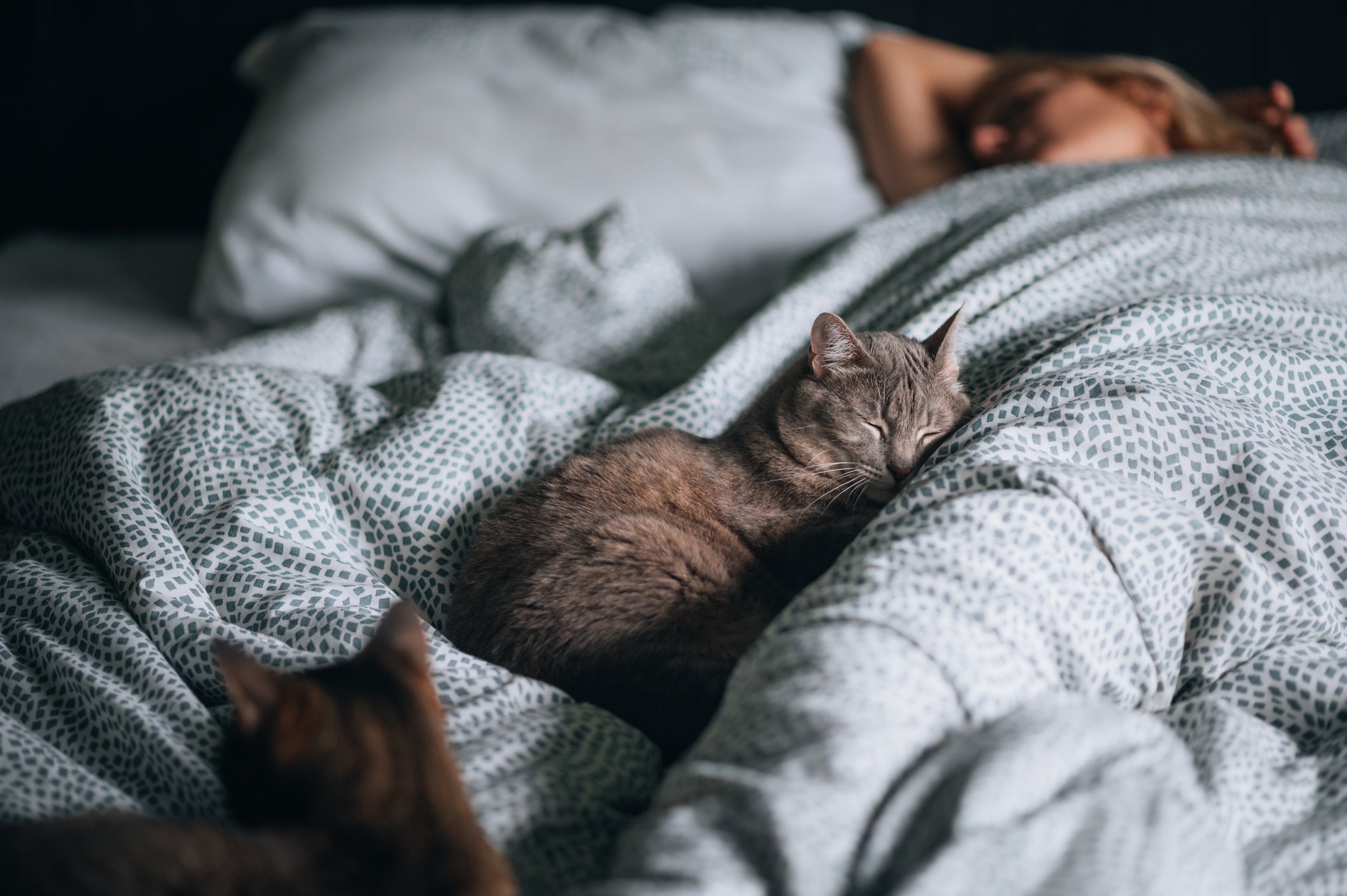
Waking up with a pet next to them can bring a sense of happiness, which may lead people to feel they slept well (Getty Images)

Emotional regulation is another possible mechanism in this context, as feeling safer can lower emotional arousal. In other words, the presence of a pet may simply help pet guardians feel safe and comfortable. Waking up with a pet next to them can bring a sense of happiness, which may lead them to feel they slept well.

At the same time, some studies using standard questionnaires to assess insomnia and sleep quality suggest that co-sleeping with a pet is not linked to lower stress and may increase insomnia and reduce perceived sleep quality.

These mixed findings suggest that the effects of co-sleeping are more complex than they may seem — that how we feel about our sleep doesn’t always match what’s happening in our body.

Co-sleeping from a physiological perspective

We can also investigate the impacts of co-sleeping with pets more objectively, using tools to assess sleep patterns, awakenings during the night and overall sleep quality.

Research suggests that even when pet guardians report better sleep, physiological measures often show more fragmented sleep when they share the bed with their pets. In one study, researchers used a wristwatch-like device to measure people’s movement during the night while they slept with their pets.

They found that even when people felt they slept well, their sleep tended to be more disrupted.

In some cases, these disruptions were related to the pet’s movements during the night. Researchers observed a synchrony in which pet’s movements influenced their guardians’ movement patterns, and vice versa.

Co-sleeping with a pet, therefore, may affect both the person’s sleep and the pet’s sleep. And though these disruptions aren’t uniform, they may depend on the type of animal you share your bed.

Why do dogs disrupt sleep more than cats

There is also evidence that the impact may vary depending on the type and number of pets. People who sleep with dogs may experience more disruption, while those sleeping with cats often report mixed results.

Although the reasons for these differences are unclear, they may be linked to dogs’ greater sensitivity to external stimuli, such as car noise, barking in the neighbourhood and other environmental sounds.

The findings challenge the idea that co-sleeping is simply either good or bad
The findings challenge the idea that co-sleeping is simply either good or bad (Getty Images)

Considering how these experiences can shape mental health and well-being, it is important to note that poor sleep quality over time can impact emotional regulation.

This may appear as lower tolerance for frustration or a reduced ability to manage emotionally challenging situations. Fatigue, depressed mood, difficulty focusing and a range of other symptoms may also be linked to poor sleep.

Taken together, these findings challenge the idea that co-sleeping is simply either good or bad.

Rethinking the “good or bad” debate

Sleeping with a pet seems to be both comforting and disruptive at the same time.

About the author

Renata Roma is a Research Associate – Pawsitive Connections Lab at University of Saskatchewan. This article is republished from The Conversation under a Creative Commons license. Read the original article.

It is a complex behaviour, and understanding people’s motivations behind whether they share their bed is important. In some cases, for example, co-sleeping with a pet can be very meaningful, aligned with people’s needs and potentially linked to comfort and well-being.

At the same time, it is important to keep in mind that our perceptions do not always fully reflect what is happening in the body.

From a practical perspective, a more nuanced understanding of co-sleeping can shed light on how it shapes daily experiences, sleep and overall health. Closer attention to how pets are integrated into our lives can help guardians make decisions that consider both physical and mental health, without neglecting the potential impacts of those decisions on the pet.

Rather than asking whether co-sleeping with your pet is beneficial or harmful, a better questions is what are you prioritizing: emotional comfort or uninterupted sleep? Recognizing the trade-off can help pet guardians make an informed choice.


Source link