Home Blog Page 939

Michigan-Saint Louis shaped by Dusty May, Josh Schertz friendship

0
Michigan-Saint Louis shaped by Dusty May, Josh Schertz friendship


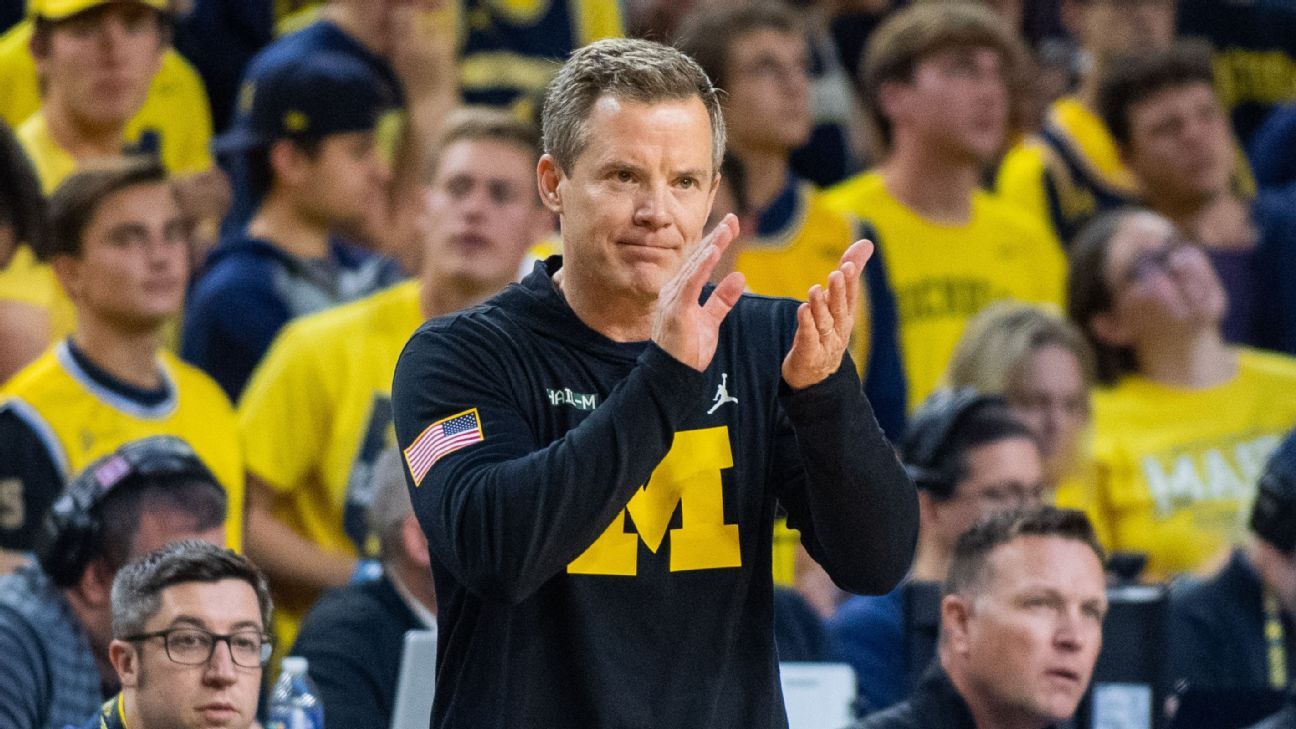
BUFFALO, N.Y. — When 1-seed Michigan continues its men’s NCAA tournament run, the round of 32 matchup will bring Wolverines coach Dusty May up against a close friend.

May and ninth-seeded Saint Louis coach Josh Schertz, who first connected while coaching at different levels, are close enough to share practice film and playbooks, an uncommon level of trust built through years of exchanging ideas and learning from each other.

“It’s probably very unusual [to share practice footage],” May admitted during his news conference Friday. “There’s a group of us that share — and actually, he and I — we’re close enough where I don’t even call him. I’ll shoot his video guy, or he’ll shoot my video guy a text and say, ‘Can you send me last week’s workouts?’ We’re toying with this, we’re thinking about this concept. It might just spur an idea.”

A Sweet 16 appearance will be on the line when their teams meet Saturday (12:10 p.m. ET, CBS). Both teams topped 100 points in their first-round wins. Saint Louis beat Georgia 102-77, and Michigan rolled past Howard 101-80.

Because of how similarly the coaches think and prepare, May expects the game to feel like “a great chess match.”

May, in his second year with the Wolverines, returned to the court after Michigan’s win Thursday to scout his upcoming opponent and even joked with Schertz about not being up by more points at halftime. The Billikens held a 17-point lead.

“It’s always nice when you have somebody who’s in the same chair as you,” said Schertz, who is also in his second season with his program but is making his first NCAA Division I tournament appearance. “It’s hard. Sometimes being a head coach can be lonely. … [May has] been an incredible resource for me.”

Their connection dates to when Schertz coached at Division II Lincoln Memorial and May was at Florida Atlantic. May was scouting a player leaving Lincoln Memorial and noted how well-coached the team was. The relationship grew from there and includes one stretch where the two spent nearly 10 straight hours in May’s office just talking.

“I loved it when he was at a Division II, we were different levels, and I was down in Boca Raton, because this would never happen where we had to compete against each other,” May said.

But he also added that he’s not wary of going up against someone he’s so close to either.

“If we’re going to lose, I want to lose to a guy that does it at the level that he and they do it. And hopefully we don’t, but if we do, then you want to do it to somebody who you’re going to be better for it.”


Source link

Creepy robot mom that gives birth is training future midwives

0
Creepy robot mom that gives birth is training future midwives


NEWYou can now listen to Fox News articles!

Most hospital training labs use basic dummies or simple mannequins to teach medical skills. Students practice procedures, learn techniques and move on to real patients later. But a new childbirth simulator called Mama Anne takes training to a very different level. This lifelike robot blinks, breathes and even talks while helping midwifery students practice delivering babies before they ever step into a real delivery room. And if the idea of a robot going into labor feels a little creepy, you are not alone.

At York St. John University in York, England, educators have introduced the simulator as part of a new approach to hands-on medical training. The technology allows students to experience complex labor scenarios in a safe environment where mistakes become learning moments instead of medical emergencies. And yes, the robot actually gives birth.

Sign up for my FREE CyberGuy Report. Get my best tech tips, urgent security alerts and exclusive deals delivered straight to your inbox. Plus, you’ll get instant access to my Ultimate Scam Survival Guide — free when you join my CYBERGUY.COM newsletter.

ROBOTS POWER BREAKTHROUGH IN PREGNANCY RESEARCH, BOOSTING IVF SUCCESS RATES  

Mama Anne is a high-fidelity childbirth simulator used to train midwifery students in realistic labor and delivery scenarios before they work with real patients.   (Laerdal Medical)

How the robot childbirth simulator trains future midwives

The simulator known as Mama Anne looks and behaves much like a real patient in labor. Developed by Laerdal Medical, the high-fidelity mannequin was designed to recreate real childbirth conditions with startling realism.

Students interact with Mama Anne as if she were an actual patient. Her eyes blink and react to light. Her chest rises and falls as she breathes. She even has pulses that can be felt in multiple places across the body. Most importantly, she can deliver a baby mannequin during a simulated birth.

Unlike older training models that stayed mostly static, this simulator moves and reacts during labor. It can deliver in several positions, including lying back or on all fours. It can also display vital signs that change in response to medical complications. In short, it turns a classroom exercise into something that feels much closer to a real hospital scenario.

Why robot childbirth simulators are becoming essential

For decades, midwifery training relied heavily on textbooks, observation and limited hands-on practice. That approach left a major gap. Many students encountered their first true emergencies only after they began working in clinical settings.

Now technology is filling that gap. Simulation tools like Mama Anne allow students to practice high-risk situations repeatedly before they ever treat a real patient. As a result, students build confidence while instructors guide them through difficult scenarios.

For example, the simulator can recreate several dangerous childbirth complications, including:

  • Postpartum hemorrhage with realistic blood loss
  • Shoulder dystocia when a baby becomes stuck during delivery
  • Pre-eclampsia and eclampsia with changing vital signs
  • Sepsis symptoms that require rapid treatment

Students also practice everyday clinical skills such as monitoring fetal heart rate, giving injections and managing labor from start to finish. Because the training environment is controlled, instructors can pause a scenario, explain a mistake and run it again.

The robot even teaches communication skills

Medical training is not only about technical procedures. Communication with patients matters just as much. Mama Anne helps with that, too.

The simulator can speak using recorded responses or real-time dialogue through hidden speakers. Students must explain procedures, ask for consent and reassure their patient just as they would in a real delivery room.

If someone touches the simulator without asking first, it can react and vocalize discomfort. That feature reinforces one of the most important lessons in modern healthcare: patient consent and respectful care always come first.

REMOTE ROBOT SURGERY REMOVES CANCER 1,500 MILES AWAY

Close up of Mama Anne which is a high-fidelity childbirth simulator.

The lifelike simulator can blink, breathe, display vital signs and deliver a baby mannequin to recreate complex childbirth situations. (Laerdal Medical)

Why universities are investing in this technology

Educators believe simulation training dramatically improves how healthcare students prepare for the real world. Rebecca Beggan, midwifery program lead at York St. John University, says hands-on simulation helps students build both competence and confidence before clinical placements.

Students can experience an entire labor scenario from beginning to end. They learn antenatal care, labor management and postnatal care in a single immersive exercise. Instructors also say the technology helps protect students from the emotional shock of encountering their first medical emergency without preparation. Instead of facing those situations cold, students enter clinical placements with real practice under their belt.

The future of childbirth training

The arrival of hyper-realistic simulators like Mama Anne suggests medical education is entering a new era. Instead of learning mostly through observation and experience, future healthcare professionals may train through realistic simulations that mirror real hospital conditions.

That shift could change everything from how nurses train to how surgeons rehearse complex procedures. Technology will never replace human caregivers. However, it can help prepare them better than ever before.

What this means to you

Even if you never step into a medical classroom, this technology could still affect your life. Better training often leads to better patient outcomes. When healthcare providers practice emergency scenarios in advance, they react faster and make fewer mistakes during real emergencies.

For expectant parents, that can mean safer deliveries and more confident medical teams in the room. Simulation training also reflects a broader shift in healthcare education across the United States. Many hospitals and universities are adopting high-fidelity simulators for surgery, emergency care and trauma response. The goal is simple: Let students practice difficult situations before lives are on the line.

Take my quiz: How safe is your online security?

Think your devices and data are truly protected? Take this quick quiz to see where your digital habits stand. From passwords to Wi-Fi settings, you’ll get a personalized breakdown of what you’re doing right and what needs improvement. Take my Quiz here: Cyberguy.com.       

Kurt’s key takeaways

A robot that gives birth may seem a little creepy at first. Still, tools like this could become common in medical training down the road. Students gain hands-on experience. Instructors guide them through emergencies. Patients benefit from better-prepared medical teams. The next generation of midwives may enter the delivery room with far more practice than any class before them. As medical simulators grow more realistic and more widespread, one question naturally follows.

Mama Anne is a high-fidelity childbirth simulator, and it is lying on a hospital bed.

Students use the simulator to practice emergencies like postpartum hemorrhage, shoulder dystocia and other complications in a safe training environment. (Laerdal Medical)

If robots can train doctors to deliver babies today, what other parts of healthcare might soon be practiced first in simulation labs instead of hospitals? Let us know by writing to us at Cyberguy.com.

CLICK HERE TO DOWNLOAD THE FOX NEWS APP

Sign up for my FREE CyberGuy Report. Get my best tech tips, urgent security alerts and exclusive deals delivered straight to your inbox. Plus, you’ll get instant access to my Ultimate Scam Survival Guide — free when you join my CYBERGUY.COM newsletter.

Copyright 2026 CyberGuy.com.  All rights reserved.


Source link

Semaglutide Launch: Domestic companies launch semaglutide jabs at affordable prices – The Times of India

0
Semaglutide Launch: Domestic companies launch semaglutide jabs at affordable prices – The Times of India


NEW DELHI: Several domestic companies including Sun Pharma, Torrent, Zydus, Dr Reddy’s, Glenmark and Alkem announced the launch of semaglutide on Day 1, substantially lowering the cost of weight-loss therapy.This is in the wake of the innovator Novo Nordisk losing its patent on semaglutide on March 20.Sun Pharma’s weekly therapy costs, from initiation to the highest dose, ranges from approximately Rs 900 to Rs 2,000 for Noveltreat and Rs 750 to Rs 1,300 for Sematrinity, supporting greater affordability, the company said in a statement.Kirti Ganorkar, managing director, Sun Pharma said, “To further support patients, we are also introducing a holistic patient support program intended to guide them throughout their treatment journey”.Further, Torrent Pharma has launched both oral and injectable formulations, expanding its presence in metabolic disorders such as type-2 diabetes and obesity. “We are proud to be the first Indian company to offer this treatment across oral and injectable formulations, giving healthcare professionals a holistic choice for treating patients”, Amal Kelshikar, CEO – India Business, Torrent Pharma said.Others like USV announced the launch in collaboration with Dr Reddy’s Labs. The flurry of launches reflects a broader push by companies to tap into India’s rapidly expanding metabolic disorders market.Blockbuster weight-loss therapies –Wegovy and Mounjaro, marketed by Novo Nordisk and Eli Lilly respectively, were launched at ‘’India-specific prices’’ last year, while the global bestseller Ozempic by the Dutch firm, made its India debut only in December last year. Semaglutide, a GLP-1 (glucagon-like peptide-1) receptor agonist, helps to control blood sugar and improve satiety, reducing cravings for food, eventually inducing weight-loss.These launches come even as India faces an escalating diabetes burden, with over 100 million people currently living with diabetes.


Source link

Families of Iran’s elite live lavishly abroad while ordinary citizens suffer at home

0
Families of Iran’s elite live lavishly abroad while ordinary citizens suffer at home


NEWYou can now listen to Fox News articles!

For decades, Iran’s Islamic Revolutionary Guard Corps and ruling clerical elite have relied on a system critics say is as strategic as it is cynical: denounce the West in public, while quietly securing a future there for their own families.

“The Islamic regime in Iran is corrupt to its core,” Kasra Aarabi, director of IRGC research at United Against Nuclear Iran, told Fox News Digital. “While regime clerics and IRGC commanders violently Islamize Iranian society and export anti-Americanism globally, their sons and daughters live lavish lifestyles on blood money in Western capitals.”

Iranian journalist Banafsheh Zand still remembers the girl from her school, the kind of memory that only becomes meaningful years later, when a familiar face reappears in a completely different context.

IRAN’S NEW SUPREME LEADER IS ‘HIS FATHER ON STEROIDS,’ EXPERTS WARN OF HARDLINE RULE

Iranian women walk past a mural painting of Iranian flags in Tehran on Nov. 26, 2024.   (Atta Kenare/AFP via Getty Images)

They sat together in classrooms at Tehran’s elite Iranzamin School, an institution designed for the children of diplomats and Iran’s upper class, where students spoke multiple languages and moved easily between cultures. The girl was quiet and studious, already shaped in part by years spent in the United States, where she had lived as a child and picked up fluent English that would later define her public role.

Years later, Zand would see her again, not across a desk or in a school hallway, but on television screens around the world. Her former classmate had become the voice of the 1979 U.S. embassy hostage crisis.

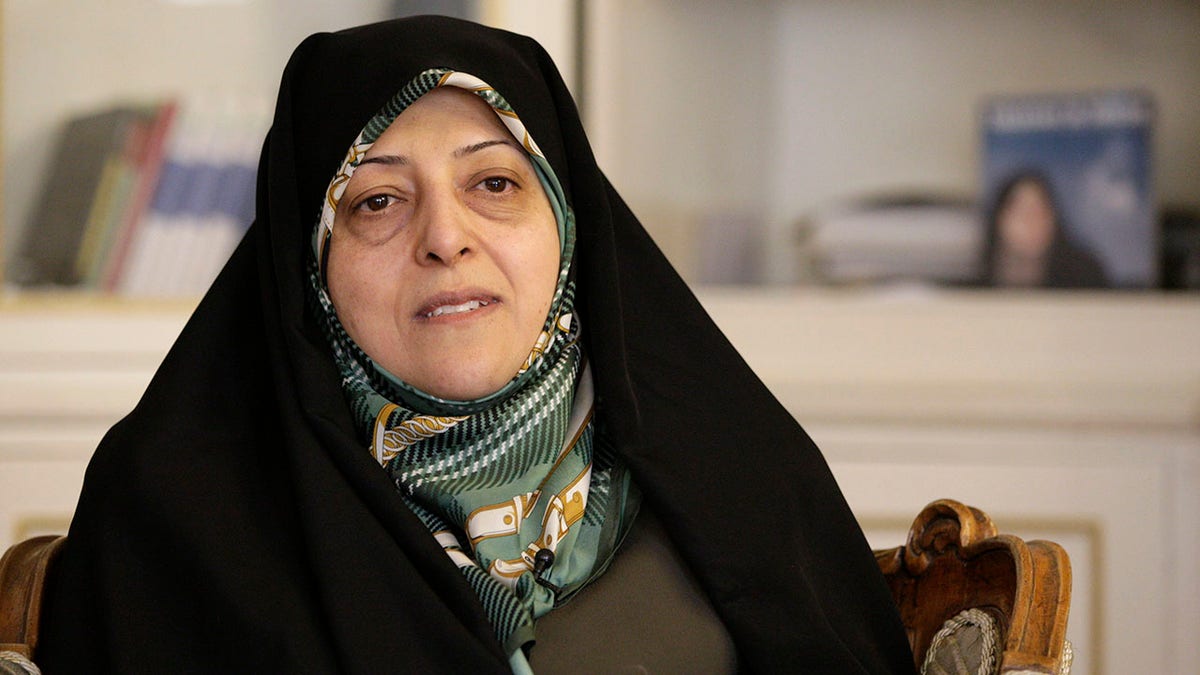
The girl was Masoumeh Ebtekar, the English-speaking spokesperson for the extremists who held 52 Americans hostages for 444 days, and who would go on to defend the takeover of the U.S. embassy and later describe it as “the best move” for the revolution.

And yet, decades later, the story did not end in Tehran. It continued, quietly and almost predictably, in California.

Masoumeh Ebtekar, the English-speaking face of the 1979 U.S. embassy hostage crisis, later rose to senior roles in Iran’s government while her family built ties to life in the West.

Masoumeh Ebtekar, the English-speaking face of the 1979 U.S. embassy hostage crisis, later rose to senior roles in Iran’s government while her family built ties to life in the West. (Vahid Salemi/AP Photo)

A life far from the revolution

Ebtekar son, Eissa Hashemi, was living in the United States, pursuing graduate studies and eventually building a career in academia in Los Angeles, Zand exposed on her substack “Iran So Far Away” — a trajectory that stands in stark contrast to the ideology his mother helped articulate to the world. 

For Zand, this is not an anecdote or an isolated irony, but a window into how the system itself functions.

WITH DOGS, DANCE AND UNCOVERED HAIR, IRANIANS DEFY ‘UNHOLY ALLIANCE’ OF SOCIALISTS, RADICALS: ‘HYPOCRITES!’

“They take the money from corruption inside the country and use it to live a better life elsewhere,” she said. “It’s not a few cases. It’s how they operate.”

What Zand is describing is widely referred to inside Iran as the “aghazadeh” phenomenon, a term used for the children of the Iranian regime’s elite who live lives of privilege abroad while their families enforce ideological restrictions at home, and who have come to symbolize for many Iranians the gap between the regime’s rhetoric and its reality.

CHASING THE APOCALYPSE: RADICAL SHIITE CLERICS ON AMERICAN SOIL PREACH PROPHETIC SHOWDOWN WITH US

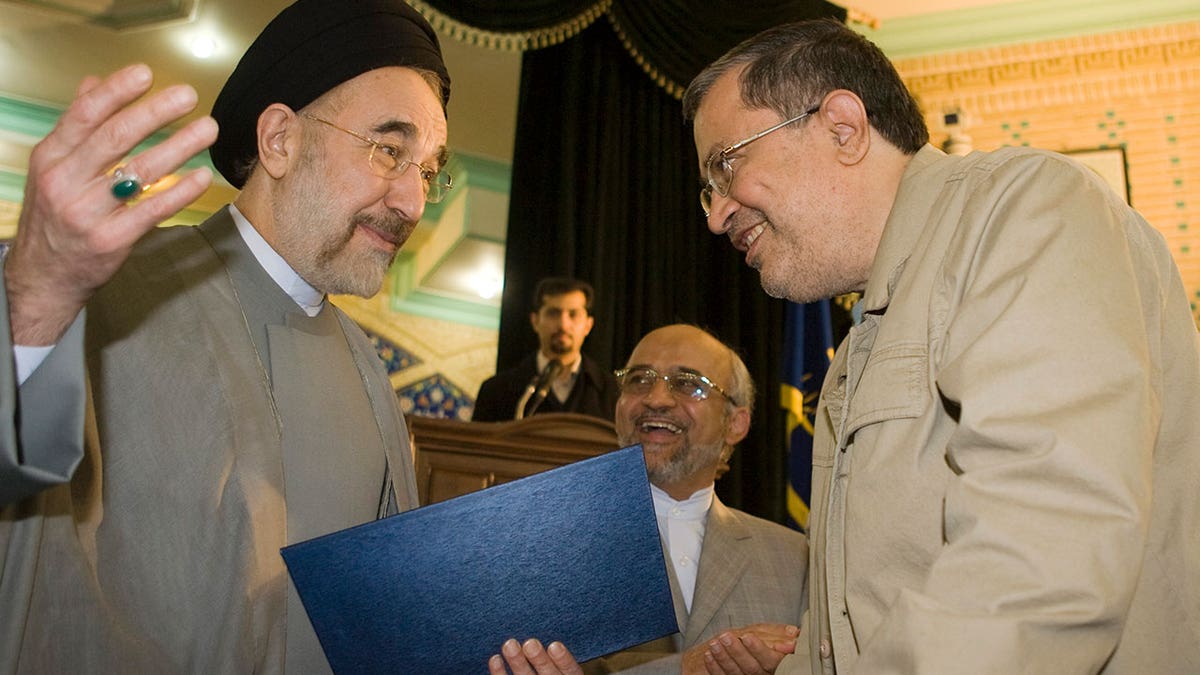
Former Iranian President Mohammad Khatami (L) and reformist politician Saeed Hajjarian

Former Iranian President Mohammad Khatami (L) gives a certificate of appreciation to leading reformist politician Saeed Hajjarian during the annual congress of the Islamic Iran Participation Front in Tehran December 4, 2008.  (Caren Firouz/Reuters)

A three-tier network inside the West

Exiled Iranian journalist Mehdi Ghadimi, now based in Canada, argues that this phenomenon is structured. 

“When we talk about the presence of agents of the Islamic Republic, especially the IRGC, here in Canada, we should understand this is not random,” Ghadimi told Fox News Digital. “It operates in layers.”

The system functions as a three-tiered structure that allows regime-linked individuals to embed themselves across Western societies, according to Ghadimi, beginning with those who arrive as students and academics, often presenting themselves as ordinary immigrants while maintaining ties to the regime or its security apparatus.

“They come as students or professors,” he said, “but many have prior connections to the IRGC, and part of their role is to normalize the Islamic Republic in universities and gather information on activists.”

Billboard shows Iran's three supreme leaders.

A billboard depicting Iran’s supreme leaders since 1979: (L to R) Ayatollahs Ruhollah Khomeini (until 1989), Ali Khamenei (until 2026), and Mojtaba Khamenei (incumbent) is displayed above a highway in Tehran on March 10, 2026. Iran marked the appointment of Ayatollah Mojtaba Khamenei to replace his father as its supreme leader on March 9, 2026.  (AFP/Via Getty Images)

That category includes individuals identified in recent reporting across U.S. campuses, such as Leila Khatami, daughter of former Iranian President Mohammad Khatami at Union College in New York, Zeinab Hajjarian, the daughter of Saeed Hajjarian, a founder of Iran’s Ministry of Intelligence, at the University of Massachusetts Lowell, according to a March 18 New York Post report.

The second layer, Ghadimi explained, is financial, consisting of former insiders and trusted affiliates who enter Western countries as investors or business figures, often carrying significant capital that raises questions about its origin.

“In Iran, a monthly salary might be $100 or $200, while an apartment costs $100,000,” he said. “So when someone arrives with millions, they are not an ordinary individual.”

These individuals, he said, often serve as conduits for moving money out of Iran, operating under the cover of private enterprise while maintaining ties to the system that enabled their wealth. “They change their professional status and enter as private-sector investors,” he said. “But they are trusted by the system.”

The third layer involves individuals who receive explicit approval from the regime to move large sums abroad, a process that, according to Ghadimi, requires a “green light” from the security apparatus and often comes with expectations in return. “In order to move that level of money, you need permission,” he said, “and in return, they help finance networks connected to the regime.”

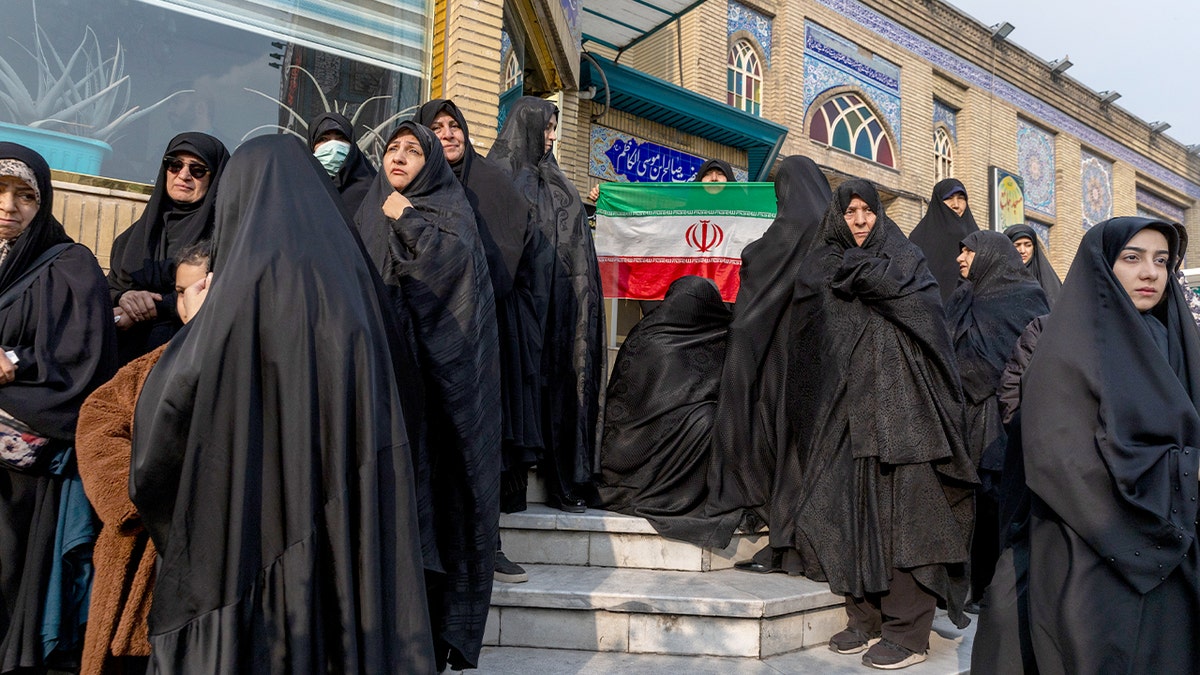
A woman holds an Iranian flag during a funeral ceremony at the Imamzadeh Saleh shrine in Tehran.

A woman holds an Iranian flag during the funeral and burial of Ali Shamkhani at Imamzadeh Saleh in northern Tehran, Iran, on March 14, 2026. (Majid Saeedi/Getty Images)

One of the most prominent examples is Mahmoud Reza Khavari, the former chairman of Bank Melli Iran, who fled the country in 2011 after the bank was implicated in a roughly $2.6 billion embezzlement scandal, one of the largest corruption cases in Iran’s history.

Khavari later settled in Canada, where public reporting shows that he and his family acquired millions of dollars in real estate, including properties in Toronto, where he remains more than a decade later.

For Zand, the pattern is unmistakable. 

“It’s a mafia structure,” she said.

FORMER IRANIAN MINISTER PRAISES TRUMP ASSASSINATION FATWA AS DAUGHTER LIVES IN NEW YORK

Ali Larijani

Ali Larijani, addresses a press conference in Tehran, Iran. Larijani, a top Iranian security official and a conservative force within Iran’s theocracy, was killed in an Israeli strike on March 17, 2026. (Henghameh Fahimi/AFP via Getty Images)

A global footprint: from Atlanta to London

As previously reported by Fox News Digital, Fatemeh Ardeshir-Larijani, the daughter of senior Iranian political figure Ali Larijani and a conservative force within Iran’s theocracy, who was killed in an Israeli strike this week, held a position at Emory University’s Winship Cancer Institute in Atlanta before leaving earlier this year following public pressure.

At the same time, a February 2026 report by The Guardian highlighted how relatives of Iranian elites have built lives not only in the United States, but also in Britain and Canada, including members of the Larijani family and relatives of other senior officials, even as the regime continues to position itself in opposition to the West.

Thousands of relatives of Iranian officials were believed to be living across Western countries, IranWire reported in 2022, though precise figures remain difficult to independently verify, underscoring both the scale of the phenomenon and the opacity of the system behind it.

“The problem is even more visible in Europe,” Aarabi said, “Governments, not least the U.K., have turned a blind eye.”

IRAN’S SUPREME LEADER MOJTABA KHAMENEI ‘MISFUNCTIONING,’ NOT CONTROLLING REGIME: SOURCES

Mojtaba Khamenei

In this picture obtained from Iran’s ISNA news agency, Mojtaba Khamenei, son of Iran’s supreme leader Ayatollah Ali Khamenei, looks on in Tehran on October 13, 2024.  (Hamed JAFARNEJAD / ISNA / AFP via Getty Images)

Power, assets and the next generation

Mojtaba Khamenei, who is slated as the country’s new supreme leader, has been linked to a network of overseas assets, including high-value real estate in Europe. 

A March 2026 investigation by The Times of London, identified two luxury apartments in London’s Kensington neighborhood, acquired in 2014 and 2016 through intermediaries, that sit directly adjacent to the Israeli Embassy compound.

The findings are part of a broader probe into Khamenei’s alleged overseas holdings, with a Bloomberg investigation estimating a portfolio spanning multiple countries and totaling roughly $138 million in assets across Europe and the Gulf, pending verification of full ownership structures.

“He has been operating behind the scenes, managing a large part of the Revolutionary Guard’s security and economic cartel,” Ghadimi said. “His hands are deeply stained with corruption and crimes, and the same Revolutionary Guard is now the main force backing his rise.”

US OFFERS $10M REWARD FOR INFO ON IRAN’S NEW SUPREME LEADER, TOP IRGC OFFICIALS

Iranian demonstrators protest against the U.S.

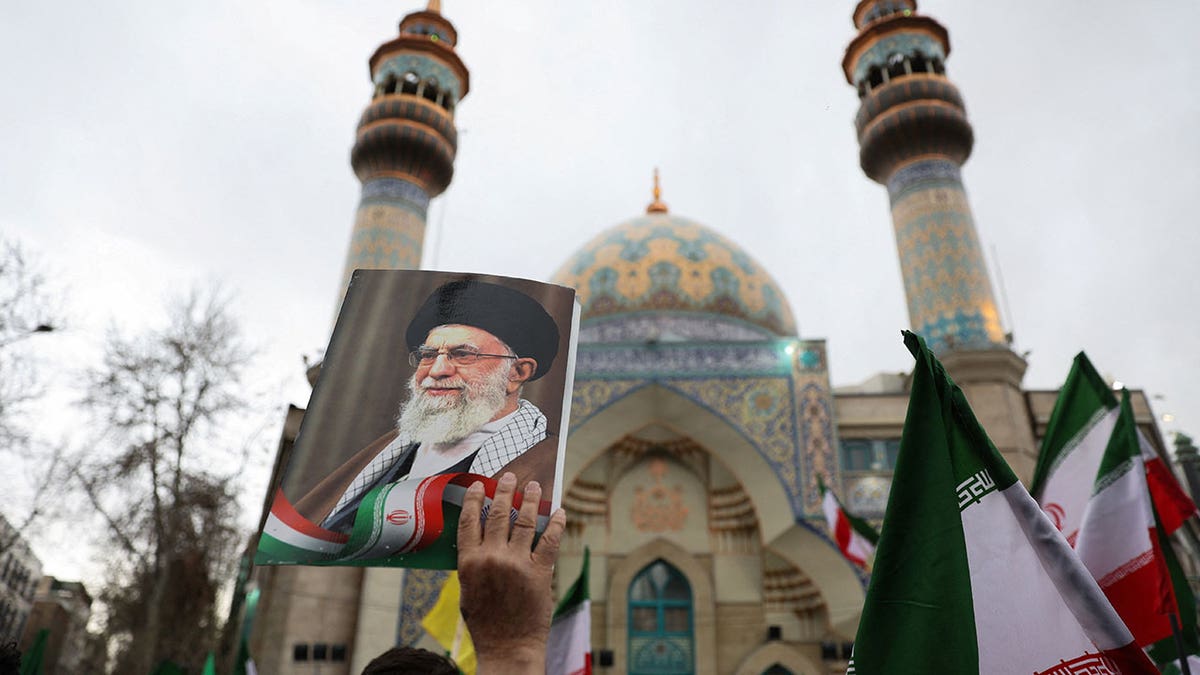
A person holds an image of Iran’s Supreme Leader Ayatollah Ali Khamenei as Iranian demonstrators protest against the U.S.-Israeli strikes, in Tehran, Iran, Feb. 28, 2026.  (Majid Asgaripour/WANA (West Asia News Agency) via Reuters)

A system Iranians themselves cannot escape

Inside Iran, the contrast with everyday life is stark. Women are arrested for violating dress codes, protesters are jailed and economic hardship has deepened across much of the population. Outside Iran, the children of the elite live differently.

“They’re telling people how to live, what to wear, what to believe,” Zand said. “But their own families don’t live like that.”

For her, the issue is not only hypocrisy, but strategy. “It’s also about influence,” she said. “They integrate into societies, they build networks, they learn how the West works.”

CLICK HERE TO DOWNLOAD THE FOX NEWS APP

Iranian protester burns U.S. flag

Pro-government demonstrators burn an American flag at Tehran University, on June 19, 2009 in Tehran, Iran.  (Getty Images)

Aarabi believes Western governments have failed to respond accordingly. “The Islamic regime’s oligarchs should be treated no differently from Putin’s oligarchs,” he said. “The West should identify, sanction and deport these individuals.”


Source link

India Electricity Supply: ‘Not going to affect us’: India sees no major power supply risk from Middle East crisis, government says – The Times of India

0
India Electricity Supply: ‘Not going to affect us’: India sees no major power supply risk from Middle East crisis, government says – The Times of India


India does not expect the ongoing Middle East conflict to significantly disrupt its ability to meet peak summer electricity demand, with the government banking on coal, renewables and battery storage to offset any stress from gas supply disruptions.Speaking on the sidelines of the Bharat Electricity Summit 2026, power secretary Pankaj Agarwal said the country’s electricity system remains largely insulated because gas plays only a limited role in India’s power mix.“We are quite hopeful that this Middle East crisis is not going to affect us,” Agarwal said, as quoted by news agency ANI.

Limited dependence on gas keeps power supply shielded

Agarwal stressed that India uses relatively little gas-based power in normal operations, which sharply reduces the direct impact of any disruption linked to the Gulf crisis.

Watch

India May Face Rising Gas Prices And Energy Supply Risks After Qatar’s Ras Laffan LNG Hub Strike

“In any case, we don’t use a lot of gas to meet our demand. About 2 and a half gigawatts is what we already have, which is off-grid. So that is consistently operating. That has no impact of Middle East crisis,” he said.As per Reuters, gas accounts for only around 2 per cent of India’s total power generation, though the country does rely on roughly 8 gigawatts (GW) of gas-fired capacity during peak-demand periods, especially in extreme summer heat.“Another about 8 gigawatts is what we use when we are actually really hard pressed, high-demand periods, particularly during the heat waves,” Agarwal said.

Govt counting on coal and renewables for peak demand

To ensure power availability during summer stress, the government is bringing in additional conventional and renewable capacity.Agarwal said the imported coal-based plant at Mundra in Gujarat is being readied to provide a major buffer.“What we have done right now is we are going to start the imported coal-based plant in Mundra that will give us a good 4,000 megawatts,” he said.India expects a 4 GW coal power plant in Gujarat to restart, which will help support demand if gas supplies tighten.The official added that the government is fast-tracking wind power projects, which can be particularly useful during evening and non-solar hours.“There is a lot of wind capacity which is about to be commissioned, we have kind of started a specific facilitation for the wind-based capacity because these capacities can help us in the non-solar hours,” Agarwal said.

Solar strong in daytime, batteries key for evening demand

Agarwal said India already has enough solar generation to comfortably meet daytime peak demand.“Solar hour, we have absolutely no problem, gas or no gas, we actually have no problem. We can very well meet more than 270 gigawatts,” he said, according to ANI.For the evening, when solar output drops and demand remains high, the focus is shifting to battery energy storage systems.“For the evening time, what we are working on is facilitating the commissioning of the battery energy projects also. About two and a half gigawatt hours is already under commissioning,” Agarwal said.“About 2.5 gigawatt hours of battery storage is already under commissioning, and we hope that gets commissioned very fast”, Agarwal added.NTPC is preparing to launch its first battery storage project soon, with Agarwal saying it is expected to come online in June.

Coal plants to play balancing role

Even as India expands renewables, coal will continue to be critical in balancing the grid.Agarwal highlighted the flexibility of coal-based plants, saying they can ramp down during periods of strong solar generation and ramp back up in the evening when demand remains elevated.“Flexibility of coal-based plants is actually unique during the daytime when you have plenty of solar. That is when you want the coal-based plants to ramp down. For the evening period, you actually need to ramp up the coal-based capacity,” he said.India had already asked domestic coal-based utilities earlier this month to be prepared to provide uninterrupted power supply in the event of gas shortages.India has produced 1 billion metric tons of coal for a second successive year, according to the coal ministry, which should further strengthen summer power preparedness.

Broader energy stress still a concern beyond electricity

While the power ministry remains confident in electricity supply, the wider energy picture remains more challenging.The US-Israeli war on Iran has disrupted gas supplies, prompting suppliers to issue force majeure notices and leaving India — the world’s second-largest liquefied petroleum gas importer — facing its worst cooking gas crisis in decades as shipments through the Strait of Hormuz have been nearly halted.That distinction is important: the government’s reassurance is specifically about power demand management, not the broader LPG or fuel import situation.

Russia, Africa partnerships also in focus

Apart from the immediate power supply outlook, Agarwal also flagged India’s growing international cooperation in the power sector.Russia has offered to partner with Indian companies for co-manufacturing electrical and power equipment in India, which he described as a business-to-business arrangement.He also said Power Grid Corporation of India is working with Kenya on a $311 million transmission project, reflecting India’s push to expand its role in overseas energy infrastructure.


Source link

James Trafford to start for Man City in Carabao Cup final – but exit door is open

0
James Trafford to start for Man City in Carabao Cup final – but exit door is open


Pep Guardiola has confirmed James Trafford will start the Carabao Cup final on Sunday, but left the door open for the goalkeeper to leave the Etihad Stadium at the end of the season.

Trafford said in an interview in February that he “didn’t expect” to find himself behind Gianluigi Donnarumma in the pecking order when he returned to the club from Burnley last summer.

Guardiola said at a news conference that he had “nothing to say” about the comments, but confirmed the 23-year-old will be in the team at Wembley.

“Players can be happy, unhappy. it is what it is,” Guardiola said.

“They have to be here to do the best they can do and after we will see what happens at the end of the season. The important thing is they have to be ready.”

After facing off at Wembley in the Carabao Cup final, City and Arsenal are also scheduled to meet in the Premier League at the Etihad in April.

The game could yet have an impact on the destination of the Premier League trophy, but Guardiola says he’s unsure whether winning on Sunday will help City claw their way back in the title race.

– Girona coach: ‘I’m ready’ to succeed Pep Guardiola at Man City
Premier League Power Rankings: Arsenal down, Man City up based on performance
Predictions: Arsenal or Man City to win Carabao final? Who takes Madrid derby?

“I don’t know,” the City boss said.

“I said before, of course winning helps just for the fact that winning helps.

“We can win on Sunday and then be bad in the league. I learned that in many competitions and many games with a short time of recovery you have to have the ability to forget and move forwards.”


Source link

Nissan’s new hybrid is a U.S.-first that mixes EV driving with a gas engine

0
Nissan’s new hybrid is a U.S.-first that mixes EV driving with a gas engine


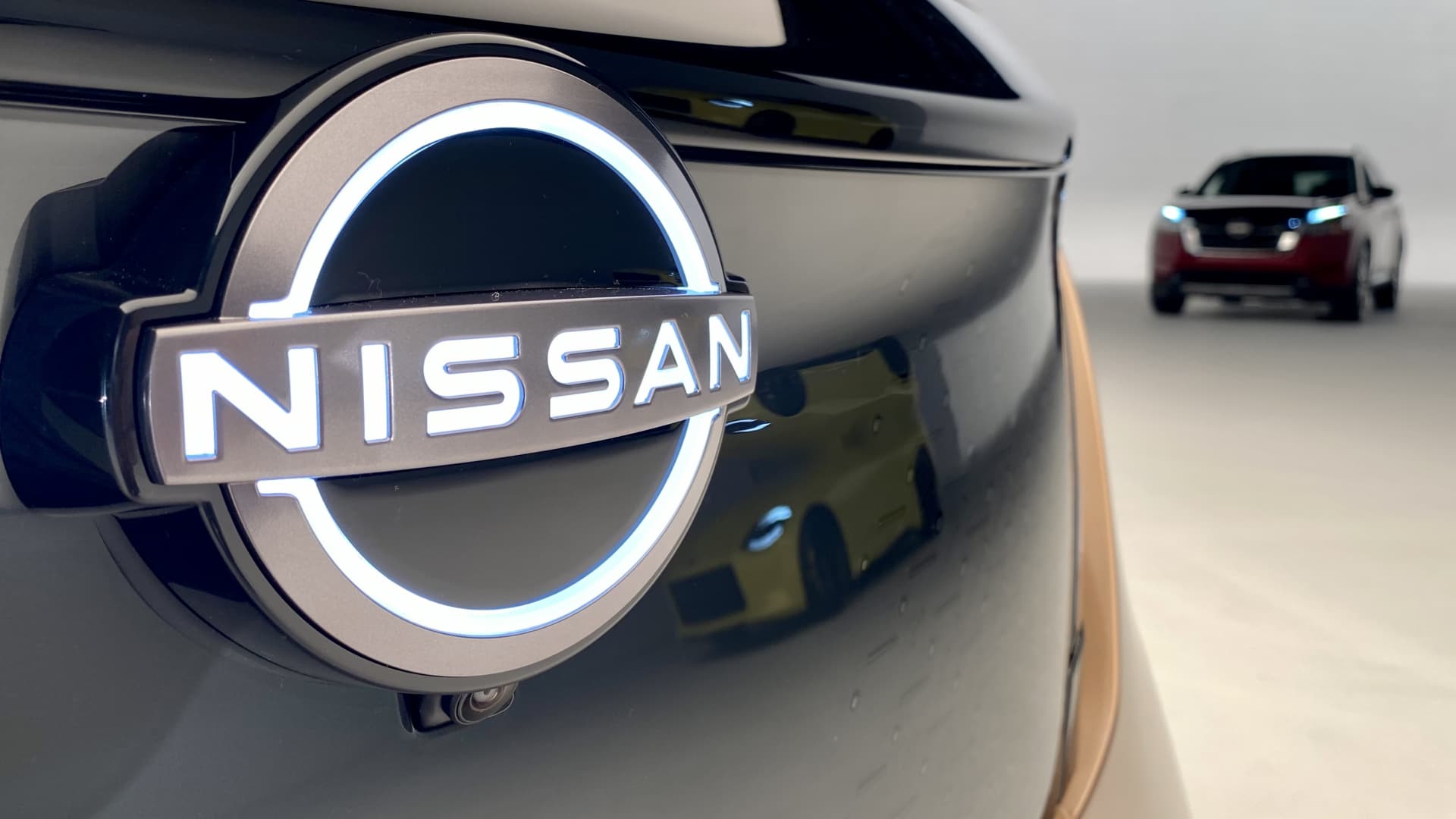
Nissan’s logo is illuminated on a prototype of its new all-electric Ariya crossover. Nissan’s Z Proto performance car is reflected in the vehicle’s grille, while a redesigned Nissan Pathfinder SUV sits in the background.

Michael Wayland / CNBC

Nissan Motor plans to introduce a new type of hybrid to the U.S. market that drives like an all-electric vehicle but is powered — not driven — by a traditional gas-powered engine. 

The new Nissan “e-Power” is called a series hybrid. It uses the engine as a generator to power the vehicle’s electric motors that then propel the vehicle. It operates like emerging extended-range electric vehicles, or EREVs, but has a smaller battery and doesn’t require a plug. 

It’s also different from a traditional hybrid, such as the Toyota Prius, because the gas engine in those vehicles is used to propel the vehicle. The series hybrid’s engine just keeps the battery charged to power the electric motors in the vehicles.

The e-Power hybrid system for Nissan is planned to launch domestically later this year in a new version of its popular Rogue compact SUV. 

Timing for such a vehicle could be ideal for Nissan with climbing gas prices, slower-than-planned adoption of EVs and an expected surge in hybrid sales amid new entries, according to officials.

After losing billions of dollars on EVs, automakers such as Nissan are turning to hybrid vehicles to meet customer expectations for fuel economy and to help with driving performance.

S&P Global Mobility expects hybrids in the U.S. this year to increase to 18.4% of new vehicle sales, up from 12.6% last year and 7.3% in 2023. It’s forecasting pure EVs, meanwhile, will be 7.1% of new vehicle sales, down from 8% last year.

“This is a unique powertrain for the for the U.S.,” Kurt Rosolowsky, Nissan North America vehicle evaluation and test engineer, said during a media briefing. “This is an electrically driven vehicle, as far as what is powering the wheels, but it doesn’t have a plug, and you fill it up with gas like you do with a normal car.”

Series hybrids

Nissan and other automakers have used series hybrids elsewhere, particularly in Asia, but companies have been reluctant to bring the vehicles to the U.S. because of consumer expectations for driving dynamics and power. 

To address those concerns, Nissan said it has developed a more powerful 1.5-liter, three-cylinder turbocharged engine specifically for the e-Power system, in addition to new packaging and other upgrades, to appease American buyers.

“The turbo is only there to serve efficiency at higher speeds for the gas engine to deliver energy,” Rosolowsky said.

The e-Power for the U.S. market is Nissan’s third generation of the series hybrid since it debuted in Japan in 2016. Since then, Nissan said it has sold more than 1.6 million vehicles globally with e-Power in nearly 70 countries.

“I think it’s going to be a really good system. I think it’s going to be very popular for Nissan in the new Rogue when it arrives later this year,” said Sam Abuelsamid, vice president of market research at communications and consulting firm Telemetry.

Abuelsamid said the only real drawback to the series hybrid is that it’s less efficient at higher speeds, which Nissan is trying to overcome with the new engine as well as battery size.

Driving e-Power

Driving a European version of the Nissan Rogue Sport sold with the ePower system around suburban Detroit, the vehicle’s driving dynamics — specifically fast acceleration and regenerative braking — are formidable.

They come with the familiar sound of an engine revving but without the shifting or sputtering of transmission gears and far less noise, vibration and harshness, or NVH, as the industry commonly refers to it. 

“The driving experience really is what makes it different with those fewer components. You have less noise and less vibration,” Rosolowsky said.

Nissan e-Power logo

Courtesy Nissan

Unlike traditional gas-powered vehicles, the e-Power system also does not require a traditional transmission to shift gears or a driveshaft that transfers torque from the transmission to the differential, powering the wheels.

While the Rogue Sport is a smaller vehicle and only forward-wheel-drive, it’s easy to see how the system will translate to a larger vehicle with all-wheel-drive, which the new Rogue with e-Power will be. 

The lack of a plug, some engine noise and slight vibration also might be more familiar for drivers who have been reluctant to adopt all-electric vehicles. 

While Nissan is not releasing specifics such as pricing or fuel economy for the upcoming Rogue with e-Power, the Rogue Sport was achieving more than 40 miles per gallon during heavy city driving, according to the vehicle’s MPG system.

The current Nissan Rogue, depending on the model, can achieve more than 30 MPG, according to U.S. Department of Energy and the U.S. Environmental Protection Agency.

Nissan’s vehicles historically been less fuel efficient than those from its larger Japanese rivals. Honda Motor and Toyota Motor, the latter of which pioneered traditional hybrids with the Prius and continues to dominate the sector in the U.S.

Nissan declined to discuss the possibility of expanding the e-Power system to other vehicles in the U.S., but confirmed the new system is modular and capable of working with many different engines.

“If we were to expand this to other vehicles, you can theoretically bolt this onto another gasoline engine of a different size and have more options for an e-Power system,” Rosolowsky said.

Choose CNBC as your preferred source on Google and never miss a moment from the most trusted name in business news.


Source link

Widespread habit may raise colorectal cancer risk more than you think

0
Widespread habit may raise colorectal cancer risk more than you think


NEWYou can now listen to Fox News articles!

Colorectal cancer is now officially the leading cause of cancer-related death among men and women 50 and younger, according to research from the American Cancer Society.

While some risk factors — like age, family history and genetics — can’t be controlled, there are some lifestyle behaviors that can increase the chances of the disease.

One of those is drinking alcohol, which has been linked to an increased risk of at least six different types of cancer. 

HIDDEN VIRUS INSIDE GUT BACTERIA LINKED TO DOUBLED COLORECTAL CANCER RISK, STUDY FINDS

The International Agency for Research on Cancer (IARC) classifies alcoholic beverages as a Group 1 carcinogen, which means there is strong, sufficient evidence that it causes cancer in humans.

Dr. Tereza Cristina Sardinha, MD, chief of colon and rectal surgery services at Catholic Health on Long Island, New York, confirmed that alcohol is a well-known risk factor for all cancers, but particularly those of the gastrointestinal tract.

Drinking alcohol has been linked to an increased risk of at least six different types of cancer.  (iStock)

“The alcohol, or ethanol, will metabolize and break down into acetaldehyde,” she shared with Fox News Digital. “This metabolism of alcohol is very toxic to the DNA of the cell, which over time can lead to the development of cancer.”

Alcohol also changes the microbiome of the gut, which is another strong factor in cancer risk, according to Sardinha.

Medical illustration of Colorectal Cancer

Colorectal cancer is now officially the leading cause of cancer-related death among men and women 50 and younger. (iStock)

“The microbiome has a significant effect on many pathogens in the colon and rectum, and diet and alcohol definitely affect the types of bacteria in your gut.”

When the gut’s “first line of defense” is disrupted, it can trigger a series of changes — particularly DNA damage, inflammation and oxidative stress within cells, the doctor said. 

“These processes are closely linked to cancer development, which is why alcohol is considered a carcinogen.”

NEARLY 40% OF CANCERS CAN BE PREVENTED WITH 3 LIFESTYLE CHANGES, STUDY FINDS

The relationship between alcohol and colorectal cancer risk is “dose-dependent,” she said.

“Patients who drink regularly for a long period of time, meaning at least 10 years, will have a lifetime increase in the development of colorectal cancer.”

Man alcohol

“The negative impact of spirits (hard liquor) is greater than beer, which is more than wine,” a doctor told Fox News Digital.  (iStock)

Research shows that for those who drink at least two drinks per day — which is considered “moderate consumption,” the doctor said — the lifetime risk of colorectal cancer will increase by at least 25%.

A heavier drinker, consuming more than two drinks a day, will have an exponentially greater risk. 

COLORECTAL CANCER NOW DEADLIEST TYPE FOR CERTAIN GROUP OF AMERICANS, STUDY FINDS

“What really makes the difference is not only the volume, but the frequency,” Sardinha said. “I just saw one of my patients who I operated on last week and she drinks six beers a day, and she developed colon cancer. She’s not morbidly obese, she’s not a smoker. The only risk factor she has is alcohol.”

The doctor advises her patients to avoid alcohol, “or at least minimize intake.”

“What really makes the difference is not only the volume, but the frequency.”

If someone stops drinking, the risk won’t disappear immediately, the doctor noted.

“It takes about an average of 10 years to know if cancer risk decreased or not,” she said. “But we do know that if you continue drinking, your risk will definitely increase.”

MOM WITH NO SYMPTOMS HAD STAGE 4 COLORECTAL CANCER — AND A RARE SURGERY SAVED HER LIFE

“That’s why we recommend that patients stop drinking or exponentially decrease their intake, in the same way we tell them to exercise and increase fruits and vegetables in their diet.”

Sardinha pointed out that alcohol isn’t the only culprit. 

“Not all heavy drinkers develop cancer, so there has to be some other mechanism that plays a role,” she said.

And not all types of alcohol are equal in terms of colorectal cancer risk, according to Dr. Nathan Goodyear, integrative medicine physician at Williams Cancer Institute in California.

CLICK HERE FOR MORE HEALTH STORIES

“The negative impact of spirits (hard liquor) is greater than beer, which is more than wine,” he told Fox News Digital. 

A Danish study also found that wine consumption was associated with a lower risk of death, while beer and spirits were not, Goodyear pointed out. Spirits had the highest risk, especially at three to five drinks per day. 

CLICK HERE TO SIGN UP FOR OUR HEALTH NEWSLETTER

“The effects of wine, beer and spirits were independent of each other,” the doctor said. 

The context in which alcohol is consumed can also play a role, he noted.

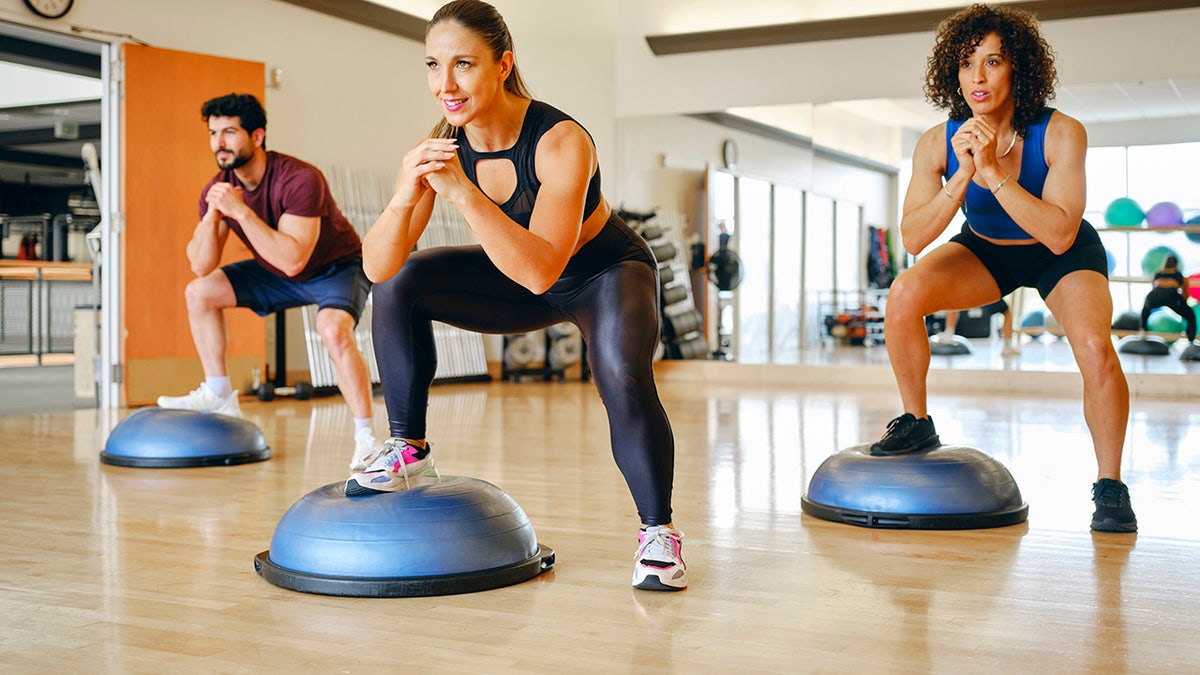
Three adults in workout class, squatting on exercise balls.

In addition to stopping or limiting alcohol intake, doctors say other healthy lifestyle behaviors, like exercise, have been shown to decrease the chances of colorectal cancer. (iStock)

“In the U.S., alcohol is often used in the context of addiction — another hit to keep the high,” Goodyear said. “But in some communities, such as Sardina, Italy, and Ikaria, Greece, wine is part of the culture, social connections and community.”

“Wine is taken outside the context of addiction, and taken within the context of a plant-based diet, social settings, daily movement, faith, community and life.”

Other ways to minimize risk

In addition to stopping or limiting alcohol intake, Sardinha shared other healthy lifestyle behaviors that have been shown to decrease the chances of colorectal cancer.

One “huge and well-established” factor is regular exercise, she said.

CLICK HERE TO DOWNLOAD THE FOX NEWS APP

“If you don’t exercise, if you don’t move, you definitely increase your risk of colorectal cancer,” she told Fox News Digital. “Even for patients who have been diagnosed with cancer, once they have surgery and are able to exercise, that will improve their long-term prognosis.”

Smoking is another highly carcinogenic habit — and it’s a common myth that it’s only associated with lung cancer.

“We do know that if you continue drinking, your risk will definitely increase.”

“Smoking is a risk factor for most cancers, and colorectal cancer is one of them,” Sardinha said.  

Taking steps to address and prevent obesity is also a well-established way to minimize risk, as is adopting a healthy, high-fiber diet to promote proper bowel function, according to the doctor.

TEST YOURSELF WITH OUR LATEST LIFESTYLE QUIZ

“Diets that are lower in fiber are often more constipating — and therefore, if there’s anything in the food that is carcinogenic, that is going to have more direct, prolonged contact with the bowel wall, with the cells, and increases the chances of DNA damage,” she said.

“Obviously, we cannot change our family history — but those good lifestyle habits will make a difference in the risk of colorectal cancer.”


Source link

BTS Arirang: Seoul hosts tens of thousands of excited fans

0
BTS Arirang: Seoul hosts tens of thousands of excited fans


RM, Jin, Suga, J-Hope, Jimin, V and Jung Kook perform together for the first time since October 2022.


Source link

Indian Railways: Inside India’s first Vande Bharat Sleeper train; “This looks so nice!” the new design leaves the Internet super impressed – The Times of India

0
Indian Railways: Inside India’s first Vande Bharat Sleeper train; “This looks so nice!” the new design leaves the Internet super impressed – The Times of India


India’s most-talked about train, Vande Bharat Sleeper, has become an Internet sensation. Since its inauguration, the train has been attracting positive praises from travellers. From Instagram to X, travellers have been sharing pictures and videos of the train’s food, interiors and cleanliness. “This looks so nice” to “Flight-like” experiences are some of the most common praises and comments that the videos of the trains are getting. The train is drawing widespread attention for its sleek design and upgraded passenger experience. Viral images and videos have triggered happy reactions and some are even calling it “flight-like” and “next-generation travel” experience. The Vande Bharat Sleeper train was introduced in January 2026 on long-haul routes.

Watch

180 Kmph While You Sleep! India’s Latest Vande Bharat Sleeper Marks New Era. Check Fares, Features

Overnight travel between Howrah and KamakhyaThe first Vande Bharat Sleeper service started between Howrah and Kamakhya. The train connects West Bengal and Assam which is an important corridor for long-distance travel. The Indian Railways plans to launch more sleeper trains by the end of 2026.Viral videos and imagesThe viral videos on social media platforms show the train’s upgraded interiors and modern design and good food.Some of the prime features include:Ergonomic berthsModern lightingAircraft-style finishes Charging pointsAdvanced suspension systems Polka-dot interiorsAutomatic doors Fully air-conditioned coachesBio-vacuum toilets Wi-FiPassenger information systemsCCTV surveillance Emergency communication systemsThe First AC coaches are being called the “hotel-on-wheels”! From privacy to cleanliness, everything is just top-notch in Vande Bharat Sleeper coaches. Quality of foodThere are several videos showing how good the catering service is on the train. The food is gaining praise and positive reviews in terms of taste and quality from travellers. As per videos circulating online, the dinner/lunch thali includes classic yellow dal, mixed veg, a bowl of packed dahi, chappatis/parathas, rice, pulao and one sweet. Speed, Safety and CapacityThe train is built with cutting-edge modern technology. The Vande Bharat Sleeper is designed for a top speed of up to 180 km/h but operational speeds are expected to range between 120–130 km/h. Each train comprises 16 coaches, capable of accommodating over 800 passengers across First AC, Second AC, and Third AC classes.The social media is clearly in awe of the sleeper variant of Vande Bharat showing it is more than just a new train. The train represents a shift in passenger expectations with improved comfort, cleanliness, safety, and technology.


Source link