
NASA launches four astronauts to the moon on humanity’s first lunar voyage in 53 years
Source link
NASA launches four astronauts to the moon on humanity’s first lunar voyage in 53 years

Mexico appoints Roberto Velasco as new foreign minister at critical moment for US ties

MEXICO CITY — MEXICO CITY (AP) — Mexico’s president on Wednesday designated Roberto Velasco, the foreign ministry’s subsecretary for North America and a leading expert in bilateral relations with the U.S., as the country’s new foreign minister during a critical time for Mexico-U.S. relations.
The previous minister, Juan Ramón de la Fuente, a 74-year-old psychiatrist who has been a key member of Mexican President Claudia Sheinbaum’s administration, requested to step down for health reasons, the president’s office announced Wednesday on social platform X.
Velasco, a 38-year-old lawyer with a master’s degree in Public Policy from the University of Chicago, has been involved in Mexico’s foreign relations with the U.S. and Canada for six years, first as North America general director and then as subsecretary. He stepped in for De la Fuente for a few weeks after a surgery last year. His appointment must be ratified by the Senate.
He is considered one of the foremost experts on the technical intricacies of bilateral relations during the end of U.S. President Donald Trump’s first administration and in this second term. He has led numerous bilateral and trilateral negotiations on security, migration, the economy, the border and the management of shared waters.
When Trump returned to power, Velasco became De la Fuente’s right-hand man during a period of turbulent relations between the two countries, which are now at one of their most critical points. It remains to be seen whether the young official has the necessary political clout at such a difficult times.
Velasco will be in charge of leading Mexican diplomacy amid negotiations to revise the U.S.-Mexico-Canada Free Trade Agreement, and Trump’s continued pressure in the fight against the cartels at a time when the U.S. president has shown willingness to launch military operations against those he considers his enemies, including Mexico’s ally Cuba.
Previously, Velasco had served as spokesperson for Marcelo Ebrard, the current economy secretary, when Ebrard was Mexico’s foreign minister during the first part of former Mexican President Andrés Manuel López Obrador’s administration.
Outgoing minister De la Fuente, who served in the role since October 2024, was known for his discretion and negotiating skills. He accompanied Sheinbaum throughout the transition period, received envoys from then-U.S. President Joe Biden, and was responsible for preparing the entire U.S. consular network for the deportations announced by Trump.
When the Republican returned to the White House in January 2025, De la Fuente became a key figure in the negotiations with his administration, always maintaining a low profile and fully aligned with Sheinbaum in exercising caution in the face of Trump’s impulsive social media posts. In September, he hosted U.S. Secretary of State Marco Rubio in Mexico City.
Arturo Sarukhan, Mexico’s former ambassador to the U.S., said “the reshuffle in the foreign ministry was long overdue” but he didn’t want to comment about Velasco and wished him good luck.
___
Follow AP’s Latin America coverage at https://apnews.com/hub/latin-america
Artemis II astronauts bound for moon after rocketing away on NASA’s first lunar voyage in decades
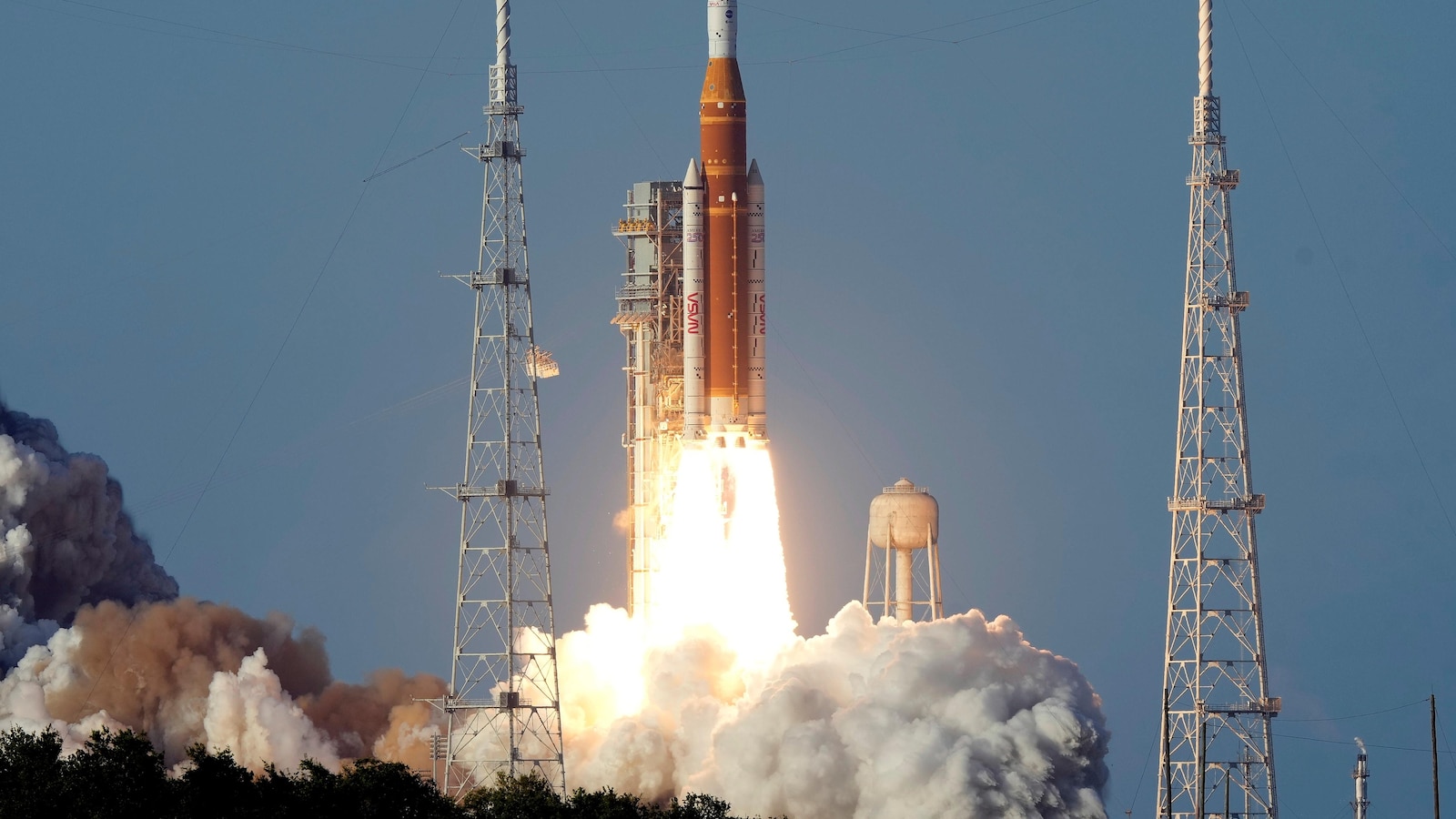
CAPE CANAVERAL, Fla. — Four astronauts embarked on a high-stakes flight around the moon Wednesday, humanity’s first lunar voyage in more than half a century and the thrilling leadoff in NASA’s push toward a landing in two years.
Carrying three Americans and one Canadian, the 32-story rocket rose from NASA’s Kennedy Space Center where tens of thousands gathered to witness the dawn of this new era. Crowds also jammed the surrounding roads and beaches, reminiscent of the Apollo moonshots in the 1960s and ’70s. It is NASA’s biggest step yet toward establishing a permanent lunar presence.
“On this historic mission, you take with you the heart of this Artemis team, the daring spirit of the American people and our partners across the globe, and the hopes and dreams of a new generation,” launch director Charlie Blackwell-Thompson told the crew right before liftoff. “Good luck, Godspeed Artemis II. Let’s go.”
Artemis II set sail from the same Florida launch site that sent Apollo’s explorers to the moon so long ago. The handful still alive cheered this next generation’s grand adventure as the Space Launch System rocket thundered into the early evening sky, a nearly full moon beckoning some 248,000 miles (400,000 kilometers) away.
Five minutes into the flight, Commander Reid Wiseman saw the team’s target: “We have a beautiful moonrise, we’re headed right at it,” he said from the capsule. On board with him are pilot Victor Glover, Christina Koch and Canada’s Jeremy Hansen. It is the most diverse lunar crew ever with the first woman, person of color and non-U. S. citizen riding in NASA’s new Orion capsule.
“NASA is back in the business of sending astronauts to the moon,” NASA Administrator Jared Isaacman told reporters following liftoff, calling the half-century hiatus a brief intermission.
Tensions were high earlier in the day as hydrogen fuel started flowing into the rocket. Dangerous hydrogen leaks erupted during a countdown test earlier this year, forcing a lengthy flight delay.
To NASA’s relief, no significant hydrogen leaks occurred. The launch team loaded more than 700,000 gallons of fuel (2.6 million liters) into the 32-story Space Launch System rocket on the pad, a smooth operation that set the stage for the Artemis II crew to board.
Then NASA had to overcome a flurry of last-minute technical issues — bad battery sensors and an inability to get commands through to the rocket’s flight termination system. In both cases, the issues were quickly resolved, allowing the launch to proceed.
The astronauts will stick close to home for the first 25 hours of their 10-day test flight, checking out the capsule in orbit around Earth before firing the main engine that will propel them to the moon.
They won’t pause for a stopover or orbit the moon like Apollo 8’s first lunar visitors did so famously on Christmas Eve 1968, reading from Genesis. But they stand to become the most distant humans ever when their capsule zooms past the moon and continues another 4,000 miles (6,400 kilometers) beyond, before making a U-turn and tearing straight home to a splashdown in the Pacific.
Once settled in a high orbit around Earth, the astronauts assumed manual control and practiced steering their capsule around the rocket’s detached upper stage, venturing as close as 33 feet (10 meters). NASA wants to know how Orion handles in case the self-flying feature fails and the pilots need to take control.
During Monday’s lunar flyby, the moon will appear to be the size of a basketball held at arm’s length. The astronauts will take turns peering through Orion’s windows with cameras. If the lighting is right, they should see features never before viewed through human eyes. They’ll also catch snippets of a total solar eclipse, donning eclipse glasses as the moon briefly blocks the sun from their perspective and the corona is revealed.
All of NASA’s moon plans — a surge in launches over the next several years leading to a sustainable moon base for astronauts assisted by robotic rovers and drones — hinge on Artemis II going well.
It’s been more than three years since Artemis I, the only other time NASA’s SLS rocket and Orion capsule have soared. With no one aboard, the Artemis I capsule lacked life-support equipment and other crew essentials like a water dispenser and toilet.
These systems are now making their space debut on Artemis II, ratcheting up the risk. That’s why NASA is waiting a full day before committing Wiseman and his crew to a four-day trip to the moon and four-day journey back.
The capsule’s toilet is already acting up. Koch informed Mission Control that it shut down seconds after she activated it. Mission Control advised her to to use a handheld bag-and-funnel system for now — CCU, short for Collapsible Contingency Urinal — while engineers pondered how to deal with the so-called lunar loo.
“There’s always been a lot riding on this mission,” NASA’s Lori Glaze said ahead of launch. But the teams are even more “energized” now that the space agency is finally accelerating the lunar launch pace and laser-focusing on surface operations — seismic changes recently announced by Isaacman.
With half the world’s population not yet born when NASA’s 12 moonwalkers left their boot prints in the gray lunar dust, Artemis offers a fresh beginning, NASA’s science mission chief Nicky Fox said earlier this week.
“There are a lot of people who don’t remember Apollo. There are generations who weren’t alive when Apollo launched. This is their Apollo,” said Fox, who was 4 when Apollo 17 closed out the era.
NASA is in it for the long haul this time. Unlike Apollo, which focused on fast flags and footprints in a breakneck race against the Soviet Union, Artemis is striving for a sustainable moon base elaborate enough to satisfy even the most hard-core science fiction fans. But make no mistake: Isaacman and the Trump Administration want the next boot prints to be made by Americans, not the Chinese.
Until Isaacman’s program makeover, Artemis III was crawling toward a moon landing no sooner than 2029. The billionaire spacewalker slid in a new Artemis III for 2027 so astronauts could practice docking their Orion capsule with a lunar lander in orbit around Earth. Astronauts’ momentous landing near the moon’s south pole shifted to Artemis IV in 2028 — two years before an anticipated Chinese crew’s arrival.
Like Apollo 13 — astronauts’ only moon landing miss — Artemis II will use a free-return, lunar flyby trajectory to get home with gravity’s tug and a minimum of gas. The gravity of both the moon and Earth will provide much if not most of the oomph to keep Orion on its out-and-back, figure-eight loop.
The danger is right up there for Artemis II. NASA has refused to release its risk assessment for the mission. Managers contend it’s better than 50-50 — the usual odds for a new rocket — but how much more is murky.
The SLS rocket leaked flammable hydrogen fuel during ground tests, a recurring problem that engineers still do not completely understand. The hydrogen leaks and unrelated helium blockages stalled the flight for two months, coming on top of years of vexing delays and cost overruns. Both problems also thwarted Artemis I, whose capsule returned with excessive heat shield damage. To NASA’s relief, Wednesday’s countdown was leak-free.
Beating the Soviet Union to the moon made the huge risks acceptable for Apollo, said Charlie Duke, one of only four surviving moonwalkers.
“I’m cheering you on,” Duke said in a note to Wiseman and his crew before their flight.
During a weekend news conference, Koch stressed how humanity’s path to Mars goes through the moon, the proving ground for points beyond.
“It is our strong hope that this mission is the start of an era where everyone, every person on Earth, can look at the moon and think of it as also a destination,” she said.
Added Glover: “It’s the story of humanity. Not Black history, not women’s history, but that it becomes human history.”
___
The Associated Press Health and Science Department receives support from the Howard Hughes Medical Institute’s Department of Science Education and the Robert Wood Johnson Foundation. The AP is solely responsible for all content.
Video Stolen beer truck slams into deputy’s patrol car

Authorities in Indiana say a 41-year-old man is facing multiple charges after he stole a Bud Light truck and crashed into a patrol car.
Source link
Sewing group helping women and girls in period poverty

Debi Angell says the kits they make help women and girls who can not afford period products.
Source link
Dubai Airports Update April 2: Emirates offers free rebooking/refunds; extends flexible travel window till June 15 for affected passengers – The Times of India

In a recent update, Emirates has announced extension of flexible travel options for passengers affected by the ongoing airspace disruptions. It comes as a big relief for thousands of passengers transiting via Dubai International Airport (DBX), which is among the world’s busiest aviation hubs. The move comes amid ongoing operational adjustments by international airlines due to regional tensions. Dubai Airports, including Dubai International and Al Maktoum International, continue to operate but airlines are constantly adjusting, rerouting or cancelling amid evolving regional developments.Emirates extend flexible travel window The update shared by Emirates on its X profile reads, “Booked to travel with Emirates between 28 February and 30 April, 2026? If your flight has been disrupted, or if you just wish to change your travel plans, you have the following options”The airline has given options to travellers. * Rebook on an alternate flight : You can rebook on another flight to your intended destination for travel up to 15 June, 2026. If your original travel date is within 72 hours. * “Manage Your Booking” on the Emirates App. If your booking is for later, please contact us for assistance at http://emirat.es/support.* Request a refund : You can request for a refund of your ticket by completing the refund form at http://emirat.es/refund. Please allow up to 21 days for your request to be processed.The airline has also asked passengers who booked their tickets through travel agents to directly contact their respective agents for any modifications or cancellations.Advisory for passengersMoreover, Emirates has also asked passengers to:Always check the status of their flight before heading to the airport.Schedules are subject to changeThis is crucial for those flying in and out of Dubai, where transit traffic remains high. Despite myriad challenges, Dubai’s airports continue to function efficiently while taking care of the security of passengers and crew. As international travel demand remains strong, airlines like Emirates are constantly focusing on customer-centric measures. It is all to maintain confidence among flyers. While disruptions may be short term, the availability of flexible options gives passengers the option to adjust plans without much stress.
AI machine sorts clothes faster than humans to boost textile recycling in China
ZHANGJIAGANG, China — In an industrial park in Zhangjiagang, a small city on China’s east coast, a large humming and hissing machine feeds on piles of used clothes and sorts them.
The novelty? It uses artificial intelligence to sort them by composition at high speed, offering a glimpse into how AI could play a role in reducing the impact of synthetic textile waste.
The Fastsort-Textile machine, named one of Time magazine’s Best Inventions of 2025, was created by DataBeyond, a Chinese AI recycling company founded in 2018.
“We can make full use of textile waste and reduce the amount that is incinerated which will be a great help to recycling resources,” DataBeyond CEO Mo Zhuoya said.
Synthetic textiles are derived from fossil fuels and are a low-cost, popular option for fashion production. Altogether they account for around 70% of global textile production, according to a report from Amsterdam-based nonprofit Circle Economy, which analyzes ways to reduce textile waste.
Textile waste is a major global pollutant, with China as the leading contributor. China led global textile exports at $142 billion, more than double that of the European Union, according to the World Trade Organization’s 2025 Key Insights and Trends report.
Fastsort-Textile is being used only in one location in China: Shanhesheng Environmental Technology Ltd., a textile recycling facility in Zhangjiagang that installed the machine in 2025.
The equipment uses an AI scanner to read the composition of such textiles and sorts them by fibers, after which they can be recycled.
Fastsort-Textile sorts through 100 kilograms (220 pounds) of clothes in two to three minutes , compared to around four hours for one worker to do the same thing. The machine can process two tons per hour, while two people would need two days and at reduced accuracy, according to analysis by Shanhesheng.
The AI scanner measuring 5-by-2 meters (16-by-6.5 feet) works with a series of conveyer belts. Workers load stacks of textiles onto belts that move them through the scanner, which emits a sharp hiss while reading the textiles’ composition. A live video feed displays the reading on the scanner’s side.
It takes less than one second to accurately read one item’s material composition, which is set according to customers’ desired benchmarks.
After the scanning process, the textiles are transported to nylon and polyester sorting areas for recycling. Items below the benchmark are sorted into a different area mainly for incineration or landfill, which is where textile pollution wreaks its most damage.
“This sort of thing saves money on labor costs, it saves time. When people sort materials, they can’t tell accurately if it’s 80 or 90% polyester. This machine rarely makes mistakes,” Shanhesheng Sales Manager Cui Peng said.
Previously, up to 50% of the processed textiles were deemed unrecyclable and sent to landfills or incinerated. That number is down to 30% with the Fastsort-Textile machine, Sales Director Li Bin said.
“Now, though machines are already capable of sorting, people’s energy is limited,” he said. “People can’t work for 24 hours straight, so robots may take over the roles in the end. The ultimate goal is a ‘dark factory’ with the robots running 24 hours.”
Oil jumps and shares fall after Trump Iran address

The US president called on nations that need Gulf oil to take the lead to keep the Strait of Hormuz open.
Source link
Indonesia earthquake: Magnitude 7.4 quake kills one

The quake struck between the islands of Manado and Ternate. Tsunami warnings have now been lifted.
Source link
7-month-old baby killed by stray bullet in Brooklyn shooting, police say

NEWYou can now listen to Fox News articles!
A 7-month-old baby girl was killed by a stray bullet Wednesday afternoon when a gunman on a moped opened fire on a Brooklyn street, police said.
According to the New York City Police Department, two individuals on a moped approached the intersection of Moore Street and Humboldt Street in Brooklyn when the individual in the back fired a weapon multiple times, with a stray bullet striking a young girl on the sidewalk.
The NYPD has identified the 7-month-old girl as Kaori Patterson-Moore of Brooklyn. She was pronounced dead at the hospital.
The individuals fled the scene on the moped. The NYPD said one person of interest is in custody, while a manhunt is underway for the second suspect as police ask for the public’s help identifying those involved.
HOUSTON POLICE INVESTIGATE FATAL SHOOTING OF 17-YEAR-OLD AT VALENTINE’S DAY HOUSE PARTY
Authorities are asking for the public’s help identifying suspects in a Brooklyn shooting that left a baby dead. (Google Maps; NYPD)
The shooting was believed to be gang-related, and the child was an unintended victim, according to police.
“There are no words that can mend the heartbreak this family is feeling right now,” New York City Mayor Zohran Mamdani said during a news conference. “A life that had barely begun was taken in an instant.”
The shooting took place around 1:20 p.m. on a street corner where several adults and children were gathered. Police said there were no other injuries connected to the shooting.

Images released by the NYPD show suspects wanted in connection with a Brooklyn shooting that killed a 7-month-old baby. (NYPD/ DCPI)
Police Commissioner Jessica Tisch said the moped sped off after the shooting but crashed into an oncoming car two blocks away. Both riders fell off the vehicle, and the impact caused the passenger to lose both his shoes, she added.
One of the men on the moped was injured and taken to the hospital and is in police custody in connection with an unrelated investigation, police said. Investigators believe the man fits the description of the alleged shooter based on his clothing and appearance.
The other man fled and has not been located by police as of Wednesday evening.
MAN FOUND NOT GUILTY BY REASON OF INSANITY IN KILLING OF PREGNANT SEATTLE WOMAN, UNBORN CHILD

An image released by police show two suspects believed to be involved in the shooting that killed a 7-month-old baby on April 1. (NYPD/ DCPI)
No gun has been recovered from the scene, but two shell casings were found, police said.
“This is a terrible day in our city, a tragedy that truly shocks the conscious,” Tisch said at the news conference. “As a mother, I cannot imagine the pain that this family is feeling or the grief that they now carry with them. It is unspeakable.”
Investigators reviewed neighborhood security cameras and tracked the moped’s movement following the shooting, Tisch said.
Mamdani said Wednesday’s homicide is a reminder that more work needs to be done to reduce gun violence.
CLICK HERE TO DOWNLOAD THE FOX NEWS APP

New York Mayor Zohran Mamdani, flanked by Police Commissioner Jessica Tisch, left, and Chief of Detectives Joseph Kenny, provide an update on a Brooklyn shooting during a news conference, Wednesday, April 1, 2026, in New York. (NYPD via AP)
Police are asking anyone with information regarding the incident to call the NYPD’s Crime Stoppers Hotline at 1-800-577-TIPS (8477) or, for Spanish, 1-888-57-PISTA (74782). The public can also submit tips online or on X @NYPDTips.
The Associated Press contributed to this report.