JOHANNESBURG — South African anti-graft investigators have arrested 12 senior police officers on allegations of corruption and fraud, prosecutors said Wednesday.
The officers appeared later in a court in the capital, Pretoria.
The arrests come while an inquiry continues into allegations of high-ranking corruption in the South African police. The inquiry was ordered by South African President Cyril Ramaphosa, who also suspended the police minister last year.
A second inquiry by Parliament is also looking at claims that senior police officers had corrupt relationships with alleged crime bosses and in some cases allegedly received money from them for favors.
The arrest of the 12 officers relates to an allegedly corrupt contract to provide health and wellbeing services to police officers, the National Prosecuting Authority’s anti-corruption investigative unit said in a statement. It said a 13th person, the director of a company, was also arrested.
Washington — Federal health officials posted a warning Tuesday about misleading statements made by biotech billionaire Dr. Patrick Soon-Shiong, who recently told podcast listeners his company’s bladder cancer drug may be able to treat, cure or even prevent other types of cancers.
The warning letter from the Food and Drug Administration takes issue with a TV advertisement and a separate podcast episode promoting Anktiva, the lead product of ImmunityBio Inc. The drugmaker is one of several biotech firms acquired by Soon-Shiong, who also owns the Los Angeles Times.
The “FDA has determined that the TV ad and podcast are false or misleading,” the letter says. … “Furthermore, the TV ad and podcast provide evidence that Anktiva is intended for new uses for which it lacks approval, and for which its labeling does not provide adequate directions for use.”
Company shares fell more than 21% in Tuesday trading to close at $7.42 after the FDA letter was posted online.
Anktiva was approved by the FDA in 2024 for patients with a hard-to-treat form of bladder cancer. ImmunityBio has been working to win FDA approval to expand the drug’s use to a number of other conditions, including forms of lung and pancreatic cancer.
Soon-Shiong’s controversial statements came during a January episode of “The Sean Spicer Show” podcast titled “Is the FDA blocking life-saving cancer treatments?”
At one point during the interview, Soon-Shiong described his company’s drug as “the most important molecule that could cure cancer.” A few minutes later, Soon-Shiong, who is the company’s executive chairman and chief medical officer, said that while the drug is approved for bladder cancer, “it actually can treat all cancers.”
Later in the episode he said, “We have the therapy to prevent cancer if you were exposed to radiation, and that’s Anktiva.”
FDA regulators said the statements violate federal drug marketing rules because they “create a misleading impression” of the drug.
Regulators also noted that the podcast didn’t contain any information about risks and side effects of the drug, which can include urinary tract infections, pain, chills and pyrexia. Under FDA law, drug promotions are required to give a balanced view of a drug’s risks and benefits.
The FDA warning, addressed to ImmunityBio CEO Richard Adcock, raises similar concerns with a TV advertisement for Anktiva. Both the ad and the podcast refer to the company’s drug as a “cancer vaccine,” which the FDA said is false.
The letter gives the company 15 days to correct the problems and respond to the agency in writing about its plans to comply. By Tuesday afternoon, a link to the podcast had been removed from ImmunityBio’s website.
Sarah Singleton, spokesperson for Culver City, California-based ImmunityBio, said via email that the company takes the FDA’s warning “very seriously” and plans to “work cooperatively with the agency to address the matters raised in the letter.”
Under the Trump administration, the FDA has stepped up warnings against drugmakers as well as online pharmacies, including appearances by company executives on TV shows and podcasts.
Barcelona are considering an attacking shake-up this summer which would include listening to offers for Ferran Torres and the arrival of up to two new forwards, various sources have told ESPN.
Torres, 26, is out of contract in 2027 and the club would prefer to move him on than Robert Lewandowski, given this is the last summer they can obtain a fee for the Spain international, to raise money to invest in signings.
Lewandowski’s deal is up this summer but Barça president Joan Laporta recently confirmed a desire to prolong his terms, as revealed by ESPN in February.
Barça have an option to make the England international’s loan from Manchester United permanent for around €30 million ($34.7m) but they hope to either reduce that amount or extend the loan by an additional season.
The Spanish champions are aware that none of the three operations — renewing Lewandowski, signing Álvarez, keeping Rashford — will be straight forward and are also looking at alternative options to strengthen though the middle and out wide.
At 37, Lewandowski has offers from around the world and has reiterated this week that he will wait until the end of the season before making a definitive decision on his future.
One of the options for the Poland striker is a move to MLS, with a source telling ESPN in January that Chicago Fire have held discussions with his camp “for several months.”
Finally, United, various sources told ESPN, have made it clear the only way Barça can keep Rashford is by paying the full €30m as agreed last year when he moved to Spotify Camp Nou on loan.
Therefore, Barça are looking at ways to make these deals, or others, happen, with a source admitting that the club would be open to offers for Torres in order to raise funds.
Torres is out of contract in 2027 and the Catalan club must either move him on this summer or renew his contract to avoid losing him for free next year.
Deco has tied down the majority of the first team squad in recent months — with Lamine Yamal, Pau Cubarsí, Frenkie de Jong, Gavi, Ronald Araújo, Pedri and Fermín López among those to pen new deals — but the same sources told ESPN there have still been no sit down talk about Torres’ future.
Barça signed Torres from City in 2022 for over €50m and he’s played a part in winning two LaLiga titles, a Copa del Rey and three Spanish Super Cups.
He started the current season in fine form, taking Lewandowski’s place in the team in the autumn, but his performances have dipped at a key moment of the campaign.
Torres has scored 16 goals in 40 games this term, but he’s scored just three in 2026 and has not scored since the 3-1 win against Elche on Jan. 31.
Sources on coach Hansi Flick’s staff told ESPN that the Spain international’s commitment to the cause is “not in doubt” and the he’s just on a “bad run,” but behind the scenes the club are considering a transfer to aid other operations.
One source says Barça’s ideal scenario would be to have Álvarez as the starting striker next season and Lewandowski as his backup, which would reduce the amount of minutes available to Torres.
There would also be limited options to play wide, with Barça looking to either retain Rashford or sign another versatile winger to complement Yamal and Raphinha
new video loaded: What Soaring Fuel Costs Mean for Your Air Travel
The price of jet fuel has almost doubled since the start of the war. Our reporter Niraj Chokshi, who covers aviation, describes what that will mean for flights.
By Niraj Chokshi, Léo Hamelin, Stephanie Swart, Rebecca Suner and Lauren Pruitt
If you’re hauling freight on America’s highways, safety isn’t optional. It’s the price of admission.
That principle is at the heart of Dalilah’s Law, which the House Transportation and Infrastructure Committee passed today.
Backed by President Trump during last month’s State of the Union, this legislation reinforces a fundamental principle: only properly trained and qualified professionals should be behind the wheel of an 80,000-pound truck. It strengthens safety standards, ensures drivers can understand and communicate in English, and closes loopholes that have allowed unqualified or improperly licensed individuals to slip through the cracks — making roads safer for everyone.
Dalilah’s Law is named for a young girl whose life was forever changed by a preventable crash involving an undocumented immigrant behind the wheel of a commercial truck.
Speeding through a construction zone, this reckless driver hit the car five-year-old Dalilah Coleman was traveling in, leaving her with permanent disabilities that will require lifelong care. It is a devastating example of what happens when safety standards are not upheld or enforced.
Only properly trained and qualified professionals should be behind the wheel of an 80,000-pound truck. Dalilah Coleman’s story is a painful reminder of what’s at stake when we fall short.
In the years following COVID-19, a surge in freight demand brought an influx of opportunity seekers into our industry. While many answered the call responsibly, others chased quick profits without respecting the safety standards on which the industry depends. When enforcement slips, safety suffers. And that’s when tragedies like Dalilah’s happen. We saw it in Florida. We saw it in California. We saw it in Indiana.
It ensures consistent enforcement of English-language proficiency requirements during roadside inspections and makes clear that drivers who cannot meet those standards should be placed out of service. It modernizes the driver record notification system, so motor carriers are promptly alerted if a driver’s commercial driver’s license (CDL) has been revoked, suspended, or is otherwise invalid. And it requires the Department of Transportation to strengthen oversight of training providers, ensuring new drivers receive the instruction they need to operate safely.
Just as importantly, it reinforces accountability across the CDL system. States play a central role in issuing licenses, and consistent, rigorous enforcement is critical. By closing gaps and improving coordination, this legislation helps remove bad actors from the road while supporting the vast majority who are doing the job the right way.
This is what it looks like when government and industry work together to fix a real problem. President Trump, Transportation Secretary Sean Duffy, Rep. David Rouzer, and the House Transportation and Infrastructure Committee have answered the call to strengthen roadway safety.
By closing gaps and improving coordination, this legislation helps remove bad actors from the road while supporting the vast majority who are doing the job the right way.(AP Photo/Ted S. Warren)
At its core, trucking is about trust. Americans trust that the goods they rely on will arrive safely. They trust that the trucks they share the road with are operated by qualified professionals. And they trust that the system overseeing this industry is working as it should.
Chris Spear is president and CEO of the American Trucking Associations, the nation’s leading organization representing the interests of the trucking industry.
April is around the corner, and with it a new financial year that promises to bring lots of change to households across the UK.
Cost of living concerns have grown as conflict in the Middle East suddenly threatens to hit Britain’s economy. The situation has severely disrupted the global oil trade, bringing knock-on effects to the price of essentials like energy and food.
Economists say that the worst impacts can be avoided should the conflict end soon, but uncertainty remains as the exchange of fire continues.
In positive news for household finances, inflation saw a steep drop in January to 3 per cent, marking a 10 month low. Some analysts now predict the rate could hit the Bank of England’s target of 2 per cent by April, which was last seen briefly in 2024.
The downward trend means prices are rising less quickly, but for many the cost of living still remains too high.
Meanwhile, 55 per cent of households living in poverty now contain at least one working person, according to the Resolution Foundation think tank, which revealed the scale of the issue.
The state pension is expected to rise by 4.8 per cent from next April in line with annual earnings growth (PA)
Against this difficult economic backdrop, households should claim all the support they are entitled to. There are now around 24 million people in the country claiming some combination of Department for Work and Pensions (DWP) administered benefits, which include those drawing a state pension, representing around one in three people.
Get a free fractional share worth up to £100. Capital at risk.
Yet research by Policy in Practice shows that £24bn worth of benefits goes unclaimed every year – you can use its helpful calculator to work out what you might be entitled to.
Are you struggling with the DWP or the cost of living? Share your story: [email protected]
Here is an overview of the financial support available to households this April and key dates for benefit and state pension recipients to look out for:
Benefit payment dates in April
Benefit payments will go out as usual in April, except on two key dates. Anyone due a benefit payment on Friday 3 April (Good Friday) or Monday 6 April (Easter Monday), should instead receive this on Thursday 2 April.
The DWP is aiming to complete the migration of all “legacy benefits” to universal credit by the end of March 2026. Those receiving tax credits, income support, jobseeker’s allowance, and housing benefit should have received a notice about moving to universal credit already.
Are you having issues with universal credit, PIP, or any other benefit? Get in touch via email: [email protected]
Pension payment dates in April
The basic state pension is paid straight into bank accounts, similar to how benefits are paid. It is usually paid every four weeks, with the exact day you receive it corresponding to the last two digits of your national insurance (NI) number.
Here’s when you should be paid based on those numbers:
00 to 19: Monday
20 to 39: Tuesday
40 to 59: Wednesday
60 to 79: Thursday
80 to 99: Friday
The same bank holiday payment date changes that apply to most benefits will also apply to state pension payments.
When will benefit rates go up?
In April 2026, all universal credit claimants will receive an above-inflation income boost of around 6.2 per cent to the standard allowance. For a single person over 25, this will be a £6 per week increase, rising from £92 to £98.
For couples with one or both partners over 25, it will be an increase of £9 per week, rising from £145 to £154.
Most other benefits should be uprated by September’s inflation rate alone, increasing by 3.8 per cent. This includes PIP, DLA, attendance allowance, carer’s allowance, ESA and more.
However, at the same time, the monthly payment rate for the health-related element of universal credit for new claimants will be cut from £105 to £50. The rate for existing claimants will also be frozen until 2029.
This is a reduction of more than £200 a month, cutting the additional rate by around half. This means it is advisable for anyone who thinks they might be eligible to apply as soon as they can.
The state pension will rise by 4.8 per cent from next April in line with annual earnings growth, the government has confirmed. This will bring the weekly amount to £241.05.
From April, councils will be able to administer Labour’s new ‘Crisis and Resilience Fund’, designed to support low-income households at times when affording the essentials becomes a struggle.
It will replace both the household support fund and discretionary housing payments.
Crisis payment
The first part of the new scheme will be a ‘crisis payment’ to to support low-income households that have experienced a financial shock, or are at risk of entering crisis.
Like the Household Support Fund, councils will continue to have discretion over the exact eligibility criteria. However, the government’s guidance says it should not be limited just to those in receipt of benefits.
The DWP has asked that councils take a ‘cash-first’ approach to the crisis payment, meaning cash payments should be awarded unless there is a fair reason not to do so.
Housing payment
A new ‘housing payment’ will also be introduced across the UK, aimed at providing financial support towards housing costs for those in need.
This will usually be related to rent, such as needing rent in advance, a rental deposit, or shortfall. It could also cover a lump sum associated with housing, like the cost of moving.
Unlike the crisis payment, the housing payment will be restricted to those in receipt of certain benefits. These are either housing benefit, or universal credit with the housing element for rental costs. However, DWP says those who do not qualify but are still in need could be considered for a crisis payment instead.
Budgeting advance loans
The government offers a “budgeting advance loan” for people on universal credit who face an emergency lack of money. The loan has a maximum repayment period of two years.
These loans are interest-free and are automatically deducted from universal credit payments. You can borrow an ‘advance’ of up to:
£348 if you’re single
£464 if you’re part of a couple
£812 if you or your partner claims child benefit
Following Labour’s 2024 Budget, a new cap was introduced on the amount the DWP can deduct from benefit payments to repay loans and debts, including budgeting advance loans.
Beginning in April 2025, deductions from universal credit have been capped at 15 per cent of the standard allowance, down from 25 per cent.
Charitable grants
If you are struggling financially, you may be eligible for certain charitable grants. There is a wide range of grants available depending on your circumstances.
However, these grants will typically require you to meet specific criteria and will only be able to offer limited funds.
Charitable grants are available for people who are disabled or ill, carers, bereaved, unemployed, students, and for many other reasons. The charity Turn2us has an online tool to search for grants which may be available to some.
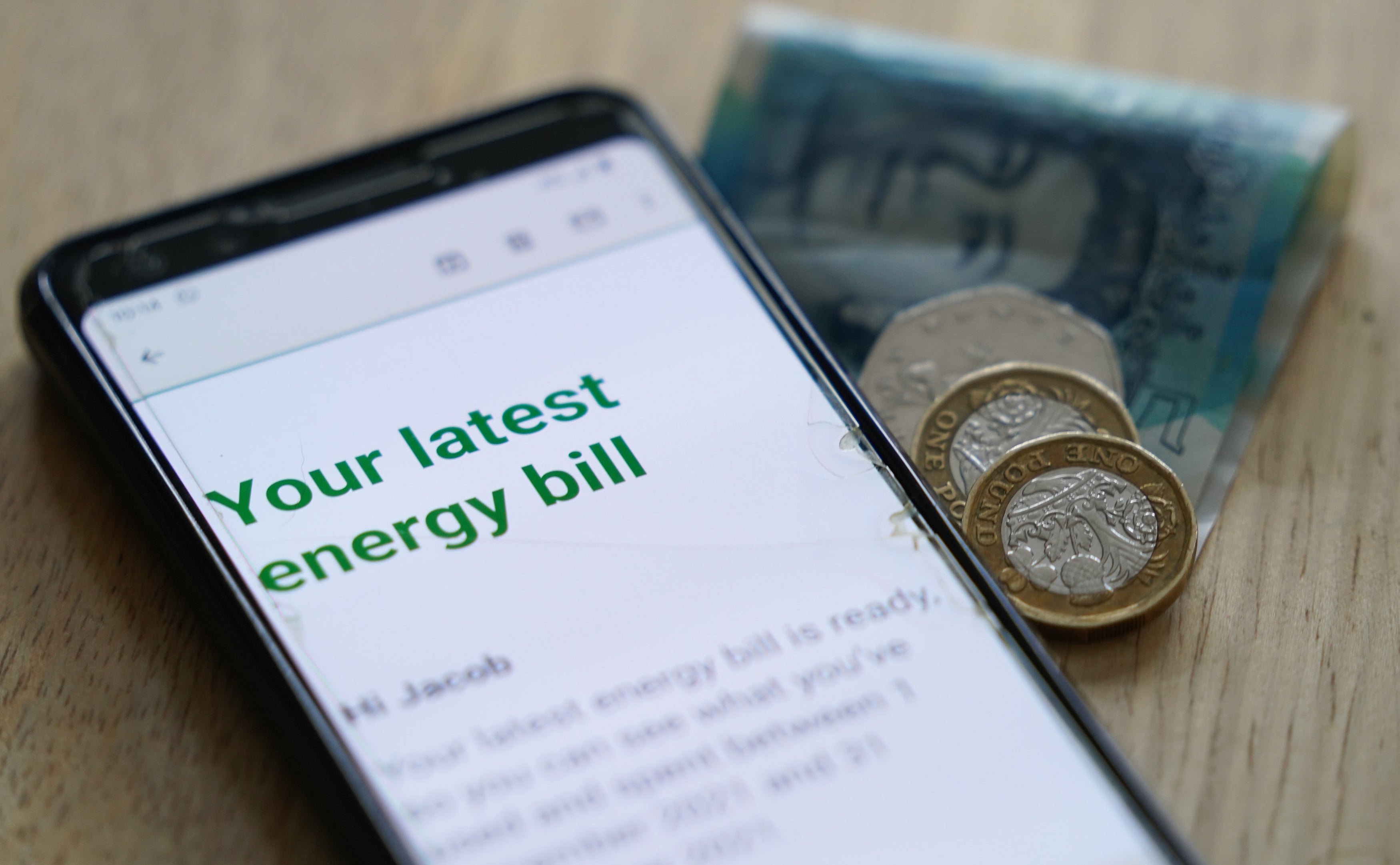
Some energy suppliers offer assistance to those who aren’t able to afford their bills, including Octopus and British Gas (PA)
Energy provider help
A number of energy suppliers offer help for those struggling with their energy bills. These include British Gas, Scottish Power, EDF, E.ON, OVO and Octopus. It is worth contacting your energy provider to find out if you are eligible.
For those struggling with household costs, social tariffs are available for both broadband and water bills. This will mean a reduced rate for certain eligible households.
For water, every company operating in the UK has a social tariff by law. However, the amount on offer can vary between regions and, because water providers can’t be chosen like energy providers, the support has been criticised as a “postcode lottery”.
For instance, some offer as much as 90 per cent off bills, while others cap support at a 20 per cent reduction.
To find out what support your water company offers, it is worth checking on its website or contacting the helpline. In all cases, households will need to be deemed to be on a low income and/or in receipt of certain benefits.
Similarly, many broadband providers offer social tariffs to those on certain benefits like universal credit or pension credit.
Council tax reduction
If you meet certain criteria or are on certain benefits, you may be able to apply for a discount on your council tax of up to 100 per cent (this is sometimes called council tax support).
Your local council may still be able to offer you a discretionary reduction if you can demonstrate you are facing severe hardship and can’t afford to pay your council tax.
To apply for a council tax reduction, contact your local council via the government’s website.
Up to 30 hours of free childcare
From 1 September 2025, all working parents in the UK became entitled to 30 hours of free childcare for children up to the age of four. This concluded a gradual set of expansions that began in April 2024.
Parents must apply online and reconfirm their eligibility every three months, in time for each school term. Working parents can also apply for tax-free childcare, giving back 20p for every 80p you put towards childcare, up to a maximum of £500 a year.
Energy price cap: Is it going up?
Ofgem’s energy price cap will drop to £1,641 for 1 April to 31 June 2026 – decreasing by around seven per cent, or £117. It will remain at £1,758 until 31 March.
The energy price cap is the maximum amount energy suppliers can charge you for each unit of energy if you’re on a standard variable tariff. That includes most households. It is expressed as an annual bill for an average home.
Many experts – including Ofgem itself – are recommending households consider a fixed tariff energy deal, with many on the market offering lower than the price cap rate.
Ofgem will announce its cap for July to September by 27 May. This could be a steep increase of as much as 10 per cent, or £160, increase due to the situation in the Middle East, energy consultancy Cornwall Insight has warned.
Will there be another cost of living payment in 2026?
The DWP has not announced any continuation of the cost of living payment scheme that ran between 2022 and 2024. The final payment should have been made to eligible households between 6 February and 22 February 2024.
Mental health support
In the UK and Ireland, Samaritans can be contacted 24 hours a day, 365 days a year. You can call them for free on 116 123, email them at [email protected], or visit samaritans.org to find your nearest branch
Mind runs a support line on 0300 102 1234 which provides a safe and confidential place to talk about how you’re feeling. There is also an information line on 0300 123 3393 for nearby support, and a welfare benefits line on 0300 222 5782 to support the mental health of those navigating the benefits system
Disability charity Scope has a forum where people can have supportive chats with others going through the same experiences
The NHS offers an online mental health triage service
The assignment involves no laptop, no chatbot and no technology of any kind. In fact, there’s no pen or paper, either.
Instead, students in Chris Schaffer’s biomedical engineering class at Cornell University are required to speak directly to an instructor in what he calls an “oral defense.”
It’s a testing method as old as Socrates and making a comeback in the AI age. A growing number of college professors say they are turning to oral exams, and combining a variety of old-fashioned and cutting-edge techniques, to help address a crisis in higher education.
“You won’t be able to AI your way through an oral exam,” says Schaffer, who introduced the oral defense last semester.
Educators are no longer naively wondering if students will use generative AI to do their homework for them. A big question now is how to determine what students are actually learning.
College instructors across the U.S. are noticing troubling new trends as generative artificial intelligence becomes more sophisticated. Take-home essays and other written assignments are coming back perfect. But when students are asked to explain their work, they can’t. The long-term impact of AI use on critical thinking remains to be seen, but educators worry students increasingly see the hard work of thinking as optional.
At the University of Pennsylvania, Emily Hammer, an associate professor of Middle Eastern Languages and Cultures, now pairs oral exams with written papers in her seminar classes.
“It comes across as if we’re trying to prevent cheating,” Hammer says. “That’s not why we’re doing this. We’re doing this because students are actually losing skills, losing cognitive capacity and creativity.”
Hammer forbids AI use on all writing assignments but tells her class she knows she can’t enforce that. However, if they haven’t written their papers themselves, defending the material face-to-face will likely be “a very stressful situation.”
Hammer’s class is part of “a massive shift toward in-person assessments,” both written and oral, at Penn, says Bruce Lenthall, executive director of the school’s Center for Teaching and Learning. The Ivy League school is one of a small but growing number of universities that have started running faculty workshops on oral exams.
Oral exams are not traditionally part of the modern American undergraduate system, unlike certain European universities. For instance, in the Oxbridge tutorial system in England, students meet faculty for weekly discussions. Some U.S. colleges saw a move toward oral exams during the COVID-19 pandemic to address concerns about online cheating, and interest has intensified since the launch of ChatGPT in 2022.
During the pandemic, engineering professor Huihui Qi launched a three-year study at the University of California, San Diego on how to scale oral exams. Several universities have since invited her to provide faculty workshops or discuss her research.
At New York University, several types of oral assessments are on the rise. More faculty are requiring office hours, assigning presentations and cold-calling on students in class. Instructors are saying, “I need to look my students in the eye and ask, ‘Do you know this material?’” says Clay Shirky, vice provost for AI and technology in education.
One NYU professor has put a modern spin on the traditional oral test.
Panos Ipeirotis, a professor at NYU’s Stern School of Business, unveiled an AI-powered oral exam last semester for the final exam in a class on AI product management. He calls it “fighting fire with fire.”
Students log in from home, at any time that fits their schedule. A voice cloned from a business school professor greets them.
“Hi there,” says the voice on their screen. It asks for the student’s name and school ID number and then says, “I’m ready to conduct your exam today.”
The chatbot starts with questions about a final group project and drills into details based on each student’s answers. If the student stumbles, the AI agent gives them clues, along with criticism and positive feedback. Ipeirotis grades the exams separately, also with the help of AI.
“We wanted to check: Do you know what your team did? Were you a free rider? Did you outsource everything to AI?” says Ipeirotis, who designed the tool with ElevenLabs, a company that develops generative AI voice agents to conduct job interviews.
Students in the class this semester are redesigning the AI agent to smooth out some kinks, and Ipeirotis plans to use it in all his future classes.
“I want oral exams everywhere now. I want to pair it with every single written assignment,” says Ipeirotis. “I don’t trust written assignments anymore to be the result of actual thinking.”
Feedback from students last semester was mixed.
Business major Andrea Liu found the chatbot’s voice to be surprisingly human, but the conversation felt choppy with odd pauses. It asked multiple questions at once, which was confusing. And it was jarring to hear a voice but not see a person.
“It felt kind of awkward to be talking to what was pretty much a blank screen,” says Liu, 21.
But, she agreed with worried educators: “There is no perfect world where AI exists and kids are not abusing it.”
Across the humanities and STEM disciplines, like computer science, educators worry that students who skip the mental struggle that is necessary for problem solving won’t develop the skills they need to advance in upper-level classes and careers.
That’s why Schaffer, the Cornell professor, introduced the oral defense in his biomedical engineering class. He requires students to sign up for 20-minute sessions of Socratic-style questioning after submitting written problem sets, which are assigned several times each semester.
With a class of 70 students, Schaffer splits the job with his teaching assistants. They no longer grade the written problem sets, just the oral defenses. He calls it “incentivizing” his students to do the work, or at least understand it enough to explain.
Schaffer’s class is highlighted in a new “Oral Assessment Workshop” offered by Cornell’s Center for Teaching Innovation.
Other examples at Cornell: a religious studies professor who now holds 30-minute “final conversations” with students instead of a final exam; and another engineering course where the professor gives four-minute mock interviews to each student in a 180-person class.
Skeptics point out oral exams can be unsettling for students who are shy or have serious anxiety, but clarifying the format ahead of time and starting with softball questions can help, says Carolyn Aslan, who leads Cornell’s oral exam training.
“Sometimes it’s actually good to get that quiet student one-on-one, and you finally get to hear from them. Sometimes that is the breakthrough,” Aslan says.
Several of Schaffer’s students say they felt nervous at first but ended up preferring the oral exam.
“I honestly liked it a lot,” says Cornell junior Olivia Piserchia, a biomedical engineering major. She initially found the oral defense nerve-wracking but came to value the one-on-one time with instructors. It kept her from feeling lost in a large class and helped her build the skill of articulating her technical knowledge, as she would need to in a job.
“Having that live check-in holds you accountable,” says Piserchia. “It’s a lot harder to look people in the eyes and say out loud, ‘I don’t know this.’ And, that makes you realize, ‘I should study this.’”
___
The Associated Press’ education coverage receives financial support from multiple private foundations. AP is solely responsible for all content. Find AP’s standards for working with philanthropies, a list of supporters and funded coverage areas at AP.org.
Dhurandhar 2: The Revenge did not just arrive with a soundtrack, it arrived with chaos, drama, and a playlist that refused to pick a side. One minute it is Tamma Tamma, the next it is Rasputin, and somehow, it all makes sense. The film’s music feels like your parents’ cassette collection crashing into your Spotify algorithm, and instead of clashing, they start vibing.
This is not remix culture. This is reinvention with attitude.
When nostalgia got a bass drop
Composer Shashwat Sachdev has not simply polished old hits; he has re-engineered them for a generation raised on reels and rage beats. Tracks like Aari Aari carry their early 2000s DNA, but now come layered with heavy trap drops and sharp rap cuts that feel straight out of a late-night gaming session.
Image credit : Pinterest | Each track is designed with dramatic shifts, soft, melodic build-ups that explode into hard drops.
The result is a dual experience. Millennials get their nostalgia fix, while Gen Z gets something that actually belongs on their playlists. No one feels left out, and that is rare.
Action scenes that said “why be subtle?”
The film goes full chaotic genius by pairing high-stakes action with songs that were never meant to be “serious.” Imagine intense sequences backed by Tamma Tamma or a reworked Tirchi Topiwale. It sounds absurd on paper, but on screen, it hits different.
Suddenly, these classics are not retro, they are rebellious.
Image credit : Pinterest | The film goes full chaotic genius by pairing high-stakes action with songs that were never meant to be “serious.”
Built for the algorithm, powered by emotion
The soundtrack clearly understands the internet. Each track is designed with dramatic shifts, soft, melodic build-ups that explode into hard drops. Perfect for reels, edits, glow-ups, and everything in between.
But beyond the virality, there is intent. The music proves that younger audiences are not rejecting the past, they are reshaping it into something louder, darker, and more their own.
Dhurandhar 2 quietly pulled off what most Bollywood projects fail to do: it made different generations listen to the same song and actually enjoy it. Not ironically. Not nostalgically. Just genuinely.
And in 2026, that might be the most dramatic twist of all.







.jpg?width=1200&height=800&crop=1200:800 "April 2026 payment dates for universal credit, benefits & pensions with Easter change")